best dryer vent cleaning kit for homeowners
A dryer vent cleaning kit can make routine lint removal easier, but the right choice depends on vent length, routing, duct material, access, and whether you want to clean manually or with a drill-powered system. More reach and more aggressive brushing are not automatically better. For an accessible vent, choose the simplest kit that fits the route without requiring risky access or excessive force.
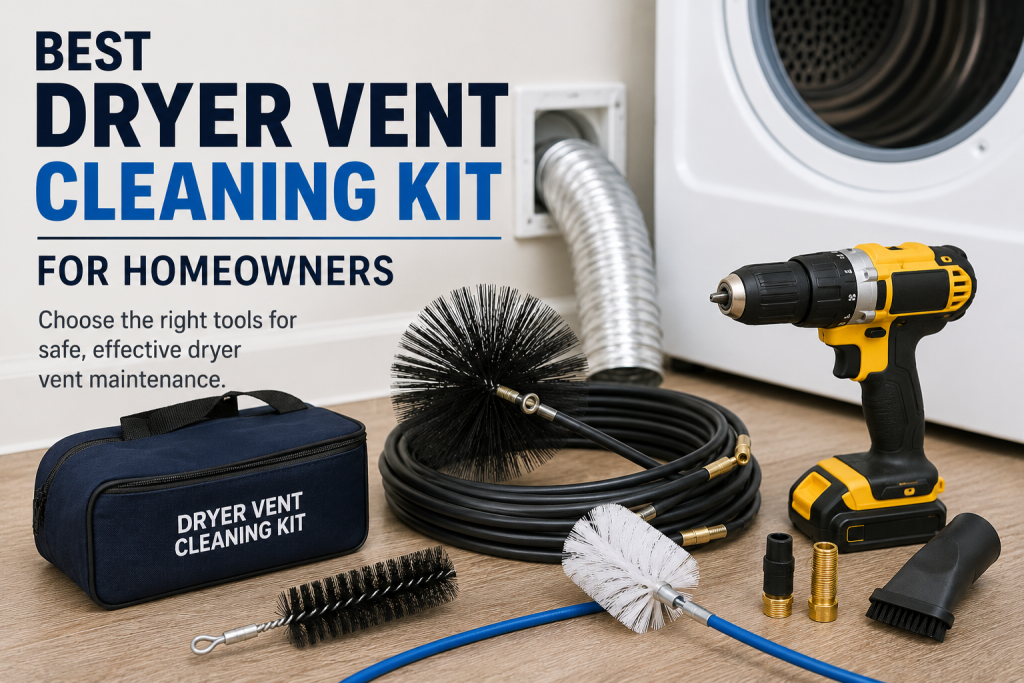
Best Dryer Vent Cleaning Kit by Use Case
| Kit Type | Best For | Main Limitation |
|---|---|---|
| Flexible rod-and-brush kit | Accessible vents needing moderate reach | Rods can bind in difficult bends |
| Drill-compatible rotary kit | Longer accessible metal vent runs | Requires careful control and compatible duct |
| Manual lint brush | Lint-screen areas and short accessible sections | Limited reach |
| Vacuum attachment | Loose lint in accessible openings | May not remove buildup deeper in the duct |
| Compact lint-tool kit | Routine cleaning around dryer and connections | Not a full-length vent-cleaning solution |
Before cleaning, turn the dryer off, allow it to cool, and disconnect power where appropriate. Avoid disturbing gas connections on a gas dryer.
Do not proceed if cleaning requires roof access, an unsafe ladder, confined-space entry, major dryer movement, or aggressive work on damaged or unknown ductwork.
If there is an active burning smell, smoke, scorching, severe overheating, damaged ducting, or gas odor, stop and use qualified help instead of treating the problem as routine vent maintenance.
Flexible Rod-and-Brush Dryer Vent Cleaning Kits
Flexible rod-and-brush kits use connecting rods to extend a round brush through the dryer vent.
They are often a good fit for:
- Accessible vents
- Straight or moderately routed ducts
- Homeowners who prefer manual control
- Routine lint removal
Compare rod length, flexibility, connector design, brush compatibility, and replacement-part availability.
The rods should flex enough to follow the route without easily kinking. Connections should also stay secure because a separated rod inside the duct can create a difficult retrieval problem.
Never force a brush through strong resistance. Tight bends, damaged ducting, or hidden obstructions may require professional inspection.
Drill-Compatible Rotary Dryer Vent Cleaning Kits
Some rod kits connect to a drill so the brush rotates while moving through the vent.
Rotary cleaning can loosen lint more effectively in some accessible ducts and may be useful for longer runs. It also creates more opportunity to damage ducting or separate rod sections if used incorrectly.
Before buying, check whether the kit clearly explains:
- Required drill rotation direction
- How rod sections lock or thread together
- How to add and remove rods
- What to do if the brush binds
- Which duct materials are suitable
Some threaded rod systems must rotate in one direction so the sections do not unscrew. Follow the kit instructions rather than assuming every design works the same way.
Do not use excessive speed or force. Stop if the brush binds, rod connections loosen, or the duct appears to deform.
Drill compatibility does not automatically make a kit better for beginners. Manual use may offer better control in shorter, uncomplicated vents.
Manual Dryer Lint Brushes
A long flexible lint brush is one of the simplest dryer vent cleaning tools.
It can be useful for:
- Accessible lint-screen housings
- Short duct sections
- The appliance-to-wall connection area
- Loose lint around the dryer
Manual brushes are inexpensive and easy to control, but their reach is limited.
A lint brush is not a substitute for a rod system when the vent extends farther through a wall, floor, or ceiling.
Keep brushes out of internal electrical, heater, motor, and blower compartments.
Vacuum Attachments
Narrow vacuum attachments can help collect loose lint from accessible areas such as lint-screen housings, short visible vent sections, and the floor behind the dryer.
They work well for loose debris but may not remove lint attached farther inside the duct.
Do not push an attachment so deeply that it can become stuck. A household vacuum is also not a substitute for professional vent-cleaning equipment when the system is long, hidden, heavily restricted, or difficult to access.
What Brush Size Should You Choose?
Choose a brush that is compatible with the vent dimensions and the kit manufacturer’s instructions.
A brush that is too small may make limited contact with the duct walls. One that is too large can bind or require excessive force.
Before buying:
- Check accessible vent dimensions.
- Compare them with the kit specifications.
- Confirm the brush is intended for dryer exhaust ducts.
- Consider whether bends could restrict a larger brush.
The goal is controlled contact with the duct, not the largest brush that fits into the opening.
How Much Rod Length Do You Need?
Estimate the actual vent route rather than measuring only the distance from the dryer to the wall.
Consider:
- Dryer-to-wall distance
- Wall or floor penetration
- Route to the exterior
- Bends or vertical sections
- Whether access is available from one or both ends
Choose enough rod length for the expected route with some practical margin.
A longer kit does not mean it can safely navigate every vent. Multiple tight bends, hidden sections, or uncertain routing can make professional cleaning a better option even if the rods are technically long enough.
Rod Quality and Connections Matter
Rod connections deserve close attention because a loose section can separate inside the duct.
Look for:
- Secure threaded or locking couplings
- Rods that flex without easily kinking
- A firmly attached brush
- Clear rotation and assembly instructions
- Replacement rods or accessories when useful
For threaded systems, confirm whether rotation direction affects the couplings.
Do not use cracked rods, damaged connectors, or loose fittings. Losing part of the kit inside a concealed duct can turn routine maintenance into a professional retrieval job.
Does the Dryer Vent Material Affect Which Kit You Should Buy?
Yes. Duct condition and material affect how safely a cleaning tool can be used.
Rigid metal duct may tolerate controlled brushing better than material that is crushed, deteriorated, loose, or otherwise fragile. Semi-rigid transition duct also requires care because it can be compressed or damaged.
Before using a rotary kit, look for accessible signs of:
- Crushing
- Separation
- Deterioration
- Loose connections
- Severe deformation
Do not assume a powered brush is appropriate simply because it fits through the opening.
If the duct material is damaged, questionable, or difficult to identify, professional inspection is safer than sending powered rods through it blindly.
What Should Be Included in a Good Dryer Vent Cleaning Kit?
A useful dryer vent cleaning kit does not need a huge accessory bundle.
Depending on your vent, useful features may include:
- An appropriate brush head
- Enough rods for the expected route
- Secure rod connectors
- Clear instructions
- A drill adapter if desired
- A manual-use option
- Replacement rods or brush heads
- A storage bag or case
Choose features that match your vent and cleaning method instead of buying the kit with the most pieces.
Features You Probably Do Not Need
More accessories do not necessarily make a kit more useful.
You may not need:
- Numerous duplicate brushes
- Rod length far beyond your vent route
- Oversized or aggressive attachments
- Powered accessories you will not use
- Tools intended mainly for chimney cleaning
- Specialty pieces with no clear dryer-vent purpose
A smaller kit with dependable rods, secure connections, an appropriate brush, and clear instructions may be the better purchase.
When a Dryer Vent Cleaning Kit Is Not Enough
Some vent systems are not practical homeowner maintenance jobs.
Use professional help when:
- The vent exits through the roof.
- Safe access requires a difficult ladder setup.
- The duct route is unknown.
- The run is unusually long or has difficult bends.
- Rods repeatedly bind.
- Ductwork is crushed, deteriorated, or damaged.
- A rod or brush becomes stuck.
- Lint buildup appears severe.
- A hidden duct may be disconnected.
- Cleaning requires significant dryer movement.
- A gas connection would need to be disturbed.
- An active burning smell or severe overheating is present.
If you smell natural gas or a sulfur-like rotten-egg odor, do not continue cleaning or disturb the dryer connection. Leave the affected area and contact the gas utility or emergency services from a safe location.
If the main symptom is a dryer taking too long to dry, diagnose the airflow and loading problem first rather than assuming the vent simply needs more aggressive cleaning.
Professional cleaning is not a failure of DIY. Some vent layouts simply require access, inspection, or equipment beyond routine homeowner maintenance.
Common Dryer Vent Cleaning Kit Buying Mistakes
Avoid these common mistakes:
- Buying only by total rod length
- Ignoring duct condition or material
- Choosing the largest brush available
- Assuming drill-powered is always better
- Buying rods with weak or unclear connections
- Forcing rods through difficult bends
- Overlooking whether exterior access is safe
- Buying chimney tools instead of dryer-specific tools
- Using powered equipment on questionable ductwork
- Assuming a kit can fix crushed or disconnected ducting
If the real problem is a dryer taking too long to dry, diagnose the airflow, loading, and venting issue before assuming a cleaning kit is the only solution.
Dryer Vent Cleaning Kit FAQ
What is the best dryer vent cleaning kit for homeowners?
The best dryer vent cleaning kit is one matched to your vent layout and access. For a known, accessible route, a flexible rod-and-brush kit with secure connections and an appropriately sized brush is often practical. Short accessible areas may need only a manual brush or vacuum attachment.
Are drill-powered dryer vent cleaning kits safe?
They can be appropriate when the kit and duct are compatible and the manufacturer’s instructions are followed. Use the required rotation direction, avoid excessive speed and force, and stop if the brush binds. Powered cleaning is not appropriate for fragile, damaged, or unknown ductwork.
How long should a dryer vent cleaning kit be?
Choose enough rod length to cover the expected vent route, including bends and vertical sections. Do not estimate only from the dryer-to-wall distance. Extra length does not make a difficult vent safe to clean yourself.
Can I clean a dryer vent with a vacuum?
A vacuum can remove loose lint from accessible openings and short sections, but suction alone may not remove buildup deeper inside the duct. Long or heavily restricted systems may need brushing or professional cleaning.
When should I hire a professional instead of using a dryer vent cleaning kit?
Hire a professional when the vent requires roof or unsafe ladder access, follows an unknown or difficult route, contains damaged ductwork, repeatedly binds cleaning rods, or cannot be reached without disturbing a gas connection. Burning odor, severe overheating, smoke, or gas odor also calls for qualified help.
Final Thoughts
Choosing the right dryer vent cleaning kit comes down to vent access, length and routing, duct condition, brush compatibility, rod connections, and whether manual or drill-powered cleaning fits the installation.
For most homeowners, the simplest suitable tool is better than the most aggressive kit. Choose enough reach for a known, accessible vent, use a compatible brush without excessive force, and prioritize secure rod connections. When access, duct condition, or safety is uncertain, professional dryer-vent cleaning is the better choice.