
box vent vs ridge vent: which is better for attic ventilation?
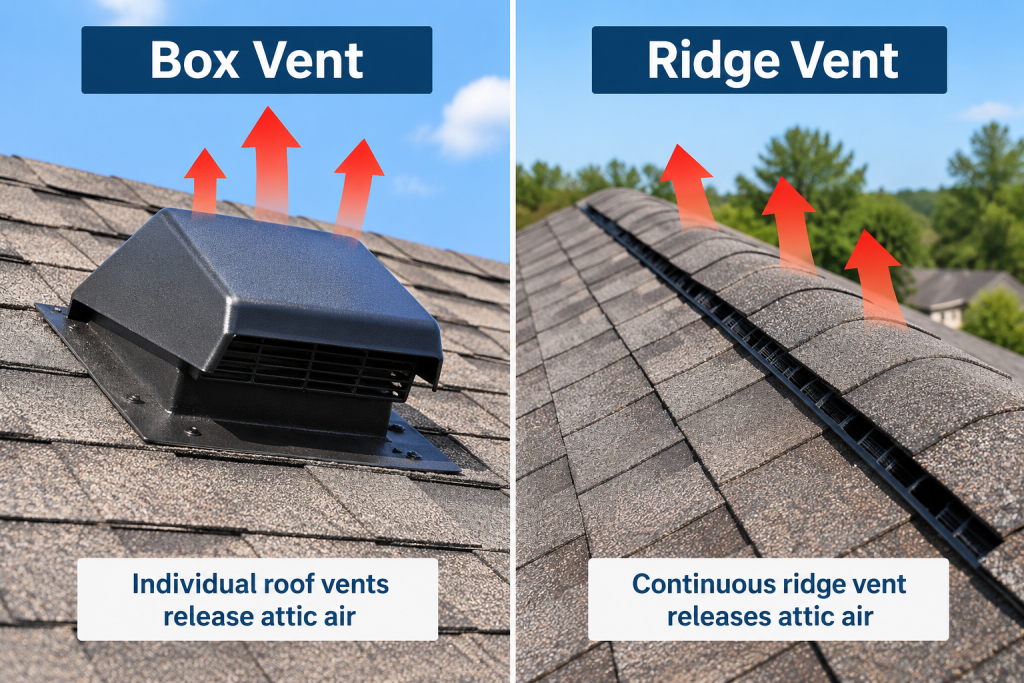
For box vent vs ridge vent decisions, neither option is automatically better for every home. Ridge vents are often a strong fit for roofs with a long, usable ridge and good soffit intake, while box vents can make more sense for retrofits, limited ridge lengths, or roofs where continuous ridge venting is impractical. Neither works well without adequate intake, so the whole attic ventilation path matters more than the exhaust vent type alone.
| Vent Type | Exhaust Style | Best Fit | Main Advantages | Main Limitations |
|---|---|---|---|---|
| Box vent | Individual roof openings | Retrofits and roofs with limited ridge options | Flexible placement, individual replacement | Multiple penetrations, less continuous coverage |
| Ridge vent | Continuous or semi-continuous ridge exhaust | Long, simple ridges with usable soffit intake | Low profile, distributed high-level exhaust | Depends heavily on ridge length, geometry, and intake |
How Box Vents and Ridge Vents Work
Both are passive attic exhaust vents. They allow warmer attic air and moisture to leave through openings near the upper part of the roof while lower intake vents supply replacement air.
Box vents
Box vents are individual roof-mounted exhaust vents. They may also be called static roof vents, roof louvers, turtle vents, or similar names depending on the product and region.
Each unit serves a limited area around its location, so the number and placement of vents matter. Manufacturers typically list the net free vent area, or NFVA, for each vent.
Box vents are commonly distributed across the upper portion of the roof rather than installed directly along the entire ridge.
Ridge vents
Ridge vents run along part or most of a roof ridge and provide high-level exhaust through a continuous or semi-continuous opening. They are usually covered by ridge-cap shingles or another ridge-covering system.
Manufacturers commonly rate ridge vents by NFVA per linear foot. The available ridge length therefore affects how much exhaust capacity the system can provide.
Ridge vents are often paired with soffit intake to create airflow from the lower roof edge toward the ridge.
Box Vent vs Ridge Vent: Airflow and Intake
The biggest mistake in comparing exhaust vents is evaluating them without checking the intake side of the attic.
A ridge vent cannot draw useful replacement air through soffits that are blocked by insulation. Box vents face the same limitation. Adding exhaust to an intake-starved attic does not correct the missing airflow path.
Airflow distribution
A ridge vent can distribute exhaust along a long roof peak when the ridge and attic layout support it. That can provide a relatively even high-level exit path across a simple attic.
Box vents exhaust air at individual locations. Their effectiveness therefore depends more heavily on how the units are distributed across the roof and whether all parts of the attic communicate with those locations.
Neither approach guarantees good airflow by itself.
Why soffit intake matters
For either system, usable lower intake is critical. Soffit vents may look open from outside while insulation, framing, or other obstructions restrict airflow from reaching the attic.
Before choosing between box vents and ridge vents, confirm that there is an actual intake path into the attic rather than assuming exhaust improvements will solve the problem.
If you want a broader explanation of how intake and exhaust work together, see our attic ventilation guide.
When Box Vents Make More Sense
Box vents can be a practical choice where continuous ridge ventilation is difficult or unnecessary.
They may be a better fit when:
- The usable roof ridge is short.
- Roof geometry makes a continuous ridge vent difficult.
- A functioning box-vent system already exists.
- Individual vents are easier to integrate into a retrofit.
- Separate attic areas require carefully placed exhaust.
- The homeowner wants to replace damaged individual vents without redesigning the entire system.
One advantage is flexibility. A roofing professional can evaluate placement based on the existing roof and attic rather than depending on a long ridge.
Box vents can also work on roofs where hips, short ridge sections, additions, or other architectural features limit ridge-vent options.
Box vent tradeoffs
Because each box vent requires its own opening through the roof, a system using several units creates multiple roof penetrations.
The vents may also be more visually noticeable than a low-profile ridge system.
Placement is important. Several vents clustered in one area do not necessarily provide effective exhaust for a large or divided attic.
Adding more box vents is not automatically an improvement. The total NFVA, intake capacity, attic layout, and existing vent locations need to be considered together.
When Ridge Vents Make More Sense
A ridge vent can be a strong option for a simple roof with a long, usable ridge and continuous or well-distributed soffit intake.
It may be a better fit when:
- The roof has a long, straightforward ridge.
- Usable intake is available along the lower roof edge.
- Even high-level exhaust is desirable.
- A low-profile appearance is preferred.
- Reroofing or other ridge work is already planned.
Because the vent follows the ridge, it can provide exhaust across a broader portion of the attic than a few isolated static vents.
Ridge vents also avoid the series of separate roof penetrations required by multiple box vents.
Ridge vent tradeoffs
Ridge vent performance depends heavily on roof geometry. A short ridge may not provide enough length for the required exhaust capacity, while complex roofs can contain attic sections that do not communicate effectively with the main ridge.
Installation is also more involved than placing an individual static vent because the ridge assembly itself must be configured for the vent system.
A ridge vent cannot compensate for poor intake. If soffits are blocked or no usable lower intake exists, installing continuous exhaust at the ridge does not create a complete ventilation system.
Roof Design, Retrofit Practicality, and Cost
Roof geometry often makes the decision clearer than the vent product itself.
Roof compatibility
A long gable roof with a straightforward ridge may suit ridge ventilation well. A roof with short ridges, multiple hips, additions, or separated attic spaces may make individual box vents more practical.
Divided attic sections need particular attention. A vent on one roof section cannot necessarily exhaust air from another area separated by framing, walls, or other barriers.
Retrofit versus reroofing
Box vents can be practical during some retrofit projects because individual units can be evaluated, replaced, or added where the roof layout permits.
Ridge vents often make the most sense when reroofing is already planned because the ridge covering is being addressed as part of the project. Converting an existing roof to ridge ventilation may involve changes to roofing and the ridge opening.
That work should be evaluated and performed by a qualified roofing professional. Homeowners should not cut roof sheathing, remove shingles, alter flashing, or modify ridge framing as a DIY ventilation experiment.
Cost considerations
There is no reliable rule that one vent type is always cheaper.
Box-vent cost depends on the number of units required, labor, roof access, and any repairs around existing penetrations. Ridge-vent cost depends on usable ridge length, roof condition, ridge-cap work, and whether installation is part of a reroof or a separate project.
Compare the complete project rather than the price of individual vent components.
NFVA and Vent Quantity
Physical vent size does not tell you how much usable ventilation an opening provides.
Net free vent area accounts for restrictions created by screens, louvers, and the vent’s construction. Use the manufacturer’s listed NFVA rather than estimating capacity from outside dimensions.
For box vents, NFVA is typically listed for each unit. Planning therefore depends on both the rating and the number of vents.
For ridge vents, NFVA is often listed per linear foot. Planning depends on that rating and the usable installed ridge length.
The required total should also be considered alongside intake capacity. A ventilation calculation can help with overall sizing, but the comparison between these two products still comes down to how that required exhaust can best be distributed across the actual roof.
To estimate the amount of net free vent area your attic may need, use our attic ventilation calculator.
Can You Combine Box Vents and Ridge Vents?
Using both exhaust types on the same attic is not automatically beneficial.
When different high-level exhaust openings serve the same attic, one opening may draw air through another instead of drawing replacement air consistently from lower soffit intake. That can alter the intended airflow pattern.
This does not mean every mixed system is wrong. Roof geometry and attic compartments vary, and some designs require more specialized evaluation.
Before adding a ridge vent to an attic that already has box vents—or adding box vents beneath an existing ridge system—have the full intake-and-exhaust layout evaluated. More exhaust openings do not necessarily mean better ventilation.
Maintenance and Weather Considerations
Both vent types need to remain open and weather-resistant while allowing attic air to escape.
Box vents should be checked from safe locations for visible damage, debris, or deterioration around the vent and surrounding roofing.
Ridge vents can also be affected by debris, damaged ridge caps, or installation problems that restrict the intended opening.
Snow and wind-driven weather can affect roof vents differently depending on roof pitch, vent design, climate, and installation details. Choose products intended for the roof conditions in your area rather than assuming one vent style is universally better in bad weather.
Roof inspections that require walking on steep surfaces or approaching roof edges should be left to a qualified professional.
Common Box Vent and Ridge Vent Mistakes
Several common mistakes can undermine either exhaust system:
- Comparing exhaust without checking intake. Both systems depend on usable replacement air.
- Adding exhaust to an intake-starved attic. More exhaust does not remove the intake restriction.
- Mixing exhaust types without evaluating airflow. Ridge and box vents can interact in unintended ways.
- Estimating capacity from vent dimensions. Use manufacturer-listed NFVA.
- Ignoring divided attic sections. Each compartment needs an effective airflow path.
- Putting vents over spaces they do not serve. Roof location and attic communication matter.
- Assuming more vents are always better. Correct distribution and balance matter more than vent count.
- Changing ventilation because the attic feels hot. Attic temperature alone does not establish that exhaust capacity is inadequate.
Which Vent Type Is the Better Fit?
A ridge vent is often the stronger candidate when the roof has a long, simple ridge, the attic communicates freely beneath it, and usable soffit intake can support continuous high-level exhaust.
A box-vent system may make more sense when ridge length is limited, roof geometry complicates ridge ventilation, an existing static-vent system is functioning well, or retrofit conditions favor individual vent locations.
Before choosing, check:
- Roof and ridge geometry
- Available soffit or other lower intake
- Existing exhaust vents
- Whether attic sections communicate
- Required exhaust capacity
- Retrofit versus reroofing plans
- Condition of the existing roof
- Whether mixing vent types would alter airflow
The better product is the one that fits the complete attic ventilation system rather than the one that appears to provide the most exhaust openings.
Frequently Asked Questions
Are ridge vents better than box vents?
Not universally. Ridge vents can provide well-distributed exhaust on roofs with sufficient ridge length and usable intake, while box vents can be a better fit for certain retrofits, short ridges, or complex roof layouts.
Can you use box vents and a ridge vent together?
Sometimes, but combining exhaust types can change airflow and may cause one exhaust opening to draw through another. Evaluate the complete ventilation layout before mixing them.
How many box vents do I need?
The answer depends on the manufacturer’s NFVA per vent, the required total exhaust area, intake capacity, and attic layout. Do not determine quantity from vent size or roof square footage alone.
How much ridge vent do I need?
Ridge vents are commonly rated by NFVA per linear foot. The necessary length depends on the required exhaust capacity and available intake, so use the product rating and the attic ventilation plan rather than a universal length.
Do ridge vents work without soffit vents?
A ridge vent needs adequate replacement air from lower intake locations to function as part of an effective system. Without usable intake, continuous ridge exhaust alone does not create a complete ventilation path.
Are box vents good for older roofs?
They can be, depending on roof condition, attic layout, intake availability, and existing ventilation. Older roofing should be evaluated before adding or replacing penetrations.
Final Thoughts
Choose between box vents and ridge vents based on roof geometry, available intake, existing ventilation, retrofit practicality, and how evenly the exhaust system can serve the attic.
A continuous ridge vent is not automatically better, and adding more box vents is not automatically an upgrade. The entire intake-and-exhaust path matters, so evaluate the system as a whole before changing the roof.