
best attic fan: how to choose a powered attic ventilator
The best attic fan is the one that fits the attic design, available intake, mounting location, power source, controls, and airflow needs—not simply the model with the highest CFM rating. Some attics do not need a powered fan at all if passive ventilation, air sealing, and insulation are already working properly. Before buying, confirm that the attic can supply enough replacement air for the fan.
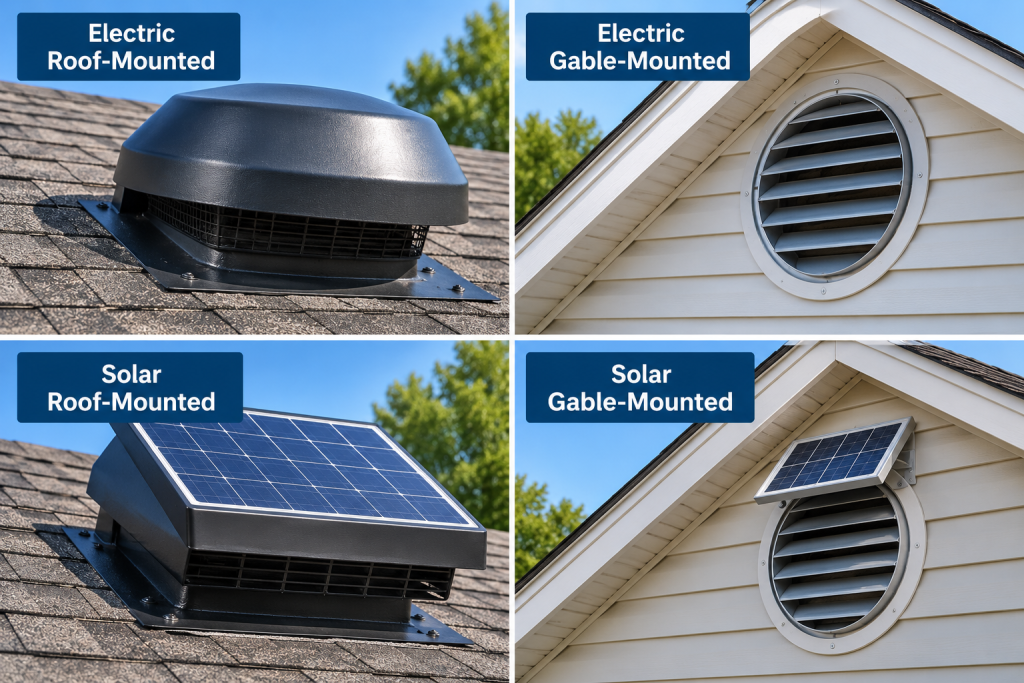
| Fan Type | Power Source | Typical Mounting | Main Advantages | Main Limitations | Best Fit |
|---|---|---|---|---|---|
| Electric roof-mounted | Grid power | Through roof | Predictable output, strong airflow, automatic controls | Roof penetration, wiring, noise, operating cost | Suitable roof location with adequate intake |
| Electric gable-mounted | Grid power | Behind gable vent | May avoid new roof opening, easier service access | Requires suitable gable, wiring, uneven airflow possible | Attics with usable gable location |
| Solar roof-mounted | Solar panel | Through roof | No routine grid power, fewer wiring needs on some models | Output varies with sunlight, roof exposure matters | Sunny roofs with suitable intake |
| Solar gable-mounted | Solar panel | At gable | May avoid roof penetration, no routine grid power | Needs suitable gable and solar exposure | Attics where gable mounting and solar access work |
What a Powered Attic Ventilator Does
A powered attic ventilator uses a motor-driven fan to exhaust attic air. Unlike passive ridge or box vents, it actively moves air and needs enough intake area to replace the air it removes.
It is also different from a whole-house fan, which moves air through living areas, and a bathroom exhaust fan, which removes moisture from a room.
A powered attic fan cannot substitute for blocked soffits, major ceiling air leaks, poor insulation, or a bathroom or dryer exhaust problem. Stronger exhaust may leave those underlying issues unchanged.
How to Choose the Best Attic Fan Type
The first buying decision is usually mounting location and power source.
Electric roof-mounted attic fans
Roof-mounted electric fans are installed through the roof and are commonly hardwired. Many use a thermostat, while some add humidity-sensitive or combination controls.
Their advantages are dependable power and strong airflow potential. The tradeoffs are roof penetration, flashing, electrical work, operating cost, and possible motor noise or vibration.
If intake is inadequate, a powerful fan can also increase negative pressure in the attic.
Electric gable-mounted attic fans
A gable-mounted fan is usually installed behind or near an existing gable vent. Where a suitable opening already exists, this approach may avoid a new roof penetration and can offer easier service access.
Not every attic has a useful gable location, and airflow may be less evenly distributed in a long or divided attic. These fans still need adequate intake and line-voltage power.
Solar attic fans
Solar attic fans use a solar panel to power the motor. Roof-mounted versions are common, although gable-mounted configurations also exist.
They avoid routine grid electricity during operation and may reduce wiring needs depending on the product. They can make sense where solar exposure is strong and the mounting location suits the attic.
Output depends on solar conditions and product design. Shade, roof orientation, clouds, and time of day can reduce available power, and basic models may provide little or no operation after sunset. Solar power does not eliminate the need for adequate intake.
If you are deciding between solar and grid-powered models, our solar attic fan vs. electric comparison breaks down the differences in output, controls, operating cost, and reliability.
Size the Fan Around the Attic, Not the Biggest CFM Number
Powered attic fans are commonly rated in cubic feet per minute, or CFM. That number describes airflow capacity, but it is not a “more is better” specification.
Sizing recommendations vary by manufacturer, attic dimensions, climate, intake capacity, and system configuration. Use the manufacturer’s sizing guidance for the specific fan and verify that the attic has the required intake area.
Oversizing can add noise, energy use, and stronger negative pressure without improving performance. If the attic floor is leaky and intake is inadequate, the fan may draw conditioned air from the home below.
Do not choose a fan solely because it has the highest CFM rating in your price range.
Intake Capacity Is a Major Buying Factor
A powered exhaust fan must get replacement air from somewhere.
Before buying, check the existing intake arrangement at a high level. Depending on the attic, that may include soffit vents, gable openings, or other intended lower intake locations.
Look for:
- Soffit intake blocked by insulation
- Missing, crushed, or displaced baffles
- Vents that do not communicate with the attic
- Insufficient lower intake for the proposed fan
- Divided attic sections that restrict airflow
The manufacturer may specify a minimum free intake area for a particular model. Follow that requirement rather than assuming existing vents are sufficient.
An intake-starved fan may move less air than expected and can increase pressure differences between the attic and living space. Correct blocked intake before relying on stronger exhaust.
If you need to estimate how much passive intake and exhaust area the attic may require, use our attic ventilation calculator before comparing powered fan airflow.
Compare Controls, Noise, and Durability
Two fans with similar CFM ratings may differ substantially in daily use.
Thermostat and humidity controls
A thermostat turns the fan on based on attic temperature. It is simple and common, but temperature alone does not diagnose a ventilation problem.
A humidistat responds to humidity. It can provide moisture-sensitive operation but does not identify or correct the moisture source.
Combination controls can respond to both conditions, while some models add manual override or programmable features. There is no universal temperature or humidity setting for every climate and attic, so compare control range, adjustability, and manufacturer instructions.
Noise and vibration
All powered fans make some sound.
Roof-mounted models can transmit vibration through the roof structure, while gable fans may be more noticeable near rooms close to the gable wall. Mounting quality also affects noise.
If bedrooms or quiet rooms are nearby, compare published sound information when available and do not assume any attic fan will be silent.
Weather resistance and service life
For a roof-mounted fan, compare housing quality, flashing design, corrosion resistance, rain protection, and suitability for prolonged sun exposure.
For a gable fan, consider the exterior louver or shutter, resistance to wind-driven rain, and pest screening where appropriate.
Also compare motor construction, warranty, service access, energy use, and whether controls or replacement parts can be reached without difficult roof work. Paying more can make sense for better durability, controls, or serviceability; a simpler fan may be enough for straightforward needs.
When a Powered Attic Fan May—or May Not—Make Sense
A powered ventilator may be worth considering when passive exhaust is difficult to provide adequately, the roof or gable layout supports the fan, sufficient intake is available, and persistent attic heat is a concern.
It is a poorer first move when:
- Soffit intake is blocked or inadequate.
- Significant ceiling air leakage is present.
- Bathroom or dryer exhaust enters the attic.
- Insulation is severely deficient or displaced.
- Passive ventilation is already properly designed.
- The attic is conditioned or intentionally unvented.
- The proposed fan could create substantial negative pressure.
Some homes may benefit more from correcting air sealing, insulation, intake, or existing passive ventilation than from adding powered exhaust.
Combustion safety deserves extra attention
Strong attic depressurization can be a concern in some homes with atmospherically vented fuel-burning appliances or significant leakage paths between the attic and living space.
Do not attempt pressure or combustion testing yourself. If the home has fuel-burning equipment and pressure interactions are uncertain, have a qualified professional evaluate the situation before installing a powerful attic exhaust fan.
Installation Requirements Can Change the Best Choice
A roof-mounted model requires a weather-tight roof penetration and flashing. Homeowners should not climb steep roofs, work near roof edges, cut roof openings, or modify flashing without appropriate training and fall protection.
Hardwired electric fans involve line-voltage electrical work and must follow manufacturer instructions and applicable electrical requirements. Use a qualified electrician or appropriate professional when that work is outside your safe skill level.
A gable-mounted model may simplify roof work when a suitable opening already exists, but safe attic access still matters. Do not walk on unsupported ceiling drywall, work around exposed or questionable wiring, or disturb vermiculite or suspected asbestos-containing insulation.
Common Attic Fan Buying Mistakes
Avoid these common selection errors:
- Buying by maximum CFM alone. Match airflow to the attic and manufacturer guidance.
- Ignoring intake requirements. Powered exhaust needs replacement air.
- Using a fan to compensate for blocked soffits. Restore the intake path first.
- Overlooking attic air leakage. A fan can pull conditioned air through ceiling gaps.
- Confusing attic and whole-house fans. They serve different spaces.
- Defaulting to a roof model. A suitable gable location may avoid another roof penetration.
- Choosing solar without checking shade. Solar exposure affects available power.
- Ignoring noise and controls. Both affect daily operation.
- Assuming powered ventilation is always better. A sound passive system may not need a fan.
- Installing in a conditioned attic without understanding the assembly.
- Mixing powered and passive exhaust without considering airflow.
Frequently Asked Questions
What size attic fan do I need?
Use the manufacturer’s sizing method for the specific product and attic. CFM recommendations vary, and enough intake must be available for the selected airflow.
Are attic fans worth it?
They can be useful in some attics, but they are not automatically an upgrade. If passive ventilation, air sealing, insulation, and intake already work well, adding powered exhaust may offer limited benefit.
Is a roof-mounted or gable-mounted attic fan better?
Roof-mounted fans suit attics without a useful gable location, while gable-mounted fans may avoid a new roof penetration when an appropriate opening already exists. The better choice depends on geometry, airflow, access, and installation requirements.
Are solar attic fans effective?
They can move useful air when solar exposure and sizing are appropriate. Their output varies with sunlight, so compare expected operation and roof orientation.
Can an attic fan run with ridge vents?
It can, but powered and passive exhaust openings may change the intended airflow path. Evaluate the overall ventilation layout before assuming the combination is beneficial.
Can an attic fan pull air from the house?
Yes, especially when attic intake is inadequate and the ceiling plane has air leaks. That is why intake capacity and air sealing should be considered before adding a powerful fan.
Should an attic fan run all the time?
Operation depends on the fan’s controls, climate, and manufacturer instructions. Continuous operation should not be assumed necessary simply because the attic becomes hot.
Final Thoughts
Choose a powered attic ventilator by attic design, intake capacity, mounting location, controls, durability, noise, power source, and manufacturer sizing guidance. A higher CFM rating does not automatically make a fan a better choice.
Do not use a powered fan as a substitute for correcting blocked intake, major air leakage, or other attic moisture and insulation problems. In some homes, the best attic fan decision may be not to add one at all.