
are attic fans worth it? when powered ventilation helps – and when it doesn’t
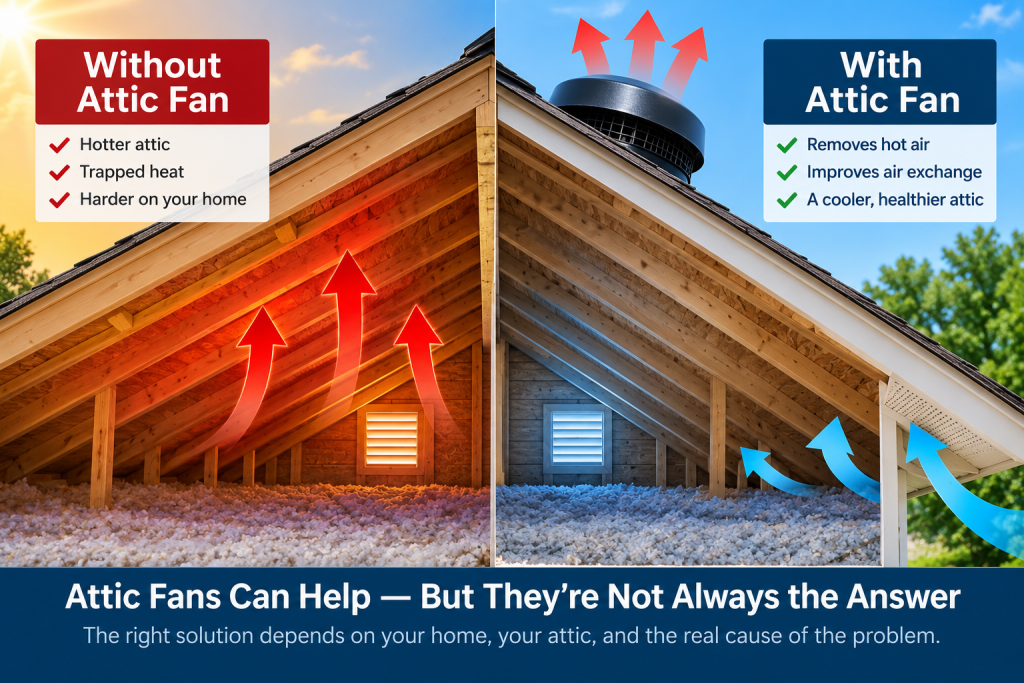
Are attic fans worth it? They can be in the right home, but they are not automatically a good investment. The strongest candidates are conventional vented attics with adequate intake, persistent heat, reasonable air sealing, and a layout that benefits from powered exhaust. A fan is usually a poor first fix for blocked soffits, ceiling air leakage, poor insulation, moisture sources, or an already-effective passive ventilation system.
| Situation | Attic Fan Likely to Help? | Why |
|---|---|---|
| Hot vented attic with good soffit intake | Possibly | Powered exhaust may increase air exchange |
| Hot attic with blocked soffits | Usually not yet | Correct the intake restriction first |
| Major ceiling air leakage | Often a poor first move | Fan may pull conditioned air from the house |
| Good ridge-and-soffit system | Often unnecessary | Passive ventilation may already be adequate |
| Conditioned or unvented attic | Usually not appropriate | Different attic design |
| Difficult attic layout with persistent heat | Possibly | Powered exhaust may help selected areas |
| Bathroom or dryer moisture entering attic | No | Correct the moisture source |
What Homeowners Mean by an Attic Fan
Here, an attic fan means a powered attic ventilator: a motor-driven fan that removes air from a vented attic.
That is different from a whole-house fan, which pulls air through living areas, and from passive ridge, box, or gable vents, which move air without a motor.
A powered attic fan may be roof-mounted or gable-mounted and may use grid electricity or solar power. Its job is to increase attic air exchange, not directly cool the rooms below.
What a Powered Attic Fan Can—and Cannot—Do
A powered fan can actively exhaust attic air when enough replacement air is available. In the right conditions, that may reduce attic air temperature and improve air movement through poorly served areas.
It cannot fix:
- Blocked soffit vents or missing intake
- Major ceiling air leaks
- Poor or displaced attic-floor insulation
- Bathroom or dryer exhaust terminating in the attic
- Roof leaks or other moisture sources
- Problems in a conditioned or intentionally unvented attic
It also cannot guarantee lower utility bills, cooler rooms, longer roof life, or moisture elimination. Those outcomes depend on the rest of the attic and the home below.
Why a Cooler Attic Does Not Guarantee Lower Cooling Bills
Lower attic air temperature does not automatically produce proportional air-conditioning savings.
Insulation slows heat transfer between the attic and living space, while air sealing limits conditioned air from leaking upward. Climate, roof exposure, HVAC and duct location, fan electricity use, and attic design also affect the result.
A poorly sealed ceiling can work against the fan. If powered exhaust creates negative pressure and the attic cannot draw enough air through intended intake vents, it may pull cooled household air through ceiling penetrations instead.
That can reduce or erase the expected energy benefit even while the attic itself becomes cooler.
Intake Capacity Is Critical
A powered attic fan removes air faster than passive vents. Replacement air must come from somewhere.
Ideally, it enters through intended intake openings such as soffit vents. If those are blocked or inadequate, the fan may draw air through attic hatch gaps, recessed-light openings, plumbing or wiring penetrations, and other leaks from the living space.
Before buying a fan, confirm that soffit or other intake openings are actually usable. Exterior vents can look open while insulation blocks the pathway inside the attic.
Adequate intake is a prerequisite, not an optional upgrade after the fan is installed.
If you need to understand how intake and exhaust should work together before considering powered ventilation, see our attic ventilation guide.
When an Attic Fan May Be Worth Considering
A powered attic fan makes the most sense when the fundamentals are already in reasonable condition and a real need for powered exhaust remains.
It may be worth considering when:
- The attic is a conventional vented attic.
- Persistent heat remains a concern despite usable intake.
- Roof or attic geometry makes passive exhaust difficult.
- Enough intake is available for the proposed fan.
- The ceiling plane is reasonably air-sealed.
- Insulation is in reasonable condition.
- A suitable roof or gable mounting location exists.
- The homeowner accepts noise, maintenance, and operating costs.
Climate and roof layout matter. Homes exposed to long periods of strong heat may present a different case from homes where attic overheating is brief, and divided or irregular attics can behave differently from simple open spaces.
When an Attic Fan May Not Be Worth It
A powered fan is often a poor first investment when a more basic problem is still unresolved.
Think twice when:
- Soffit vents are blocked, or intake is inadequate.
- Significant attic-floor air leakage is present.
- Insulation is missing, compressed, or badly displaced.
- Bathroom or dryer exhaust releases moisture into the attic.
- Existing passive ventilation is already working properly.
- The attic is conditioned or intentionally unvented.
- Roof modifications would be extensive.
- The expected benefit is based on one hot attic reading.
- The fan may pull conditioned air from the house.
- Combustion-safety concerns are unresolved.
A hot attic alone does not prove that powered ventilation is needed.
Pressure and Combustion Safety Matter
Powered exhaust creates stronger negative pressure than passive ventilation.
If intake is inadequate, the fan may draw air through unintended openings. In some homes, this can also be a concern when atmospherically vented fuel-burning appliances are present.
Do not attempt combustion or pressure testing yourself. If the home has fuel-burning equipment and pressure interactions are uncertain, have a qualified professional evaluate the situation before installing or operating a powerful attic exhaust fan.
Cost and Value Go Beyond the Fan Price
Possible costs include the fan, electrical work, roof or gable installation, flashing, controls, maintenance, electricity for grid-powered models, and future repair or replacement.
Roof-mounted fans add a roof penetration that must remain weather-tight. Gable-mounted models may avoid that issue where a suitable gable opening already exists.
Electric fans provide predictable powered operation. Solar fans avoid routine grid electricity during operation but depend on sunlight, exposure, and product design. Neither power source changes the need for sufficient intake.
A cheaper fan is not good value if the attic does not need powered exhaust.
If you decide a powered fan is worth considering, our best attic fan guide explains how to compare mounting type, CFM, controls, noise, intake requirements, and power source.
What to Check Before Buying an Attic Fan
Before comparing models or CFM ratings, check:
- Whether the attic is conventionally vented
- Whether soffit or eave intake is open
- Whether insulation blocks intake pathways
- Whether visible baffles remain open
- Whether attic-floor air leakage appears significant
- Whether insulation is reasonably complete
- Whether bathroom and dryer exhaust terminate outdoors
- Whether existing passive exhaust appears functional
- Whether attic geometry creates isolated areas
- Whether a safe roof or gable mounting location exists
- Manufacturer sizing and intake requirements
- Noise and maintenance expectations
- Any combustion-safety concerns
Do not walk on unsupported ceiling drywall, work around exposed or questionable wiring, or disturb vermiculite or suspected asbestos-containing insulation.
Roof penetrations, flashing, hardwired electrical work, and uncertain combustion-safety conditions should be handled by qualified professionals.
Common Attic Fan Misconceptions
“My attic is hot, so I need a fan.” Not necessarily. Hot attic conditions can be normal, especially in sunny weather.
“More CFM is always better.” No. A larger fan needs more replacement air and can create stronger negative pressure.
“An attic fan will cool my house.” It may lower attic temperature, but indoor comfort also depends on insulation, air sealing, HVAC, ducts, and climate.
“An attic fan will fix moisture.” Not if the real source is air leakage, exhaust ducts, roof leaks, or another moisture problem.
“Solar means free ventilation.” Solar avoids routine grid power, but purchase, installation, maintenance, and sunlight limitations still matter.
“If passive vents are present, intake must be adequate.” Not always. Soffit vents can be blocked or provide less usable intake than the fan requires.
“Powered ventilation is always better.” No. A well-designed passive system may need no powered fan.
Frequently Asked Questions
Do attic fans really work?
Yes, they can move substantial attic air when enough intake is available. Whether that produces worthwhile value depends on the attic, climate, insulation, air sealing, and existing ventilation.
Do attic fans save money on air conditioning?
Sometimes, but savings are not guaranteed. Fan electricity use and conditioned-air loss through ceiling leaks can reduce or eliminate the benefit.
Can an attic fan make the house less efficient?
Yes. If intake is inadequate and the ceiling plane is leaky, the fan can pull conditioned air from the house into the attic.
Are attic fans worth it with ridge vents?
Sometimes, but an effective ridge-and-soffit system may not need powered exhaust. Adding a fan can also change the intended airflow pattern.
Are solar attic fans worth it?
They can make sense where sunlight and attic conditions support them, but solar power does not make an unnecessary fan worthwhile.
Can an attic fan cause negative pressure?
Yes. Powered exhaust creates negative pressure, and inadequate intake can cause air to be drawn through unintended openings.
Should I fix insulation or ventilation first?
Correct obvious defects such as blocked intake, major air leakage, poor insulation, or moisture sources before assuming powered ventilation is the answer.
Final Thoughts
An attic fan is worth considering only when the attic actually needs powered exhaust and can supply enough replacement air. Persistent heat, difficult attic geometry, and adequate intake can make a fan reasonable, but a hot attic alone is not enough reason to install one.
Before buying, confirm the attic type, intake path, insulation, air sealing, existing passive ventilation, and safety conditions. In many homes, correcting those fundamentals provides more value than simply adding a fan.