
best exterior caulk for siding and trim: how to choose
The best exterior caulk for siding and trim is usually a high-quality exterior sealant that stays flexible, bonds to the materials being joined, and can be painted when the finished joint needs to match surrounding trim. Acrylic products are often easier to use and paint, while polyurethane and hybrid sealants generally handle more movement. Silicone excels at weather resistance but is often a poor fit for painted trim.
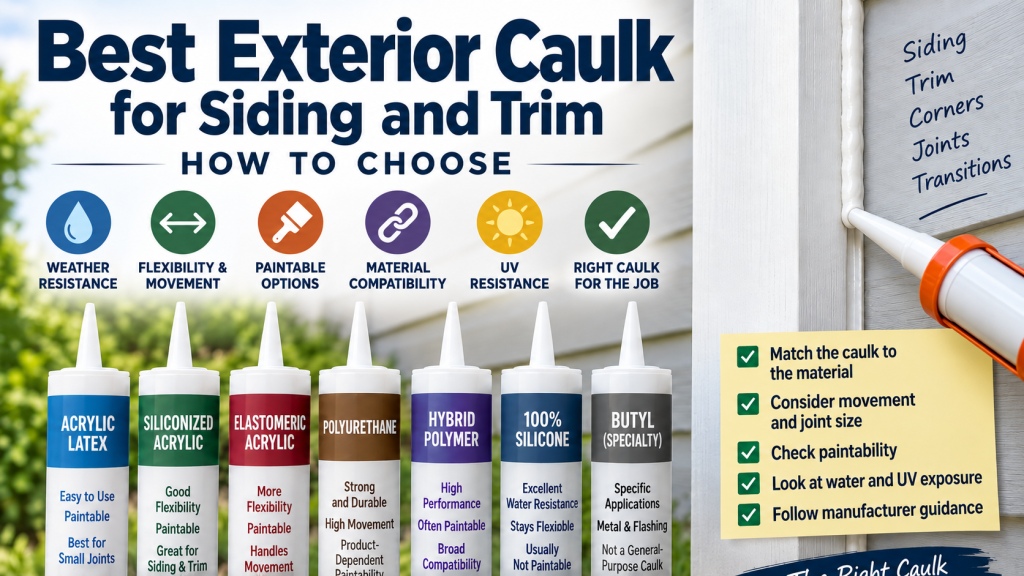
| Sealant type | Flexibility | Paintable | Moisture resistance | Best use |
|---|---|---|---|---|
| Acrylic latex | Low to moderate | Yes | Moderate | Small, lower-movement painted joints |
| Siliconized acrylic | Moderate | Usually | Good | General siding and trim joints |
| Elastomeric acrylic | Moderate to high | Yes | Good | Painted joints that move more |
| Polyurethane | High | Product-dependent | High | Larger or higher-movement joints |
| Hybrid/polymer | High | Often | High | High-performance general exterior sealing |
| 100% silicone | High | Usually no | Excellent | Unpainted weather-exposed joints |
| Butyl/specialty | Varies | Varies | High | Specific metal, flashing, or specialty uses |
What Makes a Good Exterior Caulk?
Exterior caulk has to tolerate rain, ultraviolet exposure, temperature swings, and movement as siding and trim expand and contract. Good adhesion matters just as much as flexibility because a durable sealant that does not bond to the surfaces will still fail.
There is no universal “best” tube for every exterior joint. The right choice depends on the materials, how much the joint moves, whether it will be painted, its width and depth, and how much water and sun it receives.
Best Exterior Caulk Types for Siding and Trim
Acrylic Latex Exterior Caulk
Acrylic latex exterior caulk is easy to apply, tool, paint, and clean up. It works best on smaller, relatively stable exterior joints where paintability and appearance matter more than maximum movement capability.
Its main tradeoff is durability. Basic acrylic products generally do not tolerate large or repeatedly moving joints as well as higher-performance sealants.
Siliconized Acrylic Latex
Siliconized acrylic combines the easy application and paintability of acrylic caulk with improved flexibility and water resistance. It is a common general-purpose choice for exterior trim and siding joints with modest movement.
“Siliconized” does not mean the product is the same as 100% silicone. The two categories have different paintability and performance characteristics.
Elastomeric Acrylic
Elastomeric acrylic is designed to stretch and recover more than standard acrylic caulk while remaining paintable. It can be a useful middle ground for siding and trim joints that move enough to challenge ordinary acrylic but still need a painted finish.
Check the specific product’s movement rating and approved substrates rather than assuming all elastomeric acrylics perform alike.
Polyurethane Sealant
Polyurethane sealants generally provide strong adhesion, flexibility, and durability for exterior joints with more movement or exposure. They can suit larger siding, trim, masonry, or transition joints when compatible with the materials involved.
They may be harder to tool than acrylic products and can require longer cure times. Paintability and application conditions vary by product.
Hybrid or Polymer Sealants
Hybrid sealants combine high flexibility and weather resistance with broad adhesion to many building materials. Many are paintable, which makes them attractive for exterior trim where both movement and finish appearance matter.
They usually cost more than basic acrylic caulk, but the added performance can make sense for demanding joints.
100% Silicone
Silicone stays flexible and offers excellent resistance to water, UV exposure, and weathering. It can be appropriate for exterior joints where painting is unnecessary and compatibility is confirmed.
The main limitation for siding and trim work is paintability. Many 100% silicone sealants cannot be painted reliably, and adhesion varies on some painted or porous surfaces.
Butyl or Specialty Sealants
Butyl and other specialty sealants are useful for certain metal, flashing, roofing, or manufacturer-specific applications. They are not automatically the best general-purpose choice for visible siding and trim joints.
Use specialty products when the exterior system or material manufacturer specifically calls for them.
Best Caulk by Exterior Material
Vinyl Siding
Vinyl siding moves substantially as temperatures change, so flexibility matters. More importantly, not every seam or edge should be caulked.
Do not seal drainage openings, expansion paths, or joints the siding system is designed to leave free. Use sealant only where the siding manufacturer calls for it, such as certain transitions or penetrations, and choose a compatible flexible product.
Fiber Cement Siding
Where fiber-cement siding instructions call for sealant, a high-quality paintable exterior product with suitable flexibility is usually appropriate. Compatibility, joint location, and the siding manufacturer’s requirements should drive the choice.
Do not cut, drill, sand, grind, break, or otherwise disturb unknown older cementitious siding or trim if asbestos-containing material is suspected.
Wood Siding and Trim
Wood joints often benefit from a paintable sealant with good adhesion and enough flexibility to accommodate seasonal movement. Moisture exposure and the condition of the coating also matter.
Caulk cannot repair rotten wood or substitute for missing flashing. Deteriorated material and water-entry problems should be corrected first.
PVC Exterior Trim
PVC trim expands and contracts with temperature, so choose a sealant specifically compatible with PVC and capable of handling the expected movement. Paintability may also matter when the trim will receive a finish coat.
Follow the trim manufacturer’s sealant guidance, particularly at expansion joints and transitions.
If you are still deciding whether PVC is the right material for the project, our PVC exterior trim guide covers its pros, cons, cost, maintenance, and best-use locations.
Metal Siding and Trim
Metal can move with temperature and may have factory coatings that affect adhesion. Choose a sealant approved for the specific metal or coating, with suitable flexibility, UV resistance, and corrosion compatibility.
Paintability matters when the joint must blend with finished trim.
Paintability, Movement, and Joint Size
These three factors often narrow the choices faster than the material label on the tube.
Paintable vs. Non-Paintable Exterior Caulk
A paintable sealant is usually preferable when trim, siding transitions, or joints will be coated to match the exterior. Acrylic, elastomeric acrylic, polyurethane, and hybrid products often include paintable options.
Non-paintable silicone may be a better fit where weather resistance is the priority and the joint will remain exposed in its original sealant color.
How Much Movement Should Exterior Caulk Handle?
Exterior materials rarely move at exactly the same rate. Wood responds to moisture and temperature, while vinyl, PVC, and metal can move noticeably with temperature changes.
The more a joint opens and closes, the more important elasticity becomes. Higher-movement joints generally call for elastomeric acrylic, polyurethane, hybrid, or another sealant specifically rated for that movement.
What Joint Size Matters?
A hairline crack and a wide moving gap are not the same sealing problem. Sealant labels usually specify acceptable joint dimensions, and exceeding them can lead to poor curing, excessive stress, or early failure.
Very wide or deep joints may need a different repair approach. Some require backer rod to control sealant depth, but backer-rod selection and installation are separate topics.
Where Exterior Caulk Should Not Be Used
Caulk is useful only when the joint is actually intended to be sealed. Do not use it to hide a larger building-envelope or material problem.
Avoid using exterior caulk to:
- Block weep holes or intended drainage openings
- Seal expansion paths that siding needs for movement
- Cover active water leaks
- Conceal rotten or structurally damaged material
- Bridge significant structural movement
- Replace missing flashing
- Close joints the siding system is designed to leave open
If a joint repeatedly opens after being recaulked, the underlying movement, substrate condition, or water-management detail may need evaluation rather than another bead of sealant.
Where water needs to be directed out of the wall assembly, flashing—not another bead of caulk—is usually the critical detail; our siding flashing guide explains where flashing is needed and how it helps prevent water damage.
How to Choose the Best Exterior Caulk
Start with the joint rather than the brand. Before buying, check these factors:
- Material: Confirm compatibility with both surfaces being joined.
- Movement: Choose enough flexibility for expansion and contraction.
- Paintability: Use a paintable product when the joint must match the finish.
- Water exposure: Increase weather and moisture performance where exposure is high.
- UV exposure: Exterior joints need products rated for sunlight and weathering.
- Joint size: Stay within the product’s listed width and depth limits.
- Cure requirements: Check temperature, weather, and time needed before exposure or painting.
- Manufacturer compatibility: Follow siding or trim requirements when they specify a sealant type.
- Maintenance: Consider how accessible the joint will be for future inspection.
- Climate: Temperature swings, strong sun, rain, and coastal exposure can raise performance demands.
What to Look for on the Label
Look for an exterior rating, approved substrates, paintability, flexibility or movement capability, weather and UV resistance, application and service temperatures, cure information, cleanup method, and warranty terms.
Avoid choosing solely by a long warranty printed on the tube. A premium sealant can still fail if it is incompatible with the material, used in the wrong joint, or applied over a surface that cannot support adhesion.
Exterior caulk also has no universal service life. Longevity depends on the sealant type, joint movement, UV and weather exposure, surface condition, installation quality, coatings, and climate. Inspect exposed joints periodically and replace failed sealant when it separates, cracks, or loses adhesion.
When Professional Help Makes Sense
Professional evaluation is appropriate when the joint is high on the house, siding must be removed, flashing is involved, active water intrusion is present, rot or hidden damage is suspected, or a large moving joint repeatedly fails.
Older painted siding or trim may contain lead-based paint. Avoid casual sanding or scraping without appropriate lead-safe practices.
Do not disturb suspected asbestos-containing siding or trim. Work near electrical service conductors or equipment also requires professional caution; ladders, tools, and removed siding should be kept away from energized components.
Final Thoughts
The best exterior caulk depends on the joint and materials rather than one universal product. Acrylic and siliconized acrylic products are practical for paintable, lower-movement work; elastomeric acrylic adds flexibility; polyurethane and hybrid sealants suit more demanding moving joints; and silicone provides excellent weather resistance where paintability is not required.
Choose by compatibility, movement, paintability, moisture and UV exposure, joint size, and the siding or trim manufacturer’s requirements. Just as important, do not use caulk to block drainage, hide rot, or substitute for flashing or repairs that the exterior assembly actually needs.