
how to get rid of ants in the house: a low-risk approach
How to get rid of ants in house areas starts with removing the food and moisture that support them, then using targeted bait and basic exclusion rather than relying only on sprays. Observe where the ants are traveling, clean competing food sources, correct accessible moisture problems, and use an appropriate labeled bait when suitable. Then monitor the trend and reassess if activity does not decline.
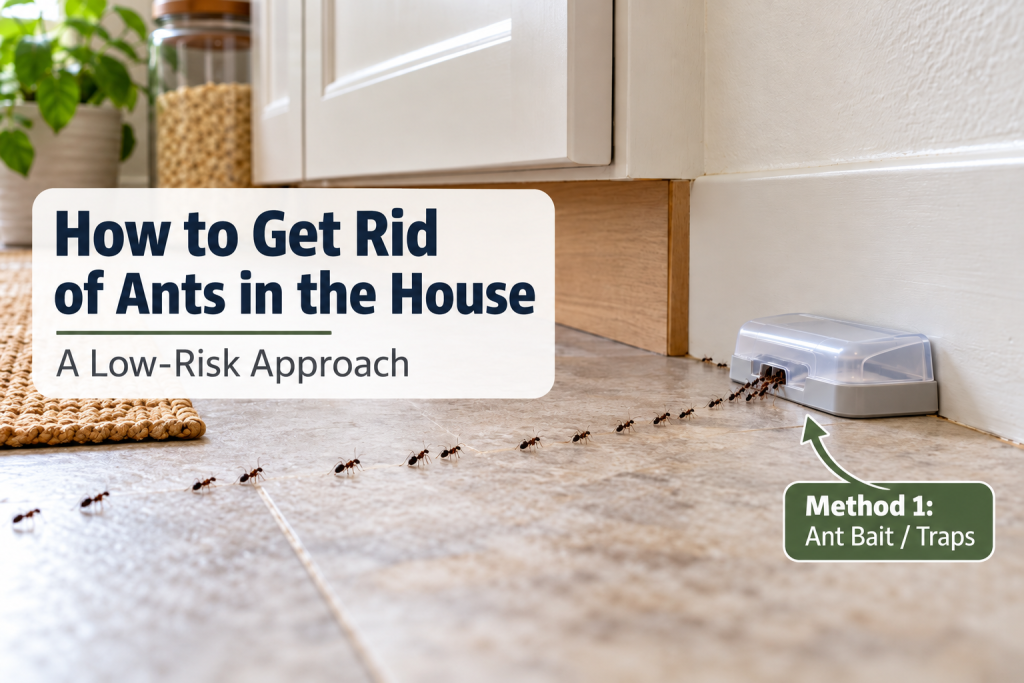
Start by Observing the Ant Activity
Before wiping up the trail or applying a product, watch where the ants move.
Note whether they follow the same path, where they seem to enter the room, and what they are moving toward. Pay particular attention to activity near food, sinks, pet bowls, doors, windows, baseboards, or plumbing.
You do not need to identify the species before taking basic low-risk steps. The immediate goal is to understand the route well enough to avoid treating the wrong area.
If you are not yet sure what is attracting the ants or where they are coming from, see our guide to ants in the house for a closer look at food, moisture, trails, and entry-point clues.
Remove Competing Food Sources
Ant control is harder when ordinary food is easier to reach than the treatment you are using.
Clean accessible crumbs, sticky spills, sugar residue, grease, and food particles where ants are active. Check pet feeding areas, pantry shelves, trash, recycling, and beneath small appliances.
Useful steps include:
- Wiping sticky counters and floors
- Cleaning pantry spills
- Securing open food packages
- Managing pet food after normal feeding
- Cleaning accessible food residue around appliances
- Keeping trash and recycling reasonably clean
- Removing exposed ripe or damaged food that ants are visiting
You do not need a perfectly spotless home. Focus on food that can repeatedly support foraging.
Reduce Moisture
Ants may also seek water, especially in kitchens, bathrooms, laundry areas, basements, and utility spaces.
Check for dripping faucets, visible leaks, condensation, damp areas beneath sinks, and appliance leaks.
Pet water bowls may attract foragers, although pets still need normal access to water. Keep the surrounding area clean rather than restricting necessary water.
Persistent moisture deserves attention as a home-maintenance issue even if it is not the only reason ants are present.
Follow the Trail Before You Disrupt It
A repeated ant trail can reveal where the insects are entering and what resource they are using.
If you are still trying to locate the route, observe the trail before repeatedly wiping it away. Follow it visually toward wall edges, doors, windows, trim gaps, plumbing penetrations, or food sources.
Do not open walls, remove electrical covers, or dismantle fixtures to follow ants.
Use Ant Bait as a Targeted Tool
An appropriate ant bait can be useful because it is designed to be eaten by foraging workers and carried or shared within the colony.
That process is slower than killing an ant on contact. Ants actively feeding on bait are part of the treatment, so continued foraging near a bait placement does not automatically mean the product is failing.
Choose a bait labeled for the ant problem and intended location. Follow the label for placement, amount, replacement, and storage.
Keep bait accessible to ants but inaccessible to children and pets. Avoid food-contact surfaces, water sources, and any location prohibited by the label.
Detailed choices among bait formats and food formulations depend on the ants and placement conditions. The important step here is to choose an appropriate labeled bait rather than applying a product simply because it is available.
For help choosing between liquid, gel, enclosed stations, and other bait formats, see our complete ant bait guide.
Avoid Spraying Around Active Bait
If ants are feeding on bait, avoid spraying contact insecticide directly on the ants, trail, or surrounding bait area.
A spray can kill or deter the foraging workers that need to reach the bait and return along their normal route. Using several pesticide products at once is not automatically more effective.
Do not mix pesticide products, modify bait, or increase concentrations. Use each product only as its label directs.
Where to Place Bait
Placement should follow existing ant activity rather than random distribution around the room.
Depending on the product label, useful locations may include:
- Near an active trail
- Near a likely entry point
- Along a wall edge the ants already use
- Near an area where ants are feeding
Keep placements away from exposed food-preparation surfaces and anywhere children or pets can reach them.
Do not place bait inside electrical equipment, behind inaccessible panels, or anywhere that creates a hazard.
Clean Without Disrupting the Control Strategy
Sanitation and baiting are not opposing strategies. Remove competing food while allowing ants to reach the treatment you intentionally placed.
Continue cleaning spills, crumbs, grease, trash residue, and other food sources. At the bait location, avoid spraying cleaners or pesticides onto the bait or repeatedly disturbing the active route while ants are feeding.
If bait dries out, becomes contaminated, or is consumed, manage or replace it according to the label.
Seal Accessible Entry Points
After activity begins to decline, correct simple entry points you can safely reach.
Look for small gaps around doors, windows, trim, and accessible utility penetrations. Worn weatherstripping or a gap beneath a door may also provide a route indoors.
Use repair materials appropriate for the opening. Do not seal required vents, drainage openings, weep paths, combustion-air openings, or other functional openings.
Why Killing the Ants You See May Not Solve the Problem
The ants walking across a counter or baseboard are usually foraging workers, not the entire colony.
Removing visible ants can provide temporary relief, but activity may return if more workers use the same route and the underlying food, moisture, or colony source remains.
Why Ants May Keep Coming Back
Continued activity does not always mean you need more pesticide.
Possible reasons include:
- Food or moisture remains available
- The entry route is still open
- Ants are not accepting the bait
- The bait type does not match their current feeding preference
- The bait has dried out or become contaminated
- More than one nearby colony or source is involved
- The ants need more specific identification
Recheck those factors before increasing treatment.
What Not to Do
Do not:
- Spray pesticides randomly throughout the house
- Spray directly around active bait
- Mix pesticide products
- Make homemade toxic bait recipes
- Apply more pesticide simply because ants are still visible
- Place pesticides where children or pets can reach them
- Apply products to food-contact surfaces unless the label permits it
- Drill or inject pesticide into walls
Store unused pest-control products securely and in their original containers.
How Long Should You Give the Approach to Work?
Bait-based ant control is not immediate. Activity may continue while ants forage and interact with the bait.
Watch the trend rather than expecting every ant to disappear at once. Fewer ants and reduced trail activity can indicate progress, while unchanged or increasing activity is a reason to reassess.
Follow the product label for monitoring and replacement intervals. Do not assume that adding more pesticide will make control faster.
How to Get Rid of Ants in House Areas: A Low-Risk Sequence
Step 1: Observe the activity
Note where ants travel, what they are moving toward, and whether they use a repeated route.
Step 2: Remove competing food and moisture
Clean accessible food residue and address practical moisture sources near the activity.
Step 3: Clean obvious residue
Wipe crumbs, grease, sticky spills, trash residue, and pantry spills without contaminating bait.
Step 4: Use an appropriate labeled bait
Place bait where permitted by the label and where ants can reach it without creating access for children or pets.
Step 5: Avoid spraying around the bait
Allow foraging ants to use the bait rather than killing or repelling them at the placement.
Step 6: Monitor activity
Watch whether the number of ants and strength of the trail begin to decline.
Step 7: Seal accessible entry points
Once activity is declining, correct simple gaps that ants have been using where the repair is homeowner-safe.
Step 8: Reassess if ants persist
Check food, moisture, entry routes, bait condition, and whether closer identification is needed.
When Ant Activity Needs a Different Approach
Consider professional pest evaluation when heavy activity continues despite appropriate sanitation and bait use, when ants repeatedly emerge from inaccessible structural areas, or when the source cannot be located safely.
Large ants repeatedly associated with damp or damaged wood also deserve closer identification. Size alone does not diagnose carpenter ants, but activity linked with moisture or deteriorated wood may require a more specific inspection.
Do not open walls or attempt structural pesticide treatment to investigate persistent activity.
Final Thoughts
Getting rid of indoor ants works best when you address the conditions supporting them rather than relying only on killing the workers you can see. Reduce competing food and moisture, use targeted bait appropriately, protect the baiting process from incompatible sprays, and correct practical entry points.
Then monitor the result. If activity does not decline, reassess the food source, moisture, bait acceptance, entry route, or ant identification before applying more pesticide.