
ant bait guide: types, placement, and how to choose
Ant bait is usually most useful when you match the bait format and food type to where the ants are active, then place it where foraging ants can reach it safely. Liquid, gel, enclosed stations, and granular baits suit different situations. The right choice also depends on whether ants are seeking sweets or protein- or grease-based food, whether the location is indoors or outdoors, and whether children or pets can reach it.
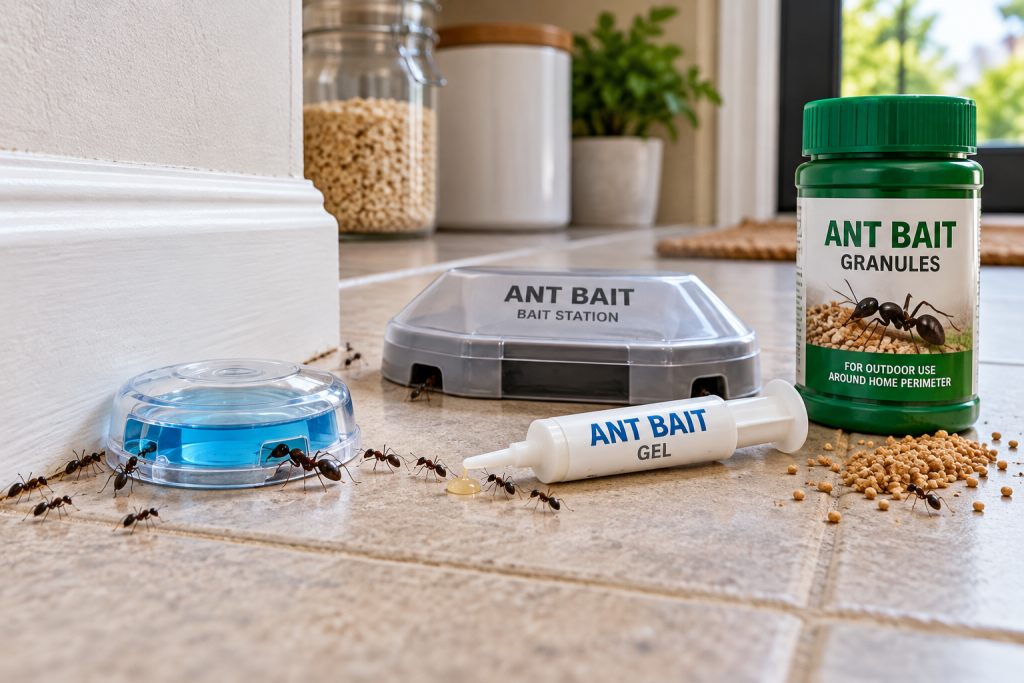
| Bait type | Best fit | Main advantage | Main limitation |
|---|---|---|---|
| Liquid | Indoor trails and sugar-feeding activity | Easy feeding access | Can spill or dry out |
| Gel | Targeted protected placements | Fits locations where stations may not | Can dry out or become contaminated |
| Bait station | Convenient indoor or labeled outdoor placement | Bait is enclosed in a housing | Ants still need to enter and feed |
| Granular | Labeled outdoor or perimeter use | Practical for some exterior activity | Moisture can affect use |
What Ant Bait Is and How It Works
Ant bait combines an attractive food source with an active ingredient intended for ants to consume. Worker ants forage, find the bait, and may carry food back or share it with other ants.
That is different from a product designed to kill insects on contact. The goal is not simply to kill the workers you can see. It is to let foraging ants interact with the bait long enough for treatment to reach beyond the visible trail.
This is also why bait is generally not instant. Visible activity can continue while workers forage. Performance depends on whether ants accept the bait, where it is placed, whether it stays usable, and whether competing food is easier to reach.
Ant bait vs. ant spray
A contact spray affects ants directly exposed to it. Bait is designed to be eaten and transferred through normal foraging and food-sharing behavior.
Spraying directly on or around an active bait placement can interfere with that process by killing or disrupting foragers. If you choose a bait-based approach, avoid treating the immediate bait area with another pesticide unless product directions specifically support it.
Main Types of Ant Bait
The best format depends on where the bait needs to go and how the ants are feeding.
Liquid ant bait
Liquid bait can be attractive to ants seeking sweet food sources. It is commonly suited to indoor foraging routes when the label permits the location and the bait can remain undisturbed.
Its advantage is easy feeding access. The tradeoffs are that liquid can spill and may dry out over time. Keep it away from places where it could contaminate food, dishes, pet bowls, or other sensitive surfaces.
Gel ant bait
Gel allows targeted placement where a station may not fit. Depending on the label, it may be intended for protected spots, cracks, crevices, or edges where ants travel.
Gel still needs to remain accessible to ants and protected from cleaning, water, dust, and contamination. It can dry out as well.
Use gel only in locations and amounts permitted by its label. Do not inject pesticide into walls or dismantle building components to create placements.
Bait stations
Bait stations hold bait inside a housing that ants enter or feed from. They are convenient to position and can reduce direct contact with bait compared with exposed formulations.
Enclosed does not mean child-proof or pet-proof. Stations still need to be kept where children and animals cannot access or play with them.
A station also works only if ants find it and feed. Poor placement or an unattractive food type can lead ants to ignore it.
Granular ant bait
Granular products are commonly suited to certain outdoor or perimeter situations when specifically labeled for those uses.
Outdoor conditions matter. Rain, irrigation, or excessive moisture may affect some products, so follow the label for where and when granules can be applied.
Do not assume any granular insecticide is an ant bait or that an indoor product can be scattered outdoors. The label should cover both the pest and intended placement.
Sweet vs. Protein or Grease Ant Baits
Ants do not all seek the same food, and feeding preferences can change with colony needs, season, or available food.
Sweet baits use a sugar-oriented food source. Protein- or grease-oriented baits are designed for ants seeking different foods.
This matters when ants walk past a well-placed bait. Adding more of the same product may not help if its food source is not attractive at that time. Reassess the placement and consider a different labeled bait type instead.
Food preference can provide a useful clue, but it is not a reliable way to identify an ant species by itself.
If you are still trying to understand why ants are appearing or what may be attracting them, see our guide to ants in the house before choosing a control approach.
How to Choose Ant Bait
Start with location and exposure risks, then narrow the choice by format and feeding preference.
Match the product to the location
Check whether the label allows indoor use, outdoor use, or both. A protected indoor bait may not tolerate weather, while an outdoor product may not be labeled for living spaces.
Consider what happens around the placement. Under a sink may be damp. A countertop may involve food contact. An exterior location may receive rain or irrigation. A spot behind an appliance may be difficult to monitor safely.
Choose a format that fits the environment rather than forcing a convenient product into an unsuitable location.
Compare the features that matter
When comparing products, look for:
- The pest listed on the label
- Indoor or outdoor use approval
- Bait food type or formulation
- Placement restrictions
- Moisture considerations
- Ease of monitoring or replacement
- Spill and cleanup concerns
- Directions involving children, pets, food, and water
A defined ant trail can make placement easier than scattered sightings. If ants seem interested in sweet residues, a sweet bait may be worth considering. If they consistently ignore it while feeding on protein- or grease-based foods, another formulation may be a better match.
Do not choose by package claims alone. A bait that ants do not eat or that cannot be placed safely is a poor choice.
Where to Place Ant Bait
Placement strongly affects whether ants find and accept bait. The goal is to position it close to normal ant movement without contaminating food areas or creating access for children or pets.
Useful zones may include active trails, suspected entry points, wall edges, or areas where ants are already feeding, as long as the label permits use there.
Keep bait protected from mopping, splashing water, strong heat, heavy dust, and unnecessary disturbance. Do not scatter it randomly around the home.
Indoor placement considerations
Depending on the label and household conditions, possible locations may include:
- Near baseboards along an active trail
- Near a door or window entry area
- Beneath a sink where the bait can remain dry and inaccessible
- Behind an appliance when safely accessible
- Inside a cabinet only where the label permits and food contamination can be prevented
Avoid exposed food-preparation surfaces and locations where bait could contact food, dishes, utensils, pet food, or water.
Do not reach into electrical spaces, remove appliance panels, or place bait where servicing it creates an electrical or access hazard.
Outdoor placement considerations
For products labeled for outdoor use, possible locations include exterior trails, foundation areas, patios, and entry zones where ants are traveling.
Consider rain, irrigation, runoff, and moisture exposure. Use perimeter placements only with products specifically labeled for that application.
Outdoor baiting does not require aggressive nest treatment or pesticide injection into the structure.
For the broader control process around sanitation, bait use, and basic exclusion, see our low-risk guide on how to get rid of ants in the house.
Why Ants May Ignore Bait
Ants can be present in large numbers and still ignore a bait. That does not automatically mean you need more pesticide.
Common reasons include:
- The food type does not match their current preference.
- Crumbs, grease, pet food, or other foods are more attractive.
- The bait has dried out or become stale.
- Water, cleaners, dust, or another substance contaminated it.
- The bait is too far from the active route.
- The trail was disrupted.
- The ant or situation does not respond well to that bait.
If ants repeatedly pass without feeding, reassess the bait type and location before adding more.
If the ants are unusually large or seem associated with damp or damaged wood, review the warning signs of carpenter ants before continuing to switch bait products.
How Long Ant Bait Takes to Work
Ant bait works through feeding behavior, so it should not be judged by the speed of a contact-kill product.
Visible ants may continue traveling to and from bait while it is being used. The time needed for activity to decline varies with the product, ant species, colony size, food preference, placement, and feeding behavior.
Follow the label for replacement or maintenance intervals. If bait dries out, a station empties, or outdoor conditions compromise the product, replace or manage it only as directed.
Continued activity alone does not necessarily mean the bait has failed.
Should You Kill Ants You See Near the Bait?
If ants are actively feeding on bait, allow them to forage unless there is an immediate sanitation or safety concern. Those workers are part of the baiting process.
Avoid spraying directly on the ants, trail, or surrounding bait area while relying on that placement. You can still maintain normal cleanliness elsewhere.
Food and Sanitation While Using Ant Bait
Bait has to compete with other available food. Clean accessible crumbs and spills, wipe food residue from preparation areas, store pantry goods securely, and manage trash reasonably.
Pet food can compete with bait too, so avoid leaving it available longer than necessary for normal feeding.
Focus cleaning on competing food sources while protecting an active bait placement from contamination or unnecessary disturbance.
For broader prevention beyond the current ant problem, our whole-home guide explains how to keep bugs out by reducing food, moisture, shelter, and common entry points.
Ant Bait Safety Around Children and Pets
Treat every ant bait as a pesticide product, including small enclosed stations.
Read the label before buying and using it. Choose a location children and pets cannot access, and do not assume an enclosed housing makes the contents harmless or impossible to reach.
Use only the amount and placement method the label permits. Keep bait away from exposed food, food-preparation surfaces, pet food, water bowls, and other places where contamination could occur.
Handle the product as directed, including washing your hands when instructed. Store unused bait in its original container and securely away from children, pets, food, and animal feed.
Do not alter commercial bait, mix it with another pesticide, increase its concentration, or make homemade pesticide bait recipes.
When Ant Bait May Not Be Enough
A different approach may be needed when heavy activity continues despite appropriately selected and placed bait, ants repeatedly emerge from inaccessible structural areas, or recurring infestations have no clear source.
Large ants associated with damp or damaged wood can also warrant closer identification because carpenter-ant activity may be connected with moisture or structural conditions.
When identification affects treatment or activity suggests a hidden structural issue, professional pest evaluation may be more useful than continuing to switch products.
Final Thoughts
Choosing ant bait is mainly about matching the food type and format to the ants’ activity and the location where you need to place it. Liquid, gel, station, and granular baits can all be appropriate in the right setting, but none is universally best.
Place bait where ants can find it safely, reduce competing food, keep the product usable, and allow the foraging process to work. If ants will not feed or persistent activity points to a different problem, reassess the situation rather than simply applying more pesticide.