carpenter ants: warning signs, moisture problems, and when to call a pro
Carpenter ants deserve closer attention when large ants repeatedly appear around damp, damaged, or deteriorated wood. They do not eat wood the way termites do, but they can excavate it to create nesting galleries. The homeowner’s job is to note the pattern, look for visible moisture or wood damage, and call the appropriate professional when activity appears tied to structural areas or hidden moisture.
What Carpenter Ants Are
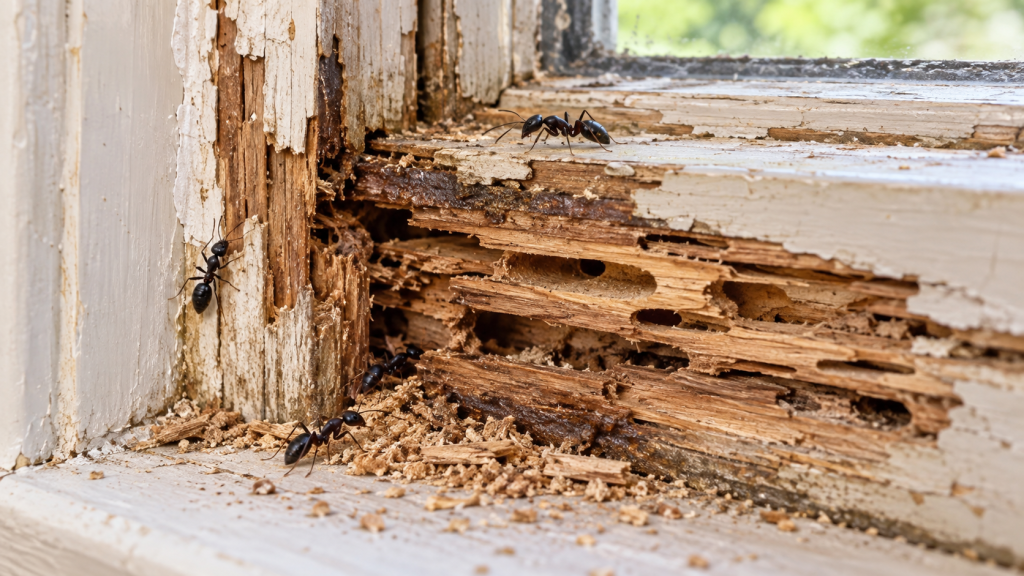
Carpenter ants are relatively large ants that create nesting galleries in wood and other protected materials. Unlike termites, they do not digest wood as food. They remove material as they excavate space for the colony.
They are often associated with wood that is moist, softened, or already damaged by decay. A leak, condensation problem, damaged trim, or other moisture issue can create favorable conditions.
Carpenter ants found indoors do not always mean the main nest is inside the house. Workers can forage indoors from nests located outside, and some colonies can establish satellite nests in or near structures.
What Carpenter Ants Look Like
Carpenter ants are generally larger than many common household ants, but size varies within the group and even among workers from the same colony.
Depending on the species, they may appear:
- Black
- Reddish
- Brown
- Black with reddish or brown areas
Like other ants, they have elbowed antennae and a noticeably narrow waist between the middle and rear body sections.
Do not identify carpenter ants from size or color alone. Not every large black ant is a carpenter ant, and other ants can look similar at a glance.
If identification matters, a clear photograph or intact specimen can be more useful than guessing from one visual feature.
Carpenter Ants vs. Regular Household Ants
The practical concern increases when repeated sightings of large ants overlap with wood, moisture, or structural areas.
Pay closer attention when ants repeatedly appear near:
- Damp or damaged wood
- Window or door framing
- Wall voids
- Plumbing areas
- Exterior trim
- Roof or eave areas
- The same crack or structural opening
A few large ants wandering indoors do not prove there is a structural nest. Repeated activity in the same moisture-prone area is more meaningful.
Warning Signs of Carpenter Ant Activity
No single sign proves carpenter ants are nesting in the structure, but several clues together can justify closer evaluation.
Watch for:
- Repeated sightings of large ants indoors
- Ants emerging from the same crack, trim joint, or wood area
- Coarse sawdust-like debris near wood
- Winged ants appearing indoors
- Faint rustling or activity within a wall or wood area
- Repeated activity near damp or damaged wood
- Ants concentrated around windows, doors, plumbing, roof drainage areas, or exterior trim
The pattern matters. One ant near an open door is different from repeated ants emerging from the same wall edge beside water-damaged trim.
If the activity looks more like ordinary household ants and is centered on food, moisture, or a visible trail, our guide to ants in the house explains what to inspect first.
What Is Carpenter Ant Frass?
Carpenter ants remove material from their nesting galleries rather than consuming the wood.
The debris they push out may include coarse wood shavings, bits of material from the gallery, and insect debris. It can accumulate beneath a small opening or near the wood where the ants are active.
This material is often described as frass or sawdust-like debris.
Do not drill, probe, cut, or open the wall or wood to look for more. If suspicious debris repeatedly appears from the same structural area, photograph the location and have it evaluated.
Why Moisture Matters
Moisture is one of the most important clues in a possible carpenter-ant problem.
Carpenter ants commonly establish primary nests in moist or decayed wood, so recurring ant activity can sometimes point toward a building-maintenance problem that already exists.
Possible moisture sources include:
- Roof leaks
- Plumbing leaks
- Window leaks
- Door-frame leaks
- Condensation
- Damaged siding or trim
- Poor exterior drainage
- Damp crawlspace or basement conditions
- Gutter or flashing problems
The ants may not be the original cause of the wood deterioration. Water intrusion can soften or decay the material first, making it more suitable for nesting.
That is why pest treatment alone may not solve the whole problem. If wet or deteriorated wood remains, the moisture source still needs to be corrected.
Common Places to Check
Keep your inspection visual, accessible, and ground-based.
Around windows and doors
Inspect visible trim, sills, and surrounding surfaces for swelling, staining, softness, peeling finishes, recurring dampness, or other signs of moisture.
Repeated ants around a window or door can also be associated with gaps in the framing or exterior vegetation that provides a route to the building.
Do not remove trim or open the wall to follow the ants.
Around plumbing
Check accessible areas beneath sinks and around visible plumbing penetrations for leaks, condensation, water stains, damp cabinet material, or deteriorated wood.
Recurring ants near bathrooms, kitchens, or plumbing do not automatically prove a nest is present, but moisture in the same location makes closer inspection more important.
Basements and crawlspace areas
From safely accessible locations, look for damp rim areas, visible leaks, water-stained wood, stored lumber, and activity near foundation or utility penetrations.
Do not enter a crawlspace that is restricted, poorly ventilated, wet, contaminated, electrically hazardous, or otherwise unsafe.
Exterior trim and drainage areas
From ground level, inspect visible siding transitions, porch areas, deck connections, lower trim, and locations beneath roof drainage.
You may also be able to see staining or deterioration on soffits or fascia from the ground.
Do not climb onto a roof or use an unsafe ladder to investigate ant activity.
Carpenter Ants vs. Termites
Homeowners often confuse carpenter ants with termites because both can be associated with wood.
Carpenter ants excavate galleries but do not eat the wood. They have elbowed antennae and a narrow waist.
Termites consume cellulose and have a different body shape, including straighter antennae and a less pinched waist.
Damage patterns can differ as well, but do not rely on a single visual clue to make a structural pest diagnosis. Winged insects indoors or uncertain wood damage are good reasons to get professional identification.
If you are seeing mud tubes, discarded wings, swarmers, or suspicious wood damage, see our guide to the signs of termites for the warning clues homeowners can check safely.
What You Can Safely Check Yourself
A homeowner inspection should focus on observation rather than opening the structure.
You can:
- Note where the ants first appear
- Photograph ants or winged insects
- Watch repeated travel routes
- Look for visible frass
- Check accessible leaks
- Look for staining, swelling, rot, or damp wood
- Note whether activity repeats at certain times or locations
- Inspect exterior trim from ground level
- Record where winged ants or debris appear
These notes can make a professional inspection more efficient.
What Not to Do
Do not turn a suspected carpenter-ant problem into an invasive DIY investigation.
Avoid:
- Drilling into walls or wood
- Injecting pesticides
- Opening structural cavities
- Removing siding to search for nests
- Cutting into framing
- Spraying blindly into wall voids
- Treating structural wood without identifying the problem
- Climbing onto roofs or using unsafe ladders
- Disturbing electrical or utility systems
A concealed nest can be difficult to locate, and opening the structure without a clear diagnosis can create unnecessary damage.
Why Spraying Visible Ants May Not Solve the Problem
Visible worker ants do not necessarily show you where the nest is.
Killing individual ants may reduce what you see temporarily, but it does not correct a leak, replace deteriorated wood, or confirm whether a concealed colony is present.
If the nest is hidden, treating only visible workers can miss the underlying problem entirely.
When to Call a Pest Professional
Professional pest evaluation is a sensible next step when:
- Large ants repeatedly appear indoors
- Winged ants appear inside
- Ants seem to originate from a wall or structural wood
- Frass repeatedly appears in the same area
- Activity overlaps with damp or damaged wood
- The likely nest location is inaccessible
- Activity continues despite basic sanitation and exclusion
- You cannot confidently identify the ants
A pest professional can help determine whether carpenter ants are actually involved and whether activity points to an indoor nest, satellite nest, or outdoor colony.
When to Call a Building Professional
A carpenter-ant problem may also reveal a separate repair problem.
Consider the appropriate contractor, roofer, plumber, or other building professional when you find:
- Roof leakage
- Plumbing leakage
- Damaged siding or trim
- Rotted or deteriorated wood
- Recurring water intrusion
- Structural deterioration
Pest control does not repair a leaking roof, failed flashing, plumbing leak, or decayed structural material.
A Practical Carpenter Ant Warning-Sign Checklist
Look more closely when several of these conditions occur together:
- Repeated sightings of large ants
- Ants emerging from one structural area
- Coarse sawdust-like debris or frass
- Winged ants indoors
- Damp or damaged wood nearby
- Plumbing, window, or roof leaks
- Deteriorated exterior trim
- Recurring moisture in the same area
- Activity coming from inaccessible cavities
The more the ant activity overlaps with moisture and deteriorated wood, the more useful professional identification becomes.
Final Thoughts
Carpenter ants are most important when repeated activity overlaps with damp, deteriorated, or moisture-damaged wood. The ants may be using a condition that already exists, so finding and correcting the moisture source can be just as important as dealing with the insects.
Keep your own inspection visual and noninvasive. Document where ants, frass, moisture, and wood damage appear, then bring in a pest professional when the nest may be hidden or identification is uncertain. If the area also shows leaks, rot, or structural deterioration, the appropriate building professional may be needed as well.