
pantry moth traps: how they work and how to choose
Pantry moth traps can help confirm and monitor adult moth activity, but they cannot eliminate larvae developing inside stored food. Most purpose-made traps use a pheromone lure to attract certain male pantry moths to a sticky surface. Choose a trap labeled for the stored-food moth you are dealing with, follow its placement and replacement directions, and use catches as a monitoring signal rather than proof that the infestation has been eliminated.
| Trap feature | What to look for | Why it matters |
|---|---|---|
| Pest coverage | Clearly names pantry or stored-food moths | Not every lure attracts every moth species |
| Lure system | Integrated or separately installed pheromone lure | Determines how the trap attracts moths |
| Trap design | Easy to handle without touching adhesive | Makes placement and checking simpler |
| Replacement guidance | Clear manufacturer interval | Lures and adhesive have a limited useful life |
| Coverage guidance | Directions for spacing and area | Helps produce more useful monitoring results |
What Pantry Moth Traps Are
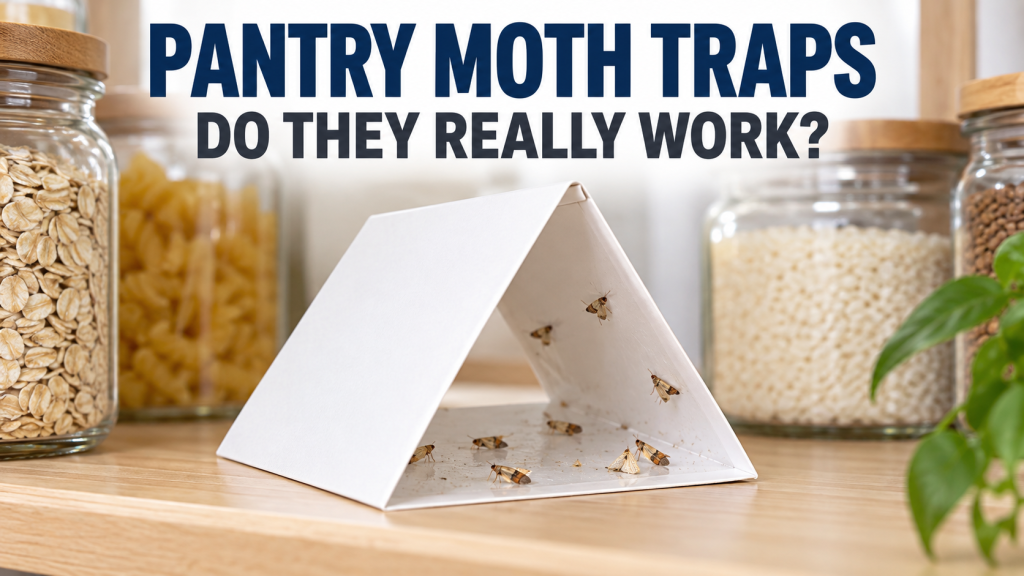
Most traps sold specifically for pantry moths combine a pheromone lure with a sticky capture surface. The lure releases a scent signal designed to attract certain adult male stored-food moths. When a moth follows the lure, it becomes stuck to the adhesive.
Common designs include folded cardboard traps, tent-style traps, enclosed traps, and sticky cards used with a separate lure.
The shape matters less than whether the lure targets the moth you want to monitor and whether the trap is intended for indoor use around food-storage areas.
What Pantry Moth Traps Can Tell You
Traps are useful for monitoring adult moth activity.
A properly selected and placed trap can help you:
- Confirm that adult moth activity is present
- See which pantry or storage area has more activity
- Monitor whether catches are declining
- Detect renewed activity
- Compare activity between separate food-storage areas
A catch does not identify the exact infested package. Moths can travel before reaching a trap, so trap results are best treated as evidence of activity in the general area.
What Pantry Moth Traps Cannot Do
Pantry moth traps do not:
- Kill larvae developing inside food
- Remove moth eggs
- Clean contaminated products
- Identify the exact infestation source
- Replace inspection of stored food
- Guarantee that an infestation is gone
This is their main limitation. A trap may reduce the number of adult males you see while larvae continue developing in an overlooked food product.
If larvae, webbing, or contaminated food are present, the underlying food source still needs to be addressed separately.
If larvae, webbing, or contaminated food are present, see how to get rid of pantry moths by finding and removing the stored-food source.
Pheromone Traps vs. General Sticky Traps
Both trap types can catch insects, but they work differently.
Pheromone traps
Pheromone traps use a lure designed to attract particular stored-food moths rather than waiting for an insect to cross the adhesive by chance.
Advantages may include:
- More targeted attraction
- Easier confirmation of pantry moth activity
- Simple visual monitoring
- Better comparison of activity over time
The main limitation is species coverage. Many pantry moth lures primarily attract males, and a lure intended for one stored-food moth should not be assumed to attract every small moth found indoors.
General sticky traps
A general sticky trap catches insects that happen to contact its adhesive. It may help show that insects are active in a cabinet or pantry, but it does not necessarily attract pantry moths specifically.
For targeted pantry moth monitoring, a pheromone trap designed for the appropriate stored-food moth is generally more informative.
How to Choose Pantry Moth Traps
The most useful pantry moth traps are those that match the pest and the area you want to monitor. Large packages and stronger marketing claims do not necessarily make a trap more suitable.
Check the pest or species coverage
Read the package to see which stored-food moths the lure is designed to attract.
Indianmeal moths are a common stored-food pest, but other moths can occur around stored products. A trap labeled only for “moths” may be intended for clothing moths or another pest.
Choose a product that clearly identifies pantry moths, stored-food moths, or the specific moth you need to monitor.
Confirm indoor-use suitability
Choose a trap intended for indoor food-storage environments.
The package should provide clear instructions for placement, handling, replacement, and precautions around kitchens or stored food.
Do not substitute a clothing-moth or outdoor-moth trap simply because it also uses adhesive.
Compare lure types
Some products incorporate the pheromone lure into the trap. Others provide a separate lure that is placed into or onto the trap during setup.
An integrated lure can simplify installation. A separate lure adds a setup step but may make the active component easier to identify and replace.
Neither design is automatically superior. Follow the instructions for the specific trap.
Consider the trap design
Folded, tent-style, or enclosed traps can shield part of the adhesive from accidental contact. Flat sticky cards may offer a large visible capture area but can be easier to brush against if poorly placed.
Choose a design that is easy to set up, inspect, and handle without repeatedly touching the adhesive.
Check replacement and coverage guidance
Pheromone lures and sticky surfaces have a limited useful life. Look for clear manufacturer directions explaining when the trap or lure should be replaced.
Also check the recommended coverage and spacing. More traps are not automatically better, especially if several pheromone traps are clustered in one small pantry.
Where to Place Pantry Moth Traps
Place traps where they can monitor moth activity without contacting food or interfering with normal pantry use.
Typical locations include:
- Inside or near an affected pantry
- Near cupboards with repeated moth sightings
- Close to stored dry-food areas
- In a separate food-storage room
- Near areas where adult moths repeatedly appear
Use a stable location away from strong drafts from fans, open windows, or heating and cooling vents unless the manufacturer says otherwise.
Keep traps away from exposed food, food-preparation surfaces, clothing, and frequently handled items. If children or pets can reach the trap, move it to a location where they cannot interfere with the adhesive or lure.
Where not to place them
Avoid placing traps:
- Directly beside uncovered food
- On food-contact surfaces
- Inside food packages
- In greasy or heavily dusty areas
- Where clothing or skin will frequently touch the adhesive
- Where children or pets can easily reach them
- In strong airflow that may interfere with monitoring
How Many Pantry Moth Traps Do You Need?
The right number depends on pantry size, the number of separate storage areas, and the manufacturer’s coverage guidance.
For one typical pantry, a single appropriately placed trap may be more informative than several traps grouped together. If moths are appearing in separate food-storage areas, additional traps can help compare activity between those locations.
Use the spacing guidance supplied with the product rather than adding traps simply to increase the catch count.
How to Read Trap Results
Trap catches are most useful when interpreted as a pattern.
A few moths are caught
One or several catches show that adult moth activity is present or was recently present in the area.
The trap does not tell you which stored product is responsible.
Moths keep being caught
Repeated catches may indicate that an infestation source remains, moths are developing elsewhere, or new adults are still emerging.
Look at whether catches are declining, staying steady, or increasing instead of focusing on one individual count.
The trap catches nothing
An empty trap does not always mean the problem is gone. Adult males may not be active at that moment, the lure may not target the species present, the trap may be poorly placed, or the lure may need replacement.
Use trap results together with what you are actually seeing in the pantry.
If moths keep being caught, return to our pantry moth control guide and reinspect stored foods, pet food, birdseed, and other overlooked sources.
How Long Should You Keep Monitoring?
Continue monitoring according to the product directions and recent moth activity.
Replace the trap or lure at the manufacturer’s recommended interval, even if unused adhesive remains visible. An old lure may no longer provide reliable monitoring.
It can make sense to continue using a trap while adult moths are still being seen or caught and during a reasonable follow-up period afterward. There is no single monitoring timeframe that fits every product or infestation.
Are Pantry Moth Traps Safe Around Food?
Pheromone pantry moth traps generally work through attraction and adhesive capture rather than spraying pesticide into the pantry. They still need to be used carefully around food.
Follow the package directions and keep traps from contacting exposed food or food-contact surfaces. Store unused traps as directed, and place active traps where children and pets cannot handle the adhesive or lure.
Do not place traps inside food packages or improvise homemade pheromone lures.
Common Pantry Moth Trap Mistakes
Avoid these common errors:
- Relying on traps instead of addressing the food source
- Buying a lure intended for the wrong moth
- Clustering too many pheromone traps together
- Leaving traps in place beyond their recommended replacement period
- Putting adhesive where dust or grease quickly coats it
- Positioning traps beside exposed food
- Assuming an empty trap proves activity has ended
- Ignoring other food-storage areas when catches continue
Most trap problems come from using the wrong lure, poor placement, expired components, or expecting a monitoring device to do more than it can.
A Simple Pantry Moth Trap Buying Checklist
Before buying, check that the product:
- Is intended for pantry or stored-food moths
- Clearly identifies the target pest or lure type
- Is suitable for indoor use
- Has a design you can handle without contacting the adhesive
- Provides clear replacement instructions
- Includes useful coverage or spacing guidance
- Fits the pantry or storage area you need to monitor
- Comes in a practical package quantity
- Can be placed safely away from children, pets, and exposed food
You do not need the most elaborate trap. You need one that targets the correct moth and provides monitoring information you can interpret.
When Pantry Moth Traps Are Not Enough
Trap monitoring should not delay source control when there are clear signs of an active pantry moth problem.
Additional source investigation is needed when larvae or webbing are visible, adult moths continue appearing, trap catches remain steady or increase, or activity occurs in more than one food-storage area.
If the source cannot be found despite repeated inspection, the insects cannot be identified confidently, or activity appears to involve inaccessible areas, a pest professional may be useful.
Final Thoughts
Pantry moth traps are most valuable as detection and monitoring tools. Choose a trap designed for the appropriate stored-food moth, check its lure type, placement requirements, coverage, and replacement instructions, and interpret catches as evidence of adult activity rather than proof of the infestation’s exact location.
Most importantly, remember what the trap cannot do. It cannot remove eggs or larvae developing inside food. If moth sightings or catches continue, the next step is to address the underlying source rather than simply adding more traps.