best appliance cleaning tools for homeowners
Appliance cleaning tools are most useful when they form a small, versatile kit rather than a collection of appliance-specific gadgets. For most homeowners, a few soft cloths, brushes, gentle scrubbers, vacuum attachments, and reach tools can handle routine cleaning without scratching finishes or encouraging unnecessary appliance disassembly.
The best tools are reusable, easy to control, simple to clean after use, and appropriate for the surface being cleaned. They should help remove lint, dust, grease, food residue, and buildup—not turn routine cleaning into electrical, gas, refrigerant, or mechanical repair work.
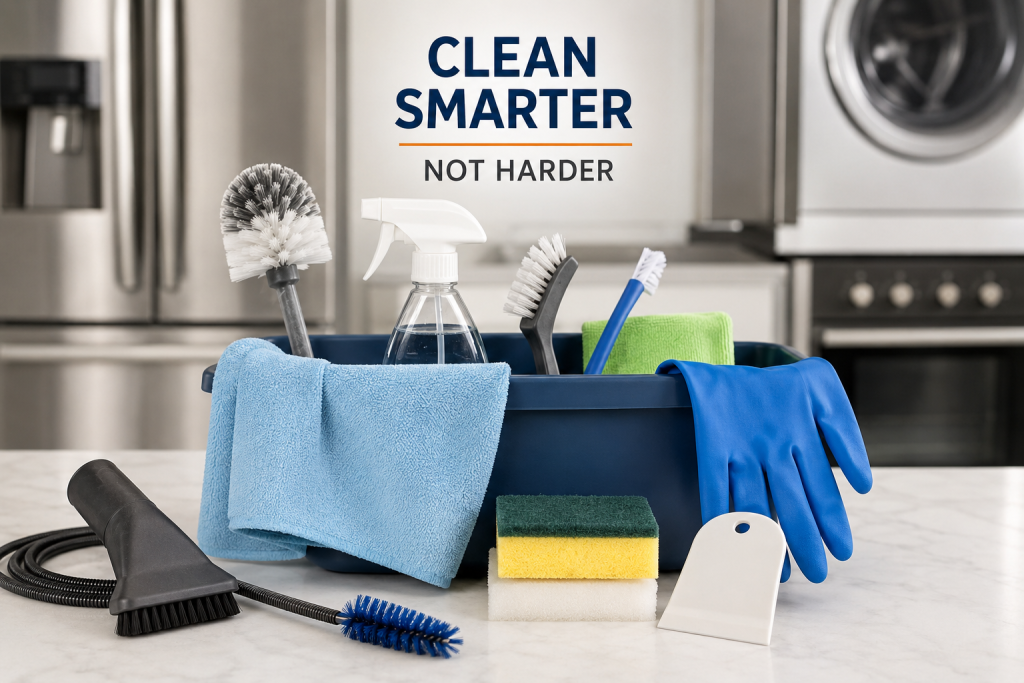
Best Appliance Cleaning Tools at a Glance
You may already own several of the most useful tools. Start with versatile supplies and add specialized equipment only when you have a recurring job that requires it.
| Tool Type | Best For | Useful On | Buying Priority |
|---|---|---|---|
| Microfiber cloths | Wiping, drying, light polishing | Exteriors, interiors, handles | Essential |
| Soft nylon brush | Gentle scrubbing | Filters, gaskets, dispensers | Essential |
| Narrow detail brush | Tight spaces | Seams, corners, gasket folds | Very Useful |
| Non-scratch pad or sponge | Stubborn residue | Compatible interior and cooking surfaces | Very Useful |
| Bottle or tube brush | Narrow accessible areas | Dispensers, removable parts | Situational |
| Vacuum with crevice attachment | Dry lint and dust | Dryer areas, gaps, surrounding floors | Very Useful |
| Flexible appliance brush | Extended reach | Beneath appliances, vents, lint areas | Situational |
| Plastic scraper | Dried-on residue | Compatible smooth surfaces | Situational |
| Spray bottle | Controlled cleaner application | General surface cleaning | Optional |
| Cleaning caddy | Storage and organization | Whole cleaning kit | Optional |
| Cleaning gloves | Messy routine cleaning | Grease, residue, dirty filters | Very Useful |
Buying priority should reflect how often you will actually use a tool. An inexpensive specialty brush can still be unnecessary if an ordinary soft brush already handles the same jobs.
What Makes a Good Appliance Cleaning Tool?
A good appliance cleaning tool removes buildup without creating a new problem. More aggressive scrubbing is not automatically more effective, especially on appliances that combine stainless steel, glass, plastic, rubber, paint, enamel, and specialty coatings.
Consider these factors before buying:
- Non-abrasive materials: Choose the gentlest material that can handle the job.
- Correct stiffness: A brush should be firm enough to remove debris without damaging seals, finishes, or soft plastic.
- Reach: The tool should fit narrow spaces without being forced into openings.
- Cleanability: Brushes, pads, and cloths should be washable or inexpensive to replace when worn.
- Grip: A comfortable handle improves control around corners and delicate surfaces.
- Moisture resistance: Tools used around wet appliance interiors should tolerate ordinary cleaning moisture.
- Storage: Compact tools are easier to keep organized and accessible.
- Surface compatibility: Check whether the material is suitable for the finish you intend to clean.
- Simplicity: Extra attachments and complicated mechanisms are rarely helpful unless they solve a specific recurring problem.
Manufacturer instructions take priority when an appliance has a specialty finish or requires a particular cleaning method.
Microfiber Cloths
Microfiber cloths are among the most versatile appliance cleaning tools because they can handle dust, fingerprints, spills, light grease, and cleaner residue on many common surfaces.
Typical uses include:
- Stainless steel appliance fronts
- Painted exteriors
- Refrigerator interiors
- Handles
- Dishwasher fronts
- Washer and dryer cabinets
- Accessible control areas
Soft cloth quality matters. A cloth that has picked up grit, crumbs, or hardened residue can scratch a glossy or polished surface even if the cloth itself is normally gentle.
It can help to keep separate cloths for different jobs. For example, use one group for greasy oven and range surfaces and another for refrigerator interiors and general wiping. This reduces the chance of transferring grease or abrasive debris between appliances.
Microfiber is not automatically compatible with every finish. Fingerprint-resistant coatings and specialty decorative surfaces may have specific cleaning requirements, so check the appliance instructions when you are unsure.
Soft Nylon Cleaning Brushes
A soft nylon cleaning brush provides more scrubbing action than a cloth while remaining easier to control than aggressive abrasive tools.
Useful cleaning areas can include:
- Door gasket folds
- Textured surfaces
- Removable dishwasher filters
- Detergent dispensers
- Refrigerator shelf tracks
- Appliance seams
- Accessible dishwasher surfaces
Choose brush stiffness carefully. A brush that works well on a durable removable filter may be too stiff for a refrigerator gasket or glossy plastic surface.
For routine appliance cleaning, metal-bristle brushes are generally unnecessary. They can scratch finishes and damage softer materials unless the appliance manufacturer specifically permits their use on a particular removable component.
Detail Brushes for Tight Spaces
A narrow detail brush is useful when a normal cleaning brush cannot reach the area without bending, forcing, or scraping surrounding surfaces.
Common uses include:
- Narrow seams
- Gasket folds
- Refrigerator corners
- Detergent dispenser edges
- Shelf tracks
- Small accessible vents
- Other reachable crevices
Choose a brush that naturally fits the space.
Do not push a detail brush through control openings, wiring passages, electrical compartments, sealed cavities, or service-only access points. Cleaning should stay within areas intended for normal homeowner access.
Non-Scratch Scrub Pads and Sponges
Some dried food, grease, or residue needs more friction than a microfiber cloth can provide. A gentle sponge or non-scratch scrub pad can be useful when the appliance surface allows it.
Abrasive pads can damage:
- Stainless steel
- Glass
- Enamel
- Plastic
- Painted surfaces
- Polished finishes
- Specialty coatings
Do not assume that a product labeled “non-scratch” is suitable for every appliance. The appliance manufacturer’s surface instructions still matter.
When trying an unfamiliar tool, use light pressure and test conservatively on an inconspicuous compatible area when practical. Steel wool should not be treated as a general appliance-cleaning tool.
Vacuum and Crevice Attachments
A normal household vacuum with a crevice or soft brush attachment can perform many dry appliance-cleaning jobs without requiring a separate specialty machine.
It can help remove:
- Accessible dryer lint
- Dust around ventilation areas
- Debris beside appliances
- Dust around refrigerator surroundings
- Lint around laundry equipment
- Dirt on floors beneath accessible appliance edges
Keep the cleaning boundary clear. Do not remove service panels simply to reach more dust, and do not vacuum energized internal electrical components.
Moving a large appliance also requires judgment. Refrigerators, ranges, washers, and dryers may have electrical cords, water lines, gas connections, drain hoses, or vent ducts behind them. Some manufacturers specify procedures for moving the appliance.
If the appliance is too heavy or its connections cannot be safely managed, do not move it merely to clean behind it.
Flexible Appliance Cleaning Brushes
Long or flexible appliance brushes are useful when lint or dust sits beyond the reach of a standard hand brush.
Depending on the appliance design, they may help clean:
- Beneath appliance edges
- Behind safely accessible appliances
- Some refrigerator ventilation areas
- Accessible dryer lint locations
- Certain reachable portions of a dryer vent system
A flexible brush should extend your reach, not encourage blind probing.
Do not push one into electrical compartments, gas components, sealed refrigeration cavities, or openings where the brush could catch wiring or become stuck.
Dryer vent systems may sometimes need dedicated cleaning equipment based on their routing and accessibility. That is a more specific tool decision than choosing a general flexible appliance brush.
Plastic Scrapers
A plastic scraper can help remove dried food and hardened residue while reducing the risk that comes with using a sharp metal edge on a delicate surface.
Possible uses include:
- Dried residue on compatible appliance surfaces
- Removable refrigerator shelves
- Hardened food spills
- Some smooth cooking surfaces when manufacturer-approved
Use light pressure. If the scraper begins marking the surface or requires substantial force, stop.
Glass cooktops require particular attention to manufacturer instructions. Some models permit specific scraper types and techniques, while other surfaces or coatings can be damaged by inappropriate scraping.
Do not assume that one scraper is compatible with every cooktop.
Spray Bottles and Controlled Cleaner Application
A reusable spray bottle can be convenient for suitable cleaners, but controlled application is often more important than the bottle itself.
Applying cleaner to a cloth instead of spraying the appliance directly can help keep excess liquid away from:
- Control panels
- Electrical openings
- Ventilation slots
- Switches
- Seams
- Other sensitive openings
Clearly label reusable bottles so there is no confusion about what they contain. Keep appliance-cleaning products separate from bottles used for food or other purposes when appropriate.
Use cleaners intended for the material being cleaned, and never mix household chemicals in an attempt to make a stronger cleaner.
Where food-contact surfaces are involved, follow the cleaning and rinsing instructions for both the appliance and the cleaning product.
Protective Gloves and Simple Cleaning Supplies
Reusable household cleaning gloves can make messy appliance jobs more comfortable.
They may be useful when handling:
- Greasy residue
- Dirty removable filters
- Detergent buildup
- Messy disposal splash guards
- Ordinary household cleaners
Gloves are a cleaning aid, not safety equipment for appliance repair. They do not make electrical components, gas systems, moving machinery, refrigerants, or hazardous chemicals safe to handle.
Appliance Cleaning Tools by Appliance
Most appliances do not require an entirely separate tool kit. The same basic supplies can usually be matched to different surfaces and cleaning jobs.
Refrigerator and Freezer
A practical refrigerator and freezer kit can include:
- Microfiber cloth
- Soft nylon brush
- Narrow detail brush
- Vacuum attachment where safely accessible
- Small plastic scraper for compatible removable surfaces
These tools can handle shelves, drawers, tracks, gaskets, accessible vents, and surrounding dust.
Some refrigerators include ventilation or condenser areas intended for homeowner cleaning, while others do not. Follow the appliance instructions and do not remove service-only panels or attempt to access sealed refrigeration components.
Dishwasher
Useful dishwasher tools include:
- Microfiber cloth
- Soft nylon brush
- Narrow detail brush
- Bottle-style brush where appropriate
- Non-scratch sponge
- Cleaning gloves if desired
Focus on areas intended for routine homeowner maintenance, such as removable filters, door edges, gaskets, accessible spray-arm openings, dispensers, and interior surfaces.
If cleaning would require pump access, wiring work, or significant internal disassembly, the job has moved beyond ordinary maintenance.
Washing Machine
A washer cleaning kit may include:
- Microfiber cloths
- Soft gasket or detail brush
- Soft nylon brush
- Bottle-style brush for accessible dispenser areas
- Cleaning gloves
These tools are useful for exterior surfaces, detergent dispensers, front-load gasket folds, and other accessible cleaning areas.
Routine cleaning does not require pump-service tools, electrical testers, valve tools, or equipment intended for internal repair.
Dryer
Useful dryer cleaning tools include:
- Vacuum crevice attachment
- Flexible lint brush
- Microfiber cloth
- Appropriate vent-cleaning equipment when suited to the vent system
A vacuum attachment and lint brush are useful for accessible lint around the lint-screen area and other manufacturer-approved locations.
A complete dryer vent may require dedicated tools depending on its length, routing, duct construction, and accessibility. Avoid treating a general appliance cleaning kit as a complete dryer vent cleaning system.
If the dryer produces an active burning smell or obvious overheating, stop using it. Do not run another test load while the condition remains.
For homeowners who also maintain an accessible dryer exhaust system, a dryer vent cleaning kit can reach lint that ordinary appliance brushes and vacuum attachments cannot.
Oven and Range
Useful oven and range cleaning supplies may include:
- Microfiber cloths
- Non-scratch pads
- Soft brushes
- Plastic scraper where compatible
- Cleaning gloves
One cooking appliance can contain glass, enamel, stainless steel, painted surfaces, burner components, and specialty coatings. Match the cleaning tool to the individual material rather than assuming one scrubber can be used everywhere.
For gas appliances, limit cleaning to normal accessible surfaces and removable parts the manufacturer identifies for homeowner cleaning.
If you smell gas, stop using the appliance. Avoid ignition sources and do not attempt to clean, adjust, or repair internal gas components.
Garbage Disposal and Sink Area
Useful tools include:
- Long-handled brush for accessible splash-guard cleaning
- Microfiber cloth
- Soft scrub brush
- Cleaning gloves for accessible sink surfaces
Never put your hand inside the garbage disposal chamber.
If an inspection requires access to the chamber or underside of the disposal, power must be safely disconnected first. Unplug it only when the plug and surrounding area are dry and safely accessible. If you cannot confidently isolate power, stop rather than reaching into or beneath the unit.
If you find water beneath the sink while cleaning, first determine whether you have a garbage disposal leaking from bottom areas or a leak from one of the surrounding plumbing connections.
What Should Be in a Basic Appliance Cleaning Kit?
A practical home appliance cleaning kit can remain compact.
For most homeowners, a useful starter set includes:
- Several microfiber cloths
- One soft nylon brush
- One narrow detail brush
- One non-scratch sponge or pad
- A vacuum crevice attachment
- One flexible cleaning brush
- A small plastic scraper
- A labeled spray bottle if needed
- Reusable cleaning gloves
- A small caddy or storage bin
Before buying anything, check your existing household cleaning supplies. You may already own appropriate cloths, brushes, sponges, gloves, and vacuum attachments.
Add tools when a recurring cleaning task gives you a reason to own them. Buying duplicate brushes or specialty gadgets that perform the same job does not make the kit more useful.
Appliance Cleaning Tools You Probably Do Not Need
A larger collection is not automatically a better one. Some tools are unnecessary for normal cleaning, while others belong to repair work rather than homeowner maintenance.
Beginner homeowners generally do not need:
- Large appliance repair tool kits
- Electrical testing equipment purchased solely for cleaning
- Refrigerant service tools
- Compressor-service equipment
- Gas-system repair tools
- Aggressive wire brushes
- Abrasive polishing equipment for ordinary appliance finishes
- Oversized steam equipment when the appliance does not permit steam cleaning
- Highly specialized gadgets with no recurring household use
Specialized cleaning equipment can make sense when you have a legitimate, compatible job that occurs often enough to justify it. The goal is not to avoid specialty tools entirely but to buy them for a specific need rather than because they carry an appliance-related label.
Cleaning Tools vs. Appliance Repair Tools
Cleaning tools remove dirt and buildup from surfaces and components intended for routine homeowner access.
They can help you:
- Remove lint
- Remove food residue
- Clean accessible filters
- Wipe seals
- Remove surface buildup
- Reach accessible crevices
- Maintain accessible ventilation areas
Repair tools serve a different purpose.
Routine cleaning does not require homeowners to buy equipment for:
- Live electrical troubleshooting
- Energized internal testing
- Refrigerant handling
- Compressor work
- Gas-line repair
- Internal gas-valve work
- Bypassing appliance interlocks
- Defeating safety switches
- Major appliance disassembly
If a supposed cleaning job requires those tools, stop. The work has crossed into repair or professional service.
Common Appliance Cleaning Tool Buying Mistakes
A poor tool choice can waste money or damage the surface you were trying to clean.
Common mistakes include:
- Buying pads or brushes that are too abrasive
- Assuming one brush stiffness works everywhere
- Purchasing specialty gadgets before trying ordinary household tools
- Ignoring specialty coatings and surface compatibility
- Using oversized brushes in delicate spaces
- Buying repair equipment for maintenance work
- Overlooking washable or reusable tools
- Choosing brushes or pads that are difficult to clean afterward
- Building a kit too large to store conveniently
- Using metal tools around scratch-prone finishes
Choose tools based on recurring jobs in your own home rather than trying to prepare for every possible appliance problem.
When Professional Appliance Cleaning or Service Makes More Sense
There is a point where purchasing another cleaning tool stops being useful.
Professional cleaning, diagnosis, or appliance service may make more sense when you encounter:
- Internal contamination that requires substantial disassembly
- Electrical damage
- Burned wiring
- Repeated electrical problems
- Gas odor
- Severe overheating
- Refrigerant or sealed-system problems
- Internal mechanical failures
- Dryer vent systems that cannot be safely accessed
- Appliance movement that cannot be performed safely
- Persistent performance problems after appropriate ordinary cleaning
If water is present near electrical components, stop appliance use and avoid wet or energized parts. Unplug the appliance only when the plug and surrounding area are dry and safely accessible.
Cleaning tools remove dirt, lint, food residue, and buildup. They do not repair failed electrical, gas, refrigeration, or mechanical components.
Appliance Cleaning Tools FAQ
What are the most useful appliance cleaning tools for homeowners?
The most useful appliance cleaning tools for most homeowners are microfiber cloths, a soft nylon brush, a narrow detail brush, a non-scratch sponge or pad, and a vacuum crevice attachment.
A flexible cleaning brush and plastic scraper can also be useful when you have compatible surfaces or hard-to-reach areas that justify them.
Do I need a special appliance cleaning kit?
Usually not. A home appliance cleaning kit can simply be a small collection of ordinary cleaning tools kept together for convenience.
Start with supplies you already own and add specialized items only when a recurring appliance-cleaning task cannot be handled effectively with your existing tools.
Can I use the same brush on every appliance?
No. Brush stiffness, size, shape, and cleanliness all matter.
A brush that works well on a removable dishwasher filter may be too stiff for a refrigerator gasket. A brush used around greasy cooking surfaces may also be a poor choice for a clean refrigerator interior.
Match the brush to the surface and the type of residue.
Are steam cleaners safe for appliances?
Do not assume they are. Steam introduces both heat and moisture, which may be inappropriate around electrical controls, coatings, seals, adhesives, and other appliance components.
Use steam only when the appliance manufacturer permits it for the specific surface or area being cleaned.
What appliance cleaning tools should beginners avoid?
Beginners should avoid tools intended primarily for electrical diagnosis, refrigerant work, gas-system repair, safety-interlock bypassing, or major internal disassembly when the goal is routine cleaning.
Aggressive abrasives, wire brushes, and metal scraping tools also deserve caution around appliance finishes. Start with gentle, controllable tools and move to specialized equipment only when the task and appliance instructions support it.
Final Thoughts
A useful set of appliance cleaning tools should be small, reusable, easy to control, and matched to the surfaces you actually maintain. Start with microfiber cloths, soft brushes, gentle scrubbers, and the vacuum attachments you already own, then add specialty tools only when a recurring cleaning job creates a real need.
Choose the least aggressive tool that gets the job done, respect material-specific cleaning instructions, and keep cleaning separate from repair. When a task requires hazardous-system access, energized work, major disassembly, or specialized diagnosis, purchasing another cleaning tool is not the solution.