
attic insulation types: fiberglass, cellulose, spray foam, and more
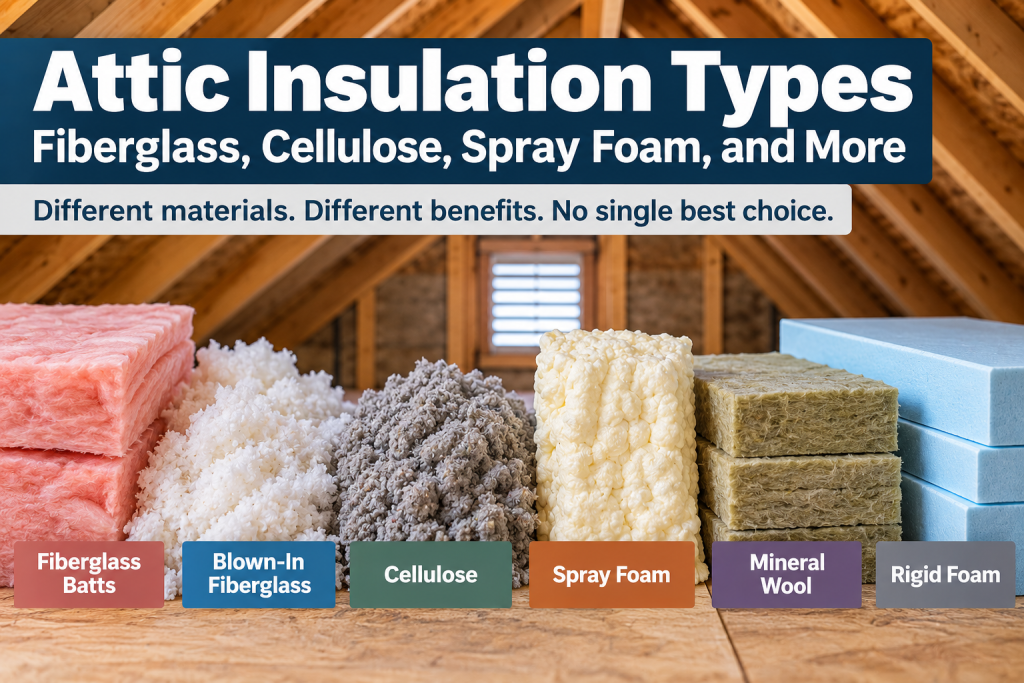
The main attic insulation types include fiberglass batts, blown-in fiberglass, cellulose, spray foam, mineral wool, and rigid foam used in specialized assemblies. Each differs in form, installation method, typical location, and practical limitations. No single material is best for every attic, and good installation matters as much as the insulation material itself.
Before inspecting existing insulation, use a stable access point and avoid stepping on ceiling drywall or balancing on exposed joists. Do not work around damaged or energized wiring or disturb unfamiliar materials.
| Insulation type | Form | Common attic use | Main strength | Main limitation |
|---|---|---|---|---|
| Fiberglass batts | Preformed blankets | Regular attic-floor framing | Simple and accessible | Gaps and compression reduce performance |
| Blown-in fiberglass | Loose fibers | Broad or irregular attic floors | Covers around obstructions | Needs even installed depth |
| Cellulose | Loose-fill fibers | Attic floors and top-ups | Conforms well to irregular areas | Can settle and must stay dry |
| Spray foam | Expanding foam | Roof decks and specialized assemblies | Insulates and air seals | Requires professional planning |
| Mineral wool | Batts or boards | Framing and specialized details | Dense with strong fire characteristics | Less common and generally costlier |
| Rigid foam | Solid boards | Specialized roof and enclosure details | Provides continuous insulation | Not a typical open-attic-floor material |
Fiberglass Batt Insulation
Fiberglass batts are blanket-like sections made from glass fibers and sized to fit common framing spaces.
They are often used between framing members at the attic floor, especially where the layout is simple and accessible. Their main advantage is straightforward handling without blowing equipment, and individual sections can be moved later for access.
Their main limitation is fit. Gaps around framing, pipes, wires, or other obstructions can reduce effectiveness, while compressing batts into spaces that are too small can also hurt performance.
Fiberglass batts are relatively homeowner-friendly in uncomplicated attics, but they become less practical where framing is irregular, or access is difficult.
Blown-In Fiberglass
Blown-in fiberglass consists of loose glass fibers installed with blowing equipment.
It is commonly used across open attic floors, around irregular framing, and when adding insulation over an existing layer. Because the material spreads rather than fitting into fixed sections, it can provide continuous coverage around many obstructions.
Its main limitation is the need for reasonably uniform installed depth. In vented attics, loose material also needs to stay clear of intended soffit ventilation paths.
Homeowners can sometimes install blown fiberglass with rented equipment, but equipment handling and difficult attic conditions often make professional installation more practical.
Cellulose Insulation
Cellulose is a loose-fill insulation made primarily from processed fiber and treated for characteristics that include fire resistance.
It is commonly blown across attic floors and can conform well around framing and obstructions. It is also frequently used to add insulation over an existing layer when conditions are suitable.
Cellulose can settle, so installed depth should be evaluated in its intended settled condition. It also needs to remain dry, making active roof leaks or recurring moisture problems important to correct first.
Installation can be dusty. It may be suitable for homeowner installation in a straightforward attic, but professional installation is often practical when access or existing conditions are more complicated.
Spray Foam Insulation
Spray polyurethane foam is applied as a liquid that expands and cures into a foam layer. It can provide both insulation and air sealing.
Open-cell and closed-cell products differ, but the larger attic question is where the foam is installed. Spray foam is often used along the roof deck in conditioned or unvented attic assemblies rather than simply being added to an attic floor.
That changes the attic strategy. Moisture behavior, ventilation, roof sheathing, fire-safety requirements, HVAC conditions, and future roof inspection or repair may all be affected.
Spray foam should therefore be treated as a professional-scope material. It is not automatically a better substitute for fiberglass or cellulose simply because it provides both insulation and air control.
Mineral Wool
Mineral wool is a dense fibrous insulation commonly sold as batts or boards.
It can be used in framing cavities and specialized attic assemblies. Its density helps it hold its shape, and it has strong fire-resistant characteristics. It can also provide useful sound control.
Mineral wool is generally less common than fiberglass or cellulose for covering large open attic floors and typically carries a higher material cost.
It can be homeowner-installed in appropriate, safely accessible applications, but its use is often more specialized.
Rigid Foam and Specialized Options
Rigid foam comes as solid boards rather than loose fibers or flexible blankets.
In attics, it is most often used where continuous insulation is needed in specialized roof, knee-wall, hatch, or enclosure details. It is not usually the default material for covering a conventional open attic floor.
Different foam-board products have different thermal and moisture characteristics, so rigid foam should be considered as part of the complete assembly rather than as an interchangeable insulation layer.
Less-common materials, including natural-fiber products and structural insulated roof systems, may also appear in specialized construction but are not typical retrofit choices for an unfinished attic.
Batt vs. Loose-Fill Insulation
Batt insulation comes in preformed sections designed to fit defined framing spaces. Loose-fill insulation consists of fibers distributed across the attic with blowing equipment.
Batts can work well where framing is regular and accessible. Loose-fill can spread more easily through irregular areas and around obstructions.
Neither is universally better. Batts can perform poorly when they are cut or fitted badly, while loose-fill insulation can leave weak areas when installed unevenly. Installation quality matters in both cases.
If you are deciding between the two most common loose-fill and batt materials, our cellulose vs. fiberglass insulation comparison breaks down the practical differences.
Attic-Floor vs. Roof-Deck Insulation
In a conventional vented attic, insulation is usually installed at the attic floor. The conditioned rooms remain below the insulation while the attic above stays outside the conditioned space.
Fiberglass batts, blown fiberglass, and cellulose are commonly used in this arrangement.
Some homes instead have insulation along the roof deck as part of a conditioned or unvented attic assembly. Spray foam and rigid insulation are more commonly associated with these designs.
Moving the thermal boundary from the attic floor to the roof deck changes how the attic handles air, moisture, and ventilation. It should be treated as a building-assembly decision rather than simply a change of insulation material.
How to Identify Existing Attic Insulation
Visual appearance can help narrow down the material, but color alone does not prove what type of insulation you have.
Fiberglass batts
Look for blanket-like sections fitted between framing. They may be pink, yellow, white, or another color, and some have kraft paper or other facing.
Loose fiberglass
Loose fiberglass generally looks light, fluffy, and fibrous. It forms a continuous layer rather than distinct blankets.
Cellulose
Cellulose commonly looks gray or gray-brown and has a denser, shredded-paper-like or fibrous texture.
Spray foam
Spray foam forms a rigid or semi-rigid layer adhered directly to framing or another surface, often the underside of roof sheathing.
Mineral wool
Mineral-wool batts are dense and fibrous. They may appear gray, greenish, brown, or another color depending on the product.
Rigid foam
Rigid insulation appears as solid boards, sometimes with foil or another facing.
Do not dig through or pull apart unfamiliar insulation simply to identify it. If material identification affects a renovation or removal decision and you are uncertain what is present, professional evaluation is safer than guessing.
A Special Caution About Vermiculite
Vermiculite is different from the main modern attic insulation materials described above. Attic vermiculite typically has a loose, pebble-like or granular appearance.
Some vermiculite insulation historically used in U.S. homes was contaminated with asbestos. If vermiculite is present or suspected, do not disturb it, dig through it, vacuum it, or remove it as part of ordinary DIY insulation work.
Leave the material in place and obtain appropriate professional evaluation before any project that could disturb it.
This does not mean all older attic insulation contains asbestos. The concern applies specifically to materials that are known or suspected to present that hazard.
Which Attic Insulation Types Usually Require Professional Installation?
Fiberglass batts are among the more approachable options in a simple attic with regular framing and safe access. Blown fiberglass and cellulose can also be homeowner projects in some situations, although blowing equipment adds complexity.
Spray foam should normally be professionally installed because it can affect the attic’s air, moisture, ventilation, and roof-deck strategy.
Professional evaluation is also appropriate when the attic contains suspected vermiculite or other asbestos-containing material, mold, significant contamination, damaged wiring, uncertain clearances around heat-producing components, major moisture problems, or areas that cannot be reached safely.
For help comparing these materials by attic layout, climate, installation method, and budget, see our guide to choosing the best attic insulation.
Frequently Asked Questions
What is the most common type of attic insulation?
Fiberglass and cellulose are both widely used in residential attics. Fiberglass appears as either batts or loose fill, while cellulose is generally installed as loose fill.
Can different attic insulation types be combined?
Often, yes. Compatible materials can sometimes be layered in the same attic assembly as long as the existing insulation is dry and serviceable and the new work does not create compression, moisture, clearance, or ventilation problems.
Is spray foam better than fiberglass?
Not universally. Spray foam and fiberglass are often used in different types of attic assemblies. Spray foam can provide insulation and air control, while fiberglass is common in conventional attic-floor applications.
What does cellulose insulation look like?
Cellulose generally looks gray or gray-brown with a loose, dense, shredded-paper-like texture. Appearance varies, so color alone should not be used for identification.
Final Thoughts
Understanding the main attic insulation types starts with recognizing their forms and typical uses. Fiberglass batts fit defined framing spaces, blown fiberglass and cellulose cover broad attic floors, mineral wool serves standard and specialized cavities, and rigid foam belongs mainly in specific enclosure details.
Spray foam occupies a different role because roof-deck applications can change the attic’s thermal and air boundaries. Whatever the material, good performance depends on correct placement, continuous coverage, appropriate moisture control, and an attic assembly designed to work as a whole.