
cellulose vs. fiberglass insulation: which is better for an attic?
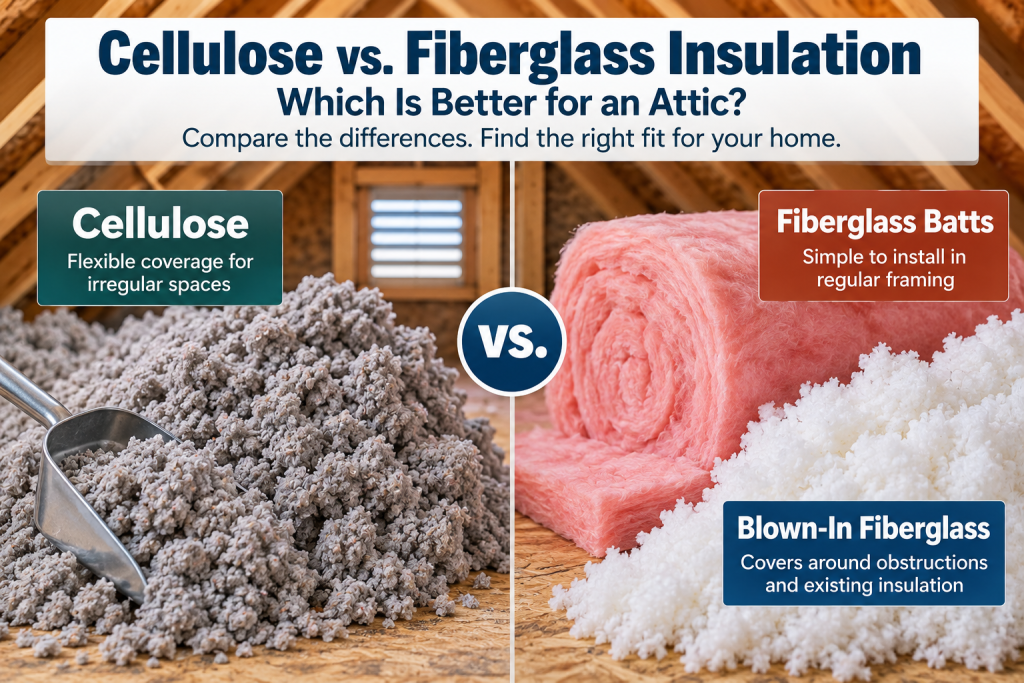
Neither material is universally better in the cellulose vs fiberglass insulation comparison. Cellulose often conforms well around irregular framing and works well for attic top-ups. Fiberglass comes as batts or loose fill, giving homeowners different installation and access options. The better choice depends on attic layout, existing insulation, moisture conditions, target R-value, installation method, safe access, and budget.
Before adding either material, correct active leaks, significant contamination, unsafe wiring, and other problems that should not be buried. If you see pebble-like vermiculite insulation, do not disturb or cover it until it has been professionally evaluated.
| Factor | Cellulose | Fiberglass Batts | Blown-In Fiberglass |
|---|---|---|---|
| Form | Loose fill | Preformed blankets | Loose fill |
| Best fit | Irregular floors, top-ups | Regular framing bays | Irregular floors, top-ups |
| Around obstructions | Conforms readily | Requires careful fitting | Conforms readily |
| Settling/compression | Settles after installation | Can be compressed | Can be displaced |
| Moisture | Significant wetting can damage it | Fibers resist water absorption, but wet assemblies remain a problem | Same general moisture concern as fiberglass batts |
| Installation | Blowing equipment | Hand-fitted | Blowing equipment |
| Future access | Must be moved aside | Individual batts can be lifted | Must be moved aside |
| Relative cost | Often economical | Often economical | Low to moderate, depending on labor and equipment |
Cellulose vs Fiberglass Insulation: The Main Differences
Cellulose used in attics is generally loose-fill insulation made primarily from processed paper fiber and treated for fire resistance. It is blown across the attic floor and readily fills around framing and other irregularities.
Fiberglass comes in two forms that behave differently.
Fiberglass batts are blanket-like sections sized for standard framing bays. They work best where spaces are regular and accessible.
Blown-in fiberglass consists of loose fibers distributed with blowing equipment. Its coverage characteristics are closer to cellulose than to batts, especially in irregular or already-insulated attics.
That three-way distinction matters because the form of the insulation often affects attic performance and practicality as much as the base material.
How Cellulose Performs in an Attic
Cellulose is common in retrofit attics because its loose fibers spread around framing, wiring, and other obstructions. It is also practical for adding insulation over a suitable existing layer.
Its main strength is continuous coverage across complicated attic floors. Unlike batts, it does not require individually fitted pieces around every obstacle.
Cellulose settles after installation. That is expected, and product coverage instructions account for the intended settled depth. Normal settling does not mean the material has failed.
Significant moisture is a more serious concern. Cellulose should not be installed over an active leak or recurring dampness, and wet or badly damaged material may need correction before a top-up.
Installation can also produce substantial dust. Homeowner installation is possible in some simple attics, but blowing equipment and difficult access can make professional installation more practical.
Fiberglass Batts: Strengths and Limitations
Fiberglass batts are preformed sections designed to fit between framing members.
They work well in open attics with regular joist spacing and few obstructions. They require little specialized equipment, are easy to inspect visually, and individual sections can often be lifted later when access to wiring or framing is needed.
Their main weakness is fit. Pipes, wires, blocking, unusual framing, and other obstacles can create gaps when batts are not carefully positioned.
Compression also matters. A batt forced into a cavity smaller than its intended thickness may provide less thermal resistance than expected.
For a simple, accessible attic, fiberglass batts are among the more homeowner-friendly insulation options. Their advantages diminish when the attic floor is highly irregular.
Blown-In Fiberglass: A Different Fiberglass Option
Blown-in fiberglass uses loose glass fibers installed across the attic with blowing equipment.
Like cellulose, it can cover irregular framing, surround many obstructions, and work well for top-up projects. This makes it substantially different from fiberglass batts.
The main installation requirement is consistent depth. Shallow areas reduce the effectiveness of the insulation layer, and material near the eaves should not block soffit vents or intended ventilation channels.
Blown fiberglass can also be displaced when someone later works in the attic. Any disturbed areas should be redistributed to restore coverage.
Homeowner installation can be practical in straightforward attics, although equipment handling, attic size, and difficult access often favor professional work.
Thermal Performance: R-Value Is Only Part of the Choice
Both cellulose and fiberglass can insulate an attic effectively when installed to an appropriate R-value.
Cellulose often provides somewhat higher nominal R-value per inch than many loose-fiberglass products. That can be useful where available depth is limited, but it should not decide the comparison by itself.
Actual attic performance depends heavily on:
- installed depth
- even coverage
- batt compression
- gaps around framing
- settling or displacement
- air leakage through the ceiling plane
- moisture and material condition
A small difference in R-value per inch matters less if one installation leaves large gaps or shallow areas. Determine the attic’s overall insulation target first, then follow the specifications for the material being installed.
If you want to compare how these materials translate into overall attic performance, see our attic insulation R-value guide.
Moisture, Settling, and Compression
These insulation types tend to develop different problems over time.
Cellulose settles
Loose-fill cellulose normally settles after installation. Installation requirements account for that expected change, so settling alone is not evidence that the insulation needs replacement.
Fiberglass batts can be compressed
Batts do not settle across the attic floor in the same way. Their common problem is compression from poor fitting, stored materials, boards, ducts, or other objects placed on top of them.
Blown fiberglass can be displaced
Loose fiberglass needs reasonably uniform depth. Air movement near eaves or later attic work can move the fibers and leave shallow areas.
Neither belongs over an unresolved moisture problem
Cellulose can be significantly affected by wetting. Fiberglass fibers handle water differently, but wet framing, drywall, dust, and surrounding materials can still lead to damage and mold concerns.
With either insulation, identify and correct the moisture source before adding more.
Which Works Better for Different Attic Layouts?
The attic layout can narrow the choice quickly.
Regular open framing: Fiberglass batts can be convenient because standard framing bays are easy to fill accurately. Loose-fill materials remain possible but may offer less advantage.
Irregular framing: Cellulose and blown fiberglass usually conform more easily around pipes, wiring, blocking, and framing transitions.
Existing loose-fill insulation: Cellulose or blown fiberglass can be practical top-up options because they spread over the existing layer without requiring empty framing bays.
Low-clearance attics: Loose fill can reach awkward areas more easily than fitted batts, although limited access can also make professional installation the safer and more practical choice.
No insulation choice makes an unsafe attic suitable for DIY work.
Can You Add Cellulose or Fiberglass Over Existing Insulation?
Often, yes. Existing insulation does not automatically need removal before a top-up.
Cellulose and blown-in fiberglass can both be added over suitable existing insulation, and fiberglass batts may work in some assemblies. The new material does not necessarily have to match the old material.
Before covering the existing layer, check for:
- active leaks or recurring moisture
- mold or significant contamination
- pest waste or damage
- damaged or questionable wiring
- blocked soffit vents
- unsafe clearances around heat-producing components
- severely damaged or displaced insulation
- suspected vermiculite or another hazardous material
Air leakage through the ceiling plane is also worth addressing before additional insulation makes those locations harder to reach.
If vermiculite insulation is present or suspected, do not dig through it, rake it aside, vacuum it, or cover it as an ordinary DIY project. Obtain professional evaluation before any work that could disturb the material.
Fire, Pests, and Future Access
Cellulose is treated for fire resistance during manufacture, while fiberglass also has favorable fire characteristics because its fibers are made from glass.
Neither material eliminates required clearances around flues, recessed fixtures, or other heat-producing components. Insulation should never be used to cover a clearance problem.
Pest infestations also need separate attention. Adding cellulose or fiberglass does not solve contamination or animal activity.
For future access, fiberglass batts have an advantage because individual sections can often be lifted and returned to place. Cellulose and blown fiberglass must be moved aside and redistributed afterward.
DIY Installation and Relative Cost
Fiberglass batts generally require the least specialized equipment and can suit homeowners working in a simple, safely accessible attic with regular framing.
Cellulose and blown fiberglass require blowing equipment and careful control of installed depth. Professional installation becomes more practical as attic size, difficult access, or obstructions increase.
All three options are commonly used in budget-conscious attic projects. Total cost depends on the required R-value, labor, preparation, attic conditions, removal needs, and regional pricing rather than material price alone.
The least expensive material is not necessarily the least expensive completed project if the attic makes it difficult to install properly.
When Each Option May Make More Sense
Cellulose may make more sense when the attic floor is irregular, existing insulation needs topping up, or loose-fill coverage around obstructions is useful.
Fiberglass batts may make more sense when framing is regular, access is straightforward, and being able to lift individual insulation sections later is valuable.
Blown-in fiberglass may make more sense when loose-fill coverage suits the attic but fiberglass is preferred over cellulose.
These are practical tendencies rather than universal rules. Existing conditions and installation quality can change the better choice for a particular attic.
For a broader comparison of fiberglass, cellulose, spray foam, mineral wool, and other options, see our guide to the best attic insulation.
Frequently Asked Questions
Does cellulose insulate better than fiberglass?
Cellulose often has somewhat higher nominal R-value per inch than many loose-fiberglass products, but both can perform well. Installed depth, coverage, compression, air leakage, and condition usually matter more than a modest specification difference.
Does cellulose insulation settle?
Yes. Cellulose is expected to settle after installation, and coverage instructions account for its intended settled depth. Normal settling does not mean the insulation has failed.
Can cellulose be installed over fiberglass?
Often, yes, when the existing fiberglass is dry, serviceable, and free of problems requiring repair or removal. The combined installation still needs proper coverage, ventilation, and clearances.
Is fiberglass better in a damp attic?
No insulation should be installed over an unresolved moisture problem. Fiberglass fibers react differently to water than cellulose, but wet surrounding building materials can still lead to damage and mold.
Final Thoughts
The cellulose vs fiberglass insulation decision usually comes down to attic conditions rather than one material being universally superior. Cellulose provides practical loose-fill coverage for irregular spaces and top-ups. Fiberglass batts work well in regular, accessible framing, while blown-in fiberglass provides another loose-fill option for complicated attic floors.
Choose based on layout, existing insulation, moisture conditions, target thermal performance, installation access, and total project needs. Correct leaks, contamination, unsafe conditions, and blocked ventilation before covering the attic with additional insulation.