
attic insulation R-value: how much do you need?
Attic insulation targets vary by climate, home construction, and existing insulation. In many U.S. homes, the appropriate attic insulation R-value falls somewhere in the broad R-30 to R-60 range, but there is no universal target. Use current local energy guidance, your climate, the location of the attic’s thermal boundary, and the insulation already in place before deciding how much to add.
If you inspect an attic yourself, stay at a stable access point or on properly supported flooring. Never step on ceiling drywall or balance on exposed joists. If you see pebble-like vermiculite insulation, do not dig into, rake, vacuum, or otherwise disturb it. Have it professionally evaluated before insulation work proceeds.
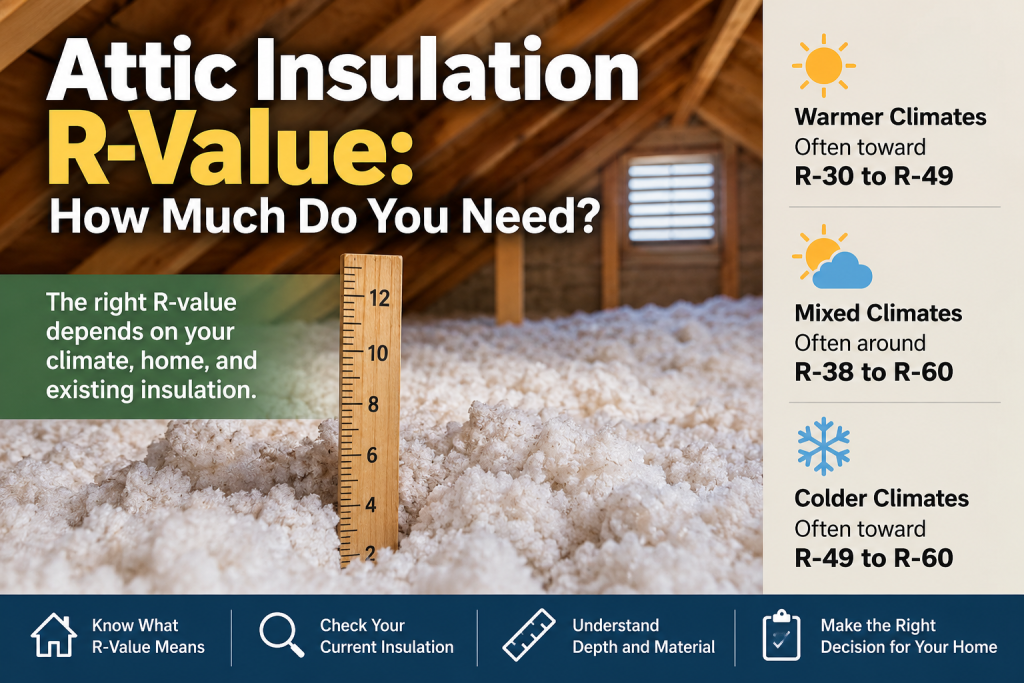
What Does Attic Insulation R Value Mean?
R-value measures how strongly insulation resists heat flow. The higher the R-value, the greater the resistance to heat moving through that insulated part of the building.
For example, an insulation layer rated R-49 provides more thermal resistance than one rated R-30 when the materials are correctly installed and the comparison applies to the same assembly.
R-values from compatible insulation layers can generally be added together. If an existing layer provides roughly R-20 and an additional layer provides R-20, the combined nominal value would be about R-40.
Actual performance also depends on installation. Gaps, severe compression, moisture, thin spots, and incomplete coverage can leave portions of the attic performing below the number suggested by the insulation label or average depth.
How Much R-Value Does an Attic Need?
For many existing U.S. homes, attic recommendations fall somewhere between roughly R-30 and R-60. Where a particular house belongs within that range depends on climate and the building itself.
A useful starting point is:
| Climate condition | General attic R-value tendency | Homeowner takeaway |
|---|---|---|
| Warmer climates | Often toward R-30 to R-49 | Do not assume the lowest value fits every home |
| Mixed climates | Often around R-38 to R-60 | Existing insulation and local guidance matter |
| Colder climates | Often toward R-49 to R-60 | Higher thermal resistance is commonly appropriate |
These are broad planning ranges, not universal code requirements.
Before choosing a target, check current guidance for your location and consider:
- your climate zone
- whether the attic is vented or conditioned
- whether insulation is at the attic floor or roof deck
- the type and condition of existing insulation
- local building or energy requirements that apply to the project
An uninsulated attic may also have a different upgrade recommendation from an attic that already contains several inches of usable insulation.
How Climate Changes the Recommended R-Value
Climate affects how much heat the attic assembly must resist over the course of the year.
In colder areas, attic insulation plays a major role in slowing winter heat loss through the ceiling and roof assembly. Higher R-values are therefore commonly recommended.
Warm climates still benefit from attic insulation because it slows heat moving from a hot attic toward conditioned rooms below. The recommended level may be lower than in a very cold climate, but that does not mean minimal insulation is automatically adequate.
Mixed climates must handle substantial heating and cooling seasons, which is one reason broad national rules can be misleading.
The attic design matters too. A conventional vented attic with insulation on the attic floor is different from a conditioned or unvented attic where insulation may be installed along the roof deck. Make sure you are evaluating the R-value for the actual thermal boundary rather than measuring insulation in the wrong part of the assembly.
How Attic Insulation Depth Relates to R-Value
There is no universal answer to how many inches of attic insulation you need because different materials provide different amounts of thermal resistance per inch.
As rough estimating values, common attic materials may provide approximately:
- Loose-fill fiberglass: around R-2.5 per inch
- Fiberglass batts: around R-3 or slightly more per inch
- Cellulose: roughly R-3.5 to R-3.7 per inch
These numbers are useful for a first estimate, not for specifying a finished installation. Product specifications, density, settling, and installation method can change the relationship between depth and R-value.
For example, 12 inches of cellulose and 12 inches of loose fiberglass should not automatically be assigned the same R-value.
Depth also needs to be reasonably consistent. An attic that averages 12 inches but contains large areas with only 5 or 6 inches will have weaker sections that an average measurement can hide.
For a broader comparison of the materials behind those R-values, see our guide to attic insulation types.
How to Estimate Your Existing Attic Insulation
A basic inspection can help determine whether more insulation deserves consideration without turning the attic into a DIY diagnostic project.
Identify the insulation when possible
Fiberglass batts usually appear as fitted blanket-like sections. Loose fiberglass commonly looks light and fibrous, while cellulose often appears gray and more densely textured.
Do not disturb an unfamiliar material merely to identify it.
Vermiculite typically has a loose, pebble-like or granular appearance. If vermiculite is present or suspected, stop the inspection rather than digging through it for a depth measurement. Not all older insulation contains asbestos, but suspected vermiculite should be treated conservatively and professionally evaluated before disturbance.
Check coverage before measuring
Look across the attic from a safe position.
Exposed joists, visibly shallow sections, large gaps, compressed batts, or loose insulation that has been pushed aside can indicate inadequate or uneven coverage.
If insulation is well above the joists and reasonably even, the attic may already contain a substantial amount, although the material and actual R-value still need to be considered.
Measure more than one location
Where the attic can be reached safely, measure insulation depth without compressing it.
One measurement near the access opening may not represent the entire attic. If conditions allow, compare several accessible areas and note significant differences.
Then use the identified material and its approximate R-value per inch—or the product information if available—to estimate the existing thermal resistance.
This is only an estimate. Poor coverage, compression, or damaged insulation can make the effective performance less uniform than the calculation suggests.
Signs You May Need More Insulation
Additional insulation may be worth considering when:
- the estimated R-value is below appropriate local guidance
- floor joists are easily visible because coverage is shallow
- insulation depth varies significantly across the attic
- previous work has left bare or thin areas
- the existing material is dry and serviceable but simply insufficient
- the attic otherwise appears suitable for a top-up
Existing insulation does not automatically need to be removed. If it is dry, clean enough to remain, and compatible with the planned upgrade, adding insulation over it can often be practical.
When Not to Add More Insulation Yet
Do not treat additional insulation as the first fix for every attic problem.
Address underlying conditions before covering them with another layer. Important examples include:
- active roof leaks or recurring attic moisture
- mold or significant contamination
- pest-contaminated insulation
- damaged or unsafe wiring
- blocked soffit vents
- major air leakage through the ceiling plane
- uncertain clearances around recessed lights, flues, or other heat-producing components
- damaged framing or other building components
These conditions can affect safety, moisture control, or the durability of the new insulation. Some require professional evaluation before work continues.
More insulation also should not be packed into a space simply to chase a higher number. Compression can reduce the expected performance of materials designed to maintain a particular thickness.
Why Air Sealing Matters Before Adding Insulation
Insulation and air sealing solve different problems.
Insulation slows heat transfer through the building assembly. Air sealing reduces uncontrolled air movement through cracks and penetrations between the living space and attic.
If substantial air leaks remain, adding insulation may leave part of the performance problem unresolved while making those openings harder to reach later.
Air sealing is therefore worth evaluating before an insulation top-up. Areas involving wiring, flues, chimneys, recessed fixtures, or other heat-producing components may require specific materials and clearances rather than ordinary sealing methods.
Ventilation also needs protection. In a vented attic, new insulation should not cover soffit vents or block the intended airflow path near the eaves.
Before adding more insulation, check the ceiling plane for leakage points with our attic air sealing guide.
How to Plan an Attic Insulation Top-Up
Start by identifying the existing material and estimating its R-value from representative, safely accessible areas.
Then compare that estimate with current guidance for your climate and home. Do not use the broad R-30-to-R-60 range as a substitute for local recommendations.
Before adding insulation, confirm that the existing layer is dry and serviceable and that moisture, contamination, air-leakage, wiring, fixture-clearance, and ventilation concerns have been addressed.
Finally, determine how much additional R-value is needed rather than starting with a universal number of inches. The required thickness depends on the material selected.
The goal is not simply to create the deepest possible insulation layer. It is to create continuous coverage at an appropriate R-value while keeping the rest of the attic assembly functional and safe.
Frequently Asked Questions
Is R-30 enough for an attic?
It can be appropriate in some warmer climates or particular existing-home applications, but it is below common recommendations for many colder locations. Check current guidance for your climate and attic rather than treating R-30 as a nationwide target.
Is R-49 enough for an attic?
R-49 falls within common attic recommendations for many U.S. homes. Whether it is the appropriate target depends on climate, existing insulation, attic design, and local requirements.
Is R-60 too much attic insulation?
Not necessarily. R-60 is commonly used toward the higher end of attic recommendations, particularly in colder climates. More insulation should still be installed appropriately without blocking ventilation, violating clearances, or creating other assembly problems.
How many inches of attic insulation do I need?
There is no single depth that works for every material. Loose fiberglass, fiberglass batts, and cellulose provide different R-values per inch, so determine the required R-value first and then use the selected product’s specifications to determine the necessary installed depth.
Final Thoughts
The right attic insulation R-value depends on climate, the home’s construction, and what is already in the attic. Broad U.S. recommendations often fall between roughly R-30 and R-60, but local guidance and the actual attic assembly should determine the final target.
Estimate existing performance by identifying the insulation, checking coverage, and measuring representative depth only where it is safe to do so. Before adding more, correct moisture, air-leakage, ventilation, contamination, and safety problems that could undermine the upgrade.