
best gutter guards for pine needles
The best gutter guards for pine needles are generally micro-mesh and very fine mesh designs. Their small openings make it difficult for most needles to pass into the gutter, although needles and fine debris can still collect on top. No gutter guard is maintenance-free, so the best choice combines effective filtration with a surface that can be inspected and cleaned safely.
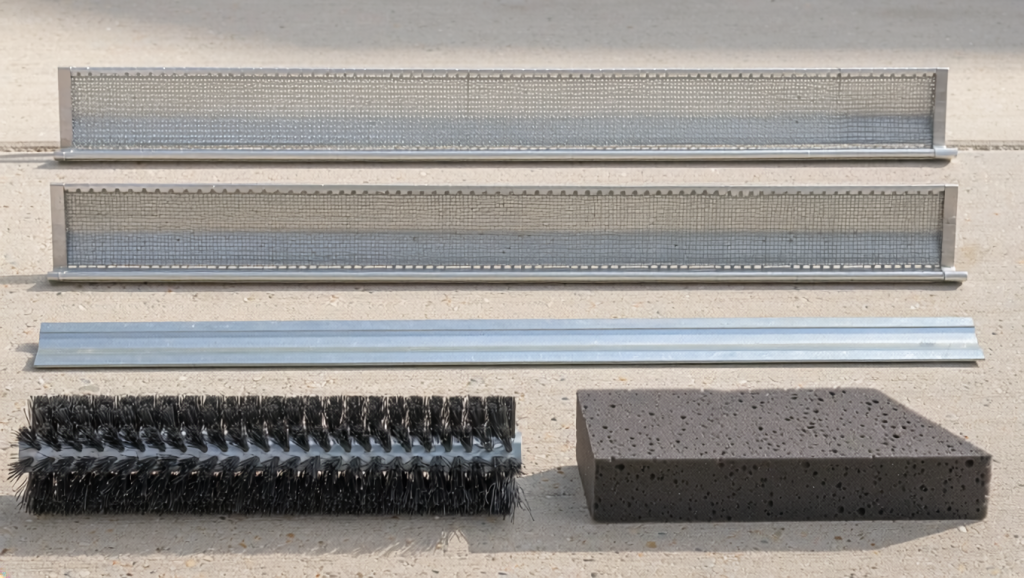
| Guard Type | Pine-Needle Performance | Main Tradeoff |
|---|---|---|
| Micro-mesh | Very strong | Fine debris can collect on the surface |
| Fine mesh | Strong when openings are small enough | Performance varies with actual mesh size |
| Standard screen | Fair to weak | Needles may pass through or lodge in openings |
| Reverse-curve | Variable | Performance depends heavily on design and installation |
| Brush | Weak to moderate | Needles can become tangled in bristles |
| Foam | Moderate initial blockage | Fine debris can become embedded |
Why Pine Needles Are Difficult for Gutter Guards
Pine needles are harder to control than broad leaves because of their shape. They are narrow, stiff, and pointed, allowing them to behave differently from larger debris.
A needle may pass lengthwise through an opening that easily stops a leaf. It can also bridge across mesh, lodge vertically in an opening, or catch at seams and edges. Once a few needles become trapped, they can create a framework that catches additional needles, seeds, roof granules, pollen, and decomposing organic material.
That means a guard can successfully prevent many needles from entering the gutter while still developing significant surface buildup.
Homeowners comparing this problem with other debris conditions can review our guide to gutter guard types for homeowners for a broader explanation of screen, mesh, reverse-curve, brush, and foam designs.
For pine-heavy properties, however, filtration is only half of the decision. The guard also needs to handle the debris that remains on top.
Best Overall Design Characteristics for Pine Needles
A strong pine-needle gutter guard usually begins with very small openings. The smaller the openings, the less opportunity needles have to pass through lengthwise or lodge deeply into the guard.
The filtering surface should also have enough rigidity to remain properly positioned. Flexible material that sags, separates, or creates gaps can allow needles to enter around the edges even if the main filtering surface is very fine.
Seams and edge gaps matter for the same reason. A system with excellent filtration across most of its surface can still perform poorly if needles repeatedly enter through openings where sections meet or where the guard connects to the gutter.
Surface shape matters too. Deep grooves, protruding edges, and abrupt transitions can create places where needles catch. A smoother surface may make it easier for dry debris to move away with wind or light runoff, although no shape guarantees that needles will clear themselves.
The best design therefore balances two goals: keeping needles out of the gutter and limiting how easily they accumulate on the guard itself.
Micro-Mesh Gutter Guards for Pine Needles
Micro-mesh is generally the strongest overall gutter guard design for heavy pine-needle exposure.
The openings are extremely small compared with standard screens, making it difficult for most needles to pass through. This can substantially reduce the number of needles reaching the gutter channel and downspout.
Micro-mesh is especially useful where several pine trees overhang the roof, where coarser guards have allowed repeated needle entry, or where pine needles are mixed with seeds and other fine vegetation.
The tradeoff is surface buildup. Needles that cannot pass through may remain on top of the mesh. Roof granules, pollen-like material, and decomposed organic matter can also collect on the fine surface.
That means micro-mesh still requires inspection and periodic cleaning. Fine filtration changes where debris accumulates; it does not eliminate the debris.
Fine Mesh Gutter Guards for Pine Needles
Fine mesh can also perform very well against pine needles, provided the actual openings are small enough.
The word “mesh” by itself does not tell you how effectively a guard will filter needles. Some mesh products have openings small enough to block most pine debris, while others are closer to ordinary screens and may allow needles to pass or lodge.
For that reason, look at the physical opening pattern rather than relying only on the product category.
Fine mesh typically sits between standard screen and micro-mesh in filtration. It may provide strong pine-needle resistance while using somewhat larger openings than very fine micro-mesh.
The important question is whether those openings are narrow enough to prevent needles from easily slipping through or becoming lodged vertically.
Standard Screen Guards
Standard gutter screens generally have larger openings intended primarily to keep broad leaves and coarse debris out of the gutter.
Those openings make them a weaker choice where pine needles are the dominant problem. Individual needles may pass through lengthwise, lodge in openings, or become caught upright.
Once several needles become trapped, they may catch additional debris and gradually form a mat on top of the screen.
Standard screens can still reduce large-leaf entry and may provide useful protection on properties with only light pine exposure. But where mature pine trees produce frequent needle loads, finer filtration is usually more effective.
Reverse-Curve Gutter Guards
Reverse-curve or surface-tension guards use a solid or mostly solid upper surface rather than a large field of mesh openings. Rainwater follows a curved edge into the gutter while larger debris is intended to continue past it.
Because there are fewer broad openings for needles to penetrate, this design can avoid some of the problems associated with coarse screens.
Pine-needle performance still depends heavily on the design of the intake edge. Needles may collect along the front opening, seams, or transitions where water enters the gutter.
Roof pitch, rainfall intensity, guard position, and installation accuracy can also influence how well the system handles water.
For that reason, reverse-curve guards should not automatically be considered either excellent or poor for pine needles. Their effectiveness depends on how well the particular design manages both debris and water at the intake edge.
Brush Gutter Guards
Brush gutter guards consist of cylindrical bristles that sit inside the gutter.
The bristles can reduce the amount of large debris settling directly into the gutter channel, but pine needles may fall between them or become tangled in the brush.
Under heavy pine coverage, that accumulation can become difficult to remove because needles may weave through the bristles rather than remaining on an exposed surface.
Brush guards therefore do not provide the same fine filtration as micro-mesh or sufficiently fine mesh.
Foam Gutter Inserts
Foam inserts fill much of the gutter opening with porous material. Water passes through the foam while leaves and needles remain closer to the top.
This can prevent pine needles from simply dropping into an open gutter, but smaller organic debris can collect on or within the foam.
Fine particles, decomposed vegetation, pollen, and roof granules may become embedded in the material. Moisture and debris retention can also make inspection and cleaning more involved.
Foam should therefore not be considered maintenance-free simply because needles cannot fall directly into the gutter channel.
What Opening Size and Surface Design Matter Most
Actual opening size matters more than marketing labels when comparing pine-needle gutter guards.
Smaller openings generally improve filtration because needles have fewer opportunities to pass through. However, finer openings also retain more small debris on the exposed surface.
That creates a balance. Very fine filtration may keep the gutter channel cleaner while increasing the need to remove material from the guard itself.
Surface geometry also affects performance. Needles can catch in deep grooves, seams, exposed edges, gaps between sections, and vertical openings.
A smoother surface with fewer obvious catch points may allow dry needles to move more easily, particularly after wind. But even a smooth guard can accumulate debris beneath heavy pine coverage.
Rather than focusing on a universal mesh measurement, compare how the actual filtering surface, seams, edges, and intake areas are designed.
How Heavy Pine Coverage Changes the Decision
The number and location of pine trees around the home can dramatically change maintenance expectations.
A house with one pine several yards away may receive occasional needle debris. A house surrounded by mature pines can receive repeated loads throughout the year.
Storms may deposit large quantities of needles in a short period. Roof valleys can concentrate those needles and direct them toward one section of gutter.
Pine trees may also contribute more than needles. Cones, seeds, pollen, small twigs, and fine organic material can mix together on the roof and guard surface.
A gutter guard that performs well under light pine exposure may require frequent attention beneath several mature trees. The heavier the debris load, the more important safe inspection and cleaning access become.
Rain, Snow, and Roof Conditions
Pine-needle filtration is important, but water still has to enter the gutter effectively.
Heavy rainfall or steep roof surfaces can send water toward the gutter at high speed. Roof valleys may concentrate that runoff into a relatively small area.
Snow and ice can temporarily cover or affect exposed guard surfaces, while roof granules can accumulate alongside needles and other fine debris.
Gutter condition also matters. A guard should not be installed over gutters that are sagging, damaged, poorly pitched, or already failing to drain correctly.
The guard position relative to the roof edge and gutter opening can further affect performance, especially with systems that rely on precise water entry.
Maintenance Expectations With Pine Trees
Pine trees often create repeated debris loads rather than one short seasonal leaf drop. Needles may fall throughout the year, and storms can increase accumulation suddenly.
Signs that a gutter guard needs attention include:
- needle mats forming on the guard surface
- water spilling over the gutter edge
- debris collecting heavily at seams or edges
- needles getting beneath the guard
- blocked gutter outlets
- guard sections shifting or sagging
Maintenance frequency depends on tree coverage, weather, roof shape, guard design, and local debris conditions.
A home beneath several mature pines may need more frequent attention than one with only occasional needle exposure, even when both use the same style of gutter guard.
Whenever possible, evaluate buildup from ground level or another safely accessible location. Do not walk on the roof or use unsafe ladder positions simply to inspect the guards.
How to Compare Guards Before Buying
Start by examining the actual filtering surface rather than the marketing description.
Look at the size and shape of openings, especially where pine needles could pass through or lodge. Examine seams and outer edges for gaps that might bypass otherwise fine filtration.
Consider surface geometry as well. Deep channels or protruding features can become catch points for needles, while smoother surfaces may be easier to clear.
Rigidity is another useful consideration. The guard should remain properly positioned instead of sagging or separating from the gutter.
Also consider how the design handles water, whether it is compatible with the existing roof and gutters, and how easy it will be to inspect or clean later.
Future maintenance access deserves as much consideration as filtration. A high-performing guard that is extremely difficult to service may not be the right choice for every home.
Common Buying Mistakes
One common mistake is choosing a gutter guard based on how well it handles leaves without considering pine needles. Narrow needles behave very differently from broad foliage.
Another is assuming that any product described as mesh provides fine enough filtration. Mesh opening size and pattern can vary substantially.
Homeowners may also assume that finer filtration means no maintenance. In reality, smaller openings can keep more material out of the gutter while leaving more debris on the guard surface.
Ignoring seam and edge gaps is another mistake. Pine needles may bypass the main filtering surface through openings elsewhere in the system.
Brush systems should not be chosen without considering how needles can tangle in the bristles. Foam inserts likewise should not be selected simply because needles cannot fall directly through them.
Fine roof granules and decomposed organic material also matter because they can accumulate with needles.
Finally, be cautious of claims that a system is maintenance-free. Any gutter protection system exposed to pine debris should remain inspectable and serviceable.
Are Gutter Guards Worth It for Pine Trees?
Gutter guards can be useful around pine trees when the design substantially reduces the amount of needle debris entering the gutter and the remaining surface maintenance is manageable.
The value depends on how heavily the property is exposed to pine debris, how often the gutters currently need cleaning, how difficult safe access is, what the system costs, and how much maintenance the guard itself requires.
A well-matched guard may reduce gutter-channel buildup without eliminating cleaning entirely. Our guide to are gutter guards worth it covers the broader cost-and-benefit decision.
When Professional Installation Makes Sense
Professional installation is appropriate when:
- gutters are high above the ground
- safe ladder access is difficult
- the roof edge is steep or complex
- overhead electrical conductors are nearby
- existing gutters need repair before guards are installed
- the system requires precise positioning
- installation would require walking on the roof
Do not walk on roofs, overreach from ladders, work from unstable positions, or work near overhead electrical conductors to install or service gutter guards.
Final Thoughts
Micro-mesh and very fine mesh are usually the strongest gutter guard design categories for pine needles because their small openings make it difficult for needles to enter the gutter.
Actual opening size and surface design matter more than labels alone. Pine needles can still collect on top of even an effective guard, especially where several mature trees create heavy debris loads.
No system eliminates maintenance. Choose a guard based on the real pine-debris conditions around the house, how well the design handles water and surface buildup, and whether future inspection and cleaning can be performed safely.