
best soft-close cabinet hinges for kitchen cabinets
The best soft close cabinet hinges are the ones that match your cabinet construction, door position, existing hinge pattern, and opening needs—not simply the hinges with the strongest damping. Before buying, identify whether your cabinets are face-frame or frameless, determine how the door sits over the opening, and confirm the existing cup, drilling pattern, and mounting arrangement.
Use those fit requirements first. Opening angle, damping adjustment, and other convenience features come after compatibility.
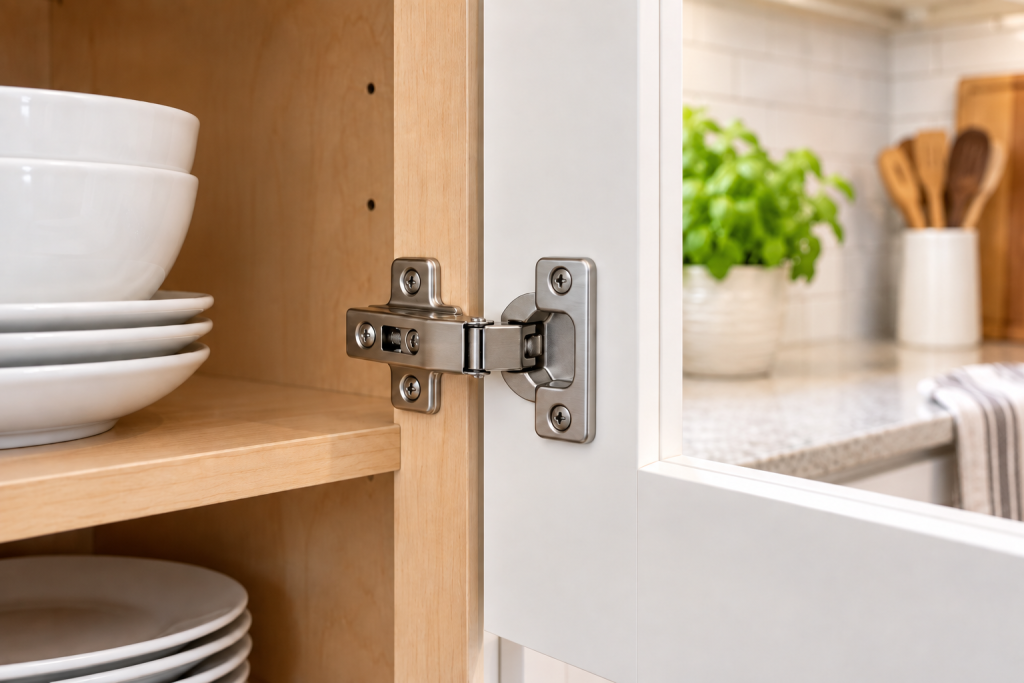
| Check before buying | Why it matters |
|---|---|
| Face-frame or frameless | Determines the required mounting arrangement |
| Full overlay, partial overlay, or inset | Affects hinge geometry and door position |
| Cup and drilling pattern | Determines whether existing door holes can be reused |
| Mounting plate | Must work with the hinge arm and cabinet |
| Opening angle | Affects access and nearby-door clearance |
| Soft-close mechanism | May be integrated or added separately |
| Door size and weight | Affects hinge model and quantity |
| Existing hinge family | Can simplify a compatible replacement |
How to Choose the Best Soft Close Cabinet Hinges
A soft-close hinge slows the final part of the cabinet door’s travel so the door closes more gently instead of slamming shut. Depending on the design, the damping mechanism may be built into the hinge or added as a separate component.
Many concealed hinges also allow normal door-position adjustments, but soft close and adjustability are separate features. A hinge can have integrated damping without offering the same adjustment range or mounting system as another hinge that looks nearly identical.
For replacement projects, start with fit. Identify what is already on the cabinet before comparing additional features.
If your current cabinet doors are crooked, rubbing, or uneven, use our cabinet hinge adjustment guide first to determine whether the existing hinges can be corrected before replacing them.
Match the Hinge to Cabinet Construction and Door Position
Kitchen cabinets commonly use either face-frame or frameless construction, and the distinction matters when selecting hinges.
A face-frame cabinet has a front frame surrounding the cabinet opening. Concealed hinges designed for these cabinets use mounting arrangements intended to attach to or work with that frame.
A frameless cabinet does not have that front frame. Concealed European-style hinges commonly connect the door to the cabinet side through a hinge-and-mounting-plate system.
Manufacturers may offer versions or adapters for multiple cabinet styles, but that does not make every hinge interchangeable. Confirm the intended cabinet construction before ordering.
You also need to identify the door position:
- Full overlay: The closed door covers most or all of the relevant cabinet edge or frame area for that opening.
- Partial overlay: The door covers only part of the cabinet edge or frame area.
- Inset: The closed door sits within the cabinet opening rather than covering its edge.
Do not choose a replacement based on a generic overlay measurement from another cabinet. Hinge geometry, mounting plates, door thickness, and drilling location can all affect the final position.
Check the Cup, Drilling Pattern, and Mounting Plate
Many concealed kitchen hinges use a round cup bored into the back of the door. A 35 mm cup is common among European-style hinges, but cup diameter alone does not establish compatibility.
Check the existing hinge for a manufacturer name, model number, series marking, or other identification. Then compare the replacement specifications for:
- cup diameter and depth
- distance between the cup and door edge
- screw, dowel, or press-in fixing pattern
- door thickness requirements
- existing holes you want to reuse
Two hinges can use the same nominal cup diameter while requiring different depths, fastener locations, or drilling patterns.
Mounting-plate compatibility deserves equal attention. On many concealed systems, the hinge arm clips or fastens to a separate plate on the cabinet. The hinge and plate are parts of the same system.
Do not assume a new hinge will attach correctly to an old mounting plate because the pieces look similar. Different manufacturers—and different product families from the same manufacturer—can use different attachment methods, plate heights, drilling patterns, or geometry.
When replacing concealed hinges, identifying the existing manufacturer and hinge family before ordering is usually safer than trying to match the hardware by appearance.
Compare Opening Angle, Damping, and Adjustability
Opening angle determines how far the door can swing. There is no single angle that is best for every kitchen.
A wider-opening hinge can improve access in some cabinets, including certain corner or wide-access applications. But extra travel can be a disadvantage when a door is next to a wall, appliance, handle, or neighboring cabinet door. Check the surrounding clearance before deciding that a wider angle is automatically better.
Soft-close mechanisms also differ.
An integrated soft-close hinge contains the damping function within the hinge assembly. This produces an all-in-one installation but requires you to find a hinge that fits the cabinet, door, cup pattern, and mounting system.
An add-on soft-close damper can sometimes add controlled closing to otherwise serviceable hinges. This may be useful when the existing hinges work properly and a compatible retrofit system is available. Add-on dampers are not universal, however, so confirm the intended hinge or cabinet application.
Some integrated hinge systems let you reduce, increase, or disable damping at individual hinges. That can be useful because a small, lightweight door may behave differently from a larger door, and a door using several hinges may not need maximum damping from every hinge.
Treat adjustable damping as a model-specific feature rather than something every soft-close hinge includes.
Many concealed hinges also offer some combination of side-to-side, height, and depth adjustment. Those adjustments can help with final door positioning, but the method and available range vary by hinge and mounting plate. Hinge adjustment itself is a separate task from choosing compatible replacement hardware.
Account for Door Size, Weight, and Hinge Construction
Do not assume that every kitchen cabinet door should use the same number of hinges. Manufacturers determine hinge requirements using factors such as:
- door height and width
- door weight
- door material and thickness
- hinge model
- mounting method
A tall solid-wood door, for example, places different demands on its hardware than a small lightweight cabinet door. Follow the load and door-size guidance for the specific hinge family rather than relying on a universal hinge-count rule.
Construction quality matters as well. Look for hinges made for the intended cabinet environment, with specifications covering the door material and application. Metal construction, corrosion-resistant finishes, sound pivot construction, and a well-integrated damping mechanism are useful considerations, but the type of metal alone does not establish durability.
Replacement Hinge or Add-On Soft-Close Damper?
A complete hinge replacement often makes sense when the existing hinge is damaged, the current hinge lacks soft close, or you can identify a compatible soft-close version within the same hardware system. It is also the more direct route when you specifically want damping integrated into the hinge.
A retrofit damper may be worth considering when the existing hinges are in good condition and the cabinet supports a compatible add-on system. It can avoid replacing otherwise functional hardware.
Neither option is automatically better. The practical question is which choice works with the cabinet already in front of you.
Before converting an entire kitchen, consider confirming the fit and closing behavior on one representative door. This is especially useful when replacing older or unidentified hardware where existing holes may not match current parts exactly.
What to Confirm Before Ordering
Take a few minutes to identify the hardware rather than shopping by appearance.
Confirm:
- whether the cabinet is face-frame or frameless
- whether the door is full overlay, partial overlay, or inset
- the manufacturer and hinge family, if marked
- hinge cup diameter and depth
- screw, dowel, or other drilling pattern
- mounting-plate type
- required opening angle and surrounding clearance
- whether the soft-close strength is adjustable, if that matters
- door thickness and other size or weight limits listed by the manufacturer
- number of hinges required for that door
- whether existing holes can be reused
Common buying mistakes usually come from skipping one of those checks. The biggest problems are buying by appearance alone, assuming every hinge with a familiar cup size is interchangeable, overlooking the mounting plate, or purchasing a full set before confirming one door.
Also avoid choosing an unusually wide opening angle without checking for nearby walls or doors, and do not pay for replacement hinges automatically if a compatible add-on damper would meet your goal.
If you are also replacing the visible door and drawer hardware, compare cabinet knobs vs pulls before choosing the final kitchen hardware style.
Frequently Asked Questions
What are the best soft close cabinet hinges for kitchen cabinets?
The best soft-close cabinet hinges are compatible with the cabinet construction, overlay or inset arrangement, existing cup and drilling pattern, mounting system, door size, and required opening angle. Damping performance matters only after those fit requirements have been satisfied.
Can I replace regular cabinet hinges with soft-close hinges?
Often, but not automatically. The replacement must accommodate the cabinet style, door position, cup dimensions, drilling pattern, mounting arrangement, and door requirements. Matching a soft-close version from the existing hinge family can simplify the process when one is available.
Do soft-close hinges fit all kitchen cabinets?
No. Face-frame and frameless cabinets can require different mounting arrangements, while overlay, inset, door thickness, drilling patterns, and mounting plates introduce additional compatibility requirements.
Are all concealed cabinet hinges interchangeable?
No. Similar-looking concealed hinges may differ in cup depth, drilling pattern, hinge-arm geometry, mounting-plate connection, overlay application, and opening angle. Match the actual specifications rather than appearance alone.
Is an add-on damper as good as replacing the hinge?
It depends on the cabinet. A compatible add-on damper can be a practical choice when the existing hinges are sound. An integrated soft-close hinge provides an all-in-one solution when a compatible replacement is available. Choose according to the existing hardware and cabinet rather than assuming one approach is universally better.
Final Thoughts
Compatibility should lead the buying decision. Identify the cabinet construction and door position, then verify the existing hinge family, cup and drilling pattern, mounting plate, opening requirements, and manufacturer door-size guidance.
Visual similarity is not proof that two concealed hinges interchange. Once fit is confirmed, compare integrated versus add-on damping and the adjustment features that make sense for your particular cabinets.