best underlayment for vinyl plank flooring
The best underlayment for vinyl plank flooring may be no additional underlayment at all. If your LVP already has an attached pad, or the manufacturer prohibits a separate layer, adding more material underneath can create too much movement and may interfere with the flooring system.
Start with the flooring manufacturer’s installation requirements, then consider the subfloor, moisture conditions, sound control, and comfort. Underlayment should solve a specific approved need rather than simply make the floor thicker or softer.
Learn how to choose the best underlayment for vinyl plank flooring based on attached pad, subfloor type, concrete moisture, sound control, and manufacturer requirements.
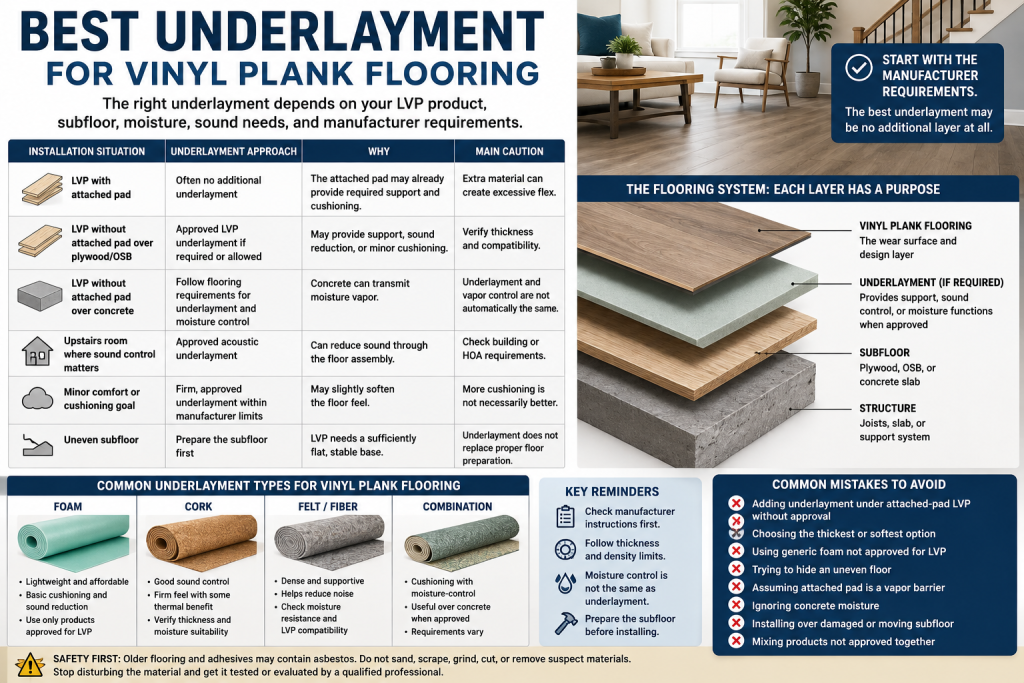
| Installation situation | Underlayment approach | Why | Main caution |
|---|---|---|---|
| LVP with attached pad | Often no additional underlayment | The attached pad may already provide required support and cushioning | Extra material can create excessive flex |
| LVP without attached pad over plywood/OSB | Approved LVP underlayment if required or allowed | May provide support, sound reduction, or minor cushioning | Verify thickness and compatibility |
| LVP without attached pad over concrete | Follow flooring requirements for underlayment and moisture control | Concrete can transmit moisture vapor | Underlayment and vapor control are not automatically the same |
| Upstairs room where sound control matters | Approved acoustic underlayment | Can reduce sound through the floor assembly | Check building or HOA requirements |
| Minor comfort or cushioning goal | Firm, approved underlayment within manufacturer limits | May slightly soften the floor feel | More cushioning is not necessarily better |
| Uneven subfloor | Prepare the subfloor first | LVP needs a sufficiently flat, stable base | Underlayment does not replace proper floor preparation |
If older flooring, sheet goods, tile, mastics, or adhesives may contain asbestos, do not sand, grind, scrape, cut, or demolish them. Stop disturbing suspect material and obtain appropriate evaluation or testing before removal work continues.
Does Vinyl Plank Flooring Need Underlayment?
Not every vinyl plank floor needs a separate underlayment.
Depending on the product, the manufacturer may:
- Include an attached pad on each plank
- Require a separate approved underlayment
- Allow an optional approved layer
- Prohibit additional underlayment
- Set different requirements based on the subfloor or installation method
This is why buying underlayment before choosing the flooring can create problems. The correct layer depends on the complete flooring system.
Click-lock and floating LVP rely on their joints and supporting surface to behave within specific limits. Adding a soft or overly thick layer can let the planks flex more than intended, which can place extra stress on the locking joints.
Glue-down vinyl has different requirements and may not use a conventional cushioned underlayment at all.
Check the installation instructions for the exact flooring before deciding what belongs underneath it.
What Underlayment Actually Does
Underlayment is a layer installed between certain flooring products and the surface below them. Its purpose varies by product.
Depending on the system, underlayment may provide:
- Sound reduction
- Minor cushioning
- Separation between flooring and subfloor
- Limited thermal benefit
- Firm support required by the flooring system
- Moisture-related protection when specifically designed for that purpose
Underlayment also has clear limits.
It does not:
- Correct major subfloor unevenness
- Repair damaged plywood or OSB
- Stop structural movement
- Solve an active moisture problem
- Waterproof a room
- Automatically serve as a vapor barrier
Treat underlayment as one component of the floor system rather than a cure for problems underneath it.
LVP With Attached Pad
Many modern vinyl plank products have foam, cork-like, or another resilient material attached to the underside of each plank.
When that pad is part of the product design, a second layer may not be necessary. In some flooring systems, additional underlayment is specifically prohibited.
Too much cushioning can allow the floor to move vertically under foot traffic or furniture. Click-lock joints are designed to operate with a certain amount of support, and excessive flex can stress those connections.
An extra layer can also affect:
- Floor stability
- Joint performance
- Finished floor height
- Doorway transitions
- Installation requirements
- Warranty compliance
Do not assume that doubling the padding will make the floor quieter or more comfortable without consequences. If the LVP has an attached pad, verify whether another layer is permitted before adding one.
Foam Underlayment
Foam is common beneath floating floors because it is lightweight, easy to handle, and available in different densities and thicknesses.
An LVP-compatible foam can provide basic sound reduction and minor cushioning while maintaining support beneath the planks.
The important word is compatible.
Generic foam intended for another flooring type may be too soft or too thick for a vinyl plank locking system. Excessive compression can allow the floor to flex when people walk across it.
When considering foam, focus on:
- Approval for vinyl plank
- Density and firmness
- Maximum permitted thickness
- Subfloor compatibility
- Moisture-related features, if needed
- Flooring manufacturer requirements
Do not select foam based only on thickness or softness.
Cork Underlayment
Cork can provide sound reduction and a firm, slightly resilient layer beneath flooring when the system allows it.
It may also provide a modest thermal benefit, which can appeal in bedrooms, offices, and other rooms where comfort matters.
Compatibility is still essential. Cork thickness and density need to remain within the flooring manufacturer’s limits, and some LVP products already include a cork-like attached backing.
Moisture also deserves attention. Cork should not automatically be assumed suitable over concrete or in damp locations simply because it is sold as flooring underlayment.
Where cork is being considered, verify both the LVP requirements and the moisture conditions below the floor.
Felt or Fiber Underlayment
Dense felt or fiber underlayments may be used with some approved floating-floor systems for sound control, support, and minor comfort.
These products can feel firmer than very soft foam while still helping reduce some flooring noise.
However, fiber underlayments vary in construction. Moisture resistance, density, compression, and suitability for LVP can differ significantly.
Before using one, confirm:
- It is approved for vinyl plank flooring
- Its thickness is within the permitted range
- It is suitable for the subfloor
- It meets any moisture requirements
- It is compatible with the installation method
Do not assume an underlayment suitable for laminate or engineered wood is automatically suitable for LVP.
Combination Underlayment With Moisture-Control Features
Some underlayments combine cushioning or sound-control functions with a layer intended to reduce moisture-vapor transmission.
These products can be useful when the flooring manufacturer specifically allows them.
A combination product may simplify the floor assembly, but it does not eliminate the need to verify what the LVP requires. Moisture-control performance, seams, subfloor compatibility, and installation details can differ.
A product marketed for moisture protection also does not solve an active leak, wet slab, or other unresolved moisture problem.
Best Underlayment for Vinyl Plank Over Plywood or OSB
A dry, flat, stable plywood or OSB subfloor may need little beyond the flooring system specified by the manufacturer.
If the LVP already has an attached pad, no separate underlayment may be required. For products without attached backing, an approved layer may be required or permitted for sound reduction, support, or comfort.
Wood subfloor condition is more important than adding extra cushioning.
Before covering it, look for:
- Loose or moving panels
- Swollen areas
- Soft or damaged material
- Significant dips or high areas
- Signs of water damage
- Excessive floor movement
Underlayment should not be used to conceal these conditions. A stable base gives the planks and locking joints consistent support.
Best Underlayment for Vinyl Plank Over Concrete
Concrete requires additional attention because a slab can transmit moisture vapor even when its surface looks dry.
Some LVP systems require a separate vapor-control layer over concrete. Others permit an approved combination underlayment that provides cushioning or sound control along with a moisture-related function.
Other flooring systems may require polyethylene or a different manufacturer-approved solution.
An attached pad does not automatically satisfy moisture requirements over concrete. The pad under the plank and a layer intended to control vapor transmission serve different purposes.
Before choosing underlayment over a slab, confirm:
- Whether slab moisture testing is required
- Whether a vapor-control layer is required
- Which materials are approved
- Whether attached pad changes the requirement
- Whether a combination underlayment is permitted
Do not install new flooring over persistent or unexplained slab moisture without addressing the underlying condition.
Best Underlayment for Sound Reduction
Sound control can matter in upstairs bedrooms, condos, apartments, home offices, and rooms above living spaces.
Underlayment can reduce some sound, but performance depends on the entire floor and ceiling assembly rather than the underlayment alone.
Product information may list IIC or STC ratings. These measurements relate to different types of sound transmission, but homeowners should not compare numbers unless the products were tested under comparable assembly conditions.
A thicker or softer underlayment also does not automatically provide better results.
In condos or apartments, check for building or HOA acoustic requirements before buying. A flooring assembly may need to meet specified sound-control criteria regardless of which material appears quieter in product descriptions.
Does Thicker Underlayment Make LVP Better?
Not necessarily.
With vinyl plank, excessive underlayment thickness or softness can be a disadvantage.
Too much movement beneath a floating floor may:
- Increase flex underfoot
- Stress click-lock joints
- Allow unwanted plank movement
- Affect warranty compliance
- Create an unstable feel
The goal is not maximum cushioning. It is appropriate support.
Density, firmness, compatibility, and the flooring manufacturer’s thickness limits matter more than choosing the thickest roll available.
Can Underlayment Fix an Uneven Floor?
No. Underlayment is not a substitute for proper floor preparation.
Some products can absorb tiny surface irregularities within the limits of the flooring system, but they cannot correct significant problems such as:
- Deep dips
- High spots
- Structural sagging
- Loose subfloor panels
- Large slab irregularities
- Areas that move under load
Installing LVP over an unsuitable base can lead to flexing, movement, clicking noises, joint separation, or premature failure.
If the floor has major irregularities or structural movement, determine the cause before installing the finished flooring.
Underlayment vs Vapor Barrier
Underlayment and vapor control are related in some installations, but the terms are not interchangeable.
Underlayment may provide:
- Sound control
- Cushioning
- Separation
- Support
A vapor barrier or vapor-control layer is intended to limit moisture-vapor transmission under specified conditions.
Some products combine both functions. Others provide only one.
Never assume ordinary foam, cork, felt, fiber material, or attached pad satisfies the flooring manufacturer’s moisture-control requirements.
What to Look for When Buying the Best Underlayment for Vinyl Plank Flooring
Once you know that a separate layer is required or permitted, compare products based on compatibility rather than marketing claims.
Check for:
- Explicit approval for LVP or vinyl plank
- Compliance with the flooring manufacturer’s instructions
- Compatibility with attached-pad flooring
- Maximum permitted thickness
- Adequate density and support
- Suitability for plywood, OSB, or concrete
- Concrete compatibility where applicable
- Moisture-control function when required
- Appropriate sound-control characteristics
- Compatibility with the installation method
- Building or HOA acoustic requirements
- Warranty restrictions
No single specification determines whether an underlayment is appropriate. A product with impressive sound claims or generous cushioning can still be wrong for a particular flooring system.
Common Underlayment Mistakes
Avoid these common selection errors:
- Adding underlayment beneath attached-pad LVP without approval
- Choosing the thickest or softest option available
- Using generic foam that is not approved for vinyl plank
- Trying to hide an uneven floor with extra cushioning
- Assuming attached pad functions as a vapor barrier
- Ignoring moisture conditions over concrete
- Covering damaged, loose, or swollen subfloor material
- Combining flooring and underlayment products that are not approved together
The simplest floor assembly that meets the flooring requirements is often better than adding layers without a clear purpose.
Questions to Ask Before Buying Underlayment
Before purchasing underlayment, answer these questions:
- Does my LVP already have an attached pad?
- Does the manufacturer require, allow, or prohibit additional underlayment?
- What installation method does the flooring use?
- Is the subfloor plywood, OSB, concrete, or another approved surface?
- Will the flooring be installed over concrete?
- Could moisture vapor be a concern?
- Is additional sound reduction important?
- Does my building or HOA have acoustic requirements?
- What underlayment thickness and density are permitted?
- Is the underlayment explicitly approved for LVP?
These checks can prevent unnecessary purchases and compatibility problems.
When Professional Evaluation Makes Sense
Ordinary underlayment selection usually does not require a flooring professional. Problems with the surface below the flooring sometimes do.
Consider qualified evaluation when you find:
- Significant floor movement
- Major unevenness
- Persistent concrete slab moisture
- Rot or substantial subfloor deterioration
- Structural sagging
- Large or moving slab cracks
- Condo or HOA acoustic requirements you cannot interpret
- Suspected asbestos-containing flooring, mastic, or adhesive
If older flooring or adhesive may contain asbestos, do not disturb it to prepare the floor. Appropriate evaluation or testing should come before scraping, sanding, grinding, cutting, or demolition.
Final Thoughts
The best underlayment for vinyl plank flooring is the layer that the flooring system actually requires, not necessarily an additional product. LVP with attached pad may need nothing else, while other installations may call for an approved layer for support, sound control, or specific moisture conditions.
Check the flooring instructions before buying underlayment, then match any permitted product to the subfloor and the problem you are trying to solve. Proper compatibility and a flat, stable base matter more than extra thickness or cushioning.