Concrete vs Asphalt Driveway: Which Is Better?
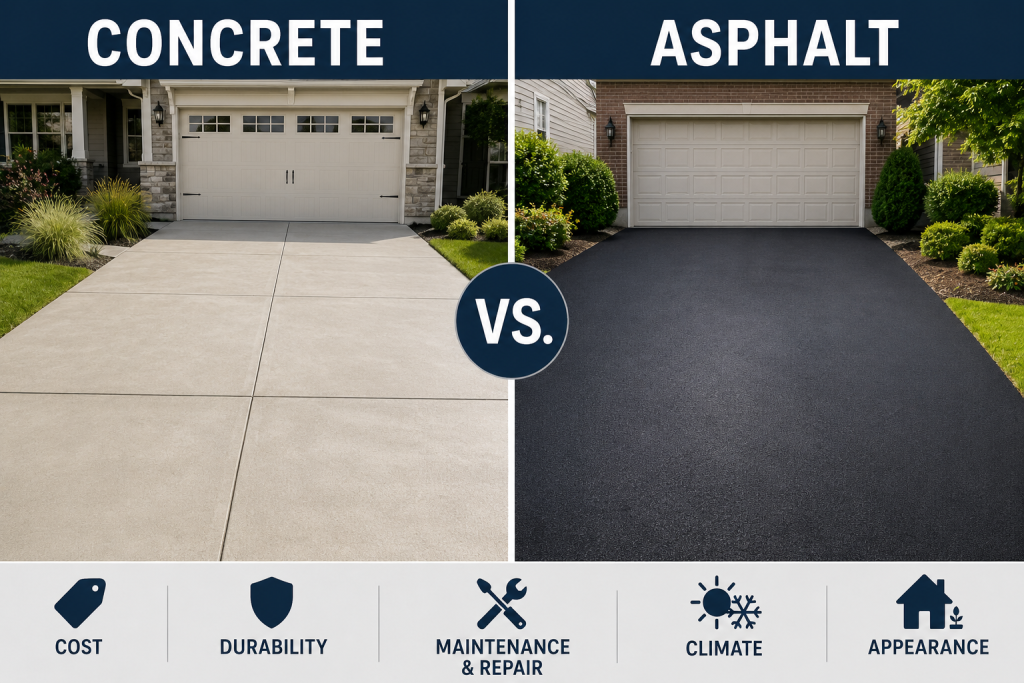
Concrete vs asphalt driveway is not a comparison with one universal winner. Asphalt usually costs less upfront and is easier to resurface, while concrete generally costs more initially but can offer longer service life, lower routine maintenance, and more appearance options. Installation quality, base preparation, drainage, soil conditions, and climate can matter as much as the surface material itself.
Concrete vs Asphalt Driveway: Quick Comparison
| Factor | Concrete | Asphalt |
|---|---|---|
| Upfront cost | Usually higher | Usually lower |
| Potential lifespan | Often longer when well built | Generally shorter, but highly site-dependent |
| Routine maintenance | Usually lower | Usually higher |
| Repair visibility | Patches can remain obvious | Repairs often blend more easily |
| Resurfacing | Possible when slabs remain sound | Often a practical long-term option |
| Hot-weather performance | Generally remains more rigid | Can soften in extreme heat |
| Cold-weather behavior | Can be vulnerable to freeze-thaw damage | More flexible, but can still crack with age |
| Appearance options | More colors, textures, and finishes | Mostly a uniform dark surface |
| Surface temperature | Usually cooler in direct sun | Usually hotter in direct sun |
| Flexibility | More rigid | More flexible |
These are broad tendencies, not guarantees. A well-installed asphalt driveway on a stable, well-drained base can outperform poorly installed concrete, and the reverse is also true.
Which Costs Less Up Front?
Asphalt generally has the lower initial cost. That can make it attractive for long driveways, large parking areas, or projects where controlling upfront spending is a priority.
Concrete usually requires a higher initial investment because material, forming, finishing, curing, and labor demands are typically greater.
Project cost can vary based on driveway size, excavation, base preparation, removal of existing pavement, drainage work, equipment access, local labor and material costs, and the thickness or design required for the site.
The lower initial price of asphalt can be meaningful, but it should not be the only cost considered.
Which Costs Less Over Time?
Long-term cost is harder to generalize. Asphalt may be less expensive initially but usually requires more recurring maintenance over its service life. Concrete often costs more to install but generally has a lower routine surface-maintenance burden.
The real ownership cost depends on climate, drainage, installation quality, repair frequency, maintenance history, and how long you expect to own the property.
An asphalt driveway that receives timely maintenance can remain serviceable for many years, while neglected pavement can deteriorate sooner. Concrete may need fewer routine treatments, but major cracking, settlement, or replacement can be expensive and visually difficult to repair.
Neither material is always cheaper over a full lifetime.
Which Lasts Longer?
Concrete generally has the potential for a longer service life when it is properly installed, supported, drained, and maintained.
Its rigidity can be an advantage when the base remains stable, but it also means concrete does not tolerate movement well. Settlement, heaving, or shifting beneath the slab can lead to cracking.
Asphalt is more flexible and can tolerate limited movement better. Over time, however, oxidation, traffic, weather exposure, and temperature changes can make it more brittle and prone to cracking.
Base preparation and water management strongly influence both materials. A durable surface still depends on stable support below it.
Which Is Better in Hot Climates?
Concrete generally has an advantage where extreme heat is a major concern because it remains more dimensionally stable at high surface temperatures.
Asphalt can soften during extreme heat. Under the wrong conditions, heavy vehicles, narrow tires, kickstands, or concentrated loads may leave impressions in a softened surface.
Concrete also tends to remain cooler in direct sun because its lighter color reflects more solar energy, while dark asphalt absorbs more heat.
That does not make concrete automatically better in every warm climate. Soil conditions, drainage, installation quality, traffic loads, and budget still matter.
Which Is Better in Cold Climates?
The cold-weather comparison does not have one clear winner.
Asphalt’s flexibility may help it tolerate some seasonal movement, but it can still crack as it ages and becomes more brittle.
Concrete can perform well in cold regions, but freeze-thaw exposure requires more attention. Water entering pores, joints, or cracks can contribute to deterioration as it freezes and thaws. Surface scaling can also become a concern when moisture exposure and winter maintenance are harsh.
Drainage and deicing practices matter for both materials. Local soil conditions, snowfall, freeze-thaw frequency, and installation quality may be more important than broad regional rules.
Maintenance Differences
Asphalt generally requires more routine maintenance. Depending on condition and product compatibility, periodic sealing may be used as the pavement ages, and cracks should be addressed before they widen or admit more water.
Concrete usually has a lower routine surface-maintenance burden. Sealing may still be useful in some situations, but it is not a requirement for every slab.
Both materials benefit from drainage control, prompt attention to developing damage, and keeping the surface free of conditions that accelerate deterioration.
Repair Differences
Asphalt repairs usually blend more easily into the dark pavement, especially after the repaired area weathers.
Concrete patches can remain visibly different in color and texture from the surrounding slab even when the repair performs well.
Concrete cracking should be evaluated by cause rather than simply covered over. If your driveway has broader damage, movement, or deterioration, the concrete driveway repair decision should be considered separately from this material comparison.
Appearance and Curb Appeal
Concrete offers more design flexibility. Homeowners can choose from differences in color, texture, broomed or decorative finishes, exposed aggregate, borders, and pattern options.
That can make concrete a strong fit when the driveway is intended to contribute to the home’s overall appearance.
Asphalt is visually simpler. Its dark, uniform surface can look clean and understated, but there are fewer practical decorative options.
Neither material has a universal curb-appeal advantage. The better choice depends on the style of the property and the appearance the homeowner prefers.
Snow, Ice, and Surface Temperature
Dark asphalt absorbs more solar heat than lighter concrete. In some sunny winter conditions, that can help thin snow or ice melt somewhat faster.
The effect should not be overstated. Air temperature, shade, snow depth, wind, and surface conditions all influence melting. Both materials can become dangerously slippery.
In summer, the same heat absorption can make asphalt noticeably hotter than light-colored concrete. Surface temperature may matter for barefoot use, children, pets, and homes in areas with intense sun.
Which Is Easier to Repair or Resurface?
Asphalt generally has the advantage in future resurfacing and repair blending.
When the underlying pavement remains suitable, a new asphalt layer can often restore the surface without removing the entire driveway.
Concrete can also be resurfaced when the existing slab remains sound. However, resurfacing cannot correct major settlement, active slab movement, or unstable support below the slab.
For a closer look at that decision, see concrete driveway resurfacing.
What About Heavy Vehicles and Everyday Use?
Either material can support ordinary passenger vehicles when the driveway is properly designed and installed.
Heavy trucks, trailers, recreational vehicles, dumpsters, or repeated delivery traffic place more stress on the surface and base.
Base support, pavement or slab thickness, soil stability, load concentration, and heat conditions all become more important under heavier use.
Concrete’s rigidity can perform well under concentrated loads when the slab is properly supported. Asphalt’s flexibility can be useful, but extreme heat combined with heavy loads can contribute to deformation.
Neither material automatically solves a difficult site.
Drainage Matters for Both Materials
Concrete and asphalt both depend on good grading and drainage.
Water that repeatedly ponds on the driveway, runs beneath pavement edges, or saturates the base can shorten the life of either material. Loss of support may contribute to cracking, depressions, settlement, or movement.
Watch for standing water after rain, downspouts discharging onto the driveway, erosion along pavement edges, sections that have already settled, water flowing toward the garage or foundation, and repeated cracking in the same area.
Replacing the surface without correcting an underlying drainage problem may simply recreate the same failure in the new driveway.
Concrete vs Asphalt: Which Is Better for Different Homeowners?
Concrete may be the better fit when longer-term durability is a priority, lower routine maintenance is preferred, decorative options matter, a lighter surface is desired, hot-weather stability matters, and a higher initial cost is acceptable.
Asphalt may be the better fit when lower upfront cost is a priority, easier future resurfacing matters, repair blending is important, a dark uniform appearance suits the property, some pavement flexibility is desirable, and more routine maintenance is acceptable.
For many homeowners, the site matters more than the material alone. A properly built driveway over a stable, well-drained base is more valuable than choosing a theoretically superior surface and installing it over poor conditions.
Final Thoughts
Concrete is often the better fit for homeowners who prioritize long-term durability, lower routine maintenance, more appearance options, and hot-weather stability.
Asphalt is often the better fit when lower upfront cost, easier resurfacing, easier repair blending, and some pavement flexibility matter more.
Neither material can compensate for poor drainage, unstable soil, weak base preparation, or poor installation. Compare the two in the context of your climate, property, maintenance expectations, budget, and site conditions before deciding which driveway makes the better long-term fit.