garbage disposal humming: causes and what to do
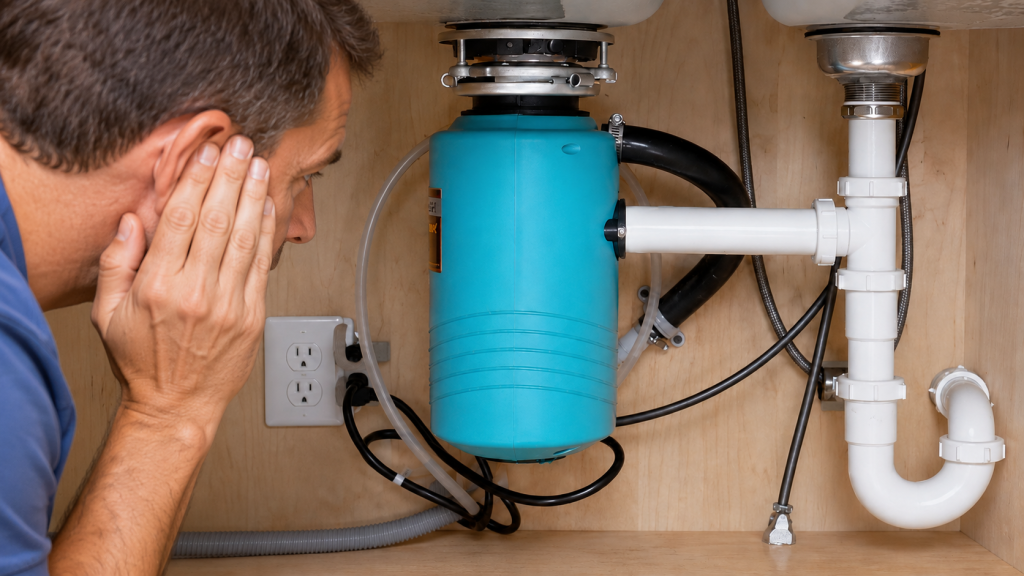
Garbage disposal humming usually means the unit is receiving power, but something is preventing normal rotation. Repeatedly flipping the switch can overheat the motor, so stop operating the disposal and disconnect power before checking for a jam. A foreign object or overload condition may be relatively simple to address, but internal mechanical or motor failure is also possible.
Garbage Disposal Humming? Start With These Checks
| What You Notice | What It May Mean | Safe First Step |
|---|---|---|
| Hums but does not grind | Jam or mechanical binding | Stop use and disconnect power |
| Stopped after food entered | Food-related jam | Inspect from above with a flashlight |
| Hums briefly, then stops | Overload protector may have tripped | Clear possible jam before resetting |
| Reset button has tripped | Motor may have overheated or overloaded | Let unit cool and address the cause first |
| Foreign object is visible | Object may be blocking rotation | Remove only with suitable tools after disconnecting power |
| Jam wrench will not move | Severe jam or internal seizure | Stop rather than applying excessive force |
| Burning smell or overheating | Motor or electrical problem | Keep power off and arrange qualified evaluation |
| Humming plus leaking water | Water/electrical safety issue | Stop troubleshooting until leak is addressed |
Never put your hands or fingers inside the disposal grinding chamber.
Before placing any tool into the disposal, turn the wall switch off and disconnect power. Unplug the disposal only when the plug, receptacle, and surrounding area are dry and safely accessible. If it is hardwired or the connection cannot be safely reached, shut off the correct breaker or use qualified help.
Stop Running a Humming Disposal
Do not repeatedly turn a humming disposal on and off.
If the grinding mechanism cannot rotate, continued attempts may:
- Overheat the motor
- Trip the overload protector
- Worsen a mechanical jam
- Place additional stress on internal components
A brief hum does not tell you exactly what has failed. It simply means you should stop operating the disposal and investigate safely rather than trying to make it power through the problem.
If you notice a burning odor, smoke, severe overheating, or other electrical symptoms, leave the disposal off and move directly to professional evaluation.
Disconnect Power Before Looking for a Jam
The wall switch alone is not enough protection when you plan to insert a tool into the grinding chamber.
Use this sequence:
- Turn the wall switch off.
- Disconnect the disposal from power.
- Keep the sink area clear of anyone who might operate the switch.
- Use a flashlight to inspect the chamber from above.
Do not perform live electrical testing or remove electrical covers to confirm power status.
If water is leaking near the cord, receptacle, reset button, electrical connection, or wiring, stop. Resolve the water and electrical issue before continuing with jam troubleshooting.
Look for an Accessible Foreign Object
A disposal can jam when a hard or non-food object becomes trapped in the grinding area.
Possible objects include:
- Utensils
- Bottle caps
- Small metal pieces
- Hard food fragments
- Broken dish material
- Glass
- Other non-food debris
With power disconnected, look into the chamber using a flashlight.
Never reach inside with your hand. If an object is plainly visible and safely reachable, long-handled pliers or tongs may be used to remove it.
Do not probe blindly around the chamber or use excessive force. If broken glass is involved, avoid reaching into the area and use professional help when safe removal is uncertain.
After removing an object, inspect again to make sure no visible pieces remain.
Use the Disposal Jam Wrench if the Model Supports One
Many, but not all, garbage disposals provide an external socket on the bottom for a jam-clearing wrench.
If your model supports this feature:
- Make sure power is fully disconnected.
- Locate the external wrench socket.
- Insert the correct manufacturer-provided or compatible wrench.
- Work it gently back and forth.
- Stop if the mechanism will not move with reasonable force.
The goal is to free the mechanism, not overpower it.
Do not assume every disposal uses the same wrench or socket size. Check the instructions for your model before using a tool.
If your disposal does not have an external jam socket, do not open the motor housing or improvise an internal method to turn the mechanism.
What If the Jam Wrench Moves the Disposal?
If the wrench begins moving back and forth more freely, the obstruction may have loosened.
Before restoring power:
- Remove the jam wrench completely.
- Check the chamber again with a flashlight.
- Remove any visible foreign object using appropriate tools.
- Make sure no tools remain in or around the sink opening.
- Check that the disposal and nearby electrical areas are dry.
If the overload protector tripped, allow the disposal to cool and follow the model’s reset instructions only after the jam has been cleared.
Restore power only after the disposal is mechanically free and the work area is safe.
If the disposal immediately hums again instead of operating normally, stop. Do not repeat the jam-and-reset process indefinitely.
What Does the Reset Button Do?
Many disposals have an overload protector that shuts the unit down when the motor overheats or experiences excessive load. Depending on the model, a reset button allows that protection to be reset after the underlying problem has been corrected.
The overload may trip because:
- A jam prevented normal rotation
- The disposal was overloaded
- The motor became too hot
Do not use the reset button as the first response to a humming disposal.
First disconnect power, check for a jam, clear any accessible obstruction, and allow an overheated unit to cool.
Do not press the reset button when water is present near the electrical area. Once the disposal is clear, cool, and dry, follow the manufacturer’s reset procedure for your model.
What If the Reset Button Trips Again?
Repeated tripping means the underlying problem may still be present.
Possible causes include:
- A remaining obstruction
- Mechanical binding
- An internal motor problem
- Another internal component failure
- An electrical fault
Do not repeatedly press the reset button and restart the disposal.
If the mechanism appears clear but the overload continues to trip, further homeowner troubleshooting is unlikely to identify the problem safely. Professional evaluation or replacement may be appropriate.
What If the Garbage Disposal Hums but the Jam Wrench Will Not Turn?
This is an important stopping point.
A wrench that will not move with reasonable pressure may indicate:
- A severe jam
- Internal mechanical seizure
- A damaged bearing or motor component
- Another internal failure
Do not add a long extension to the wrench or apply extreme leverage. Excessive force can damage the disposal or mounting assembly without correcting the problem.
If the mechanism remains firmly seized, keep power disconnected and use qualified service or consider replacement.
Do not open the disposal body to reach the jam from inside the motor housing.
What If There Is No Visible Jam?
A disposal can hum even when no obstruction is visible from above.
Possible causes may include:
- A hidden internal jam
- Mechanical binding
- Bearing wear
- Motor failure
- Another internal component problem
After checking for accessible objects and using the approved jam-wrench method where applicable, stop before deeper disassembly.
A humming disposal with no accessible obstruction may require professional diagnosis, particularly when it has also experienced repeated overload trips or other mechanical problems.
What If the Disposal Smells Hot or Burned?
A burning smell or severe overheating changes the priority from troubleshooting to safety.
Keep power off if you notice:
- A burning or electrical odor
- Smoke
- Scorching
- Melted or damaged wiring
- A damaged cord or receptacle
- Severe overheating
Do not press the reset button or run another test.
Do not remove electrical covers, test wiring, or open the motor housing. Arrange for a qualified evaluation before the disposal is used again.
What If the Disposal Is Humming and Leaking?
Address the leak and electrical risk before investigating the humming problem.
Stop using the disposal and disconnect power. Do not press the reset button while water is present around the disposal’s electrical areas.
If water is near the cord, receptacle, reset button, wiring, or electrical connection, avoid touching wet components and use qualified help.
Do not attempt jam-clearing until the leak and electrical safety issue have been resolved.
If water is also appearing beneath the unit, use our garbage disposal leaking from bottom guide to identify whether the leak comes from the disposal body or an external plumbing connection.
Could the Motor Be Worn Out?
A humming sound does not automatically mean the motor has failed.
Motor or internal mechanical failure becomes more plausible when:
- Accessible jams have been ruled out.
- The mechanism remains difficult or impossible to move.
- The reset repeatedly trips.
- The unit overheats.
- The disposal has an ongoing history of mechanical problems.
Many residential disposals are built as sealed assemblies, making internal motor repair impractical for routine homeowner work.
Do not open the motor housing, attempt rewiring, or disassemble the grinding mechanism to investigate further.
Repair or Replace a Humming Garbage Disposal?
A simple jam does not necessarily justify replacement.
Repair or continued use may make sense when:
- A visible obstruction can be safely removed.
- The jam wrench frees the mechanism normally.
- The overload reset restores operation after the cause is corrected.
- There are no leaks, overheating, or electrical concerns.
Replacement deserves stronger consideration when:
- The disposal remains mechanically seized.
- The overload protector repeatedly trips.
- The motor or internal mechanism appears to be failing.
- The housing is damaged.
- The unit also has recurring leaks.
- Water has affected electrical areas.
- Repair would require opening the sealed motor body.
- Parts or service access are impractical.
Age can be one factor, but it should not be the only reason to replace an otherwise serviceable disposal.
When to Call a Plumber or Electrician
A plumber or qualified disposal installer may be appropriate for:
- Disposal replacement
- Mounting problems
- Drain connections
- Difficult mechanical removal
- Under-sink plumbing complications
An electrician may be appropriate when there is:
- A wet or damaged receptacle
- Damaged wiring
- An overheated plug or electrical connection
- Repeated circuit problems
- A hardwired electrical concern
An appliance or disposal-service professional may also be appropriate for an internal mechanical or motor problem, depending on the model and local service options.
If a dishwasher connected to the disposal is also holding water or failing to drain, diagnose the dishwasher not draining problem separately before assuming disposal replacement will solve both symptoms.
Common Garbage Disposal Humming Mistakes
Avoid these common mistakes:
- Repeatedly flipping the disposal switch
- Putting a hand into the grinding chamber
- Relying only on the wall switch before inserting tools
- Pressing reset before clearing a jam
- Forcing the jam wrench with excessive leverage
- Running the disposal while a foreign object remains
- Ignoring a burning smell or overheating
- Repeatedly resetting a tripped overload
- Opening the sealed motor housing
- Continuing troubleshooting while water is near electrical parts
Garbage Disposal Humming FAQ
Why is my garbage disposal humming but not working?
Garbage disposal humming commonly means power is reaching the unit, but the grinding mechanism is not rotating normally. A jam, foreign object, overload condition, mechanical binding, or internal motor problem may be responsible. Stop running the disposal and disconnect power before checking for an obstruction.
Can I fix a garbage disposal that is humming?
Sometimes. A visible foreign object or simple jam may be cleared safely with power disconnected, suitable long-handled tools, or the manufacturer-supported jam wrench. If the mechanism remains seized or the unit repeatedly overheats, professional service or replacement may be more appropriate.
Should I press the reset button if my garbage disposal hums?
Not immediately. Clear the jam first and allow an overheated disposal to cool. Use the reset only when the unit is clear, dry, and safe, following the instructions for your model. Repeatedly resetting a disposal that remains jammed can worsen the problem.
What if the disposal jam wrench will not turn?
Stop if the wrench will not move with reasonable force. A severe jam or internal mechanical failure may be preventing movement. Do not apply extreme leverage or open the motor housing. Professional service or replacement may be appropriate.
When should I replace a humming garbage disposal?
Replacement becomes more reasonable when the disposal remains seized, repeatedly trips its overload protector, has an internal motor or mechanical failure, has recurring leaks, or would require opening a sealed motor body for repair. Confirm that a simple accessible jam is not the cause first.
Final Thoughts
For garbage disposal humming problems, stop running the unit, disconnect power, inspect for visible foreign objects, and remove only accessible debris with appropriate tools. If the model supports a jam wrench, use it gently according to the disposal’s instructions, then reset the overload only after the jam is cleared, the unit has cooled, and the area is dry.
If the disposal remains seized, repeatedly trips, overheats, leaks near electrical components, or continues humming without normal operation, stop troubleshooting. Repeated humming should not be ignored because continued operation can overheat the motor, and internal motor or electrical repair belongs to qualified professionals.