gas vs battery lawn mower: Which is better?
For most homeowners, the gas vs battery lawn mower decision comes down to yard size, mowing time, grass conditions, and how much maintenance you are willing to handle. Battery mowers are usually quieter, easier to start, and simpler to maintain, while gas mowers remain useful when you need long runtime or regularly cut demanding grass.
Neither power source is automatically better. A small, regularly maintained lawn can be an excellent match for battery power, while a larger property, long mowing sessions, or consistently thick growth may favor gas. Terrain and mower design can also matter as much as the motor itself.
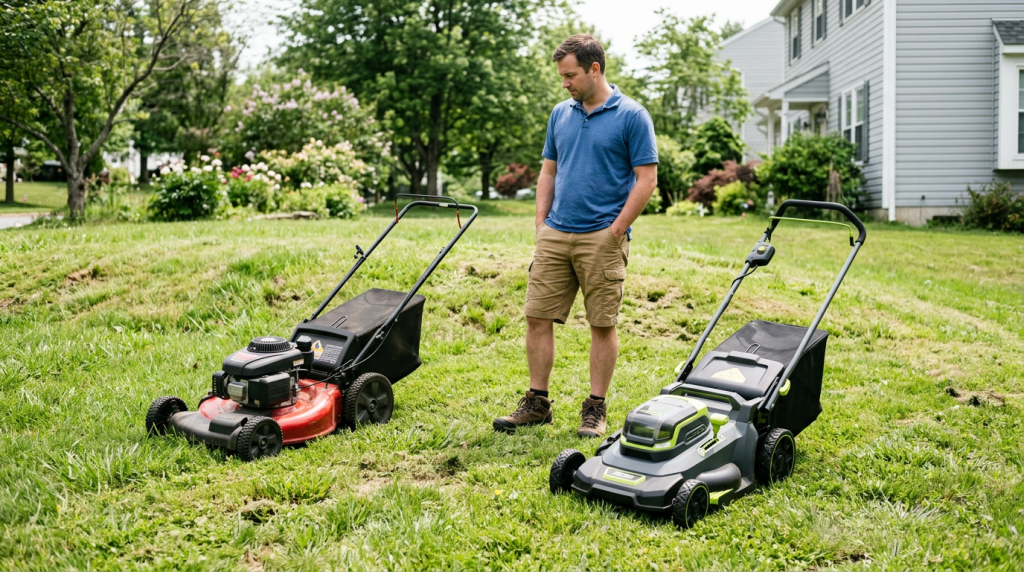
Quick Gas vs Battery Lawn Mower Comparison
| Factor | Battery mower | Gas mower |
|---|---|---|
| Starting | Push-button or lever start | Usually pull-start or electric start |
| Runtime | Limited by battery capacity and charge | Continues with additional fuel |
| Maintenance | Relatively low | Fuel, oil, engine, and seasonal maintenance |
| Noise | Quieter | Louder |
| Heavy grass | Capable, but demanding cutting can reduce runtime | Well suited to sustained demanding cutting |
| Yard size | Strong fit for small to moderate lawns | Strong fit for larger lawns and long sessions |
| Ongoing cost | Electricity and eventual battery replacement | Fuel, oil, filters, spark plugs, and service items |
| Storage | No gasoline to manage | Fuel storage requires more attention |
| Uneven terrain | Depends heavily on wheels, drive, weight, and traction | Depends heavily on wheels, drive, weight, and traction |
The biggest mistake is choosing only by power source. Deck design, cutting width, self-propelled drive, wheel size, mower weight, and battery capacity can change how two mowers perform in the same yard.
Performance, Runtime, and Yard Size
Modern battery mowers can handle routine residential mowing well, especially when grass is cut regularly and the mower is matched to the property. They deliver power immediately and do not need an engine to warm up before mowing.
Their main limitation is runtime. Thick grass, tall growth, hills, frequent self-propelled use, and repeated stops and starts can increase energy use. A mower that comfortably finishes a dry, maintained lawn may use substantially more battery when conditions become difficult.
An extra battery can extend the mowing session, but it also changes the total cost of ownership. Homeowners with larger yards should think in terms of whether the available battery capacity can finish the normal mowing job, not merely whether the mower is powerful enough to cut the grass.
Gas mowers have a different advantage: refueling is quick. If a mowing session lasts longer than expected, adding fuel allows the work to continue without waiting for a battery to recharge.
That makes gas especially practical for:
- Larger lawns that require extended mowing
- Properties where grass is sometimes allowed to grow tall
- Thick or dense grass that regularly loads the mower heavily
- Homeowners who prefer finishing the entire lawn in one continuous session
Cutting conditions also depend on mowing height. Removing too much growth at once can make mowing harder regardless of the power source. If you are setting the lawn up for the start of the growing season, see Best Mower Height for First Spring Mow.
Maintenance, Noise, and Ease of Ownership
Battery mowers are generally simpler to own. There is no gasoline engine requiring routine oil changes, spark-plug service, fuel-system attention, or similar engine maintenance.
You still need to maintain the mower itself. The blade must stay sharp, grass buildup should be removed as directed for the mower, wheels and controls should be checked, and batteries should be charged and stored according to the manufacturer’s instructions.
Gas mowers add engine-related responsibilities. Depending on the mower, ownership may involve:
- Checking or changing oil
- Maintaining the air filter
- Replacing the spark plug when needed
- Managing gasoline safely
- Preparing the mower for extended storage
- Addressing fuel-system problems if the mower sits unused
For homeowners who dislike small-engine maintenance, that difference can be decisive.
Noise and vibration also affect usability. Battery mowers are typically much quieter and produce less engine vibration. That can make a noticeable difference during a longer mowing session, especially for homeowners who find loud equipment tiring.
Gas engines are louder and create more vibration through the handle. Hearing protection may be appropriate when operating louder outdoor equipment; follow the mower manufacturer’s safety instructions.
Starting is another practical advantage for battery power. Many battery mowers start by pressing a button or engaging a control. Gas mowers may use a pull cord, although some models offer electric starting systems.
Cost, Battery Replacement, and Storage
Purchase price alone does not tell you which mower will cost less to own.
With a battery mower, check what is included before comparing prices. A mower package may include one or more batteries and a charger, while other configurations may not. If your lawn requires a second battery to finish reliably, include that battery in the real purchase cost.
Batteries also wear over time and eventually lose useful capacity. Replacement cost matters because mower batteries are a major component rather than a minor maintenance item. Staying within a compatible battery platform can be useful if you already own outdoor tools that use the same batteries, but compatibility must be confirmed for the specific equipment.
Gas mowers spread more of their ownership expense over time. Typical costs can include:
- Gasoline
- Engine oil
- Filters
- Spark plugs
- Replacement or maintenance parts
- Professional service when needed
Storage is simpler in some respects with battery power because there is no gasoline in the mower. Battery storage still requires attention to temperature, charging, and manufacturer instructions.
Gasoline-powered equipment needs additional care during storage because fuel can deteriorate and fuel systems can develop problems after long periods of inactivity.
Weight and Ease of Handling
Do not assume that lighter always means easier.
A lighter mower may be easier to push, turn, load, or maneuver around landscaping. That can be especially helpful on smaller properties with many corners, trees, beds, and narrow passages.
But weight and balance also affect how firmly a mower feels planted on rough ground. A very light mower can feel different as it crosses bumps or shallow ruts, while a heavy mower can become tiring when you repeatedly turn it or push it uphill.
Self-propelled drive can change the experience more than a modest difference in mower weight. Instead of pushing the full weight of the mower, you primarily guide it while the drive system moves it forward.
That can be valuable for anyone who tires easily or has a yard that requires more effort to mow. For additional guidance on this feature, see Best Self-Propelled Lawn Mower for Seniors.
Gas vs Battery Lawn Mower for Uneven Ground
Uneven lawns introduce issues that have little to do with whether the motor burns gasoline or uses a battery.
Common terrain problems include:
- Small bumps and depressions
- Shallow ruts
- Exposed tree roots
- Soft or damp areas
- Rolling sections of lawn
- Moderate slopes
- Areas where wheels lose traction
On this type of property, mower design deserves as much attention as the power source.
Self-Propelled Drive, Wheel Size, and Traction
Self-propelled drive is especially useful when the mower must climb gentle grades, cross rough patches, or move through thick grass. It reduces the amount of force you need to apply through the handle.
Traction matters as well. A mower that repeatedly spins its drive wheels or slides across the surface will be frustrating regardless of how much motor power it has.
Larger rear wheels can improve the way some mowers roll over shallow depressions and irregular ground. Tire tread, wheel placement, mower balance, and the drive system all contribute to how stable and controllable the machine feels.
When comparing mowers for difficult terrain, look beyond the gas-or-battery label and consider:
- Whether the mower is self-propelled
- How smoothly the drive speed can be controlled
- Rear-wheel size and tire design
- Overall mower weight
- Handle position and control
- How easily the mower turns
- Whether the deck stays reasonably stable over minor irregularities
A battery mower with good traction and a well-designed self-propelled system may be easier to use on rough ground than a basic gas push mower. The reverse can also be true.
Slopes and Mowing Safety
Slopes require more caution because loss of footing or mower control can become a serious safety problem.
Do not mow a slope that feels too steep, soft, slippery, badly rutted, or unstable to cross while maintaining secure footing and control of the mower. Avoid wet slopes, and follow the mower manufacturer’s instructions for slope operation and any stated terrain limits.
Never rely on a more powerful mower to make unsafe ground acceptable.
Some recurring mowing difficulties also point to a lawn problem rather than a mower problem. Deep ruts, serious erosion, exposed roots, depressions, or persistently soft areas may need to be corrected instead of repeatedly forcing a mower across them.
Which Type Is Better for Your Lawn?
Battery Mowers Usually Fit Small Lawns Well
Battery power is often a strong choice when the lawn can be completed comfortably on the available battery capacity.
It is particularly appealing when you value:
- Easy starting
- Lower routine maintenance
- Quieter operation
- Less vibration
- No gasoline storage
- Easy maneuverability
Small lawns also reduce the importance of maximum runtime. If the mower can finish the property with plenty of battery remaining, the main disadvantage of battery power may barely affect normal use.
Battery can also work well for moderate lawns when you have enough battery capacity, a spare battery, or access to batteries shared with other compatible tools.
Gas Mowers Still Make Sense for Larger or Demanding Lawns
Gas becomes more attractive when mowing duration is difficult to predict or when the mower regularly works under heavy load.
Consider gas when you frequently deal with:
- Long mowing sessions
- Large mowing areas
- Thick or fast-growing grass
- Periods when the lawn becomes overgrown
- Conditions that would require several battery packs
- A preference for refueling instead of managing battery charging
That does not mean every large yard requires gas. A battery mower with sufficient capacity may still be practical. The important question is whether the battery system fits the actual duration and difficulty of your normal mowing routine.
The same principle applies to rough terrain. If hills and irregular ground are your main challenge, self-propelled drive, traction, wheels, and balance may matter more than whether the mower is gas or battery powered.
Final Thoughts
Choose a battery mower when your lawn fits comfortably within its runtime and you place a high value on easy starting, quieter operation, and low routine maintenance. Choose gas when you regularly need extended mowing time, expect demanding grass conditions, or want the ability to refuel and keep working.
For uneven or sloped yards, do not make the decision on power source alone. Give equal attention to self-propelled drive, wheel design, traction, weight, and stability—and address serious terrain problems when the lawn itself is making mowing difficult or unsafe.