How to Paint Trim Without Brush Marks
Learning how to paint trim without brush marks comes down to several small habits rather than one special trick. Start with a clean, smooth surface, use a quality synthetic angled trim brush, apply controlled coats, and stop brushing once the paint begins to set. Good preparation and a light finishing stroke give the paint its best chance to level into a smooth finish.
| Problem | Likely cause | What to change |
|---|---|---|
| Deep brush lines | Too much paint or heavy pressure | Use lighter brush loading and gentler finishing strokes |
| Rough texture | Dust, debris, or rough trim | Clean and lightly sand where appropriate |
| Repeated ridges | Overbrushing | Stop working the paint as it begins to set |
| Uneven coverage | Poor loading or inconsistent strokes | Lay on an even coat in manageable sections |
| Drag marks | Paint becoming tacky | Maintain a wet edge and avoid going back over setting paint |
| Visible bristle tracks | Poor or unsuitable brush | Use a quality synthetic angled trim brush suited to the paint |
Why Brush Marks Happen on Painted Trim
Brush marks form when the paint does not level sufficiently before it dries. Sometimes the brush itself is responsible, but application technique and surface condition are just as important.
Applying too much paint can leave ridges. Applying too little can cause the brush to drag. Pressing hard spreads the bristles and can leave pronounced tracks.
Another major cause is overbrushing. Fresh paint is relatively easy to spread and smooth. As it begins to set, repeated brush passes can pull through the partially drying film instead of improving it. The result may be ridges, drag marks, or an uneven texture.
Surface defects also show through paint. Dust, old brush marks, rough repairs, dried drips, and other imperfections will not necessarily disappear beneath another coat.
A smooth finish therefore begins before the brush touches the paint.
Prepare the Trim for a Smooth Finish
Good preparation gives the paint a surface on which it can form an even film. The goal is not to make every piece of trim look new before painting, but to remove contaminants and obvious irregularities that would interfere with the finish.
Start by cleaning the trim. Remove dust, dirt, grease, and other residue using a cleaning method compatible with the existing surface and the paint system you plan to use. Follow the cleaner manufacturer’s instructions, including ventilation and personal protection where required.
Allow the surface to reach the condition required by the paint or primer manufacturer before continuing.
Sand rough areas where appropriate
If the existing finish has small ridges, roughness, or other minor imperfections, light sanding can help create a smoother surface.
You do not need to aggressively remove a sound existing finish merely to eliminate minor texture. The objective is to smooth problem areas and prepare the surface as required by the coating manufacturer.
Remove sanding residue thoroughly afterward. Fine dust left on the trim can become trapped in the new paint and create the very texture you are trying to avoid.
Use extra caution with older painted trim. If lead-based paint may be present, do not use uncontrolled sanding or scraping that could create hazardous lead dust. Determine an appropriate lead-safe approach before disturbing suspect paint.
Prime where needed
Not every previously painted piece of trim requires a complete new coat of primer.
Primer may be appropriate on bare material, repaired areas, exposed filler, stains, or surfaces where the selected paint system requires it. Spot priming can be sufficient for some repairs, while other situations call for a full primer coat.
Follow the primer and paint manufacturers’ compatibility, preparation, ventilation, application, and drying instructions.
A poorly applied primer coat can also leave texture, so allow it to dry as directed and address noticeable roughness before applying the finish paint.
If the trim has open seams or gaps that need attention before painting, see our guide to the best paintable caulk for trim and baseboards.
Use the Right Brush Without Overcomplicating It
For many trim projects using water-based architectural paint, a high-quality synthetic angled trim brush is a practical choice. The angled profile helps control the paint along edges and molding details, while good-quality bristles can lay paint more evenly than a worn or poorly made brush.
Choose a brush size that gives you comfortable control over the width and shape of the trim. A brush that feels oversized can make narrow molding difficult to control, while an unnecessarily small brush can require too many passes across a wider surface.
The condition of the brush matters, too. Bent, damaged, dirty, or hardened bristles can make smooth application more difficult.
There is no need to turn brush choice into the entire project, however. Once you have a suitable, good-quality brush, technique becomes at least as important as the tool.
If brush choice is part of the problem, see our guide to the best paint brush for cutting in walls and trim.
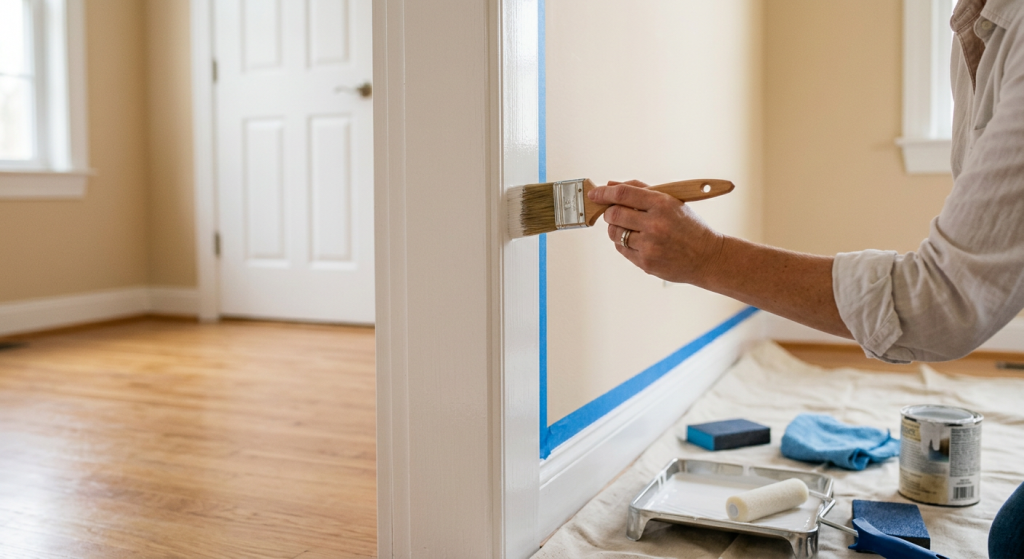
How to Paint Trim Without Brush Marks
Once the surface is prepared and the correct paint and brush are ready, concentrate on applying an even film without repeatedly disturbing it.
Step 1: Load only part of the bristles
Dip only part of the bristle length into the paint rather than burying the entire brush.
The goal is to load enough paint for a smooth application without saturating the brush or allowing paint to collect heavily near the ferrule.
Remove excess paint in a controlled way at the container edge or other appropriate working surface. Avoid aggressively scraping the brush until too little paint remains to spread smoothly.
Step 2: Lay the paint onto the trim
Apply the loaded paint to a manageable section of trim and distribute it evenly.
Use controlled strokes rather than pressing hard against the surface. Excessive pressure spreads the bristles and can produce stronger brush lines.
Aim for enough paint to form a continuous film without creating a heavy coat. An excessively thick application is more likely to develop ridges and may level or dry poorly.
Step 3: Spread the paint evenly
Work the fresh paint across the section while it remains workable.
Watch for obvious heavy spots, dry areas, runs, or ridges and correct them while the paint is still fresh. Avoid endlessly brushing back and forth in pursuit of a perfectly flat wet surface.
Good technique is less about the number of strokes and more about using each stroke purposefully.
Step 4: Finish with light strokes
After the paint is evenly distributed, reduce brush pressure and make light finishing strokes along the trim.
These final passes should smooth the freshly applied film rather than move large amounts of paint.
Do not press down in an attempt to force out every visible wet brush line. Some appearance of brush movement while the paint is fresh can diminish as the coating levels.
Step 5: Maintain a wet edge
Move along the trim in sections that are small enough to keep the adjoining paint workable.
When possible, blend the next section into an edge that has not begun setting. This helps prevent obvious transitions between areas.
Working too large an area at once can leave you trying to connect fresh paint to a section that has already become tacky.
Step 6: Stop brushing when the paint begins to set
This is one of the most important habits for avoiding brush marks.
If the brush begins to drag or the surface becomes tacky, repeated passes are unlikely to improve the finish. They can pull through the partially formed paint film and leave texture that no longer has enough working time to level.
Resist the temptation to fix every small imperfection immediately. Allow the coat to dry according to its instructions and evaluate the surface afterward.
Let the Paint Level Instead of Overworking It
Fresh trim paint needs an opportunity to level.
That does not mean every paint will become perfectly smooth on its own. The coating, surface, temperature, humidity, film thickness, and application technique all affect the result. But repeated brushing as the paint starts to dry often makes the finish worse rather than better.
Work within the paint manufacturer’s recommended application conditions. Conditions outside the specified range can change working and drying behavior.
Also avoid trying to eliminate brush marks with an excessively thick coat. More paint does not necessarily mean better leveling. Heavy application can produce sags, ridges, slower drying, and an uneven finish.
Controlled application followed by minimal disturbance is usually the better approach.
Allow Each Coat to Dry Before Recoating
A second coat can improve color uniformity and overall appearance, but it should not be rushed.
Allow the previous coat to become ready for recoating according to the manufacturer’s instructions. Drying and recoat times vary by paint formulation and application conditions, so avoid relying on one universal waiting period.
Once the coat is ready, inspect the trim before proceeding. If small dried imperfections need attention, use a preparation method appropriate for the coating and follow its recoat instructions.
Remove any resulting dust before applying more paint.
The next coat should then be applied using the same controlled approach: reasonable brush loading, an even film, light finishing strokes, and no unnecessary passes once the paint begins to set.
Common Mistakes That Leave Brush Marks
Many disappointing trim finishes come from trying too hard to make wet paint look perfect.
Common mistakes include:
- Loading the brush so heavily that paint forms ridges or runs
- Using too little paint and dragging a nearly dry brush across the surface
- Pressing hard enough to spread the bristles excessively
- Painting over dust, grease, rough repairs, or old drips
- Working sections that are too large to maintain a wet edge
- Going back over paint after it has started becoming tacky
- Applying another coat before the previous one is ready
- Expecting a new coat of paint to hide significant surface defects
If brush marks remain after the paint dries, identify whether the problem is primarily the surface or the application technique before adding another coat. Repeatedly painting over existing ridges without correcting them can preserve the texture instead of hiding it.
Final Thoughts
The key to how to paint trim without brush marks is controlling the entire process, not searching for a single special brush stroke. Clean and smooth the surface first, prime where necessary, use a suitable quality brush, apply an even coat, and finish with light, controlled strokes.
Most importantly, know when to stop brushing. Maintain a wet edge while the paint is workable, then leave it alone once it begins to set. Proper preparation, restrained brushwork, and enough drying time between coats give trim paint the best opportunity to level into a clean, smooth finish.