how to repair cracked deck boards
Cracked deck boards can sometimes be repaired when the damage is shallow, stable, and limited to the wood’s surface. Deep splits, movement, rot, failed fasteners, or damage affecting several boards usually point to replacement or professional evaluation.
Inspect the full board and nearby deck area before choosing a repair. A surface product may improve a minor defect, but it cannot make weakened or decayed wood sound again.
| Crack condition | Possible response | Main caution |
|---|---|---|
| Fine surface checking | Monitor or use an approved surface product | Confirm the crack is shallow |
| Small splintered edge | Smooth loose, sharp fibers | Do not remove sound wood |
| Short crack near a board end | Monitor or make a limited repair | Check nearby fasteners |
| Crack extending through the board | Replace the board | The board may flex or separate |
| Crack around a loose fastener | Inspect the fastening area | Do not tighten into split wood |
| Soft or rotten wood | Replace and inspect nearby areas | Do not cover decay |
| Several cracked boards in one area | Seek professional evaluation | Moisture or framing problems may exist |
What Causes Deck Boards to Crack?
Wood deck boards expand and contract as moisture levels change. Repeated wetting and drying, direct sun, freeze-thaw cycles, and natural weathering can produce shallow checks or deeper splits.
Cracks may also result from impact damage, decay, board movement, lumber installed while very wet, or fasteners placed too close to an edge or end. Overdriven fasteners can further weaken the surrounding wood.
Fine surface checking may be mostly cosmetic. Deep, widening cracks can weaken the walking surface and create sharp or raised edges.
Identify the Type of Crack
Surface checking
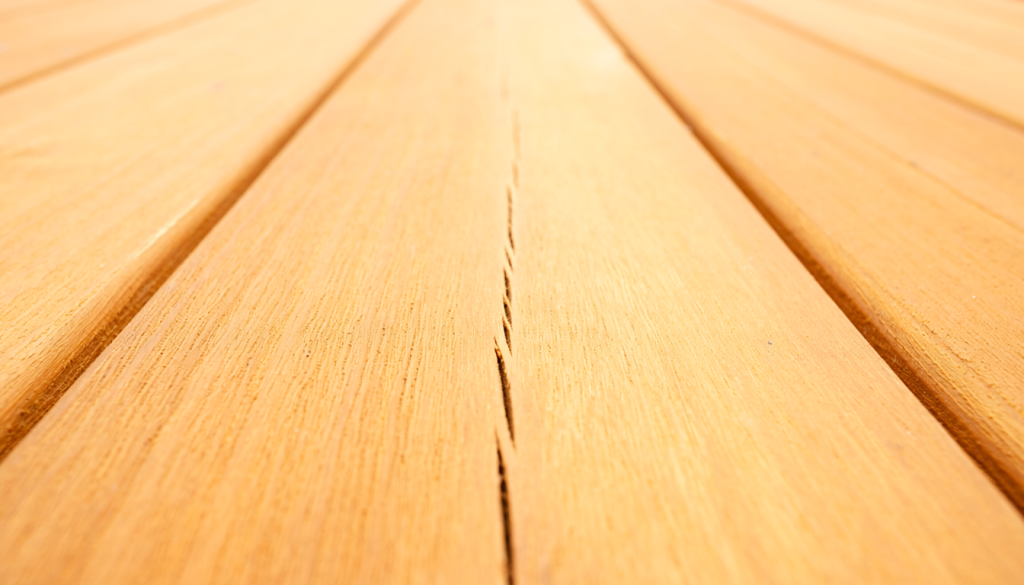
Surface checks are shallow cracks that follow the grain. They are common in weathered wood and may not extend through the board.
A stable check in hardwood may only need monitoring. Repair may be reasonable when the opening collects debris or creates a rough edge.
End splits
End splits begin near a board end and may develop around a nail or screw. They can spread as the board repeatedly absorbs moisture and dries.
A short, stable split may be monitored. A widening split or one that affects fastener holding usually calls for replacement.
Edge cracks and splinters
Edge damage affects the side or upper corner of a board. Even a small defect can snag clothing, injure bare feet, or create a trip hazard.
Loose surface fibers may be smoothed carefully. Replace the board if making it safe would require removing substantial sound wood.
Through-cracks
A through-crack extends deeply or completely through the board. The two sides may move separately, and the board may flex under normal foot pressure.
This condition generally requires board replacement rather than a cosmetic repair.
Inspect the Deck Before Repairing a Crack
Check whether the wood feels hard and whether the board remains stable during normal use. Do not bounce, pry, or place extra weight on a questionable area.
Look for soft or crumbling wood, deep splits, raised nails, loose screws, water trapped in the crack, and board movement. Observe the surrounding deck for loose railings, unstable stairs, sagging, separation from the house, or several damaged boards in one area.
Widespread rot, sagging, movement, loose railings, unstable stairs, or suspected framing damage requires professional evaluation. Do not work beneath an unstable deck.
Can a Cracked Deck Board Be Repaired?
A limited repair may be reasonable when the crack is shallow, the wood remains hard, and the board does not move. The defect should not extend through the board or continue to widen, and the supporting area should appear sound.
Replacement is generally the better choice when the board flexes or separates, fasteners no longer hold, the wood is soft, or raised edges create a trip hazard. Multiple deep cracks or damage that returns after an earlier repair also point toward replacement.
Wood moves as weather conditions change, so no surface repair can be assumed to stop future cracking permanently.
How to Repair a Small Surface Crack
Use this process only for a small, stable defect in solid wood. Do not fill deep or moving cracks.
- Inspect the entire board and surrounding deck.
- Confirm that the wood is hard, solid, and stable.
- Allow the board to dry completely.
- Clean dirt and loose material from the crack.
- Remove only splinters that are already detached.
- Lightly smooth sharp, raised edges when appropriate.
- Apply a compatible exterior wood-repair product only if it is approved for deck boards.
- Follow the product’s limits for depth, temperature, preparation, drying, and coating.
- Keep people and pets away until the repair has fully cured.
- Inspect the area after normal rain, sun, and temperature changes.
Stop if cleaning or sanding causes the crack to widen, reveals soft wood, or allows the board to move.
Choosing a Repair Product
The product must be approved for exterior horizontal wood, not merely interior woodwork or exterior trim. It must also be compatible with the deck’s paint, stain, or sealer.
Some fillers cure rigidly and may separate as the board moves. A flexible exterior repair product may suit a small surface defect when its instructions specifically allow that use.
Follow the stated limits for crack depth, preparation, temperature, curing, and refinishing. Test the appearance in an inconspicuous area because repaired spots may absorb finish differently.
Sand Sharp or Splintered Edges Carefully
Sand only loose, sharp surface fibers. Use light pressure, work with the grain, and keep the surrounding surface even.
Stop if the crack opens, the board flexes, or sound wood must be removed. Do not try to sand a deep crack until it disappears.
Remove sanding dust before applying an approved finish or repair product.
Cracks Around Nails or Screws
Cracking near a fastener may result from board movement, corrosion, overdriving, or installation too close to an edge or end. The hole may also enlarge as the board shifts.
Do not keep tightening a fastener in damaged wood, and do not reuse a split or enlarged hole. When a limited repair is appropriate, use only compatible exterior-rated deck fasteners.
Fastener requirements depend on the deck materials and support conditions, so there is no universal size for every repair. Repeated fastener failure may indicate damage below the board and should be professionally evaluated.
When the immediate problem is a raised nail in otherwise solid wood, follow the separate guidance for deck nails popping up.
When to Replace a Cracked Deck Board
Replace the board when the crack extends through most or all of its thickness, continues to widen, or allows the board to flex. Replacement is also appropriate when fasteners cannot hold or the board no longer rests properly on its supports.
Other replacement signs include soft or crumbling wood, multiple deep cracks, dangerous raised edges, and significant heat, impact, or chemical damage. Surface repairs that repeatedly reopen also suggest the board is no longer a good repair candidate.
Replacing one board will not correct damaged framing, poor drainage, or widespread deterioration.
When the damaged board is also curved, cupped, or twisted, compare the repair and replacement guidance for warped deck boards.
Do Not Use Filler to Hide Rot
Wood filler, paint, and stain do not strengthen rotten wood. Soft or crumbling boards should be replaced, nearby areas should be inspected, and the moisture source should be addressed.
Widespread decay requires professional evaluation.
Check Moisture and Drainage
Moisture can cause repaired cracks to reopen and replacement boards to deteriorate. Clear blocked gaps and remove wet leaves or debris that trap water.
Check whether rugs, planters, downspouts, or irrigation repeatedly keep one area wet. Look for standing water and poor drying beneath the deck without entering an unstable area.
Persistent moisture around supports or the need for major drainage changes calls for professional help.
Repair or Replace Cracked Deck Boards
| Condition | Limited repair or monitoring | Replace or seek help |
|---|---|---|
| Fine surface checking | Monitor if shallow and stable | Replace if it deepens or causes movement |
| Small splintered edge | Smooth detached, sharp fibers | Replace if a safe surface cannot be restored |
| Short stable end crack | Monitor or use an approved product | Replace if it widens or affects fastening |
| Crack around a failed fastener | Evaluate solid, stable wood | Seek help if failure repeats |
| Deep through-crack | Not suitable for surface repair | Replace the board |
| Soft or rotten wood | No limited repair | Replace and inspect nearby areas |
| Several affected boards | Monitor only minor checking | Seek professional evaluation |
| Sagging or structural movement | No homeowner repair | Stop using the area and seek help |
Common Repair Mistakes
Avoid these errors
- Filling a deep or moving crack
- Using interior filler or repairing damp wood
- Sanding away excessive material
- Tightening fasteners in split wood
- Reusing damaged fastener holes
- Painting over rot
- Ignoring repeated cracking
- Replacing a board without checking moisture
- Working on or beneath an unstable deck
When to Contact a Professional
Seek qualified help when you find
- Several cracked boards in one area
- Widespread rot or crumbling wood
- Boards moving under normal use
- Joists or other supports that appear damaged
- Sagging or other structural movement
- Loose railings or unstable stairs
- Separation between the deck and house
- Repeated fastener failure
- Large-scale board replacement
- Any uncertainty about the framing condition
These conditions should be evaluated before surface repairs or board replacement continue.
Final Thoughts
Fine checking and small, stable surface defects may sometimes be monitored, smoothed, or repaired with a compatible exterior product. The wood must remain hard, and the board must stay stable.
Deep splits, movement, decay, and failed fastening usually mean replacement. Check moisture and drainage before repairing or replacing a board so the problem is less likely to return.
Sagging, widespread cracking, loose railings, unstable stairs, rot, or suspected framing damage require professional evaluation.