deck nails popping up: what causes it and how to fix it
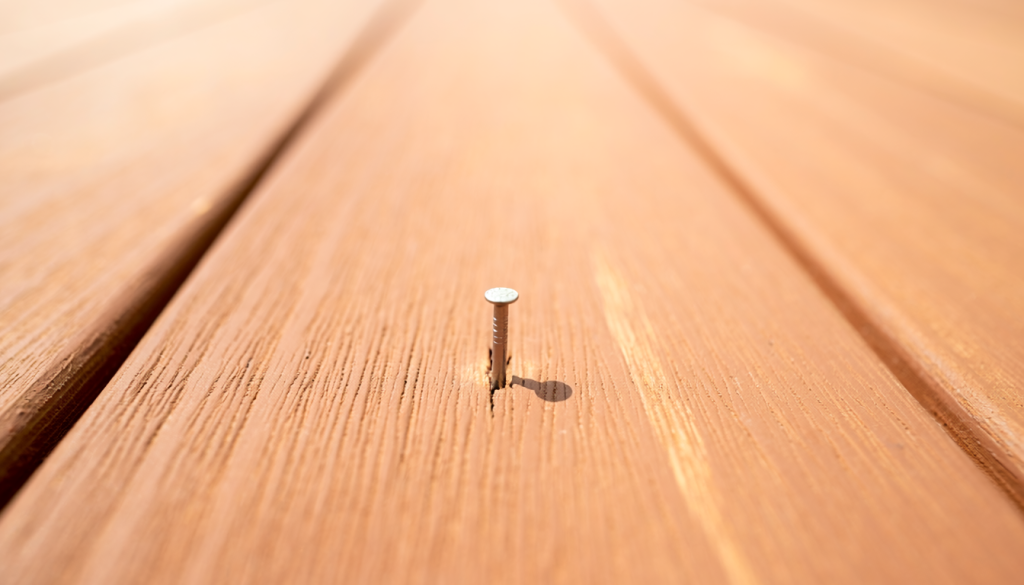
Deck nails popping up are usually caused by wood movement, moisture changes, or fasteners that have lost their grip. One slightly raised nail may be a limited surface problem, but several loose fasteners can indicate damaged decking, corrosion, excessive moisture, or movement below the board.
This guide covers only visible nails fastening wood deck boards to supporting joists. Do not attempt repairs to ledgers, framing, stairs, railings, posts, beams, brackets, or house connections. Stop using any area that feels unstable and contact a qualified professional.
| Nail condition | Possible response | Main caution |
|---|---|---|
| One slightly raised nail | Inspect and carefully reset it | Wood and support must remain solid |
| Nail rises again after being reset | Consider an approved deck screw or further evaluation | Do not keep hammering the failed nail |
| Nail surrounded by cracked wood | Replace the board or seek help | The split may continue growing |
| Nail hole is enlarged | Use a nearby sound location only when appropriate | Do not reuse the failed hole |
| Several nails rising in one area | Have the area evaluated | Movement may extend below the boards |
| Rusted or corroded fasteners | Check compatibility and surrounding conditions | Widespread corrosion needs broader evaluation |
| Soft or rotten deck board | Replace the board and inspect the support | Fasteners cannot make decayed wood safe |
Why Deck Nails Pop Up
Deck boards expand as they absorb moisture and contract as they dry. Boards may also shrink after installation. This repeated movement can gradually work nails upward.
Smooth-shank nails offer limited resistance to withdrawal. Foot traffic and slight board flexing can loosen them further, while repeated movement enlarges the hole and reduces holding strength. Corrosion, cracked boards, rot, or damaged supporting wood may also contribute.
One isolated raised nail may be a surface problem. Nails rising repeatedly or across one area can signal a larger moisture, decking, or support issue.
Inspect the Board Before Fixing the Nail
Inspect the full board and surrounding deck surface before reaching for a hammer.
Look for these warning signs
- Soft, spongy, rotten, or crumbling wood
- Cracks extending from the nail hole
- An enlarged hole or a nail that moves easily
- Board movement or raised edges
- Rust staining or several loose fasteners
- Standing water, blocked gaps, or trapped moisture
Apply only normal foot pressure. Do not jump on the board or force it to move. From above, look for sagging, unstable stairs, loose railings, or unusual movement nearby.
These checks are observational only. Widespread movement, rot, sagging, unstable stairs or railings, or suspected joist damage requires professional evaluation.
Can You Hammer a Popped Deck Nail Back Down?
A slightly raised nail may sometimes be reset when the board is solid, the nail is not badly corroded, and the supporting wood still holds it securely. Resetting can remove an immediate snag or trip point, but it may not be permanent.
If the hole has enlarged, the nail may rise again after weather changes and foot traffic. Repeated hammering can crush the wood around the head, dent the deck surface, or bend the nail.
Wear eye protection and keep fingers and feet away from the hammering area. A nail that rises again should not be repeatedly driven into the same failed hole.
How to Fix One Isolated Popped Deck Nail
This limited repair is appropriate only when the board and supporting wood appear solid and stable.
Limited repair sequence
- Inspect the full board and surrounding deck.
- Confirm that the board is solid and stable.
- Check for cracking, corrosion, and an enlarged hole.
- Clear dirt from around the nail head.
- Reset the nail only if the surrounding wood still holds it securely.
- Keep the nail head flush with the board surface.
- Stop if the nail bends, the board cracks, or the wood moves.
- Recheck the fastener after normal weather and foot traffic.
Do not bury the nail head. A deep recess can damage wood fibers and collect moisture.
When to Replace a Nail With a Deck Screw
Replacing a failed nail may be reasonable when the decking manufacturer permits screws and both the board and support remain sound. Use only an exterior-rated deck screw compatible with the lumber treatment and environmental exposure.
Do not place the screw in the same enlarged or split hole. Movement around a loose nail compresses and tears the surrounding wood fibers, so another fastener in that hole may have little holding strength. Split, soft, or decayed wood cannot hold a replacement reliably.
A nearby intact location may be suitable when the new fastener enters sound supporting wood and does not interfere with hidden metal hardware. Stop if you cannot confirm a safe fastening location from above.
Keep the screw head flush unless the decking or fastener manufacturer specifies otherwise. Do not use drywall, interior, or uncoated general-purpose screws. Repeated failure after refastening may indicate a damaged board or support below.
Before choosing a replacement fastener, compare the material, holding, corrosion, and compatibility differences between screws or nails for deck boards.
Ring-Shank Nails vs. Smooth Nails
Ring-shank nails have ridges that improve resistance to being pulled out. Smooth nails are more likely to loosen as boards expand, contract, and flex.
Any replacement nail must be exterior-rated, corrosion-resistant, and approved for the decking. Its material must also be compatible with treated lumber and the deck environment. There is no universal nail size or type for every deck.
Corrosion and Fastener Compatibility
Pressure-treated lumber can corrode incompatible metals. Coastal, poolside, damp, and frequently wet decks may require greater corrosion resistance.
Rust staining can indicate unsuitable or deteriorating fasteners. Combining different metals may also accelerate corrosion. One rusty nail may be isolated, but widespread staining or deterioration requires broader evaluation rather than spot replacement alone.
When the Deck Board Should Be Replaced
A fastener repair is not enough when the board can no longer hold securely.
Replace the board or seek professional help when
- The wood is soft, rotten, or crumbling
- A crack extends from the nail hole
- The hole is badly enlarged
- The board moves, flexes, or no longer rests properly on the joist
- Several fasteners no longer hold
- A raised edge creates a trip hazard
Prior repairs that repeatedly fail are another reason to replace the board or have the area inspected. Board replacement will not correct a damaged joist or framing problem.
A split extending outward from the fastener hole should be assessed using the repair and replacement guidance for cracked deck boards.
Check Moisture and Drainage
Recurring moisture can cause boards and fasteners to loosen again. Check for blocked gaps, wet leaves, dirt, and debris that slow drying.
Rugs, planters, storage containers, and furniture bases may trap moisture. Downspouts, irrigation, roof runoff, or standing water can keep one area wetter than the rest of the deck.
Clear ordinary surface debris and remove simple moisture traps when safe. Persistent standing water or drainage problems requiring reconstruction should be evaluated professionally.
Popped Deck Nail Repair Guide
| Condition | Limited homeowner response | Replace or seek help |
|---|---|---|
| One slightly raised nail | Inspect and reset if wood is sound | Seek help if the board moves |
| Nail rises again | Consider an approved screw in sound wood | Evaluate repeated movement |
| Split around nail | Do not reuse the area | Replace the board |
| Enlarged hole | Use a sound nearby location when appropriate | Replace if damage is extensive |
| Rusted nail | Use a compatible exterior fastener | Evaluate widespread corrosion |
| Several loose nails | Stop localized patching | Have the area inspected |
| Soft or rotten board | Keep weight off the damaged area | Replace and inspect support |
| Sagging or structural movement | Do not attempt a surface repair | Contact a qualified professional |
Common Mistakes
Avoid these repair errors
- Repeatedly hammering the same loose nail
- Driving a screw into an enlarged or split hole
- Using drywall, interior, or uncoated screws
- Burying the fastener head
- Ignoring cracked or rotten wood
- Refastening a moving board without checking support
Do not assume several rising nails are merely cosmetic, and never work beneath an unstable deck.
When to Contact a Professional
Contact a qualified professional when several nails rise in one area, boards move during normal use, fasteners repeatedly fail, or the decking is soft or rotten.
Significant corrosion, joists that appear damaged, sagging, or structural movement also require evaluation. Loose railings, unstable stairs, separation from the house, and large-scale board replacement are outside the scope of a limited surface repair.
Avoid using the affected area until it has been evaluated when movement or support conditions are uncertain.
Final Thoughts
One raised nail in solid wood may sometimes be reset or replaced with an approved exterior fastener. Do not reuse a failed, enlarged, or split hole.
Repeated movement, cracks, rot, corrosion, or several loose fasteners require further evaluation. Check for trapped moisture and poor drying that could cause the problem to return. Fasteners cannot make damaged decking, joists, or framing safe.