screws or nails for deck boards?
Choosing between screws or nails for deck boards depends on the decking material, exposure, appearance, and approved fastening system. Exterior-rated deck screws are often the practical starting choice for wood deck repairs because they resist pulling out and are easier to remove later.
Approved ring-shank nails can also work well in systems designed for them, especially when professionals use pneumatic equipment. This guide covers only visible deck boards fastened to supporting joists—not ledgers, beams, posts, railings, stairs, brackets, or structural framing.
| Deck situation | Better starting choice | Main caution |
|---|---|---|
| New wood deck boards | Exterior-rated deck screws | Confirm compatibility and required size |
| Existing boards with popping nails | Compatible deck screws | Do not reuse an enlarged or damaged hole |
| Pressure-treated lumber | Treatment-compatible screws or ring-shank nails | Incompatible metal can corrode |
| Cedar or redwood boards | Corrosion-resistant deck screws | Board ends may split or develop stains |
| Composite decking | Manufacturer-approved system | Ordinary wood fasteners may damage boards |
| Coastal or high-moisture location | Higher-corrosion-resistance fasteners | Match nearby metal hardware |
| Boards near ends that may split | Approved screws with proper preparation | Follow end-distance and predrilling guidance |
Screws or Nails for Deck Boards: The Quick Answer
Exterior-rated deck screws are often preferred for accessible homeowner repairs and many wood deck-board installations. They provide strong withdrawal resistance and controlled installation.
Approved ring-shank nails may remain suitable for certain decking systems and fast professional installation. The correct choice depends on the decking manufacturer, fastener manufacturer, lumber treatment, local requirements, and environmental exposure. Neither option is universally best.
Compare Deck Screws and Nails
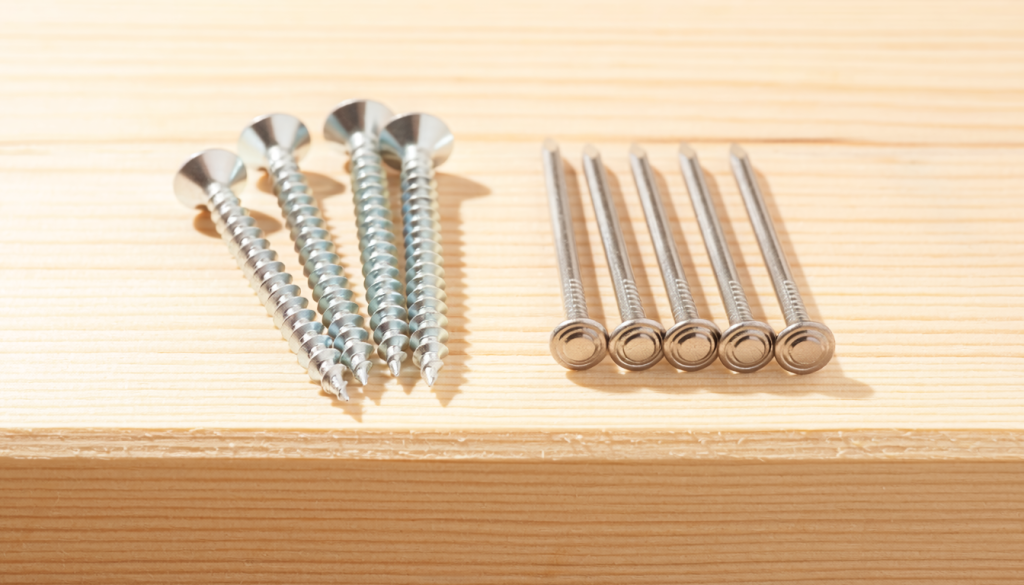
Screws use threads to resist being pulled out. Nails depend mainly on friction between the shank and wood, although ring-shank nails add ridges that improve their grip.
Nails may flex differently as boards expand, contract, and move with moisture changes. Screws generally provide better withdrawal resistance, but the wrong screw can corrode, snap, or damage the board.
Fastener material and coating matter as much as fastener type. Indoor screws, drywall screws, ordinary smooth nails, and uncoated steel fasteners are not appropriate substitutes.
Advantages of Deck Screws
Exterior-rated deck screws provide strong resistance to boards pulling away from the joists. They are also easier to back out when a damaged board must be replaced.
For small repairs, a screw gives the homeowner better control over driving speed and final head position. Properly selected screws are less likely than smooth nails to rise gradually above the walking surface.
Deck screws are available with different head styles, drives, coatings, and manufacturer-approved systems for common wood decking.
Disadvantages of Deck Screws
The word “screw” does not automatically mean the fastener is suitable for a deck. General-purpose, drywall, interior, or uncoated screws may corrode or break outdoors.
Driving a screw too deeply can crush wood fibers, collect water around the head, or damage the board surface. Over-tightening can also reduce holding quality.
Screws may split wood near board ends when preparation or spacing is inadequate. They usually take longer to install than nails driven with approved pneumatic equipment, and visible heads may affect the finished appearance.
Advantages of Deck Nails
Approved deck nails can be installed quickly with suitable pneumatic equipment. Ring-shank designs provide substantially better withdrawal resistance than smooth-shank nails.
Nails may bend more readily than some screws, allowing them to respond differently to limited wood movement. Their smaller heads may also be less noticeable.
Anyone using a pneumatic nailer should wear eye protection and follow the tool manufacturer’s instructions, including its loading, pressure, trigger, and handling requirements.
Disadvantages of Deck Nails
Smooth-shank nails can loosen as deck boards move through wet and dry cycles. Raised heads may become trip, snag, or barefoot hazards.
Removing nails can split or gouge the surrounding board, making future repairs more difficult. Hammer marks can also damage softer decking.
Like screws, nails can corrode when their metal or coating is unsuitable for the lumber or environment.
Ring-Shank Nails vs Smooth-Shank Nails
Ring-shank nails have ridges along the shank that increase withdrawal resistance after they enter the wood. Smooth-shank nails generally offer less resistance to being pulled upward.
Only exterior-rated nails approved for the decking, supporting material, and exposure should be considered. Nail diameter, length, head style, and coating must match the project requirements. There is no universal nail size for every deck.
What Type of Screw Should Be Used?
A suitable deck-board screw should be specifically rated for exterior deck use and compatible with both the decking and supporting material. For pressure-treated lumber, its coating or metal must also be approved for the treatment chemicals.
The required diameter, length, head style, and installation method depend on board thickness and the manufacturer’s fastening system.
Avoid these unsuitable fasteners
- Drywall screws
- Interior wood screws
- Uncoated steel screws
- Random leftover fasteners
- Fasteners with unknown ratings
Corrosion Resistance and Fastener Compatibility
Pressure-treated lumber can accelerate corrosion when it contacts an incompatible fastener. Hot-dip galvanized and stainless-steel fasteners are common exterior options, but the correct material depends on the treatment, exposure, and connected hardware.
Coastal, poolside, and persistently damp locations may require greater corrosion resistance. Different metals can also react when combined. Fasteners should be compatible with nearby flashing, connectors, and hardware rather than selected in isolation.
Follow the decking, lumber-treatment, and fastener manufacturers’ requirements instead of assuming one metal grade works everywhere.
Pressure-Treated, Cedar, and Redwood Deck Boards
Pressure-treated lumber
Use fasteners approved for the specific treatment chemicals. Treated boards may shrink, cup, or move as their moisture level changes, so fastening instructions should match the lumber’s condition as well as its treatment.
Cedar and redwood
These softer woods can split near board ends and may develop dark staining around unsuitable metals. Corrosion-resistant fasteners are especially important. Predrilling may be appropriate near ends when required by the decking or fastener manufacturer.
What About Composite Decking?
Composite decking usually has product-specific fastening requirements. Some products permit approved face screws, while others use hidden clips along grooved board edges. Current systems from major manufacturers illustrate both approaches.
Ordinary wood-deck screws may mushroom, distort, or otherwise damage a composite surface. An unapproved substitution may also affect product coverage. Follow the exact installation guide for the brand and product line rather than choosing a fastener based only on appearance.
Hidden Fasteners vs Face Fasteners
Face fasteners pass through the top of the board, leaving the heads visible unless an approved plug system conceals them.
Hidden systems reduce visible heads but require compatible grooved boards, clips, screws, or installation tools. Spacing and edge requirements vary by product. A hidden fastener is not automatically stronger or appropriate for every board.
Should Popping Deck Nails Be Replaced With Screws?
One raised nail may sometimes be corrected after checking that the board and joist are still sound. Repeatedly rising nails can indicate moisture cycling, board movement, enlarged holes, or deteriorated wood.
A screw driven into the same damaged hole may not develop reliable holding strength. Use a compatible exterior-rated fastener only when the surrounding board and joist remain solid.
Widespread movement, soft wood, or repeated fastener failure needs professional evaluation rather than a fastener-by-fastener repair.
For a raised fastener that has already become a trip or snag hazard, use the focused repair guidance for deck nails popping up.
Prevent Splitting and Surface Damage
Inspect the board for cracks, rot, and damaged holes before installing another fastener. Follow the required edge and end distances, and predrill when the wood or manufacturer calls for it.
Keep heads flush unless the approved system specifies another finished position. Do not bury them deeply or over-tighten until the wood crushes.
Stop if a board splits, shifts unexpectedly, or will not pull securely against the joist. Never force a fastener into hidden metal hardware.
A split that extends beyond the fastener area should be assessed using the repair and replacement guidance for cracked deck boards.
Screws vs Nails Comparison
| Factor | Deck screws | Deck nails |
|---|---|---|
| Withdrawal resistance | Usually strong | Best with ring-shank designs |
| Installation speed | Slower and controlled | Fast with approved pneumatic tools |
| Removal for repairs | Usually easier | May damage surrounding wood |
| Risk of raised heads | Generally lower | Higher with loose or smooth nails |
| Board splitting | Possible near ends | Possible from driving force |
| Appearance | Heads are usually visible | Smaller heads may be less noticeable |
| Corrosion requirements | Must match lumber and exposure | Must match lumber and exposure |
| Suitability for composite decking | Only approved systems | Usually not used unless specifically approved |
Choose Deck Screws When
- The decking manufacturer permits them
- Strong withdrawal resistance is important
- Boards may need to be removed later
- The work is a limited homeowner repair
- Compatible exterior-rated screws are available
- Controlled installation is preferred
Choose Deck Nails When
- The decking or construction system permits nails
- Approved ring-shank exterior nails are specified
- Professional pneumatic installation is being used
- Installation speed is important
- The metal and coating match the lumber and environment
Common Fastener Mistakes
- Using drywall or interior screws
- Using smooth, uncoated nails
- Ignoring treated-lumber compatibility
- Mixing incompatible metals
- Driving fasteners too deeply
- Installing too close to board ends
- Reusing enlarged or damaged holes
- Substituting fasteners on composite decking
- Fastening over rotten or unstable boards
- Assuming every deck uses the same fastener size
When to Contact a Professional
Contact a qualified deck contractor when boards are widely loose or moving, wood feels soft or rotten, fasteners repeatedly pull out, or corrosion is significant.
Professional evaluation is also appropriate for loose railings, unstable stairs, sagging, structural movement, uncertain joist condition, hidden structural hardware, large-scale board replacement, or unclear code and manufacturer requirements. Those conditions extend beyond a simple visible deck-board fastener choice.
Final Thoughts
Exterior-rated deck screws often provide strong withdrawal resistance, controlled installation, and easier board removal during future repairs. Approved ring-shank nails may remain appropriate in systems designed for them, especially during professional pneumatic installation.
The correct fastener depends on material compatibility, corrosion resistance, decking instructions, exposure, and the condition of the board and joist. No screw or nail can make rotten, unstable, or structurally damaged wood safe.