
how to use a non contact voltage tester safely
How to use a non contact voltage tester safely starts with understanding what the tool can and cannot tell you. A non-contact voltage tester can help homeowners check whether voltage may be present near a cord, outlet, switch, fixture, or device from the outside. It should never be used as permission to touch wiring, open electrical boxes, or perform electrical repairs.
Think of this tool as a warning device, not a green light. If it alerts, assume voltage may be present. If it does not alert, you still should not assume wiring is safe to touch.
For beginner homeowners, the safest use is simple: read the manual, check the battery, test the tool on a known working source, use it only on intact devices from the outside, and stop if anything seems confusing.
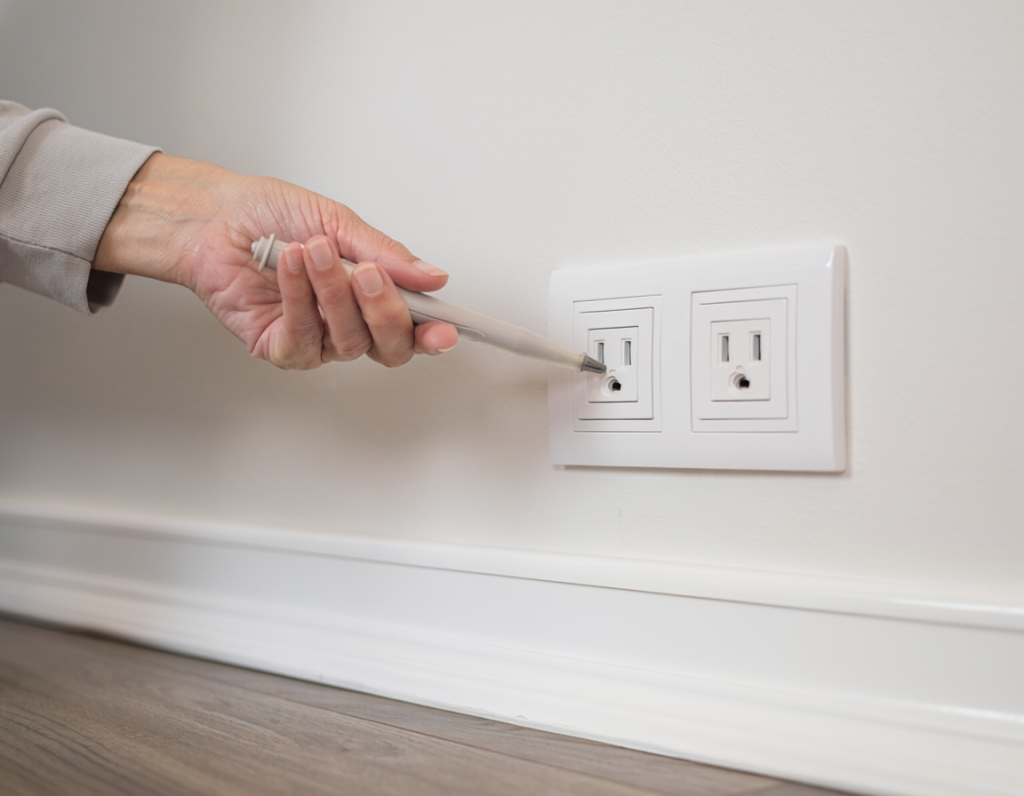
How to Use a Non Contact Voltage Tester Safely
A non-contact voltage tester is a handheld electrical safety tool. It is often shaped like a pen or small wand. The tip senses the possible presence of AC voltage near the surface of a cord, outlet, switch, fixture, or electrical device.
The “non-contact” part matters. The tool does not need metal probes pushed into wiring. For a homeowner, that makes it useful for basic awareness checks from the outside of intact devices.
A typical tester gives an alert through a light, sound, vibration, or a mix of those signals. Some testers flash red or beep when they sense voltage. Others have different colors or tones for different voltage ranges.
The exact behavior depends on the model, so the manual matters. Do not assume every tester works the same way. Some are more sensitive than others. Some are made for a wider voltage range. Some include a battery check or flashlight. Some are designed for basic household awareness, while others are made for more advanced electrical work.
The safe homeowner use is limited. You can use the tester to notice whether voltage may be present near an intact outlet face, plugged-in cord, switch area, light fixture housing, appliance cord, or similar device. You should not use it to inspect open wiring or decide that a circuit is safe to handle.
What a Non-Contact Voltage Tester Does
A non-contact voltage tester detects an electric field near the tip of the tool. In plain English, it can warn you that voltage may be nearby.
That can be helpful before you touch the outside of a questionable lamp cord, check whether an outlet area seems energized, or decide whether a strange electrical issue needs a pro. It may also help you confirm that the tester itself is working when you try it near a known working source.
It is not the same as a multimeter. It does not measure exact voltage for a homeowner in the way a meter can. It does not show load, wiring condition, grounding quality, breaker condition, or whether a device is safe to repair.
It also does not see through every material in the same way. Distance, insulation, shielding, cord position, nearby wires, and the tester’s sensitivity can all affect the alert.
| What you are checking | What the tester may show | Safest homeowner response |
|---|---|---|
| Intact outlet face | Possible voltage near the outlet | Treat the outlet as energized and do not open it |
| Lamp or appliance cord | Possible voltage near the cord | Stop using damaged cords and replace unsafe plug-in items |
| Switch area from the outside | Possible voltage near the switch | Do not remove covers or touch wiring |
| Light fixture housing | Possible voltage nearby | Stop if the fixture acts unusual and call a pro |
| Confusing or changing result | Inconsistent signal or no clear answer | Do not guess; call an electrician |
The main value is awareness. The tool can help you pause before handling something that may be energized. That pause can prevent risky guessing.
Safe Beginner Checks Before You Use It
Before using any electrical safety tool, slow down. A non-contact tester is simple, but it still depends on proper use.
Read the instructions that came with your tester. Confirm what the lights and sounds mean. Check whether the tester is made for the voltage range you may be near. Make sure the batteries are fresh enough for the tool to work.
Then test the tester on a known working source from the outside. This could be the face of a working outlet or the outside of a plugged-in cord that is already in normal use. You are not trying to repair anything. You are only confirming that the tool alerts as expected.
Keep your fingers away from the tester tip. Hold the tool by the insulated grip area. Keep the tool dry. Do not use a damaged tester, cracked tester, or tester with a loose battery cap.
Use this safe pattern for basic outside checks:
- Read the tester manual before relying on it
- Check the battery or built-in self-test feature
- Try the tester on a known working source first
- Keep your fingers behind the safe grip area
- Use it only on intact cords, outlets, switches, fixtures, or devices
- Stop if the alert is confusing, unexpected, or inconsistent
A good habit is to test the tool before and after a check. If it worked before but not after, the battery or tester may have failed during use. That means you should not trust the result.
This is also why a non-contact tester should not be your only safety step for electrical repair work. For beginner homeowners, the tool is best used to recognize risk and decide when to stop.
If you are checking a GFCI outlet specifically, this guide on how to test a GFCI outlet explains the safe TEST and RESET button routine.
What the Tester Can and Cannot Tell You
A non-contact voltage tester can tell you that voltage may be present near the tip. That is useful. But it cannot prove everything is safe.
A positive alert means you should assume the area may be energized. Do not touch wiring. Do not open the device. Do not keep investigating inside the wall or fixture.
A no-alert result is more limited. It may mean the tool did not detect voltage at that spot. It does not prove the circuit is dead. It does not prove the wiring is safe to touch. It does not prove the device was wired correctly.
False confidence is the biggest risk with this tool. Homeowners can see “no beep” and think the area is safe. That is not the right lesson. The safer lesson is: the tester is one warning tool with limits.
Several things can affect readings. Some testers may alert near nearby wires, even when the exact device you are checking is not the source. Some may miss voltage if the tip is too far away, the battery is weak, the wire is shielded, or the tester is not rated for the situation.
Moisture is another reason to stop. If an outlet, switch, fixture, extension cord, or device is wet or near water, do not test further as a homeowner project. Keep away and call a qualified electrician or the proper emergency help if there is immediate danger.
Common Mistakes to Avoid
The most common mistake is treating a non-contact voltage tester like proof that something is safe. It is not proof. It is an alert tool.
Another mistake is using the tester as an excuse to open outlets, remove switch plates, pull devices from the wall, or inspect wiring. That is outside the safe beginner scope of this article.
Do not press the tool into damaged cords or cracked devices. Do not use it around standing water. Do not use it on equipment that smells burnt, sparks, buzzes loudly, or trips a breaker. Those are stop signs.
Avoid these unsafe habits:
- Assuming “no alert” means wiring is safe to touch
- Using a tester with weak batteries
- Skipping the known-source check
- Ignoring confusing or changing alerts
- Using the tool on wet or damaged electrical items
- Treating the tester as a repair tool instead of a warning tool
Also avoid using a non-contact tester as a replacement for an outlet tester, multimeter, or professional diagnosis. Each tool has a different purpose. A plug-in outlet tester can show some basic outlet wiring conditions from the receptacle face, but it still has limits. A multimeter can measure more, but using one on circuits is not a beginner-safe task unless you are trained.
For homeowners, the best result is often not “I fixed it.” It is “I noticed a possible electrical issue and stopped before making it dangerous.”
If a plug-in outlet tester shows an open ground warning, this guide on outlet tester open ground explains what the reading may mean and when to call an electrician.
What to Look For Before Buying
A basic non-contact voltage tester can be a useful homeowner safety tool, but the cheapest option is not always the best choice. Look for a tool that is easy to understand, easy to hold, and clearly marked for household use.
A clear alert matters. Bright indicator lights and a loud audible alert are helpful, especially in garages, basements, utility rooms, and outdoor areas. A vibration alert can also be useful in noisy spaces.
Battery features are important. A tester with a battery check, self-test button, or clear low-battery warning can reduce the chance of trusting a dead tool. Some models also include an auto-off feature to save battery life.
Voltage range matters too. Some testers are single-range. Others are dual-range and can sense lower and higher voltage ranges. A dual-range tester may be useful for homeowners who want clearer sensitivity options, but the manual still needs to explain what each mode means.
Tip design can affect how easy the tester is to use around outlet faces, cords, and fixtures. A slim tip may be easier to place near small areas from the outside. A built-in flashlight can help in dark corners, but it should not be the main reason to buy.
Compare these features before choosing:
- Clear light, sound, or vibration alerts
- Battery check or self-test feature
- Voltage range that matches household use
- Easy-to-read instructions
- Comfortable grip and protected tip design
- Recognized safety listing or certification mark
Some homeowners may also want a small set of basic electrical awareness tools, such as a non-contact voltage tester and a plug-in outlet tester. These tools can support safer decisions, but they do not turn electrical repair into a beginner project.
Do not buy a tool you do not understand. If the instructions are confusing before you buy it, the tester may not be a good fit.
Final Thoughts
A non-contact voltage tester is useful because it can warn you that voltage may be present near a cord, outlet, switch, fixture, or device. Used safely, it can help homeowners pause, avoid risky contact, and decide when to call for help.
The tool has limits. It does not prove wiring is safe. It does not give permission to touch wires. It does not replace professional testing, repairs, or troubleshooting.
For beginner homeowners, the safest approach is simple: read the manual, check the battery, test the tool on a known working source, use it only from the outside of intact devices, and stop when anything seems unclear.
Call an electrician if the problem involves wiring, open boxes, repeated electrical issues, heat, buzzing, burning smells, sparks, tripping breakers, moisture, or any situation where you are unsure. A non-contact voltage tester is there to help you recognize risk, not work past it.