
kitchen sink smells bad: causes and safe checks
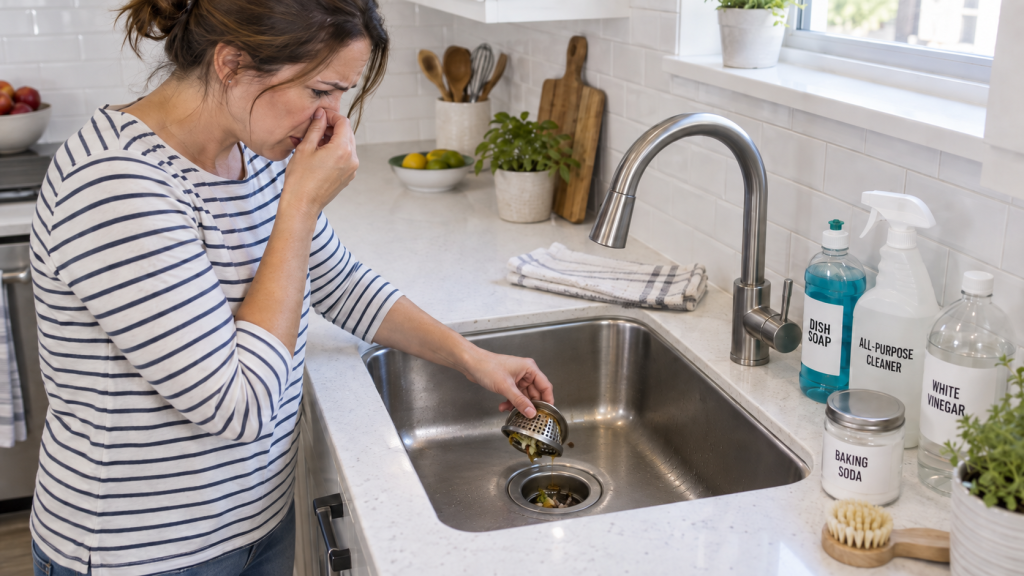
If your kitchen sink smells bad, the source is often food residue, buildup around the drain or garbage disposal, standing moisture, or another drainage-related condition. Before pouring anything down the drain, locate where the odor is strongest. Cleaning accessible residue may solve the problem, but odors accompanied by leaking, backups, slow drainage, gurgling, or smells in the water itself call for a different investigation.
| Where the odor seems strongest | Possible source | First safe check |
|---|---|---|
| Drain opening | Food or organic buildup | Clean accessible drain and strainer surfaces |
| Garbage disposal | Food around the baffle or chamber | Disconnect power and clean only accessible components |
| Cabinet below sink | Leak or damp material | Look for moisture, drips, and damaged cabinet material |
| Near dishwasher connection | Dishwasher residue or drainage issue | Determine whether odor is actually coming from dishwasher |
| Running water | Water supply or water-heating system | Collect water and smell it away from the sink |
| Several drains or fixtures | Broader plumbing issue | Look for other drainage symptoms and consider a plumber |
Where Is the Smell Actually Coming From?
Start by emptying the sink area and trying to isolate the odor without taking plumbing apart.
Smell near the drain opening, around a garbage-disposal opening if you have one, and around removable accessories such as a strainer or sink rack. Then open the cabinet below the sink and check for a separate musty or damp odor.
If a dishwasher is connected nearby, determine whether the smell is strongest inside the dishwasher rather than at the sink. A dishwasher can share drainage plumbing with a sink or disposal, but an odor clearly originating inside the appliance belongs in dishwasher-specific troubleshooting.
Also consider the water itself. Fill a clean glass with cold water and take it to another room before smelling it. Repeat with hot water if necessary. If the odor disappears away from the sink, the drain area is a more likely source. If the collected water still smells, investigate the water supply or water-heating system rather than repeatedly cleaning the drain.
That test helps narrow the source, but smell alone cannot establish whether water is safe or identify a specific contaminant.
Common Reasons a Kitchen Sink Smells Bad
Food and Organic Residue
Small amounts of food can collect around strainers, stoppers, drain openings, sink accessories, and garbage-disposal components. Grease and other organic residue can coat these areas and hold additional debris.
The sink may continue draining normally even while residue produces an odor.
Garbage-Disposal Buildup
Disposal manufacturers identify accumulated food around the grinding chamber and baffle or splash-guard area as a common source of odor.
The rubber baffle is easy to overlook because its underside may hold residue that cannot be seen from above. Cleaning it safely requires shutting off and disconnecting power before touching any accessible disposal component.
Moisture Below the Sink
Not every sink odor comes from the drain.
A slow drip can wet stored items, cabinet panels, or other materials under the sink. Dampness may create a musty smell that seems to come from the basin above.
Look for standing water, active drops, staining, swollen cabinet material, damp belongings, or visible mold-like growth. If you find an active leak, the underlying issue is no longer simply drain cleaning.
Standing Water or a Drainage Problem
Water that does not clear normally can allow food and residue to remain in the sink or drain system longer.
This article does not cover clearing slow drains, but persistent standing water, slow drainage, or backups are important diagnostic clues. Treat them as drainage symptoms rather than trying to mask the odor.
If the sink is holding water or draining more slowly than normal, see our guide to a kitchen sink draining slowly for common causes and safe fixes to try.
A Lost Water Seal
Plumbing traps normally retain water that forms a barrier between the room and the drainage system. A trap that has lost its water seal can allow unpleasant drainage odors into the room.
This is more commonly associated with fixtures or drains that have gone unused for an extended period. A regularly used kitchen sink should normally have water passing through its trap.
Do not dismantle the trap to investigate an odor. If a sewer-like smell persists despite normal use and accessible cleaning, a plumber can check the trap, connections, and venting.
Safe Checks When a Kitchen Sink Smells Bad
Step 1: Clear and clean the sink area
Remove dishes and removable sink accessories. Pick up food scraps and clean visible residue from the basin using a cleaner that is compatible with the sink finish.
This establishes whether the odor is simply coming from material sitting in or around the sink.
Step 2: Clean the strainer and accessible drain opening
Remove a strainer or stopper only if it is designed for ordinary removal without tools. Wash away food and residue from the removable part and wipe the accessible surface around the drain opening.
Do not push tools deep into the drain or dismantle drain piping.
Step 3: Clean a garbage-disposal area safely
If your sink has a garbage disposal, turn it off and disconnect its power supply before touching accessible disposal components. Unplug a plug-connected unit where accessible. A hardwired unit should be de-energized according to its manufacturer’s instructions before cleaning.
Never put your hand into the disposal grinding chamber.
Some disposal designs have a removable splash guard or baffle that can be cleaned separately. Others have different configurations. Follow the disposal manufacturer’s instructions and limit cleaning to components intended to be accessed by the homeowner.
Food buildup on the underside of the baffle or around the upper disposal area may be enough to create a persistent odor.
Step 4: Rinse according to the disposal or fixture guidance
After accessible residue has been removed and all components are correctly replaced, restore power only when the disposal area is clear.
Disposal manufacturers commonly provide specific water-flow and cleaning instructions for their units. Follow the applicable manual rather than assuming internet remedies involving ice, citrus, baking soda, vinegar, boiling water, or another material are suitable for every disposal and plumbing system.
Step 5: Check below the sink
Use a flashlight to inspect the cabinet without removing plumbing.
Look around visible drain connections, supply lines, the disposal exterior, and the cabinet floor for dripping or moisture. Check stored items and cabinet panels for dampness or swelling.
If you find an active leak, contain water when practical and address the leak rather than continuing to treat the odor as a cleaning problem.
Step 6: Test whether the water smells
Collect water in a clean glass and move away from the sink before smelling it.
If water smells normal away from the sink, concentrate on the drain and accessible sink components. If the odor stays with the water, especially at other fixtures as well, the source may be in the water supply rather than the kitchen drain.
If only hot water has the odor, the water-heating system becomes another possibility. That requires its own diagnosis rather than drain treatment.
What If the Sink Smells Like Sewage or Rotten Eggs?
A sewer-like odor is a reason to investigate, but smell alone does not tell you exactly what has failed.
Possible plumbing-related causes include a lost trap water seal, leaking or improperly functioning drainage connections, or a venting problem. Routine cleaning may remove organic buildup that smells similar, which is why locating the odor first matters.
A rotten-egg or sulfur-like odor also has more than one possible source. Organic material in a sink drain can produce an odor that seems to be coming from the water. Water itself can also develop sulfur-like odors under certain conditions, including some well-water and water-heating situations.
The glass test is useful here: collect the water and move away from the drain. If the odor follows the water, do not assume the sink drain is responsible.
If a persistent sewer-like odor clearly comes from the plumbing, especially when it affects several fixtures or appears with drainage symptoms, have a plumber investigate rather than opening traps or attempting vent repairs yourself.
Do You Need Drain Chemicals?
Usually not as the first response to an unidentified odor.
A chemical poured into the drain cannot remove grime from every accessible sink surface, diagnose a leak beneath the cabinet, determine whether a disposal baffle is dirty, or tell you whether the odor is actually in the water.
Some manufacturers publish specific cleaning procedures involving products such as baking soda. Those instructions apply to the equipment or materials for which they were written; they are not universal drain-cleaning formulas.
Avoid repeatedly adding corrosive drain cleaners, improvised chemical combinations, or stronger concentrations because an odor returns.
Do not mix cleaning chemicals unless the product labels specifically indicate the combination is safe. In particular, never mix bleach with ammonia, vinegar, or other acids, because dangerous vapors can be released.
If you have already used one drain-cleaning chemical, check its label before introducing anything else into the drain.
When the Odor Points to a Larger Problem
Routine accessible cleaning should not become an endless cycle. Further investigation is appropriate when you notice:
- A sewer-like odor that repeatedly returns
- Water backing up into the sink
- Persistently slow drainage
- Repeated gurgling from the sink or nearby fixtures
- Similar drainage problems at multiple fixtures
- Active dripping or standing water below the sink
- Damaged or visibly disconnected plumbing
- A smell that remains in water collected away from the sink
- An odor that returns quickly after accessible food residue has been removed
Gurgling and slow drainage are separate diagnostic problems. Their presence makes it less likely that continued surface cleaning alone will solve the odor.
If several fixtures are affected, sewage backs up, or you suspect a drainage or venting defect, contact a plumber rather than dismantling the under-sink plumbing.
If the drain also makes bubbling or gulping sounds, our kitchen sink gurgling guide explains what those noises can indicate and what to check next.
Common Mistakes
Avoid turning an odor problem into a cleaning-chemical experiment.
- Assuming every smell requires drain cleaner
- Masking an odor without removing accessible food residue
- Reaching into a garbage disposal
- Cleaning disposal components without disconnecting power
- Mixing household cleaning chemicals
- Ignoring damp or swollen material below the sink
- Assuming every sewer-like smell means a simple clog
- Overlooking an odor that is actually present in the water
- Repeatedly treating slow drainage as an odor-cleaning problem
The most useful next step usually comes from locating the odor, not choosing a stronger cleaner.
Frequently Asked Questions
Why does my kitchen sink smell even after cleaning it?
The odor may be coming from an area ordinary basin cleaning does not reach, such as a strainer, accessible disposal baffle, damp cabinet material, or another part of the drainage system. It may also be present in the water itself. Isolate the source before cleaning the same surface again.
Why does my kitchen sink smell like sewage?
Organic drain buildup can smell unpleasant, but a persistent sewer-like odor can also point to a trap-seal, drainage, connection, or venting problem. Do not diagnose the plumbing by odor alone or dismantle the trap. Persistent odors deserve a plumbing inspection, particularly when other fixtures are affected.
Can a garbage disposal make a kitchen sink smell bad?
Yes. If a kitchen sink smells bad and it has a garbage disposal, retained food around the baffle or accessible upper disposal area is one possible cause. Disconnect power before cleaning accessible components and never put your hand into the grinding chamber.
Can a dishwasher cause an odor near the kitchen sink?
It can contribute to odors in the same area because the dishwasher may share drainage plumbing with the sink or disposal. If the odor is clearly strongest inside the dishwasher, however, use appliance-specific cleaning or troubleshooting guidance instead of treating the sink drain.
Should I pour bleach down a smelly kitchen sink?
Bleach should not be the automatic response to an unidentified odor. First, locate and remove accessible residue and determine whether a drainage, disposal, leak, or water-supply issue is present. Never mix bleach with vinegar, ammonia, acids, or other household cleaners.
Final Thoughts
When a kitchen sink smells bad, locate the odor before trying to eliminate it. Clean accessible food and residue, handle garbage-disposal components only with power disconnected, inspect below the sink for moisture, and use a collected-water test when the odor might be coming from the water itself.
If the smell quickly returns or appears with backups, slow drainage, gurgling, leaks, multiple affected fixtures, or a persistent sewer-like odor, stop treating it as a routine cleaning problem and investigate the underlying drainage, plumbing, or water-source issue.