
Low water pressure in one faucet: causes and fixes
Low water pressure in one faucet usually points to a restriction at that faucet or its nearby supply rather than a whole-house pressure problem. Common causes include a clogged aerator, mineral buildup, debris, a partially closed shutoff valve, a kinked supply line, or an internal faucet or cartridge restriction. Start by confirming that other fixtures have normal flow, then compare the faucet’s hot and cold sides.
| What you notice | More likely area | First check |
|---|---|---|
| Both hot and cold are weak | Aerator or shared faucet outlet | Inspect the aerator |
| Only hot is weak | Hot-side supply or faucet restriction | Check hot shutoff and supply line |
| Only cold is weak | Cold-side supply or faucet restriction | Check cold shutoff and supply line |
| Several fixtures are weak | Broader plumbing issue | Stop treating it as one-faucet problem |
| Flow became weak after plumbing work | Debris or changed valve position | Check aerator and accessible valves |
Confirm the Low Water Pressure Is Limited to One Faucet
Before removing or adjusting anything, compare the weak faucet with other fixtures nearby.
Run another sink faucet, shower, or other convenient fixture. You do not need precise pressure measurements for this initial check. You are simply determining whether the problem is isolated.
If nearby fixtures have normal flow and only one faucet has low water pressure, a local restriction becomes more likely.
If several fixtures suddenly have weak flow, stop treating the problem as a faucet-level issue. The cause could be elsewhere in the plumbing or water supply and deserves broader diagnosis.
Also note whether the change happened suddenly or gradually. That timing can provide useful clues later, particularly if plumbing work or a water-service interruption occurred shortly before the weak flow started.
Compare Hot and Cold Water Flow
Next, test the hot and cold sides separately.
This simple comparison can narrow the problem substantially.
Both Hot and Cold Are Weak
If both sides produce similarly weak flow, look first for something they share.
The aerator at the end of the faucet spout is a practical first check because both hot and cold water pass through it before leaving the faucet.
Debris or mineral deposits in the aerator can restrict the outlet enough to make the problem feel like low water pressure.
If the aerator is clear, the restriction may be farther inside the faucet.
Only the Hot Side Is Weak
If cold flow is normal but hot flow is noticeably weaker, the aerator is less likely to be the only cause because the same outlet serves both sides.
Check the accessible hot-side shutoff valve and supply line for an obvious restriction or problem.
If those appear normal, debris or a restriction inside the faucet or cartridge may be affecting the hot side.
Only the Cold Side Is Weak
The same reasoning applies when hot flow is normal but cold flow is weak.
Inspect the cold-side shutoff valve and accessible supply line. If nothing obvious is wrong, the restriction may be inside the faucet.
This hot-versus-cold test helps prevent unnecessary disassembly and random parts replacement.
Check the Aerator First When Both Sides Are Weak
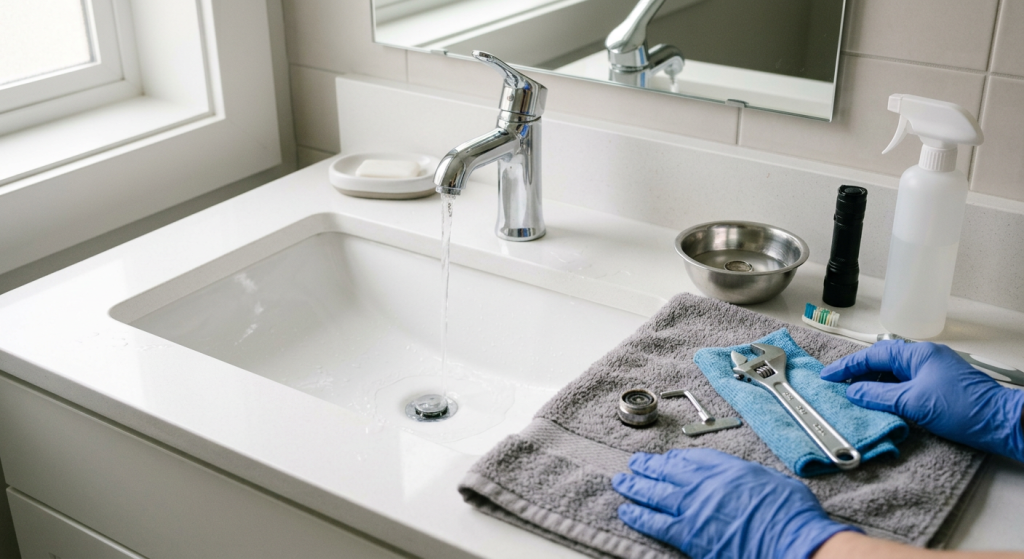
The aerator is the small outlet component at the end of many faucet spouts. It shapes the stream and often contains screens or flow-control components.
Because all faucet water passes through this relatively small outlet, debris and mineral buildup can noticeably reduce flow.
If the aerator can be safely removed, inspect it for:
- Loose sediment
- Mineral deposits
- Small pieces of debris
- Blocked screens
- Damaged components
If appropriate for the faucet, you can briefly compare the flow with the aerator removed. A great improvement in flow points toward the aerator as the restriction.
Clean loose debris and compatible mineral deposits carefully, or replace a damaged aerator with the correct type. Reinstall it gently rather than overtightening it.
Do not force an aerator that refuses to turn. If it is seized, recessed, or difficult to identify, follow Faucet Aerator Stuck: How to Remove It Safely rather than escalating to aggressive tool use.
If removing or cleaning the aerator makes little difference, continue the diagnosis.
Inspect the Faucet Shutoff Valves
Most sink faucets have hot and cold shutoff valves beneath the sink. Under normal conditions, these valves generally need to be fully open for unrestricted faucet flow.
Look at both valves and compare their apparent positions.
If only one temperature has weak flow, pay particular attention to the valve supplying that side.
A partially closed valve can restrict water without stopping it completely. This can happen after maintenance if a valve was closed and not fully reopened.
Use caution with older valves.
Do not force a shutoff valve that is stiff, heavily corroded, or difficult to operate normally. If the valve begins dripping when touched or turned, stop.
A leaking or unreliable shutoff valve is a separate plumbing problem. This article does not require rebuilding or replacing the valve to continue troubleshooting.
If you cannot reliably control the water supply, do not disconnect supply lines or begin faucet disassembly.
Look for Kinked or Damaged Supply Lines
Inspect the accessible hot and cold supply lines running between the shutoff valves and faucet.
You are looking for visible conditions that could restrict flow, including:
- A sharp kink
- A severe bend
- Crushing or pinching
- Obvious physical damage
- An unusual position following recent work
Compare the hot and cold lines if only one side has weak flow.
Keep this inspection observational unless you are comfortable working with plumbing connections and can reliably shut off the water.
Do not disconnect a supply line simply to investigate low flow if the shutoff valve is questionable or you cannot safely control the water.
Likewise, avoid randomly tightening supply connections. A connection that is not leaking should not be tightened merely because flow is weak.
Consider Recent Plumbing Work or a Water Interruption
Timing matters when troubleshooting low water pressure in one faucet.
Think about whether the problem started immediately after:
- Faucet replacement
- Shutoff-valve work
- Supply-line work
- Other nearby plumbing repairs
- A water-service interruption
- Water being shut off and restored
Small amounts of debris can sometimes move through the plumbing after work or an interruption and become trapped at a narrow point.
The aerator is an obvious place to check because debris can collect in its screens. Internal faucet passages can also become restricted.
Do not assume a newly installed faucet is defective simply because the weak flow appeared after installation. First verify the aerator, hot-versus-cold behavior, shutoff positions, and accessible supply lines.
If the problem appeared after substantial plumbing work and the simple faucet-level checks do not identify the cause, contact the installer or a qualified plumber rather than dismantling additional components without a diagnosis.
Consider an Internal Faucet or Cartridge Restriction
If the aerator is clear, the accessible supply lines look normal, and the shutoff valves are fully open and operating normally, the restriction may be inside the faucet.
Depending on the faucet design, debris or mineral buildup can interfere with internal passages or cartridge components.
This possibility becomes more relevant when only the hot or cold side is affected, but the corresponding supply line and shutoff valve show no obvious problem.
Avoid replacing the cartridge simply because it is one possible cause.
Faucet designs vary, and a cartridge replacement may require identifying the faucet model, obtaining compatible parts, shutting off the water reliably, and disassembling finished components.
The useful diagnosis at this stage is that the restriction appears to be internal after simpler external causes have been ruled out.
Low Flow at One Faucet Is Usually a Local Problem
Homeowners commonly describe weak faucet flow as low water pressure, but those terms are not always describing the same plumbing condition.
When every other fixture works normally, the home may have adequate water pressure while one faucet has restricted flow.
A clogged aerator is a simple example. Pressure may be available to the faucet, but a restricted outlet prevents normal flow.
The same principle applies to a partially closed valve, kinked supply line, or restricted internal faucet component.
That is why whole-house pressure testing is usually not the first step when the symptom is isolated to one faucet.
If the weakness spreads to multiple fixtures, however, the diagnostic scope changes.
Stop if the Faucet Begins Leaking
Low-flow troubleshooting should not create a leak.
Stop if operating a shutoff valve causes dripping, a supply line appears damaged, or a plumbing connection begins leaking during inspection.
Also stop if the faucet body or base moves noticeably while you are checking components.
Water appearing around the faucet base, handle, supply connections, or cabinet is a separate symptom that needs to be traced before continuing low-flow troubleshooting.
If moisture appears around the fixture itself, Faucet Leaking at Base: What to Check First explains how to identify the actual source before tightening or disassembling anything.
Do not keep testing a faucet while an active leak is soaking the cabinet, countertop, or flooring.
Avoid Random Parts Replacement
A weak faucet does not automatically need a new cartridge, supply line, shutoff valve, or complete faucet.
Work through the evidence in order.
First confirm that other fixtures are normal. Then compare hot and cold flow. Check the aerator when both sides are weak, inspect accessible valves and supply lines, and consider recent plumbing work.
Only after those checks should an internal faucet restriction move higher on the list.
This approach reduces unnecessary disassembly and avoids disturbing connections that are currently dry and functioning normally.
When to Call a Plumber
Qualified plumbing help is appropriate if a shutoff valve leaks, is badly corroded, or cannot be operated normally.
Professional diagnosis also makes sense when a supply line is visibly damaged, the faucet develops an active leak, or the restriction appears to be internal, and you are not comfortable disassembling the faucet.
If several fixtures have weak flow, the problem is no longer limited to one faucet and may require broader plumbing diagnosis. The same applies when weak flow began after significant plumbing work and simple faucet-level checks do not identify the cause.
Final Thoughts
Low water pressure in one faucet is often caused by a local restriction rather than a whole-house pressure problem. Confirm that nearby fixtures work normally, compare hot and cold flow, and check the aerator before moving deeper into the faucet.
If the aerator is clear, inspect accessible shutoff valves and supply lines without forcing or disconnecting questionable components. When those checks are normal, internal debris or a cartridge restriction becomes more plausible. Stop if valves leak, plumbing is damaged, or the problem expands beyond a safe faucet-level diagnosis.