
Roof Leak vs Condensation: How to Tell the Difference in an Attic
Figuring out roof leak vs condensation starts with identifying where the moisture is coming from and when it appears. If you are trying to determine whether you have a roof leak or condensation in attic spaces, pay close attention to recent weather, the location of wet areas, frost, staining, indoor humidity, and whether moisture is localized or widespread.
Roof leaks are more strongly associated with rain, snowmelt, flashing problems, roof penetrations, and other exterior water entry. Condensation is more commonly connected to warm, humid indoor air reaching cold attic surfaces, air leakage from the living space, inadequate ventilation, or improperly exhausted indoor air. Frost can be an especially useful condensation clue during cold weather.
Both problems can also occur at the same time, so no single clue should be treated as proof.
| Clue | More Likely Roof Leak | More Likely Condensation |
|---|---|---|
| Appears during or after rain | Yes | Less likely |
| Appears during snowmelt | Possible | Possible |
| Localized staining below roof penetration | Yes | Less likely |
| Widespread frost on roof sheathing | Less likely | Yes |
| Moisture worse during very cold weather | Less likely | Yes |
| Dampness near bathroom exhaust duct | Possible | Yes |
| Rusty nail tips | Less likely | Yes |
| Isolated wet roof decking | Yes | Less likely |
| Multiple attic surfaces damp | Less likely | Yes |
| Symptoms occur without precipitation | Less likely | Yes |
Roof Leak vs Condensation: The Basic Difference
A roof leak occurs when water from outside the home gets through the roofing system and enters the attic. Common sources include damaged roofing, flashing problems, roof penetrations, valleys, and other locations where rain or melting snow can find a path indoors.
Condensation begins inside the home. Warm air containing moisture moves into the attic and contacts cold surfaces such as roof sheathing, nails, rafters, or other framing. When those surfaces are cold enough, water vapor can condense into liquid water or freeze into frost.
Indoor humidity, air leakage through the ceiling, poor attic airflow, and exhaust ducts that release humid air into the attic can all contribute.
Appearance alone does not reliably separate the two. A roof leak can leave wet decking, dripping water, or stained insulation, but melting attic frost can produce many of the same symptoms. The surrounding pattern and timing usually provide better diagnostic clues.
Timing Is One of the Best Clues
When moisture appears can tell you a great deal about its likely source.
Moisture that develops during rain, shortly after a storm, during a thaw, or repeatedly when rain is driven from a particular direction raises suspicion of an exterior leak. A small roof defect may only allow water to enter under certain combinations of wind and precipitation.
Condensation tends to follow different conditions. It may worsen during very cold weather, when indoor humidity is high, or after activities that add moisture to the home, such as bathing and cooking. Repeated frost or dampness during winter, even when there has been no rain or snowmelt, is a strong reason to investigate condensation.
Timing is evidence rather than proof. Water entering through roofing materials may travel along decking, framing, nails, or other surfaces before becoming visible, so the moisture may not appear immediately after a storm.
Signs That Point Toward a Roof Leak
Roof leaks commonly create a more localized moisture pattern.
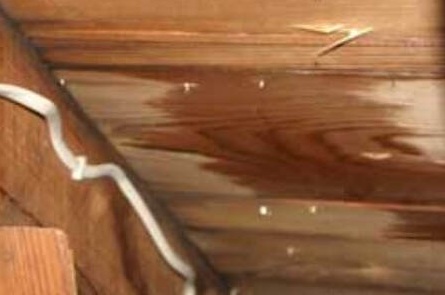
You may see one section of roof decking that is visibly wet, staining concentrated below a specific part of the roof, or wet insulation directly beneath one area. Water trails running along framing or sheathing can also indicate that outside water entered somewhere above the visible stain.
Pay particular attention to moisture that repeatedly appears after storms. Wetness concentrated near a roof penetration, valley, flashing transition, or similar vulnerable area also increases the likelihood of a leak.
The place where water becomes visible is not always the place where it entered. Water can travel before dripping, so stains should be viewed as clues rather than exact leak locations.
Roof Penetrations and Flashing
Roof penetrations and transitions deserve special attention when moisture seems connected to rainfall.
Plumbing vents, chimneys, skylights, roof vents, valleys, wall-to-roof intersections, and flashing transitions all create locations where roofing materials must direct water around an interruption or change in the roof surface.
If attic moisture repeatedly develops near one of these areas after storms, an exterior leak becomes more likely. This is especially useful when diagnosing a roof leak after heavy rain, because storm-related timing can help separate exterior water entry from moisture produced inside the home.
Homeowners should not attempt to confirm the diagnosis by walking on the roof or removing roofing materials. Inspection or repair that requires roof access is better left to a qualified professional.
Signs That Point Toward Attic Condensation
Condensation frequently affects a broader portion of the attic than a single roof leak.
Instead of one isolated wet area, you may notice dampness across sections of roof sheathing, moisture on several attic surfaces, rusty nail tips, or damp insulation spread across a wider area. Frost is another important sign, especially during prolonged cold weather.
Condensation can also appear when there has been no recent precipitation. If attic surfaces repeatedly become damp during cold periods but remain dry during rain at other times, indoor moisture becomes a stronger possibility.
This does not mean every widespread moisture problem is condensation. Exterior water can sometimes travel farther than expected. The overall pattern should be considered together with weather conditions and other observations.
Frost in the Attic
Frost can form when warm, humid air from the home reaches attic surfaces that are below freezing. It may appear on roof sheathing, nail tips, rafters, or other cold materials.
When temperatures rise, that frost can melt. The resulting water may drip onto insulation or ceiling materials and look very similar to an active roof leak even though there has been no recent rain.
This is one reason winter attic moisture can be confusing. A home may appear dry during the coldest period while frost is accumulating, then suddenly develop dripping as outdoor temperatures increase.
Winter roof conditions can also overlap with other moisture problems. Understanding how to prevent ice dams can help homeowners recognize how heat, snow, cold roof surfaces, and attic conditions interact, although attic frost and ice dams are not the same problem.
Air Leakage and Indoor Humidity
Attic condensation often begins with moisture generated inside the home.
Warm indoor air can move through openings and bypasses in the ceiling and enter the attic. Bathrooms, cooking, humidifiers, and normal household activities can all increase the amount of moisture carried by that air.
When humid air reaches cold attic surfaces, condensation or frost may develop.
This is why attic condensation should not automatically be described as only a roof-ventilation problem. Ventilation may influence conditions, but indoor humidity and air movement between the living space and attic can also be important parts of the diagnosis.
A useful observation is whether attic moisture becomes worse during periods of unusually high indoor humidity or heavy moisture production inside the home.
Ventilation and Exhaust Problems
Attic airflow can influence how readily moisture accumulates.
Blocked or inadequate ventilation may allow humid air to remain in the attic longer, increasing the chance that moisture will collect on cold surfaces. Insulation can sometimes interfere with airflow near soffit areas, although identifying or correcting a ventilation problem may require professional evaluation.
Bathroom and kitchen exhaust systems also deserve attention. These systems are intended to carry humid air outside rather than release it into the attic. A disconnected, damaged, or improperly terminated duct can introduce substantial moisture into one area.
If dampness is concentrated around an exhaust duct, that clue may be particularly important. It can create a moisture pattern that appears somewhat localized even though the water originated indoors rather than through the roof.
When Both Problems May Be Present
Finding evidence of condensation does not rule out a roof leak, and finding a roof leak does not prove that every damp attic surface has the same cause.
A home can have both problems at once.
For example, a small flashing leak may create localized staining near one roof penetration while high indoor humidity causes widespread frost elsewhere. Wet insulation might receive water from an exterior leak in one area while condensation contributes additional moisture during cold weather.
This is why diagnosing attic moisture requires looking for patterns rather than forcing every symptom into one explanation.
If one section responds closely to rain while another develops frost during cold, dry weather, the attic may have more than one moisture source.
What You Can Safely Observe
Homeowners can gather useful information without attempting roof repairs or entering hazardous areas. Useful observations include:
- Recent rain, snowfall, snowmelt, or prolonged cold weather
- Whether moisture appeared during or after precipitation
- Ceiling stains visible from inside the home
- Frost on safely visible attic surfaces
- Rust or corrosion on nail tips
- Damp insulation
- Visible exhaust-duct termination
- Whether moisture is localized or spread across several surfaces
Only inspect an attic when it has safe permanent access, adequate lighting, stable flooring or designated safe walking surfaces, and no electrical or structural hazards.
Do not crawl across exposed ceiling joists or insulation to reach a suspected wet area. Do not touch wet wiring, electrical fixtures, or other electrical components.
If safe access is unavailable, the better approach is to stop and arrange professional inspection.
Common Diagnostic Mistakes
Several assumptions can make attic moisture harder to diagnose:
- Treating every attic drip as proof of a roof leak
- Assuming frost automatically means the roof has failed
- Assuming condensation is caused only by poor ventilation
- Ignoring high indoor humidity
- Overlooking bathroom or kitchen exhaust problems
- Painting or sealing over stains before identifying the source
- Assuming every wet area has one single cause
- Inspecting during unsafe weather
- Entering an attic without safe access
The goal is to identify relationships among weather, temperature, humidity, and moisture location before deciding what repair may be needed.
When to Call a Professional
Professional evaluation is appropriate when active leaking is present, the suspected problem requires roof access, or the source remains uncertain.
You should also seek professional help when electrical components are wet, insulation or framing is extensively saturated, mold-like growth is extensive, or structural damage or sagging is visible.
Recurring condensation also deserves attention when the cause cannot be confidently identified. Persistent moisture can affect insulation and building materials even when no exterior roof leak is present.
If flashing, roof penetrations, or other exterior roofing components appear involved, avoid climbing onto the roof to investigate them yourself.
An unsafe attic should not be entered simply to confirm a diagnosis. A qualified roofer, home inspector, insulation or building-envelope specialist, HVAC professional, or other appropriate contractor may be needed depending on what the initial observations suggest.
Final Thoughts
Roof leak vs condensation is mainly a source-diagnosis problem rather than something that can be identified from one wet spot alone.
Timing and moisture pattern are two of the strongest clues. Localized moisture that repeatedly follows rain or snowmelt points more toward exterior leakage. Widespread frost, rusty nail tips, or dampness that develops during cold weather without precipitation points more toward condensation.
Both conditions can occur at the same time, so one explanation should not automatically be applied to every wet area in the attic.
Safe observation can help narrow the possibilities, but roof work, electrical hazards, unsafe attic access, structural damage, and moisture sources that remain uncertain should be evaluated by a qualified professional.