
soffit baffles: how to choose the right type and size
The right soffit baffles fit the actual framing cavity, stay open after insulation is installed, resist crushing or moisture where needed, and preserve a clear path from the soffit intake into the attic. Molded plastic and other rigid baffles generally offer greater durability, while lightweight foam or fiber products may cost less and be easier to trim. The best choice depends on the attic, not simply the nominal framing size printed on the package.
| Baffle Type | Durability | Moisture Resistance | Stiffness | Best For |
|---|---|---|---|---|
| Thin foam/polystyrene | Moderate | Generally good | Low to moderate | Basic, budget-conscious installations |
| Molded plastic | High | High | High | Areas where crush resistance matters |
| Cardboard/fiberboard | Low to moderate | Lower | Moderate | Dry attics and simple applications |
| Rigid foam-style channel | Moderate to high | Good | High | Assemblies needing a firm airflow path |
| Site-built channel | Varies | Varies | Varies | Unusual framing or custom conditions |
A soffit baffle does not create ventilation by itself. It only preserves an airflow path where a functional soffit or eave intake already exists.
What Soffit Baffles Do
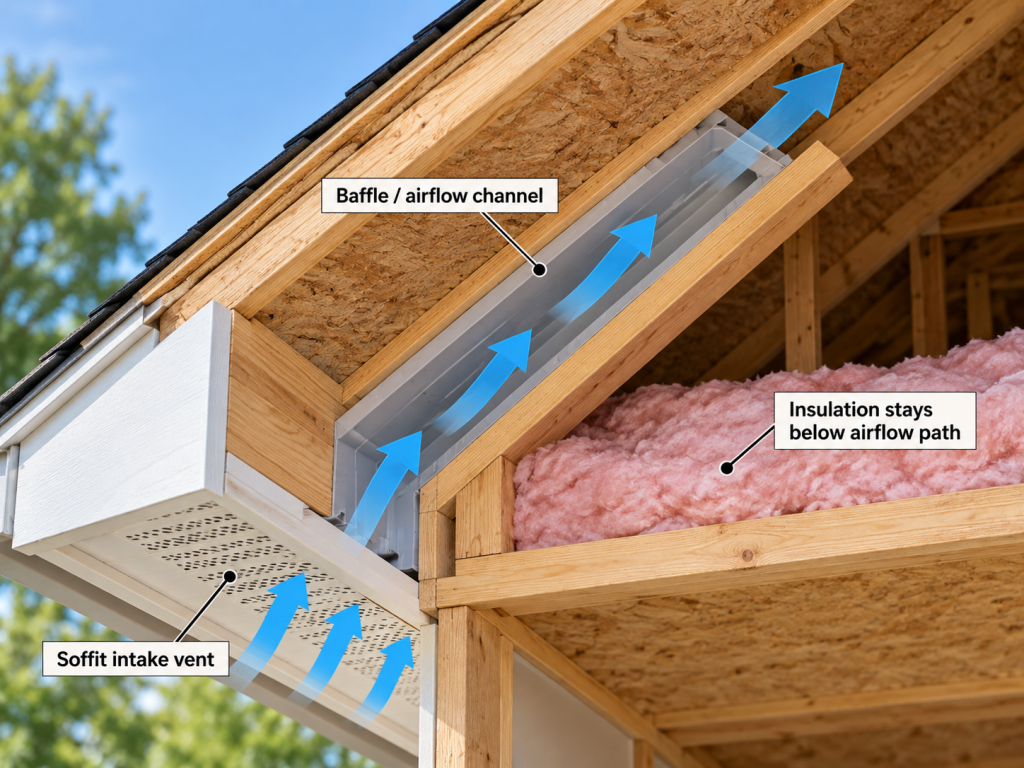
Soffit baffles are shaped channels installed near the eaves between rafters or trusses. Their job is to keep insulation from blocking the path between a soffit intake vent and the attic.
You may also see them called:
- Attic baffles
- Rafter vents
- Vent chutes
- Ventilation channels
These terms are often used interchangeably, although individual products can differ in shape, material, length, and installation method.
Without a baffle or another suitable airflow channel, loose-fill or batt insulation can extend into the eaves and cover soffit openings. That may leave an exterior vent looking functional while little air can actually enter the attic.
The baffle separates the insulation from the underside of the roof deck enough to preserve the intended airflow path.
For the broader intake-and-exhaust picture, see our attic ventilation guide to understand how soffit airflow fits into the complete system.
How to Choose Soffit Baffles by Material
Material affects how easily a baffle can be installed, how well it survives insulation pressure, and how it responds to moisture.
Thin foam or polystyrene baffles
Lightweight foam baffles are common because they are easy to carry, trim, and fit between framing members.
They can be a practical choice in a straightforward attic where the baffle will not be heavily compressed. Their lower stiffness, however, means careless installation or dense insulation can deform or crush some products.
They generally offer good moisture resistance, but durability varies with thickness and construction.
Best for: Simple attic layouts where low weight, easy trimming, and lower cost matter.
Tradeoff: A very thin product may not hold its intended shape as well as a more rigid alternative.
Molded plastic baffles
Molded plastic products are typically stiffer and more resistant to crushing than lightweight foam or fiber alternatives.
Their rigidity can help preserve the channel when insulation is installed around them. Plastic also handles incidental attic moisture better than moisture-sensitive fiber products.
They may be less forgiving when an attic has irregular framing, unusually tight cavities, or awkward eave geometry because the material does not conform as easily.
Best for: Homeowners who value durability, moisture resistance, and a channel that is less likely to collapse.
Tradeoff: More rigidity can make trimming or fitting irregular spaces less convenient.
Cardboard or fiberboard baffles
Fiber-based baffles can provide a firm channel at relatively low cost and may be easy to cut or shape for simple framing.
Their main limitation is moisture sensitivity. In an attic with recurring condensation, roof leaks, or damp materials, a fiber product may be a poor choice unless the product is specifically designed for those conditions.
Best for: Dry attics with straightforward framing where moisture exposure is unlikely.
Tradeoff: Generally less moisture tolerant than plastic or foam alternatives.
Rigid foam-style vent channels
Some assemblies use stiffer foam products that create a more defined ventilation space between the insulation and roof sheathing.
Their added rigidity can help prevent compression and may be useful where insulation depth makes maintaining the channel more challenging.
Fit and fastening requirements vary, so homeowners should confirm that the product suits the framing depth and intended insulation system.
Best for: Applications where a firm, crush-resistant channel is desirable.
Tradeoff: Thicker or more rigid products may require more careful sizing in shallow or irregular cavities.
Site-built channels
Custom channels can sometimes be created from suitable rigid materials when manufactured baffles do not fit unusual framing.
This is not automatically the cheaper or easier option. The material still needs to remain securely positioned, tolerate attic conditions, and maintain an appropriate airflow path without interfering with the roof assembly.
Custom solutions make the most sense when standard products clearly do not fit the existing framing. Structural framing should never be cut or altered simply to make a baffle fit.
How to Choose the Right Baffle Size
Do not buy soffit baffles based only on labels such as “for 16-inch framing” or “for 24-inch framing.”
Those numbers normally refer to framing layout rather than the exact open cavity between rafters or trusses. Actual spacing can vary because of lumber width, construction tolerances, framing details, or repairs.
Measure the cavity before buying.
Check the actual cavity width
Measure between the framing members where the baffle will sit.
A baffle that is too wide may buckle, fold, or fail to seat properly. One that is too narrow may leave gaps or be difficult to secure in a position that protects the airflow path.
Common framing layouts include 16-inch and 24-inch centers, but the usable opening will be narrower than the nominal center-to-center dimension.
Check rafter depth and eave geometry
Width is only part of the fit.
Rafter depth, roof pitch, insulation thickness, and the shape of the eave affect how much room is available for both insulation and an airflow channel.
A shallow roof assembly may provide less space than expected. A product that fits comfortably in one attic may interfere with insulation or the roof deck in another.
Do not assume one universal air-gap depth is appropriate for every roof. The required space can depend on the roof assembly and applicable requirements.
Check the baffle length
The channel needs to extend far enough for the intake air to move from the soffit area beyond the insulation at the eaves.
If the baffle ends too low, insulation may still block the path farther upslope.
Some attics may need more than one section per rafter or truss bay depending on product length, insulation depth, and how far the channel must continue before it opens freely into the attic.
What Makes a Good Airflow Channel
A successful soffit baffle should protect a continuous path from a usable intake opening into the attic.
That means the finished channel should:
- Align with the soffit or eave intake
- Keep insulation out of the intake opening
- Remain open after insulation is installed
- Extend above the top of the insulation where needed
- Stay securely positioned
- Avoid crushing, folding, or sagging
A baffle cannot compensate for a solid soffit with no intake vent. Before buying a large quantity, confirm that air actually has a way to enter at the eaves.
If you need to estimate how much intake and exhaust vent area the attic may require, use our attic ventilation calculator guide.
Product Features Worth Comparing
Products that appear similar on the shelf can behave differently once they are surrounded by insulation.
Stiffness and crush resistance
A more rigid baffle may be worth paying more for when loose-fill insulation or crowded eave conditions could push against the channel.
A lightweight product may be sufficient if the cavity is easy to access and the insulation can be kept clear without deforming it.
Moisture resistance
Attics should not be routinely wet, but condensation or small amounts of incidental moisture can occur.
Plastic and foam products generally tolerate moisture better than untreated fiber-based materials. If the attic already has recurring dampness, correct the moisture problem rather than choosing a baffle simply because it can withstand being wet.
Ease of trimming
Irregular framing can make a trimmable baffle easier to work with.
Foam and fiber products are often easier to cut, while molded plastic may require more effort but can retain its shape better afterward.
Trimming should never involve cutting rafters, trusses, roof sheathing, or other structural components.
Fastening method
Check how the manufacturer expects the baffle to be secured and whether that method works with the existing framing and access.
A baffle that fits correctly but cannot be secured reliably may shift when insulation is placed around it.
Temperature tolerance
Attics can experience wide temperature swings. Choose products intended for attic or roof-cavity use rather than improvising with unrelated sheet materials.
Quantity and packaging
Compare the usable length of each baffle, not just the number of pieces in a package.
A lower-cost package may require more pieces per bay, while longer products may cover the same area with fewer joints.
How Many Soffit Baffles Do You Need?
Quantity planning starts with the attic layout rather than the total square footage of the house.
First determine which rafter or truss bays are intended to receive intake airflow. Then determine how far the channel needs to extend through each bay and compare that distance with the length of the baffle product.
For example, a bay requiring a longer protected channel may need multiple pieces if the product is short.
Do not automatically assume every framing bay needs a baffle. Intake vent location and attic design determine where airflow paths are required.
It is also worth buying enough material to account for damaged pieces, trimming, or unusual cavities rather than discovering midway through the job that the package count was based on ideal conditions.
Common Soffit Baffle Buying Mistakes
The most common mistakes usually involve fit or misunderstanding what the baffle actually does.
Avoid:
- Buying by nominal framing size alone. Measure the actual cavity.
- Choosing an overly flimsy product. A collapsed baffle no longer protects the airflow channel.
- Using moisture-sensitive material in a damp attic. Address moisture and choose material appropriate for the environment.
- Stopping the channel too low. The path should remain open beyond the insulation at the eaves.
- Leaving the soffit opening exposed to insulation. The baffle should help prevent insulation from blocking usable intake.
- Assuming every bay needs one. Match baffle placement to the actual intake layout.
- Buying too few pieces. Account for product length and the number of bays being served.
- Ignoring blocked or nonexistent intake. A baffle cannot move air through a soffit that has no functional vent.
- Assuming a baffle creates ventilation. It preserves a pathway; it does not supply the intake opening.
What Successful Placement Requires
This is primarily a product-selection decision, but choosing correctly means understanding what the finished baffle needs to accomplish.
The intake opening should be clear, the baffle should align with it, and the channel should remain open above the insulation. The product also needs secure support so it does not shift or collapse when insulation is installed.
Installation should only be attempted where the attic provides safe footing and access. Do not walk on unsupported ceiling drywall, work around exposed or questionable wiring, or disturb vermiculite or suspected asbestos-containing insulation.
If proper placement would require extensive insulation removal, unsafe crawling, structural modifications, or work from the roof, use a qualified professional.
Frequently Asked Questions
Do I need soffit baffles in every rafter bay?
Not necessarily. Baffle placement should correspond to the attic’s usable soffit intake and ventilation layout. Installing one in a bay with no functional intake opening does not create ventilation.
What size soffit baffle do I need?
Choose a product that fits the actual clear width between framing members and works with the available rafter depth, insulation level, and eave geometry. Measure the cavity rather than relying only on nominal framing spacing.
Are foam or plastic soffit baffles better?
Neither is best for every attic. Plastic is generally more rigid and crush-resistant, while lightweight foam can be easier to trim and may cost less. Moisture exposure, access, framing, and insulation pressure should guide the choice.
Can soffit baffles touch the roof deck?
The product should be used in the configuration intended for the roof assembly and manufacturer. The important requirement is preserving the necessary ventilation channel without improvising a universal spacing rule.
Do soffit baffles work if there are no soffit vents?
No. A baffle preserves an airflow route from an existing intake opening. It does not create an intake vent through a solid soffit.
How far should a soffit baffle extend?
It should extend far enough to keep the airflow path open past insulation that could otherwise block the eave area. The needed length depends on insulation depth, roof geometry, and the attic assembly rather than one universal measurement.
Final Thoughts
Choose soffit baffles by actual cavity size, durability, moisture resistance, and how well they maintain a clear intake path above the insulation. More rigid products can be worth the added cost where crushing or moisture is a concern, while basic lightweight products may work well in straightforward, dry attic conditions.
Measure before buying, confirm that usable soffit intake actually exists, and avoid choosing a product simply because its nominal size appears to match the framing.