vinyl plank vs engineered hardwood: which is better?
Choosing between vinyl plank vs engineered hardwood usually comes down to priorities. If water tolerance, easy maintenance, and practical everyday use matter most, luxury vinyl plank often has the advantage. If you value a genuine wood surface, natural aging, and possible future refinishing, engineered hardwood may be the better fit.
Neither material is automatically better. Product quality, room conditions, subfloor preparation, installation method, household activity, and how long you expect to keep the floor can all change the decision.
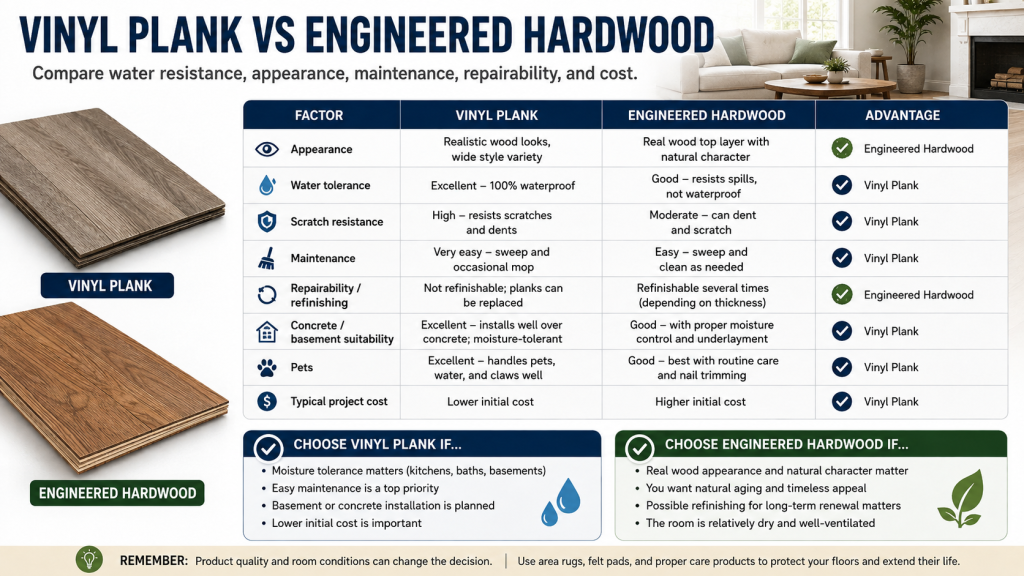
| Factor | Vinyl plank | Engineered hardwood | Advantage |
|---|---|---|---|
| Appearance | Printed wood-look surface with many styles | Genuine wood wear layer with natural variation | Engineered hardwood |
| Water tolerance | Strong for many products | More moisture-sensitive | LVP |
| Scratch resistance | Good, but varies by wear surface | Real wood can scratch | Depends on product/priority |
| Dent resistance | Can dent under heavy point loads | Can dent depending on species and construction | Depends on product |
| Comfort | Resilient and relatively forgiving | Natural wood feel | Depends on priority |
| Maintenance | Generally easy | Requires more moisture-conscious care | LVP |
| Repairability | Damaged planks may be replaceable | Boards may be repairable; some floors can be renewed | Engineered hardwood |
| Refinishing | Cannot be sanded and refinished | Possible on some products | Engineered hardwood |
| Concrete suitability | Common when product requirements are met | Possible with approved products and systems | LVP |
| Below-grade suitability | Common with suitable products | More limited and product-specific | LVP |
| Pets | Easy cleanup; may still scratch | Can scratch but may age naturally | Depends on priority |
| Installation flexibility | Floating and glue-down options | Floating, glue-down, or fastened options | Depends on product |
| Expected service life | Can provide long practical service | May offer greater renewal potential | Depends on construction |
| Typical project cost level | Often lower | Often higher | LVP for lower initial cost |
If existing flooring, sheet goods, tile, mastics, or adhesives may contain asbestos, do not sand, grind, scrape, cut, or demolish them. Stop disturbing suspect material and obtain appropriate evaluation or testing before removal work continues.
Vinyl Plank vs Engineered Hardwood at a Glance
These two floors can create a similar wood-look appearance from across a room, but they are fundamentally different materials.
Vinyl plank
Luxury vinyl plank, or LVP, typically uses synthetic layers with a printed decorative surface and a protective wear layer. Many products use rigid cores and click-lock construction.
That synthetic construction helps explain LVP’s strong resistance to everyday moisture and its relatively simple maintenance.
Engineered hardwood
Engineered hardwood has a genuine wood wear layer over a layered core. The visible surface is real hardwood rather than a printed reproduction.
That real wood surface gives engineered flooring natural variation and aging characteristics, while its layered construction generally provides greater dimensional stability than solid hardwood.
This basic material difference influences nearly every other comparison, including moisture tolerance, repairability, refinishing, and long-term appearance.
Appearance and Real-Wood Feel
Appearance is one of engineered hardwood’s clearest strengths.
LVP uses printed images to recreate wood grain, color, knots, and other natural features. Better products can look convincing, especially when texture is coordinated with the printed pattern.
Vinyl also provides a broad range of colors and styles. Homeowners who want a specific visual effect without sourcing a particular wood species may appreciate that flexibility.
The main limitation is repetition. Because designs are printed, the same grain pattern may appear on multiple planks. Careful layout can reduce how noticeable this becomes.
Engineered hardwood uses actual wood as its visible surface. Each board naturally varies in grain, color, and character. The floor can also develop the small scratches, color changes, and patina associated with real wood.
That does not mean every engineered hardwood floor looks expensive or every LVP floor looks artificial. Finish quality, plank dimensions, texture, color, and overall product construction influence both.
If authentic wood appearance is the main priority, engineered hardwood generally has the advantage.
Water Resistance
Moisture is one of the biggest practical differences between these materials.
Many LVP products tolerate surface water very well. Some are marketed as waterproof because the planks themselves use materials that resist swelling or deterioration during water exposure.
That makes vinyl appealing in kitchens, basements, entry areas, and households where spills are common.
A water-tolerant plank does not make the complete installation waterproof. Water can still reach the subfloor around edges, transitions, penetrations, cabinets, or other openings. Moisture underneath the floor can damage materials even when the vinyl itself survives.
Engineered hardwood is more dimensionally stable than solid hardwood, but it still contains genuine wood and other moisture-sensitive components.
Excess water can contribute to:
- Staining
- Swelling
- Edge damage
- Finish deterioration
- Plank movement
- Permanent dimensional changes
For rooms where significant moisture exposure is realistic, LVP generally has the advantage.
If water exposure is one of your biggest concerns, compare the best waterproof flooring options before making the final choice.
Scratch and Dent Resistance
Scratches and dents are separate types of damage, and neither material is immune to both.
LVP has a protective wear surface designed to handle ordinary household traffic. Depending on product quality, it can resist everyday abrasion from shoes, pets, and furniture reasonably well.
Sharp grit, dragging furniture, pet claws, or other concentrated contact can still scratch the surface.
Vinyl can also dent. Heavy furniture, appliance feet, or other concentrated loads may compress some products, particularly when the flooring or supporting surface is less rigid.
Engineered hardwood has a real wood surface, so scratches and dents are part of the ownership tradeoff. Species, finish, wear-layer construction, and household conditions all affect how visible that wear becomes.
Some homeowners dislike any mark in a wood floor. Others prefer the way genuine wood develops character over time.
Engineered hardwood may also provide better repair or renewal options later, depending on its construction. That can matter more than initial scratch resistance for long-term ownership.
Comfort and Sound
Both materials are generally comfortable enough for bedrooms, living rooms, and family spaces, but they feel different.
LVP has a somewhat resilient feel and is usually softer underfoot than tile. Some floating products have attached pads, while others use approved underlayment depending on the installation system.
The sound of a vinyl floor can vary based on:
- Core construction
- Attached pad
- Underlayment
- Subfloor
- Installation method
- Room acoustics
Engineered hardwood provides the feel of real wood underfoot. Depending on whether it is floating, glued, or fastened, the sound can also vary considerably.
Neither material is universally quieter. The complete floor assembly matters more than the material name alone.
Maintenance and Cleaning
For routine maintenance, LVP generally has the simpler requirements.
Most vinyl plank floors need regular sweeping or vacuuming and occasional damp cleaning with products approved for the floor. They do not need sanding or refinishing.
Engineered hardwood also benefits from regular dry cleaning, but homeowners need to be more careful with moisture. Standing water and overly wet cleaning methods can damage wood flooring.
Finish-specific care may also be important.
Some engineered floors can eventually be recoated or refinished, which adds maintenance options that vinyl does not have.
This highlights an important difference: lower maintenance and longer service life are not necessarily the same thing.
Vinyl may require less ongoing care, while a repairable engineered floor may offer more options for renewal after years of wear.
Repairability and Refinishing
Repairability can significantly change the long-term value of a floor.
LVP cannot be sanded and refinished. If the surface is deeply scratched, gouged, or permanently stained, the usual repair is replacement of the affected plank when practical.
How easy that is depends on the installation. A damaged floating plank in the middle of a room may require disassembling part of the floor. Glue-down systems involve different repair considerations.
Matching replacement material can also become difficult if the flooring has been discontinued.
Engineered hardwood may offer more renewal options.
Some products have enough real wood in the wear layer to allow sanding and refinishing. Others use thin veneers that provide little or no practical refinishing potential.
Individual boards may sometimes be repaired or replaced as well.
If refinishing matters to you, verify the wear-layer construction of the exact engineered product rather than assuming all engineered hardwood can be renewed.
If you already have hardwood and are weighing restoration against replacement, see our guide on when to refinish or replace hardwood floors.
Which Lasts Longer?
There is no reliable universal winner.
Product quality makes a major difference for both materials. Installation, moisture, household traffic, subfloor conditions, maintenance, and damage can shorten the life of either floor.
A quality LVP floor installed in suitable conditions can provide many years of practical service. Its main long-term limitation is that the decorative surface cannot be renewed once it wears through or becomes severely damaged.
Engineered hardwood may have greater renewal potential if it has a substantial wear layer. A floor that can be recoated or refinished may remain useful even after its original finish has worn significantly.
That potential disappears with some thin-veneer products.
Think about two different questions:
- How well will the floor resist initial wear?
- What can be done when visible wear eventually occurs?
LVP may perform very well at the first. Quality engineered hardwood may offer more options for the second.
Vinyl Plank vs Engineered Hardwood Over Concrete
Both flooring types can be installed over concrete in appropriate systems, but moisture conditions deserve careful attention.
LVP is frequently used over concrete when the slab and product requirements are satisfied. Some products have attached pad, while others require approved underlayment or separate moisture-control measures.
Attached pad does not automatically satisfy every vapor-control requirement.
Engineered hardwood can also be suitable over concrete when the specific product and installation method are approved. Floating and glue-down systems are available for some engineered floors.
Because wood remains sensitive to moisture, slab conditions and manufacturer requirements deserve particular attention.
Do not install either material over persistent, unexplained concrete moisture and assume the finish flooring will solve the problem.
Which Is Better for Basements?
For many finished basements, LVP is the more practical choice.
Below-grade spaces have a higher likelihood of slab moisture, humidity, plumbing leaks, or other damp conditions. Vinyl’s synthetic construction generally gives it an advantage where moisture exposure is the deciding factor.
That does not mean every LVP product is automatically suitable for every basement. Slab conditions, moisture requirements, and installation instructions still apply.
Engineered hardwood may be possible when:
- The specific flooring permits below-grade use
- Moisture conditions meet requirements
- The approved installation system is used
- The basement does not have an unresolved moisture problem
If moisture risk is uncertain or significant, LVP usually provides the more forgiving choice.
Which Is Better for Kitchens?
Both materials can work in a kitchen, but they involve different compromises.
LVP
Advantages include:
- Strong surface-water tolerance
- Easy cleanup
- Comfortable feel for standing
- Practical handling of routine spills
- Relatively low maintenance
The main concern is that water can still travel underneath the flooring during a larger leak.
Engineered hardwood
Advantages include:
- Genuine wood appearance
- Natural board variation
- Visual continuity with nearby wood-floored rooms
- Possible repair or refinishing options
The tradeoff is greater vulnerability to leaks from sinks, refrigerators, dishwashers, and supply lines.
Engineered hardwood is not automatically inappropriate for kitchens. Homeowners who value real wood may reasonably accept the additional moisture risk.
Which Is Better for Living Rooms and Bedrooms?
In dry living rooms and bedrooms, moisture tolerance becomes less important, so personal priorities carry more weight.
Engineered hardwood may appeal if you want:
- Genuine wood underfoot
- Natural variation
- A surface that can develop patina
- Possible future refinishing
- Long-term repair potential
LVP may appeal if you prefer:
- Easier routine maintenance
- Strong resistance to everyday spills
- Consistent appearance
- Lower initial project cost
- Less concern about occasional household moisture
Pets, sunlight, furniture, and how long you expect to own the home can also influence the decision.
Which Is Better for Pets?
Pets create a combination of scratch, moisture, traction, comfort, and cleaning concerns.
LVP handles water bowls and accidents relatively well and is generally easy to clean. It can still scratch, particularly from grit or active dogs with long claws.
Engineered hardwood may show claw marks more readily because the surface is real wood. Some homeowners accept those marks as part of natural aging, especially when future repair or refinishing is possible.
Traction varies with the surface finish of either material. Very smooth flooring can be harder for some older pets to navigate.
Neither option is scratch-proof.
If pet accidents and water are the main concern, LVP has an advantage. If long-term repairability and natural appearance matter more, engineered hardwood may still be worth considering.
Which Is Better for Homes With Children?
Children expose floors to spills, dropped toys, furniture movement, crafts, food, and frequent cleaning.
LVP can be attractive for family spaces because it tolerates routine spills well and requires relatively simple care.
Engineered hardwood may scratch and dent more readily, but it can provide a natural surface that some homeowners are comfortable allowing to age.
Dropped objects can damage either material in different ways. Vinyl may dent or gouge, while wood may dent or scratch.
For households expecting several years of hard use, consider not only which surface resists damage initially but also how easily damaged areas can be repaired later.
Installation Differences
Installation flexibility exists with both flooring types.
LVP
Depending on the product, vinyl plank may use:
- Click-lock floating installation
- Glue-down installation
Engineered hardwood
Depending on the floor and subfloor, engineered hardwood may use:
- Floating installation
- Glue-down installation
- Fastened installation
For both materials, subfloor flatness and stability matter. Large dips, excessive movement, damage, or persistent moisture should not simply be covered.
Floor height and transitions also deserve attention, especially when the new flooring meets tile, carpet, exterior doors, stairs, or adjoining rooms.
The exact product instructions control the installation method and supporting layers.
Cost: Vinyl Plank vs Engineered Hardwood
LVP often has a lower initial material and total project cost than engineered hardwood, but material price alone does not tell you what the project will cost.
Compare:
- Flooring material
- Removal of the existing floor
- Subfloor preparation
- Underlayment
- Moisture-control requirements
- Trim
- Transitions
- Professional labor
- Future repairs
- Replacement difficulty
- Refinishing potential
A less expensive floor can become a costly project if extensive floor preparation is necessary.
Engineered hardwood generally costs more upfront, but a product with a substantial wear layer may provide long-term value if it can be renewed rather than completely replaced.
That benefit should be confirmed for the specific flooring rather than assumed from the engineered-hardwood label.
Which Flooring Adds More Long-Term Value?
There is no guaranteed resale winner.
Some buyers strongly prefer genuine wood and may view engineered hardwood favorably when it is in good condition and suits the home.
Other buyers may prefer LVP because it provides modern appearance, easy care, and practical moisture tolerance.
Long-term appeal depends on:
- Local buyer preferences
- Installation quality
- Flooring condition
- Consistency between rooms
- Style
- Material quality
- How well the floor fits the home
A damaged premium material can be less appealing than a well-installed practical floor in excellent condition.
Choose based primarily on how the flooring will serve your household rather than assuming either material guarantees a specific increase in home value.
Quick Decision Guide
| Choose vinyl plank if… | Choose engineered hardwood if… |
|---|---|
| Moisture tolerance is a major priority | Genuine wood appearance is a major priority |
| You want relatively easy maintenance | You value natural grain and aging |
| You are flooring a suitable basement | Future refinishing potential matters |
| Household spills are frequent | Long-term repairability matters |
| Lower initial project cost is important | The room is relatively dry |
| You want a practical floor for pets or children | You are comfortable with normal wood scratches and dents |
Product-specific requirements can override these general guidelines. A high-quality engineered floor and an entry-level LVP product may compare very differently from two products at similar quality levels.
Questions to Ask Before Choosing
Before making the final decision, ask:
- Is the room likely to experience regular moisture?
- Is the flooring going over concrete?
- Is the room below grade?
- Are pets or children likely to create heavy wear?
- Do I specifically want genuine wood?
- How important is a nearly scratch-free appearance?
- Do I want the option to refinish the floor later?
- How much maintenance am I willing to handle?
- How long do I expect to keep the flooring?
- Can damaged planks or boards be repaired or replaced?
- What is the complete project cost, not just the flooring price?
- What does the manufacturer require for the subfloor, moisture control, underlayment, and installation method?
Answering these questions usually makes the better choice much clearer.
When Professional Evaluation Makes Sense
Choosing between these two flooring types does not normally require a contractor. Problems with the existing floor system sometimes do.
Consider qualified evaluation when you find:
- Persistent slab or basement moisture
- Significant subfloor damage
- Structural movement
- Major unevenness
- Rot
- Large or moving concrete cracks
- Extensive previous water damage
- Installation conditions beyond your skill level
- Suspected asbestos-containing flooring, mastic, or adhesive
If older flooring or adhesive may contain asbestos, stop disturbing it. Do not sand, grind, scrape, cut, or demolish suspect material until it has been appropriately evaluated or tested.
Final Thoughts
The vinyl plank vs engineered hardwood decision is usually a choice between practical moisture tolerance and maintenance on one side and genuine wood appearance and renewal potential on the other. LVP often makes more sense for moisture-prone or hard-working spaces, while engineered hardwood can be worth the additional care where natural wood is the priority.
Compare the specific products as well as the material categories. Construction quality, wear layer, room conditions, subfloor, installation requirements, repair options, and total project cost can matter as much as the words “vinyl” or “engineered hardwood” on the label.