
AC Coil Cleaner Spray vs foam: which works best?
AC coil cleaner spray vs foam is less about choosing the “stronger” format and more about matching the cleaner to the coil, contamination, and manufacturer instructions. Spray is often easier to control for light, accessible outdoor maintenance, while foam may provide longer surface contact. Neither is automatically safer or more effective, and light outdoor dirt may need only gentle water cleaning.
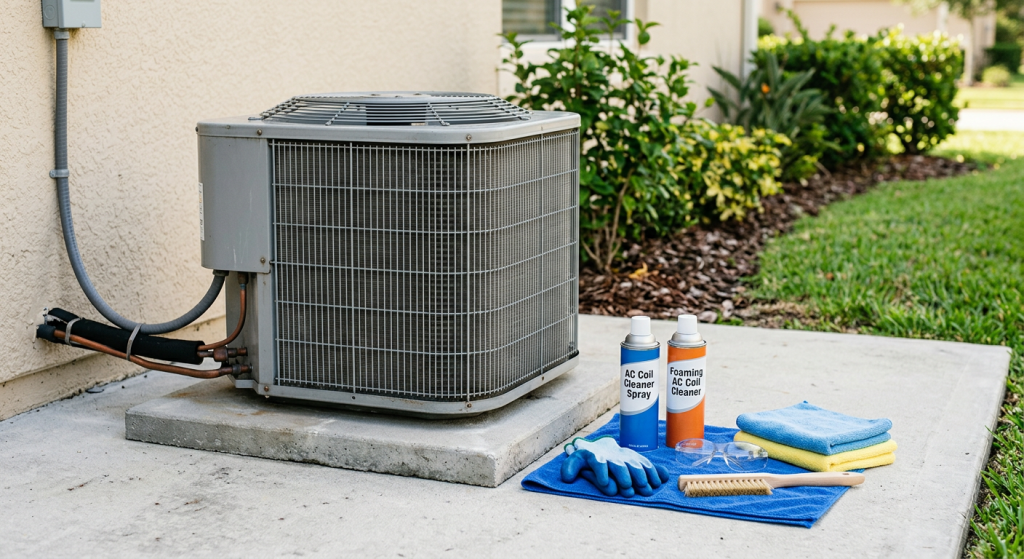
Quick Answer
For most homeowners, the safest DIY target is a condenser coil that can be reached externally without cabinet disassembly. Indoor evaporator-coil cleaning usually requires access near electrical, refrigerant, drainage, insulation, and airflow components and is better left to an HVAC professional.
Before using any HVAC coil cleaner, check the equipment instructions, coil cleaner label, and coil cleaner Safety Data Sheet. The chemical formulation, coil material, rinse requirements, and application directions matter more than whether the product comes out as liquid spray or foam.
AC Coil Cleaner Spray vs Foam: Quick Comparison
| Comparison factor | Spray cleaner | Foaming cleaner |
|---|---|---|
| AC coil cleaner spray vs foam control | Often easier to apply lightly | May expand after application |
| Surface contact | May run sooner | May cling longer |
| Expansion | Usually limited | Often expands visibly |
| Mess and runoff | May be easier to contain | May create more runoff |
| Soil level | Often useful for light surface dirt | May help with more persistent surface grime |
| Rinse requirements | Depends on product | Depends on product |
| Outdoor condenser suitability | Often suitable when specifically labeled | Often suitable when specifically labeled |
| Indoor evaporator suitability | Professional use often appropriate | Professional use often appropriate |
| Electrical overspray risk | Present | Present |
| Ventilation | Follow label and SDS | Follow label and SDS |
| Metal and coating compatibility | Formula-specific | Formula-specific |
| Beginner suitability | Often easier to control outdoors | Requires careful control of expansion |
| Best use case | Light, accessible cleaning | Longer contact where an approved formula is needed |
“Spray” and “foam” are not completely separate chemical categories. A spray coil cleaner may come from an aerosol, trigger bottle, or pump sprayer, and a liquid applied by spray can itself produce foam.
Why the Product Label Matters More Than Foam or Spray
The best AC coil cleaner for a particular job is one approved for the actual coil and used exactly as directed.
Before buying, check the coil cleaner label for:
- Intended coil type
- Rinse or no-rinse instructions
- Dilution requirements
- Dwell time
- Compatible metals and coatings
- Required gloves, eye protection, or other PPE
- Ventilation requirements
- Aerosol or mist precautions
- Runoff and disposal instructions
- Repeat-application limits
Also read the Safety Data Sheet and confirm that the HVAC equipment manufacturer permits chemical cleaning.
Do not assume a product labeled evaporator coil cleaner is automatically appropriate for a condenser. Likewise, a condenser coil cleaner should not be used indoors unless its label specifically allows that application.
What Spray Coil Cleaner Is
A spray coil cleaner is simply a product delivered to the coil as a spray. It may come in a coil cleaner aerosol can, trigger bottle, pump applicator, or diluted coil cleaner concentrate.
Spray can be useful when you want a thin, controlled application on a visible outdoor surface. Compared with highly expanding foam, it may be easier to see where the product is landing and limit the amount applied.
That does not make every spray cleaner mild. Chemical strength depends on the formulation and concentration, not the nozzle.
Spray products can also create mist or overspray. Avoid breathing the mist, work upwind outdoors, and keep cleaner away from motors, wiring, electrical controls, and other areas prohibited by the label.
What AC Coil Cleaner Foam Is
AC coil cleaner foam expands or clings after application. Depending on the formulation, that can increase contact with vertical surfaces and help loosen certain soils.
Foaming AC coil cleaner may also make application easier to see because the treated area is temporarily covered by foam.
Potential tradeoffs include:
- Greater expansion
- More runoff as the foam breaks down
- Easier overapplication
- More cleanup around the work area
- Aerosol or mist exposure with some products
Foam coil cleaner can come as an aerosol or as a concentrate applied through a sprayer. Some commercially available foaming products require dilution, while others are ready to use, reinforcing why the exact label controls the application.
More foam does not mean more cleaning power.
Does Foaming Cleaner Work Better?
Sometimes, but not simply because it foams.
Foam may help a cleaner remain on a vertical coil long enough for its chemistry to loosen grime. The meaningful factors are the formulation, soil type, concentration, label-directed dwell time, and compatibility with the coil.
A modest amount of compatible foam may therefore work better than a thin liquid for one dirty condenser, while another coil may need nothing more than water.
Heavy grease, deeply impacted debris, crushed fins, or a coil blocked through its depth can exceed reasonable homeowner maintenance. Repeated chemical applications should be made only when the product label permits them.
Outdoor Condenser Coils Versus Indoor Evaporator Coils
The condenser and evaporator do different jobs and present different cleaning risks.
| Factor | Outdoor condenser | Indoor evaporator |
| Location | Outdoor unit | Indoor HVAC equipment |
| Primary job | Rejects heat outdoors | Absorbs heat from indoor air |
| Common contamination | Pollen, dust, grass, outdoor debris | Dust, lint, film, biological contamination |
| Access | Sometimes visible externally | Often behind equipment panels |
| Runoff management | Outdoor runoff must still be controlled | Drain pan and indoor surfaces complicate runoff |
| Electrical concerns | Motors, wiring, controls | Wiring, blower, controls, insulation |
| Homeowner boundary | Limited exterior maintenance may be reasonable | Chemical cleaning usually belongs with a professional |
| Professional cleaning | Heavy buildup or required disassembly | Generally appropriate when coil access is required |
Outdoor condenser fins can be damaged by excessive force, and manufacturers caution against pressure washers or high-pressure water.
Choosing Cleaner for an Outdoor Condenser
Start with the least aggressive method the equipment manufacturer permits.
Before limited exterior maintenance:
- Set the thermostat to Off.
- Shut off power to the outdoor unit using the clearly identified disconnect or breaker according to manufacturer instructions.
- Stop if you cannot confidently identify the correct shutoff.
- Confirm the outdoor fan does not start.
- Read the equipment instructions, cleaner label, and Safety Data Sheet.
- Wear the protective equipment required by the label.
- Work upwind and avoid breathing aerosol, mist, or foam.
- Keep children and pets away and consider nearby plants, siding, and drainage areas.
Remove only loose exterior debris that can be reached without opening the cabinet or forcing tools into the coil.
For light dirt, pollen, or grass clippings, a gentle garden-hose rinse from outside the cabinet may be sufficient when the equipment manufacturer permits it. Do not use a jet setting or pressure washer.
Use an outdoor AC coil cleaner only when additional cleaning is needed and the product is specifically appropriate for that condenser. Avoid electrical components and let the unit dry fully before restoring power.
Do not remove the fan assembly or major cabinet panels to clean condenser coil surfaces.
Why Indoor Evaporator Cleaning Is Different
The indoor evaporator coil absorbs heat from household air and produces condensate during cooling. Access often requires opening an air handler, furnace-mounted coil case, or another HVAC enclosure.
That can place the homeowner near:
- Electrical components
- Blower equipment
- Refrigerant tubing
- Insulation
- The condensate drain pan and drain line
- Airflow surfaces that affect indoor air
Chemical runoff also has to go somewhere. A no-rinse evaporator cleaner does not eliminate concerns about access, drainage, overspray, or electrical components.
For beginners, do not open equipment panels to clean evaporator coil surfaces. Indoor coil cleaning that requires access belongs with a qualified HVAC professional.
A frozen evaporator coil should not be sprayed with cleaner. Freezing can be associated with airflow, refrigerant, or equipment problems that require diagnosis.
What “No-Rinse” Really Means
No-rinse coil cleaner is a product-specific description, not permission to leave any cleaner on any coil.
Some no-rinse evaporator products are formulated so normal condensate formed during cooling carries loosened material away. One manufacturer, for example, specifies that its evaporator foam relies on condensation for self-rinsing and limits the directions to HVACR professionals.
Another foaming cleaner states that it self-rinses on condensate-producing coils but also provides its own dilution and application directions.
Those examples illustrate the rule: read the exact label.
A “no-rinse” claim does not mean:
- Every evaporator is appropriate for DIY cleaning
- Condensate will be present under all conditions
- The product can be used on any condenser
- Foam automatically means no-rinse
- Aerosol automatically means no-rinse
- Cleaner can remain on electrical components or incompatible materials
Coil Material and Coating Compatibility
Traditional coils may combine aluminum fins with copper tubing, while other designs use different construction.
Microchannel coils can use aluminum passageways and fins with cleaning requirements that differ from conventional coils. Factory protective coatings may also restrict which chemicals can contact the surface.
Some equipment documentation specifically limits or discourages chemical cleaner use on particular microchannel designs.
Before using any microchannel coil cleaner or coated coil cleaner, confirm compatibility in both the equipment documentation and cleaner label.
If the coil material or coating is unknown, do not experiment with household chemicals, pH mixtures, acids, or alkaline cleaners.
Safety Checklist Before Using Coil Cleaner
- Thermostat is Off
- Outdoor power is disconnected using the correct identified shutoff
- Outdoor fan does not start
- Cleaner is intended for the specific coil
- HVAC manufacturer permits the maintenance
- Product label and SDS have been read
- Required gloves and eye protection are available
- Wind and outdoor ventilation are acceptable
- Electrical areas can remain dry and chemical-free
- Runoff will not create an uncontrolled problem
- Children and pets are kept away
- No other cleaning chemicals are present
- Unit can dry fully before power is restored
Never mix an HVAC coil cleaner with bleach, acids, detergents, disinfectants, or another cleaning product.
Do not use compressed air, a pressure washer, stiff brush, metal brush, or scraping tool. Do not reach inside the condenser, spray electrical areas, handle refrigerant tubing, or straighten badly damaged fins.
When Water and Gentle Cleaning May Be Enough
A chemical cleaner is not automatically necessary because the condenser looks dusty.
Light pollen, loose dirt, grass clippings, and similar surface debris may come away with basic exterior cleaning and a gentle hose rinse when the manufacturer allows it.
This has several advantages: no chemical compatibility question, less runoff concern, and less chance of overapplying cleaner.
If a garden hose is permitted, use gentle flow rather than a concentrated jet. A pressure washer can bend or flatten delicate fins and restrict airflow.
If debris is embedded deeply enough that exterior water does not remove it, professional cleaning may be safer than escalating force.
Buying Checklist for the Best AC Coil Cleaner
Do not choose an HVAC coil cleaner from “heavy duty,” “professional strength,” or “maximum foam” language alone.
Check:
- Whether it is for an evaporator, condenser, or both
- Foam, liquid spray, aerosol, or concentrate format
- Rinse requirements
- Required dilution
- Label-directed dwell time
- Aluminum compatibility
- Other coil-metal restrictions
- Protective-coating compatibility
- Microchannel suitability
- Required PPE
- Ventilation instructions
- Overspray precautions
- Runoff and disposal directions
- Container size
- Application control
- Safety Data Sheet availability
The best AC coil cleaner is the one that fits the specific coil and cleaning conditions without requiring you to exceed safe homeowner access.
Common Mistakes
Avoid these AC coil cleaning mistakes:
- Assuming foam is always stronger
- Assuming spray is always gentle
- Buying by marketing claims without reading the label
- Using evaporator cleaner on a condenser without approval
- Using condenser cleaner on an evaporator without approval
- Treating “no-rinse” as permission to leave any product anywhere
- Applying more cleaner than directed
- Spraying motors, controls, wiring, or electrical connections
- Mixing chemicals
- Using a pressure washer
- Cleaning a frozen coil
- Opening HVAC panels without appropriate training
- Restoring power while the unit is still wet
- Assuming a dirty coil causes every cooling problem
Chemical cleaning cannot repair refrigerant leaks, failed electrical parts, low airflow from another cause, damaged fins, or worn equipment.
When to Call an HVAC Professional
Use professional service when:
- The indoor evaporator coil requires access
- The coil is frozen
- The AC is not cooling normally
- Airflow is weak
- Coil fins are crushed or badly bent
- Grease or debris is heavily impacted
- Wiring or electrical damage is visible
- A refrigerant problem is suspected
- Microchannel or coated-coil compatibility is uncertain
- Cleaning requires cabinet or fan removal
- Cleaner runoff cannot be controlled
- You cannot confidently identify the power shutoff
- Performance remains poor after light exterior maintenance
If the visible coil cannot be cleaned safely without disassembling the unit, stop there.
Final Recommendation
In the AC coil cleaner spray vs foam decision, choose by the coil and label rather than the delivery format.
For light, accessible outdoor dirt, water or a controlled spray product may be enough. For more persistent surface grime, compatible AC coil cleaner foam may provide useful contact time. Neither is automatically the better cleaner.
Use chemical cleaner only when the equipment instructions permit it, the product is compatible with the coil material and coating, and you can keep cleaner and water away from electrical areas.
Frequently Asked Questions
Is foam or spray AC coil cleaner better?
Neither is universally better. Spray may offer easier application control, while foam may provide longer surface contact. Formulation, soil, coil type, and label directions determine the better choice.
Is foaming AC coil cleaner stronger?
Not necessarily. Visible foam does not measure chemical strength or cleaning performance.
What is the best AC coil cleaner for an outdoor condenser?
Choose a condenser-approved cleaner compatible with the exact coil material and coating. For light surface dirt, the equipment manufacturer may permit water alone.
Can I use evaporator coil cleaner on a condenser?
Only if the cleaner label specifically approves condenser use and the HVAC manufacturer permits it.
Can condenser cleaner be used on an evaporator?
Do not assume so. Indoor use, runoff, materials, and rinse requirements may differ.
Does no-rinse coil cleaner really need no rinsing?
Follow the exact product instructions. Some no-rinse evaporator formulas rely on normal condensate, while other conditions or coils may require rinsing.
Can I clean an AC coil with only water?
For light outdoor condenser debris, gentle water may be sufficient when the equipment manufacturer permits it.
Can I use a pressure washer on condenser coils?
No. High-pressure water can bend or flatten coil fins.
Can coil cleaner damage aluminum fins?
An incompatible chemical can damage coil metals or coatings. Use only products approved for the actual materials.
Is coil cleaner safe for microchannel coils?
Only when the cleaner and equipment documentation specifically permit it. Some microchannel coils have stricter chemical-cleaning requirements.
Can homeowners clean indoor evaporator coils?
Beginners should generally leave evaporator-coil cleaning to an HVAC professional because access often involves electrical, refrigerant, drain, and airflow components.
Should I clean a frozen coil?
No. Turn the system off and have the cause of freezing evaluated rather than applying chemicals to the ice.
How long should coil cleaner remain on the coil?
Use the dwell time printed on the exact product label. There is no universal time for spray, foam, aerosol, or concentrate cleaners.
Do I need to read the Safety Data Sheet?
Yes. The SDS provides important hazard, exposure, protective-equipment, and handling information that may not fit on the front of the container.
When should I call an HVAC professional?
Call when the evaporator needs access, the coil is frozen or damaged, cooling or airflow remains poor, electrical or refrigerant problems are suspected, or safe cleaning would require equipment disassembly.
Final Thoughts
AC coil cleaner spray vs foam does not have one winner for every air conditioner. Light accessible condenser dirt may need only water or a carefully controlled compatible spray, while a properly selected foam can provide longer contact on more persistent surface grime.
Read the equipment instructions, cleaner label, and Safety Data Sheet before using chemicals. Keep homeowner maintenance limited to safely accessible exterior surfaces, and use professional service for indoor, hidden, frozen, damaged, heavily contaminated, or uncertain coils.