
Bathroom Sink Draining Slowly: What to Check first
A slow bathroom sink drain usually means hair, soap scum, toothpaste residue, shaving residue, skin oils, or grime has partially narrowed the drain path. The sink does not need to be completely clogged to drain slowly. Start at the stopper and visible drain opening before assuming the restriction is deeper in the plumbing.
| What You Notice | What It May Suggest | First Safe Check |
|---|---|---|
| Sink drains slowly but eventually empties | Partial restriction | Inspect stopper and drain opening |
| Drain looks clear from above | Buildup may be below the opening | Check around and beneath stopper |
| Water pools around stopper | Stopper-area buildup | Remove accessible debris |
| Sink gurgles while draining | Abnormal air or water movement | Check whether other fixtures are affected |
| Slow drainage keeps returning | Deeper remaining buildup | Reassess after accessible cleaning |
| Nearby fixtures are also slow | Problem may extend beyond this sink | Stop treating it as a local clog |
What a Slow Bathroom Sink Drain Usually Means
A bathroom sink can drain slowly even when there is no obvious clog.
If water still passes through the drain, the restriction may simply be partial. Hair, soap residue, toothpaste, shaving residue, skin oils, and other grime can collect along the drain path and gradually reduce the space available for water.
That is why a bathroom sink draining slowly but not clogged in an obvious way can still have a genuine drainage problem.
“Not clogged” may only mean there is no visible object, no complete blockage, and the sink eventually empties.
Start with the most accessible areas. Bathroom sink buildup commonly collects around the stopper, pop-up assembly, and drain opening, so there is no reason to assume immediately that the problem is deep inside the piping.
Start With the Stopper and Drain Opening
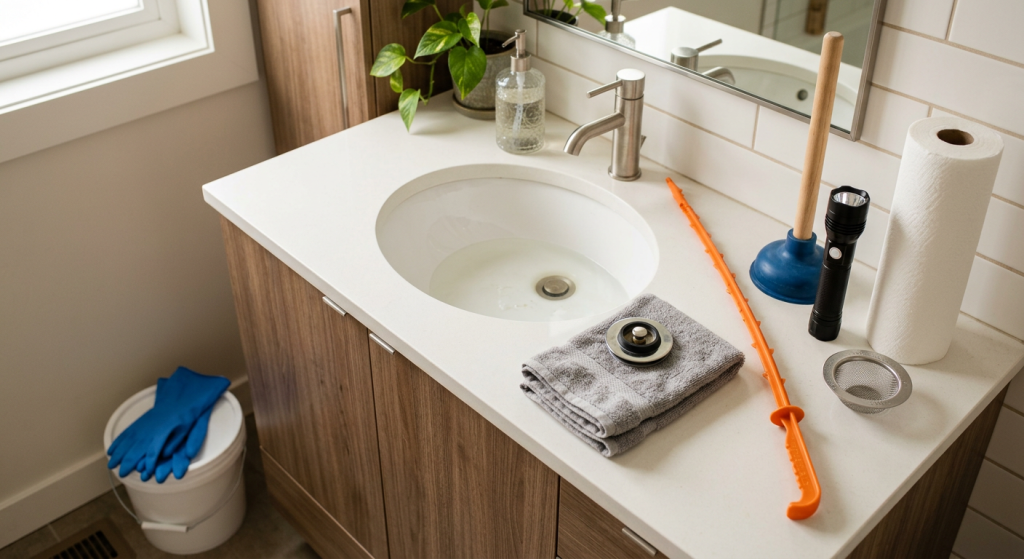
Inspect the drain from above before using a plunger, snake, or cleaner.
Use a flashlight and look around the stopper for visible hair, residue, or other material. Buildup can collect beneath the edge of the stopper even when the center of the drain appears relatively clear.
If accessible debris is visible, wear gloves and remove it carefully.
A simple plastic hair-removal tool may help retrieve hair located just inside an appropriate drain opening. Use it gently and avoid pushing material deeper.
Do not probe aggressively with screwdrivers, wire, knives, or other improvised tools. Besides potentially pushing the obstruction farther into the drain, sharp objects can damage drain components or finished surfaces.
After clearing accessible material, run a modest amount of water and see whether drainage improves.
A significant improvement suggests the restriction was concentrated near the opening. Little or no improvement means you should continue diagnosing rather than repeatedly cleaning the same visible area.
Know What Type of Stopper You Have
Bathroom sink stoppers are not all removed the same way.
Some lift out easily for cleaning. Others are part of a pop-up assembly connected to linkage beneath the sink.
If a stopper does not lift out normally with gentle handling, do not yank or pry it upward.
Forcing a connected stopper can damage the stopper, linkage, or drain assembly. Instead, inspect the setup and determine how that particular stopper is designed to be removed before proceeding.
You can still clean accessible material around a stopper that remains installed.
If the drain begins working normally after clearing hair and residue near the stopper, deeper disassembly may not be necessary.
Hair and Bathroom Residue Can Create a Partial Restriction
Bathroom sink buildup is often a mixture rather than one distinct object.
Loose hair can catch on drain components. Soap, toothpaste, shaving residue, skin oils, and other material can then collect around it.
Over time, the opening through which water passes becomes narrower.
This type of buildup explains why a bathroom sink drains slowly without suddenly becoming completely blocked.
It also explains why removing only the most visible hair may produce temporary improvement without fully correcting a recurring problem.
For material close to the opening, mechanical removal is generally more useful than trying to wash substantial hair farther down the drain.
Hot tap water may help move mild soap or toothpaste residue after accessible debris has been removed. Do not use boiling water as a universal drain-clearing method, and do not expect hot water to remove a significant hair blockage or deeper restriction.
Decide Between a Plunger and a Small Hand Snake
If accessible cleaning does not restore normal drainage, the next step depends on what the symptoms suggest.
A small sink plunger may help with a soft, localized restriction when the fixture can form an effective seal, the plumbing appears sound, and no chemical drain cleaner is present.
A small manual hand snake may be more appropriate when material appears to be farther into a suitable bathroom sink drain.
Neither tool should be used simply because the previous step failed. Choose based on the likely location and type of restriction.
Drain Snake vs Plunger: Which Should Homeowners Use? explains the differences between these tools when you are deciding which fits the problem.
Keep either method conservative. More force is not automatically more effective.
If plunging does not help, do not simply plunge harder. If a snake encounters persistent hard resistance, do not force the cable.
Stop if a Drain Snake Meets Hard Resistance
A small manual snake can help with reachable material farther into an appropriate drain, but it has limits.
Feed it only through an appropriate access point and use controlled hand pressure. Do not escalate to a powered drain machine as a beginner homeowner step.
If the cable repeatedly stops against hard resistance, reassess rather than increasing force.
Resistance can mean the cable has reached a fitting, obstruction, unsuitable path, or another condition that cannot be identified safely by pushing harder.
Forcing a snake can damage drain components or leave the cable stuck.
If your cable is already binding, kinking, refusing to advance, or repeatedly encountering resistance, see Drain Snake Not Working: What to Check First Before Forcing It instead of escalating force.
A stuck cable is also a stop condition. Do not respond by aggressively pulling, twisting, or cranking it.
Be Cautious With Liquid Drain Cleaner
Chemical drain cleaner should not be the automatic first response to a bathroom sink that drains slowly.
Hair-heavy restrictions may not clear completely, and chemical products can remain in standing water if the drain stays restricted.
That creates an additional hazard for anything you try afterward.
Never mix drain cleaner with:
- Bleach
- Vinegar
- Another drain cleaner
- Other household cleaning products
If chemical drain cleaner is already sitting in the sink or drain, do not plunge, insert a snake, or dismantle the plumbing.
Those actions can splash or unexpectedly release chemically contaminated liquid.
Avoid contact with the water. If professional service becomes necessary, tell the plumber that a chemical drain product was used and identify the product if you know it.
Do not add another chemical in an attempt to correct an unsuccessful first treatment.
What Gurgling Can Tell You
A bathroom sink that gurgles while draining may be experiencing unusual movement of air and water through the drainage system.
Gurgling alone does not prove that a plumbing vent has failed or identify the exact location of a restriction.
Look at the symptom in context.
If the sink gurgles but all other fixtures work normally, continue evaluating the sink as a potentially local problem.
If nearby fixtures also drain slowly, water appears in another fixture, or several drains begin making unusual sounds, the issue may extend beyond the bathroom sink.
At that point, repeated sink-level clearing attempts become less useful.
Recurring Slow Drainage Deserves a Different Approach
Pay attention to how long an improvement lasts.
If cleaning hair from the stopper restores normal drainage for an extended period, the restriction was likely concentrated near that area.
If the sink improves briefly and then slows again, buildup may remain farther into the drain.
Repeatedly performing the same surface cleaning will not necessarily correct a deeper restriction.
A recurring slow bathroom sink drain can also mean that several types of buildup are present. Removing accessible hair may improve flow without eliminating material farther downstream.
Use recurrence as a diagnostic clue rather than a reason to apply progressively stronger chemicals or tools.
Inspect Under the Sink Without Unnecessary Disassembly
You can visually inspect the drain piping beneath the sink without taking it apart.
Look for:
- Active dripping
- Corrosion
- Visible damage
- Connections that appear displaced
- Moisture around the drain assembly
Do not make P-trap removal a routine first step for a slow sink.
Older or corroded drain fittings may be difficult to remove and may not reseal reliably after being disturbed. Plumbing may also contain standing water, debris, or chemical cleaner that was previously added.
Do not force corroded fittings loose or dismantle unfamiliar drain assemblies merely because surface cleaning did not solve the problem.
If you discover active leakage or damaged piping, stop treating the issue as a simple slow-drain problem.
Know When the Problem Is No Longer Local
A bathroom sink restriction is more likely to be local when only that sink is affected, and accessible cleaning produces a clear improvement.
Broader symptoms change the diagnosis.
Watch for:
- A nearby sink, tub, or shower also draining slowly
- Water backing up into another fixture
- Slow drainage that repeatedly returns
- Persistent gurgling combined with other drainage symptoms
- Leaking or damaged drain piping
- Sewage backup
- A manual snake repeatedly meeting hard resistance
Several affected fixtures can indicate a restriction farther into shared drainage piping.
Water appearing in another fixture is another important warning sign. Continuing to work only on the bathroom sink may not address the actual problem.
Sewage backup is a stop condition. Avoid contact with contaminated water, keep people and pets away from the affected area, and get qualified plumbing help.
When to Call a Plumber
Consider professional plumbing help when accessible cleaning does not produce lasting improvement, and the restriction appears to be farther into the drainage system.
Stop DIY attempts if a hand snake repeatedly hits hard resistance or becomes stuck, drain piping leaks or appears damaged, or old and corroded components would need to be dismantled.
Professional diagnosis is also appropriate when nearby fixtures are slow, water backs up elsewhere, sewage is involved, or the same restriction repeatedly returns despite reasonable fixture-level cleaning.
If chemical drain cleaner has already been used and remains in standing water, avoid additional mechanical work and tell the plumber what product was added, if known.
Final Thoughts
A slow bathroom sink drain does not need to be completely blocked to have a real restriction. Start with the stopper and visible drain opening, where hair, soap, toothpaste residue, and grime commonly collect, and remove only material you can reach safely.
If simple cleaning does not restore normal drainage, use the sink’s behavior to decide whether a plunger or small manual snake is appropriate. Recurring problems, hard resistance, leaking piping, several slow fixtures, or sewage backup are signs to stop escalating DIY attempts and get the drainage problem properly diagnosed.