liquid drain cleaner vs drain snake: what homeowners should know
When comparing liquid drain cleaner vs drain snake, the better choice depends on the clog type, plumbing condition, and safety risks—not simply which option seems faster. For many shallow, localized hair clogs, manual removal or a small hand snake is a practical first approach. Chemical cleaners add exposure risks and may leave hazardous liquid behind, while neither option is appropriate for every blockage.
| Situation | Better starting point | Main concern |
|---|---|---|
| Hair near a bathroom drain | Hair-removal tool or small hand snake | Do not force the tool |
| Shallow localized clog | Manual tool may help | Confirm the access point is appropriate |
| Standing water with chemical cleaner | Neither | Water may be chemically contaminated |
| Suspected hard object | Neither as a blind approach | Chemical cleaner will not retrieve it |
| Multiple slow or backed-up fixtures | Neither | Possible deeper drainage problem |
Liquid Drain Cleaner vs Drain Snake: How They Differ
A liquid drain cleaner and a drain snake address clogs in fundamentally different ways.
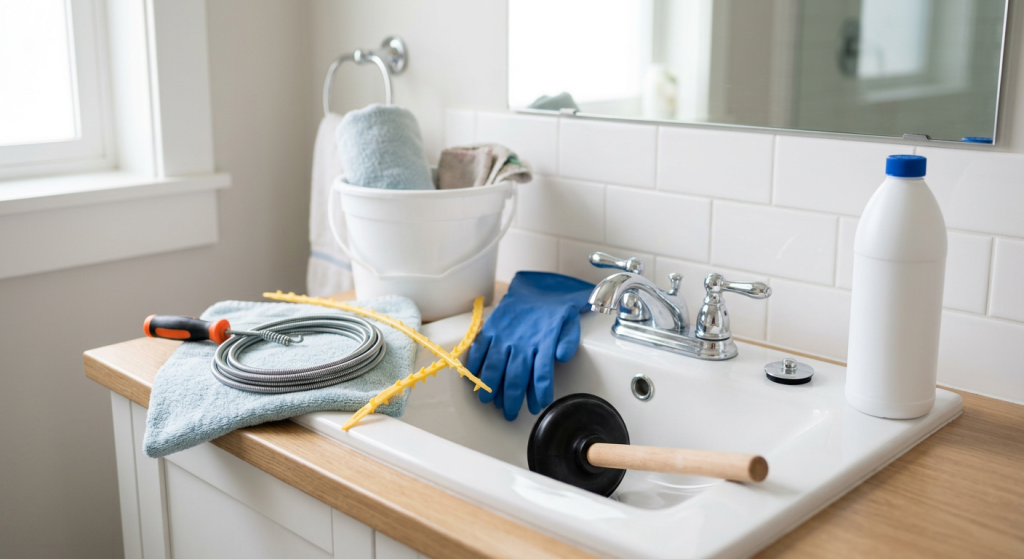
A small manual drain snake works mechanically. The cable enters the drain and may break up, loosen, or retrieve material that is within reach. It can be useful for certain localized clogs, especially hair and similar material.
Liquid drain cleaner works chemically. Depending on the product, it may dissolve or soften certain types of organic buildup. It does not physically retrieve an obstruction, and it will not make every type of clog disappear.
That distinction matters because a hard object, deep restriction, recurring drainage problem, or damaged pipe is not simply a choice between chemicals and a cable.
Chemical cleaner also changes what can be done safely afterward. If it remains in standing water, later plunging, snaking, or plumbing disassembly can create chemical exposure.
For that reason, the safest first question is not “Which one is stronger?” It is “What type of blockage am I likely dealing with?”
Match the Approach to the Likely Clog
Different clog materials respond differently to drain-clearing methods. Before reaching for either option, consider what probably entered the drain and whether the problem appears isolated.
Hair and Soap Buildup
A slow bathroom sink, tub, or shower often collects hair and soap-related buildup near the drain.
If the material is visible or shallow, a simple hair-removal tool may be more appropriate than either chemical cleaner or a longer drain snake. Removing the material physically avoids introducing chemicals into the plumbing.
For a localized clog slightly farther into an accessible drain, a small manual hand snake may be useful.
Keep the tool proportional to the problem. A shallow hair clog does not justify powered drain-cleaning equipment.
Food and Grease-Related Kitchen Problems
Kitchen drainage problems require more caution because the restriction may involve accumulated grease, food debris, or material farther into the drain system.
Do not assume that grease automatically makes chemical drain cleaner the correct choice. A product may not clear a substantial or recurring restriction, and a temporarily improved drain can still have buildup farther downstream.
If the same kitchen drain repeatedly slows or clogs, the recurrence itself is useful diagnostic information. Repeatedly adding cleaner without understanding the cause may delay appropriate diagnosis.
Hard Objects
If jewelry, a cap, utensil, toy, or another solid object may have entered the drain, chemical cleaner will not retrieve it.
Blindly forcing a snake is not a good substitute.
A cable can potentially push an object farther into the drainage system or become lodged around an obstruction. Stop and choose an appropriate retrieval or professional approach rather than escalating force.
Multiple Slow Fixtures
Several slow drains change the situation significantly.
If multiple fixtures are affected, another fixture backs up, or water rises elsewhere when a drain is used, the restriction may be farther into shared drainage piping.
At that point, neither a bottle of drain cleaner nor repeated work with a small hand snake should be treated as the obvious solution.
When a Small Manual Drain Snake Makes Sense
A manual drain snake is most useful when the problem appears shallow, localized, and reachable through an appropriate drain opening.
Its main advantage is mechanical action. Instead of adding a chemical and waiting for it to affect the clog, you are attempting to physically interact with the obstruction.
That can be particularly useful with hair-type material.
A manual snake still requires restraint. The cable should not be treated as something that can simply be forced through any resistance.
If it repeatedly encounters hard resistance, stop. The cable may be meeting a fitting, an unsuitable path, a solid obstruction, or another condition that requires reassessment.
Forcing the cable can damage plumbing or leave the snake stuck. If that is already happening, follow Drain Snake Not Working: What to Check First Before Forcing It rather than applying more force.
This comparison also does not mean a snake is the correct manual tool for every clog. Depending on the fixture and blockage, a plunger may sometimes be more appropriate. Drain Snake vs Plunger: Which Should Homeowners Use? covers that separate tool choice.
Do not escalate to powered drain machines as a beginner homeowner simply because a small hand tool was unsuccessful.
What Liquid Drain Cleaner Can and Cannot Do
Chemical drain cleaners vary considerably in formulation and intended use, so avoid treating every product as interchangeable.
Depending on the product and clog material, a cleaner may dissolve or soften some buildup. That does not mean it can correct every slow or blocked drain.
Chemical drain cleaner may be ineffective or inappropriate for problems involving:
- Solid foreign objects
- Major or recurring buildup
- Deeper drainage restrictions
- Structural pipe problems
- Damaged or leaking plumbing
- Blockages affecting multiple fixtures
Pipe compatibility also depends on factors such as the specific product, plumbing materials, existing pipe condition, repeated use, and manufacturer instructions.
Avoid blanket assumptions that every chemical cleaner is safe for every pipe—or that every drain cleaner inevitably damages plumbing.
Follow the specific product labeling for compatible fixtures, plumbing, application, protective measures, and other restrictions.
Standing Water Changes the Safety Decision
One of the most important differences in the drain cleaner vs drain snake decision appears after chemical cleaner has already been added.
If cleaner is poured into a clogged drain and the drain remains blocked, the standing water may now contain the chemical product.
That creates a new hazard.
Do not plunge the chemically contaminated water. Do not insert a drain snake into it. Do not remove the trap or disconnect plumbing containing unknown or potentially hazardous cleaner.
Those actions can splash or release the contaminated liquid.
If you do not know what product was added, treat that uncertainty seriously. Do not add another cleaner in an attempt to improve the result.
Anyone providing plumbing service should also be told that drain-cleaning chemicals may be present.
Never Mix Drain-Cleaning Chemicals
Follow the manufacturer’s labeling when using any chemical drain cleaner, including its directions for protective measures and compatible applications.
Never mix different drain-cleaning products.
Do not combine drain cleaner with bleach or other household cleaning chemicals. Do not add another product to a drain containing unknown cleaner residue.
Avoid splashing and keep other people and pets away from the work area as appropriate.
Chemical drain cleaner should also not be used in a toilet. A toilet clog requires a different troubleshooting and tool-selection approach.
Be Careful Around Garbage Disposals
Do not assume liquid drain cleaner should be poured through a kitchen sink simply because that sink has a garbage disposal.
Product restrictions vary, as do disposal designs and manufacturer instructions.
Check both the drain-cleaner labeling and applicable disposal guidance before using a chemical product in that configuration.
If the disposal itself is jammed, not operating, leaking, or otherwise malfunctioning, diagnose that problem separately. Drain cleaner is not a substitute for identifying a disposal problem.
Never reach into a disposal to investigate a drainage issue.
Consider Septic-System Compatibility
Homeowners with septic systems should not assume that every chemical drain cleaner is automatically suitable for their system.
Compatibility varies by product and application. Check the product labeling and follow applicable septic-system guidance before adding a chemical drain cleaner.
This is another situation where manually removing a reachable local obstruction can avoid introducing an unnecessary chemical into the drainage system.
However, repeated slow drainage in a home with a septic system should not automatically be treated as a simple fixture clog. Broader drainage symptoms deserve proper diagnosis.
When Neither Option Is the Right Choice
Sometimes the most useful comparison ends with neither tool being appropriate.
Stop routine homeowner drain clearing if:
- Several fixtures are slow or backed up
- Water rises or backs up in another fixture
- Sewage is present or sewage odor accompanies a backup
- The same clog repeatedly returns
- Plumbing is visibly leaking or damaged
- A snake encounters persistent hard resistance
- A drain snake becomes stuck
- Standing water contains chemical drain cleaner
- A solid foreign object is suspected and cannot be safely retrieved
These clues can point to a deeper restriction, inappropriate access point, damaged plumbing, or another problem that a bottle of cleaner or small hand snake cannot reliably solve.
When to Call a Plumber
Qualified plumbing help is appropriate when several fixtures are affected, sewage is involved, a clog repeatedly returns, or water backs up into another fixture.
Stop as well if plumbing is leaking or damaged, a manual snake becomes stuck or repeatedly meets hard resistance, or a suspected solid object cannot be safely addressed.
If chemical cleaner is sitting in a blocked drain, do not dismantle the plumbing or insert additional tools. Tell the plumber what product was used, if known, so they can account for the chemical exposure risk.
Final Thoughts
The liquid drain cleaner vs drain snake choice should be based on the likely clog and the risks involved. For many shallow, localized hair clogs, physical removal or a small manual tool offers a straightforward approach without adding chemicals. A drain snake still needs to be used conservatively and should never be forced through hard resistance.
Chemical cleaner may work on certain compatible types of buildup, but it cannot retrieve hard objects or solve every recurring or deeper drainage problem. Once chemicals are sitting in blocked water, the safety situation also changes. When multiple fixtures are affected, sewage is present, plumbing is damaged, or the clog keeps returning, stop treating it as a simple choice between two drain-clearing products.