best stain for an old deck: what homeowners should look for
The best stain for old deck boards depends on the wood’s condition, the existing finish, and how much weathering you want to hide. A product suited to bare, absorbent boards may fail over paint, sealer, or another intact coating.
Inspect the deck before shopping. Stain can improve its appearance, but rotten wood, loose railings, unstable stairs, structural movement, and drainage problems must be addressed first.
| Older-deck condition | Stain type to consider | Main caution |
|---|---|---|
| Weathered but solid bare wood | Transparent, semi-transparent, or penetrating stain | Uneven absorption may affect color |
| Previously treated with penetrating stain | Compatible penetrating stain | Confirm the surface can absorb another coat |
| Faded semi-transparent stain | Compatible semi-transparent or solid-color stain | Remove loose or failing residue |
| Existing solid-color stain | Compatible solid-color stain | Peeling areas need proper preparation |
| Mismatched replacement boards | Semi-transparent or solid-color stain | New and old boards may still look different |
| Peeling paint or thick coating | No stain until the coating is evaluated | Extensive removal may be required |
| Soft, rotten, or unstable boards | No stain | Repair or professional evaluation comes first |
The Best Stain Depends on the Deck Condition
There is no single stain that works best for every old deck. Board condition and the existing finish matter more than broad marketing claims.
The wood must be sound enough to refinish, and the new product must work with any coating that remains. Preparation also affects absorption, color, and adhesion.
Confirm that the label allows use on deck boards or horizontal exterior walking surfaces. Products intended only for fences, siding, or vertical trim may not tolerate foot traffic or standing moisture.
Inspect the Old Deck Before Choosing Stain
Look over the boards, stairs, railings, fasteners, and visible framing before deciding what to buy.
Conditions that must be addressed first
- Soft, crumbly, or rotten wood
- Deep splits, severe cupping, or major warping
- Loose boards or raised fasteners
- Loose railings or unstable stairs
- Sagging, shifting, or structural movement
- Standing water, blocked gaps, or persistently damp areas
Keep structural checks observational. Contact a qualified professional when the deck moves, sags, feels unstable, has widespread rot, or shows major drainage failure.
Identify the Existing Deck Finish
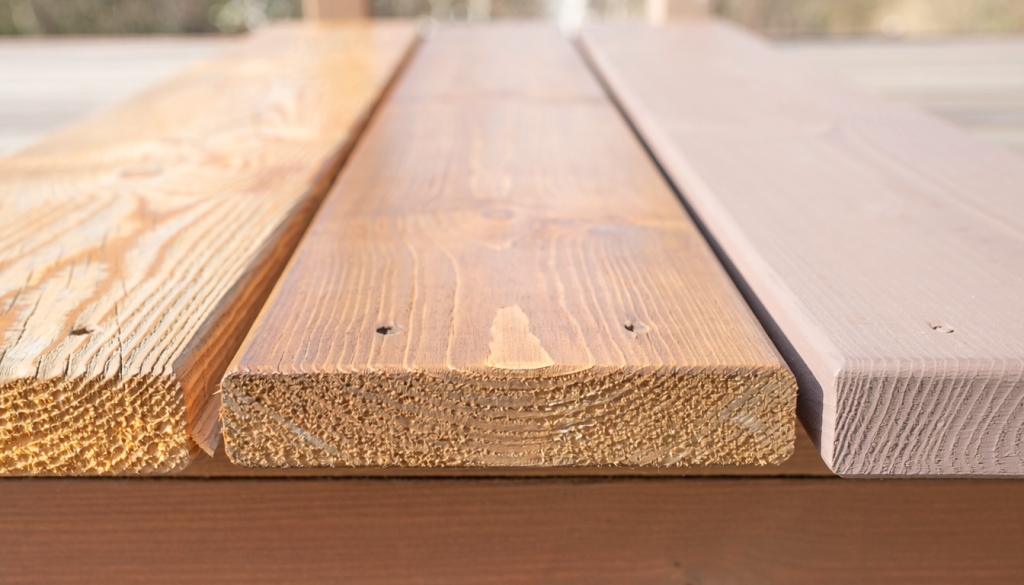
Bare weathered wood often looks gray, dry, and fibrous without a continuous coating. Penetrating stain colors the fibers but leaves little visible film. Semi-transparent stain adds color while showing grain, and solid-color stain hides most color variation while leaving some texture visible.
Paint and other film-forming coatings create a continuous layer that may crack, chip, or peel. Clear sealer can be difficult to see but may cause water to bead. Treat an unidentified finish as an unknown coating rather than assuming the wood is bare.
Penetrating stain cannot soak through intact paint, sealer, or thick coating buildup. Changing coating systems may require substantial removal.
Older painted surfaces may contain lead. Do not sand, scrape, or create dust from a coating that could contain lead. Have it evaluated and use a lead-safe qualified professional when appropriate. Extensive layered-coating removal may also require professional help.
When the old coating is difficult to identify, compare deck paint vs stain before choosing a compatible refinishing system.
What Makes a Stain Suitable for an Old Deck?
Choose according to the deck’s condition, desired appearance, exposure, and maintenance needs.
Compare these buying factors
- Compatibility with the remaining finish
- Amount of grain you want visible
- Ability to reduce color variation
- Penetrating or film-forming behavior
- Sun, shade, rain, drainage, and foot traffic
- Cleaning and recoating requirements
- Approval for walking surfaces
- Slip and application conditions
A higher price does not automatically mean a better match for your deck.
Transparent, Semi-Transparent, and Solid-Color Stain
Transparent or clear-toned stain
Transparent stain shows most of the grain and provides little cosmetic coverage. It works best when the boards are sound, attractive, and reasonably consistent.
Weathering, repairs, dark marks, and replacement boards will remain visible.
Semi-transparent stain
Semi-transparent stain keeps the grain visible while adding noticeable color. It can suit sound, weathered boards when a natural appearance is still important.
It may look uneven when boards absorb stain at different rates and will not hide major discoloration or strongly mismatched repairs.
Solid-color stain
Solid-color stain provides the strongest cosmetic coverage among stain types. It can help unify sound boards with widespread fading, repairs, or color differences.
Because more material remains near the surface, preparation is especially important. Solid stain may peel when moisture, incompatibility, or coating buildup weakens adhesion.
Penetrating vs Film-Forming Deck Stain
Penetrating stain soaks into absorbent wood rather than creating a substantial surface layer. Depending on the formula and exposure, it may fade or wear gradually.
Film-forming stain leaves more coating at the surface and usually provides stronger color coverage. That surface layer may chip, peel, or flake if moisture or adhesion problems develop.
Choose based on the existing finish, appearance goals, and expected maintenance.
Oil-Based vs Water-Based Deck Stain
Oil-based stains may penetrate weathered wood well, depending on the formula. They often have stronger odors, longer drying times, and solvent-cleanup requirements.
Water-based stains commonly offer lower odor, easier cleanup, and faster drying. Some provide strong color retention, although quick drying can make lap marks harder to avoid.
Compare individual labels rather than relying on broad assumptions. With solvent-containing products, use required protective equipment and ventilation, remove ignition sources, and follow storage and disposal directions. Never leave oil- or solvent-soaked materials piled together.
Which Stain Fits Your Appearance Goals?
Solid-color stain hides weathering and mismatched boards better than transparent or semi-transparent products. Do not apply it heavily to fill cracks or conceal deteriorated wood.
Transparent and semi-transparent stains preserve more visible grain. Results are usually more consistent when boards are similar in age, texture, and absorbency.
Test the color on the actual deck and let it dry fully. Weathered wood may absorb more pigment and appear darker than a printed card, screen image, or store sample.
Maintenance and Climate Exposure
Some penetrating stains can be cleaned and recoated without removing a thick film. Film-forming and solid-color finishes may need more scraping or sanding if they peel.
Sun, rain, shade, drainage, and foot traffic affect wear. Exposed boards may fade faster, while shaded areas and spaces beneath rugs, furniture, leaves, or planters may stay damp.
Freeze-thaw cycles and humid or coastal conditions can also affect coating performance. No universal maintenance interval applies.
Surface Preparation and Absorption Testing
Premium stain can still fail over dirt, damp wood, loose coating, grease, mildew residue, or a sealed surface.
Clean the deck using an approved method, remove loose coating, correct accessible protruding fasteners, and let the wood dry fully. Sand only when appropriate and after ruling out hazardous coatings. Remove all sanding dust.
Check the product’s wood-moisture and weather requirements. Water beading can suggest that sealer remains, but a manufacturer-approved test area is more reliable. Let the test dry before judging color, absorption, texture, and adhesion.
When sanding is appropriate for bare or weathered wood, follow the separate process for how to sand a deck before staining.
Slip Resistance, Railings, and Quantity
Film-forming stains may become slippery when wet, especially on shaded, glossy, sloped, or algae-prone surfaces. Choose a product approved for walking surfaces and use slip-resistant additives only when permitted. No finish guarantees slip prevention.
Deck boards and railings experience different wear, so compatible products or opacity levels may be used for each. Every product must be approved for its location, and loose railings must be repaired first.
Estimate the board, stair, and railing area, then compare it with the stated coverage rate. Rough wood may absorb more. Confirm the permitted coat count and, when practical, buy enough from the same product and color batch.
Best Stain for an Old Deck Comparison
| Stain type | Best suited for | Main limitation |
|---|---|---|
| Transparent stain | Consistent boards where grain is the priority | Reveals weathering and repairs |
| Semi-transparent stain | Sound wood needing moderate color | May look uneven on mixed boards |
| Solid-color stain | Sound boards with major color variation | Greater buildup and peeling potential |
| Penetrating stain | Bare, absorbent, compatible wood | Cannot penetrate intact coatings |
| Film-forming stain | Stronger surface color coverage | May chip, peel, or flake |
| Oil-based stain | Compatible weathered wood where penetration is desired | Odor, solvents, and longer drying |
| Water-based stain | Lower-odor projects and easier cleanup | Faster drying may be less forgiving |
Choose Transparent or Semi-Transparent Stain When
- The boards are solid and reasonably consistent
- Visible grain is a priority
- The wood is bare or compatible with penetrating stain
- Repairs and color differences are acceptable
- A natural appearance is preferred
Choose Solid-Color Stain When
- Sound boards have widespread cosmetic variation
- Replacement boards need stronger color coverage
- Most grain visibility is not important
- The existing finish is compatible
- More buildup and future preparation are acceptable
Common Deck-Stain Buying Mistakes
- Choosing by color or price alone
- Buying before identifying the existing finish
- Applying penetrating stain over paint or intact sealer
- Expecting transparent stain to hide mismatched boards
- Assuming solid-color stain cannot peel
- Using a product not approved for deck boards
- Ignoring wet-surface slip characteristics
- Applying unapproved extra coats
- Staining damp or poorly prepared wood
- Skipping the test area
When to Contact the Manufacturer or a Professional
Contact the manufacturer when the old coating, product compatibility, coat count, or test result is unclear.
Use a qualified professional for possible lead paint, thick layered coatings, extensive removal, widespread peeling or rot, structural movement, sagging, unstable stairs, loose railings, or major drainage problems.
Final Thoughts
The best stain for an old deck depends on sound boards, the existing finish, and the appearance you want. Transparent and semi-transparent stains preserve more grain, while solid-color stain conceals more variation.
Penetrating and film-forming finishes wear differently, and oil-based and water-based formulas should be compared individually. Careful preparation and a test area are essential before staining the full deck.