
gutter guard types for homeowners
The main gutter guards types include screen, mesh, micro-mesh, reverse-curve, brush, and foam systems. Each handles leaves, needles, seeds, roof granules, and other debris differently. Finer filtration does not automatically mean less maintenance. The best fit depends on the debris around your home, roof and gutter configuration, weather, maintenance access, and how accurately the system is installed.
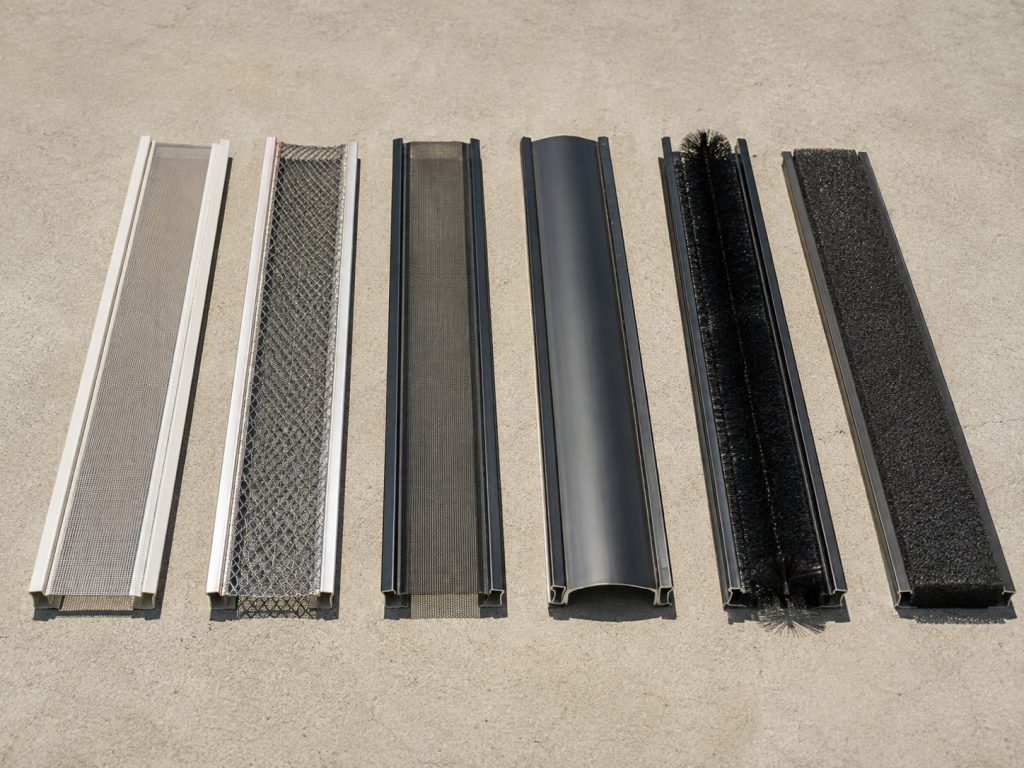
| Gutter Guard Type | Best Fit | Main Limitation |
|---|---|---|
| Screen | Large leaves and coarse debris | Smaller debris can pass through |
| Mesh | Mixed leaves and medium-size debris | Fine material may pass or collect |
| Micro-mesh | Pine needles, seeds, small fragments | Fine material can build up on the surface |
| Reverse-curve / surface tension | Keeping larger debris above the gutter | Performance depends heavily on positioning |
| Brush | Simple in-gutter debris control | Debris can become trapped in bristles |
| Foam | Blocking larger debris within gutter opening | Fine organic material may become embedded |
How Gutter Guards Work
Gutter guards reduce the amount of debris entering gutters while still allowing rainwater to reach the gutter channel. Different designs achieve that goal in different ways. Some rely on openings that physically screen out debris, while others use a curved surface, brush material, or porous insert.
Filtration size matters, but it is only one part of performance. Surface shape, installation position, roof runoff, and the type of debris falling on the house can all affect how well a gutter protection system works.
Most designs fall broadly into two categories. Cover-style systems sit over or across the gutter opening and include screens, mesh, micro-mesh, and reverse-curve guards. In-gutter systems, such as brushes and foam inserts, occupy space inside the gutter itself.
No gutter guard eliminates maintenance completely. Material stopped by the guard still has to collect somewhere, and fine particles can sometimes reach the gutter even when larger debris is blocked.
Screen Gutter Guards
Screen gutter guards use relatively large openings to keep leaves and other coarse debris from dropping directly into the gutter. Their simple design makes them easy to understand, and debris accumulating on top is often visible during routine inspection.
They are generally best suited to homes where large leaves are the primary concern. Because the openings are larger than those in mesh or micro-mesh systems, small seeds, roof granules, tiny leaf fragments, and some pine needles may still pass through.
Screens provide moderate filtration rather than extremely fine filtration. That can be an advantage in some situations because larger openings may allow water to pass readily, but they offer less protection from small or narrow debris.
Debris can also remain on top of the screen. Whether it eventually blows away or needs removal depends on the tree cover, screen shape, roof conditions, and weather.
Mesh Gutter Guards
Mesh guards use smaller openings than basic screens, providing more protection against mixed debris. They can block many medium-size leaves and fragments while still allowing water through the surface.
Because the openings are smaller, mesh is often a middle ground between a coarse screen and micro-mesh. It filters more material than a basic screen without relying on the extremely fine surface used by micro-mesh systems.
Fine debris can still pass through or collect on top. Pine needles can be especially variable: some may remain above the mesh, while others can bridge across openings, lodge in them, or pass through depending on their size and the mesh pattern.
For homes with several types of trees, mesh can offer a useful balance, but the actual debris around the house should guide the decision.
Micro-Mesh Gutter Guards
Micro-mesh systems use a very fine filtering surface designed to keep small material out of the gutter. Their tiny openings can perform well against small seeds, narrow leaf fragments, and pine needles that could pass through coarser guards.
That fine filtration comes with a tradeoff. Roof granules, pollen-like particles, decomposed organic matter, and other small material may collect on the filtering surface instead of entering the gutter.
Debris that is stopped from entering the gutter does not disappear. If fine material accumulates on the mesh faster than wind or rain removes it, the surface may require periodic cleaning to maintain good water flow.
Micro-mesh can be a strong option where small debris is the primary challenge, but homeowners dealing specifically with needle-heavy trees should also review our guide to best gutter guards for pine needles before choosing a design.
Reverse-Curve or Surface-Tension Gutter Guards
Reverse-curve guards use a solid or mostly solid cover with a curved outer edge. Water is intended to follow that curved surface into the gutter while larger leaves and debris continue past the edge.
Because the design relies on the movement of water across a shaped surface, performance can be sensitive to roof pitch, rainfall intensity, gutter position, roof valleys, gutter condition, and installation accuracy.
Heavy runoff may behave differently from light or moderate rain. Likewise, a guard positioned incorrectly relative to the roof edge may not direct water into the gutter as intended.
These systems can therefore be more installation-sensitive than simple screens or inserts. Accurate positioning matters as much as the basic guard design.
Brush Gutter Guards
Brush guards consist of cylindrical brushes installed inside the gutter. Their bristles occupy much of the open space and can keep larger debris from settling directly into the bottom of the gutter.
The design is mechanically simple, but debris can become trapped between the bristles. Leaves, seeds, small twigs, and decomposing organic material may remain within the brush rather than staying entirely above the gutter.
Periodic removal or cleaning may therefore be needed. The main tradeoff is straightforward: brush guards are simple, but they can increase hands-on maintenance when debris becomes tangled in the bristles.
Foam Gutter Inserts
Foam gutter inserts are porous sections of material that sit inside the gutter opening. Rainwater passes through the foam while larger leaves and debris remain closer to the surface.
Fine particles can work their way into the porous material, however. Roof granules, small organic debris, and decomposing material may become embedded rather than washing completely through.
Foam may also retain debris or moisture depending on site conditions, so periodic inspection and removal for cleaning may be necessary.
These inserts should not be treated as maintenance-free. They change where debris collects rather than eliminating the need to monitor the gutter system.
Cover-Style Versus In-Gutter Systems
Cover-style systems include screens, mesh, micro-mesh, and reverse-curve guards. They generally try to keep debris above the gutter opening, where material may remain on an exposed surface until it blows away, washes away, or is removed.
Brush and foam systems sit within the gutter itself. Debris may collect inside the guard material or remain partly within the gutter channel.
Neither approach automatically requires less maintenance. A cover can accumulate material on top, while an in-gutter system can trap debris internally. The better choice depends on what falls on the roof, how easily the system can be inspected, and how practical future cleaning will be.
How Debris Type Affects the Choice
The debris around the house is one of the most important factors when comparing gutter guard options.
Large broad leaves are relatively easy for many screen and cover systems to stop because they cannot fit through most openings. Small leaves and seeds are more challenging because they can pass through larger screens or lodge in mesh.
Pine needles create a different problem. Their narrow shape may allow them to pass through openings that would easily block a leaf. They can also bridge across surfaces or become lodged vertically in some mesh patterns.
Roof granules and pollen-like particles are finer still. Even guards that keep them out of the gutter may collect them on the filtering surface. Over time, decomposed leaves and organic debris can become fine enough to behave more like sediment than recognizable leaves.
That is why debris shape matters as much as size. A guard that performs well under maple leaves may behave differently under pine needles, seed pods, or fine tree debris.
Rain, Snow, and Roof Conditions Matter
Gutter guards have to handle water as well as debris. Heavy rainfall and steep roof surfaces can send water toward the gutter quickly, especially near roof valleys where runoff becomes concentrated.
A guard that accepts moderate rainfall well may behave differently when water arrives at a high rate. Roof-edge configuration, gutter size, gutter pitch, and the exact position of the guard can all influence whether water enters the gutter or overshoots it.
Snow and ice add another variable in colder climates. Accumulation can affect exposed guard surfaces and change how meltwater reaches the gutter.
Roof granules can also collect on some guard designs, particularly fine mesh. Gutters and downspouts should therefore be in good condition before guards are installed. A guard should not be used to cover an existing drainage, alignment, or structural problem.
Maintenance Still Matters
Gutter guards can reduce certain kinds of debris entry, but they do not eliminate the need for inspection and maintenance.
Leaves and fine debris may accumulate on exposed surfaces. Sediment can still develop inside gutters, and outlets and downspouts can still become restricted. Guards themselves can shift, sag, loosen, or become damaged.
Warning signs that deserve attention include:
- water overshooting the guard
- water spilling over the gutter edge
- visible debris buildup on the guard
- sagging or displaced sections
- a blocked gutter outlet
- sediment accumulating inside the gutter
Maintenance requirements vary among designs, but every system should remain inspectable and serviceable.
Avoid unsafe ladder positions, roof walking, or overreaching to inspect a gutter guard. If the system cannot be safely reached, professional inspection is the better choice.
How to Compare Gutter Guard Types Before Buying
Start with the conditions at your own house rather than a universal ranking.
Consider the dominant debris type and how heavily trees cover the roof. A home surrounded by broad-leaf trees may need different filtration than one beneath pines or trees that shed small seeds.
Roof pitch, roof material, gutter size, gutter condition, and local rainfall also matter. Homes exposed to snow and ice may have additional concerns that are less important in warmer regions.
Maintenance access should be part of the buying decision as well. A system that performs well but is difficult to remove, inspect, or clean may not be the best fit for a particular house.
Also consider installation requirements. Some guards are relatively simple in concept, while others depend on accurate positioning or integration with the roof edge. Make sure future servicing will remain practical after installation.
Common Buying Mistakes
A common mistake is assuming that finer filtration always means less maintenance. Very fine mesh may block more debris from entering the gutter, but that material can instead accumulate on the surface.
Choosing only according to leaf size can also be misleading. Pine needles, seeds, roof granules, and decomposed organic material behave differently from broad leaves.
Another mistake is installing guards over gutters that already sag, drain poorly, have damaged outlets, or need realignment. Gutter guards do not correct those underlying problems.
Homeowners should also avoid assuming that guards eliminate future cleaning or that every system handles heavy rainfall equally well.
Snow and ice conditions, safe maintenance access, and the ability to remove or service a system later should be considered before purchase. Marketing claims are less useful than matching the design to the actual roof, gutters, debris, and weather conditions around the home.
Are Gutter Guards Worth It?
Whether gutter guards provide good value depends on the amount and type of debris around the house, the difficulty of maintaining the gutters, the cost of the system, and the amount of ongoing upkeep it requires.
A properly matched system may reduce how quickly gutters fill with certain types of debris. A poorly matched system can simply move maintenance from inside the gutter to the guard surface.
Our guide to are gutter guards worth it examines that cost-and-benefit decision in more detail.
When Professional Installation Makes Sense
Professional installation may be appropriate when:
- gutters are high above the ground
- safe ladder placement is difficult
- the roof edge is steep or complex
- overhead electrical conductors are nearby
- existing gutters require repair or realignment
- the chosen system requires precise positioning
- installation would require walking on the roof
Do not walk on a roof, overreach from a ladder, work from an unstable position, or work near overhead electrical lines to install or service gutter guards.
Final Thoughts
The main gutter guard designs solve the debris problem in different ways. Screens handle larger material, mesh and micro-mesh provide progressively finer filtration, reverse-curve systems redirect water around a shaped surface, and brush or foam systems control debris from inside the gutter.
No design is maintenance-free. Debris type, roof and gutter condition, weather, installation quality, and safe maintenance access all affect how well a system performs.
Choose the gutter guard design that matches the conditions around your home rather than looking for one universal best system.