best weed killer for lawns
The best weed killer for lawns depends on the weed you are trying to control, the grass you want to protect, and whether you need prevention or treatment of weeds that are already growing. For a few weeds, targeted treatment may be enough. A widespread problem may call for a different approach.
Before buying anything, identify the weed and your lawn grass as confidently as possible. Herbicides are not interchangeable, and using the wrong type can damage desirable turf or nearby plants. When identification is uncertain, pause before treating.
| Lawn situation | Best weed-control approach | Main caution |
|---|---|---|
| A few broadleaf weeds | Hand removal or selective spot treatment | Confirm turf compatibility |
| Widespread broadleaf weeds | Selective lawn herbicide if treatment is warranted | Whole-lawn treatment is not automatically necessary |
| Crabgrass prevention | Appropriate pre-emergent | Timing matters; it will not kill established weeds |
| Existing grassy weeds | Post-emergent labeled for the specific weed and turf | Grass weeds can be harder to treat selectively |
| Weeds in bare soil | Remove weeds and address why turf is missing | Non-selective products can damage nearby grass |
| Mixed weeds in thin turf | Identify weeds and improve turf conditions | Herbicide alone may not solve the underlying problem |
| Weeds near flower beds | Hand removal or carefully controlled spot treatment | Prevent drift or contact with desirable plants |
Any herbicide used on a lawn should be labeled for the target weed, the site, and the type of turf being treated. Read and follow the complete product label, including personal protective equipment, weather restrictions, storage instructions, and directions for keeping people and pets away from the treated area. Do not increase rates, improvise mixtures, or use a product in a way the label does not permit.
What Makes a Weed Killer Right for a Lawn?
The first question is not which container to buy. It is what problem you are trying to solve.
Start with four decisions:
- What weed is present?
- What type of grass makes up the lawn?
- Is the weed already growing, or are you trying to prevent it?
- Are there only a few weeds, or is the problem widespread?
These questions narrow the choices considerably.
Weed identification matters because broadleaf weeds and grassy weeds can respond differently to herbicides. Lawn grass also matters because a product that is labeled for use on one turf type may not be appropriate for another.
If you cannot confidently identify the weed or desirable grass, avoid guessing. Taking a little more time before treatment is safer than trying to repair herbicide-damaged turf afterward.
Selective vs Non-Selective Weed Killers
One of the most important distinctions is whether a herbicide is selective or non-selective.
Selective herbicides
A selective herbicide is intended to control particular weeds while leaving compatible desirable turf relatively unharmed when the product is used according to its label.
This makes selective products the usual category to consider when weeds are growing within an established lawn that you want to preserve.
The word selective does not mean harmless to every lawn. Compatibility depends on the specific herbicide, weed, turfgrass, application conditions, and label directions.
Non-selective herbicides
Non-selective herbicides can damage or kill a much broader range of vegetation, including desirable lawn grass.
They are generally a poor choice for treating scattered weeds throughout turf unless the label and treatment method specifically fit the situation. Accidental contact can leave dead patches that then require lawn repair.
Near flower beds, shrubs, trees, vegetable gardens, or other desirable plants, the risk of unwanted plant injury deserves particular attention. Spray drift can move herbicide away from the intended target, so avoid spraying when conditions could carry droplets onto sensitive landscaping.
Pre-Emergent vs Post-Emergent Weed Control
Pre-emergent and post-emergent herbicides solve different problems.
Pre-emergent herbicides prevent certain weeds
Pre-emergent products are used before susceptible weeds become established. They act during the germination and early establishment process rather than killing mature weeds that are already visible.
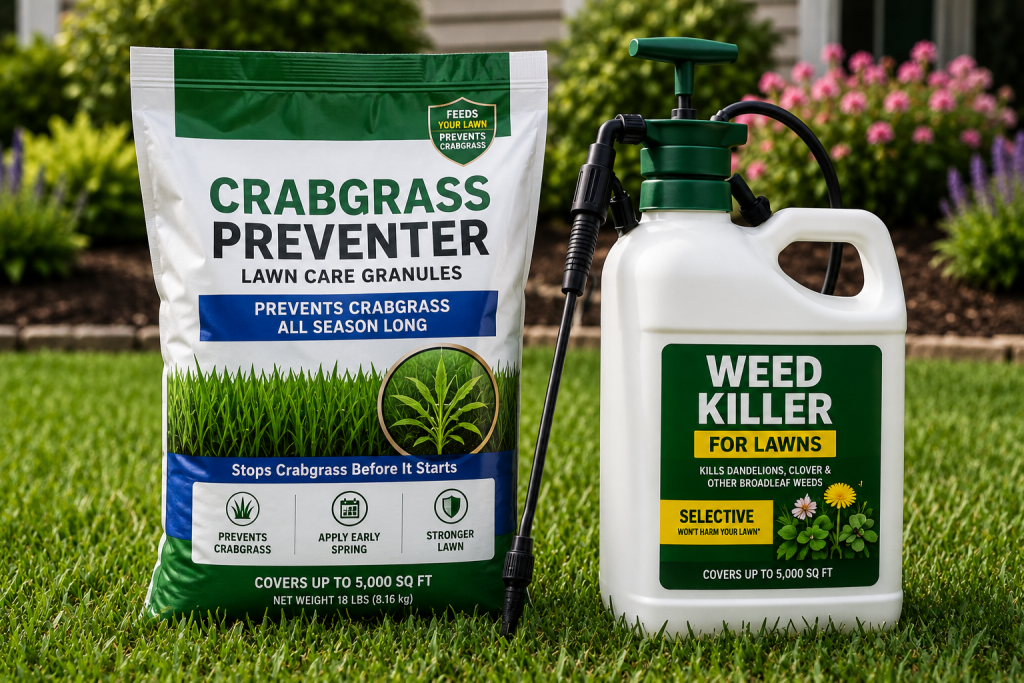
Crabgrass is a common reason homeowners consider this type of treatment. Timing is critical because applying a preventive treatment after the target weeds are already established does not turn it into a post-emergent treatment.
If crabgrass is your main concern, see when to apply crabgrass preventer for a more focused timing guide.
Pre-emergent products can also interfere with desirable grass establishment, so homeowners planning to seed or overseed need to check label restrictions carefully before choosing a treatment.
Post-emergent herbicides treat existing weeds
Post-emergent products are intended for weeds that have already emerged and are growing.
Choosing one still requires identifying the weed and checking lawn compatibility. A post-emergent label may list certain weeds and turf types while excluding others.
If the weed is already visible, buying a pre-emergent product simply because it is labeled for lawn weed control may not address the problem you actually have.
Best Weed Killer for Broadleaf Weeds
Broadleaf weeds typically have visibly different leaf shapes from lawn grasses. Common lawn examples include dandelions and clover.
For a small number of broadleaf weeds, the best approach may be hand removal or a selective spot treatment rather than spraying the entire property.
For a widespread broadleaf problem, a selective lawn herbicide labeled for the specific weeds and your turf type may make more sense. Even then, consider why the weeds have become widespread.
For specific problems, HRA has separate guides on getting rid of dandelions and controlling clover in a lawn.
A lawn with scattered weeds but otherwise dense turf does not necessarily benefit from whole-yard treatment. Targeting only the problem areas reduces unnecessary treatment of grass that does not need it.
What About Grassy Weeds?
Grassy weeds can be more difficult for beginners because they may resemble the lawn itself.
This makes identification especially important. Applying a general broadleaf weed killer to a grassy weed may accomplish nothing, while choosing a non-selective herbicide could injure both the weed and the desirable turf.
Some grassy weeds can be managed with selective products that are labeled for the particular weed and compatible lawn grass. Others require a different strategy.
If you are unsure whether the unwanted plant is crabgrass, another grassy weed, or desirable turf with a different appearance, identify it before buying a herbicide.
Lawn condition also matters. Annual grassy weeds frequently take advantage of thin or open turf, so improving mowing, watering, and overall turf density can be an important part of reducing future pressure.
Spot Treatment vs Whole-Lawn Treatment
For many homeowners, this decision can reduce both cost and unnecessary herbicide use.
Spot treatment is usually the better fit when:
- Only a few weeds are present.
- Weeds occur in isolated patches.
- You can accurately target the unwanted plants.
- Much of the lawn is otherwise healthy.
A broader treatment may be worth considering when:
- The same target weed is distributed throughout much of the lawn.
- The product is specifically labeled for that weed and turf.
- Nonchemical removal would be impractical.
- Lawn conditions are appropriate for treatment.
Do not treat the entire lawn simply because a product can be applied that way.
If weeds repeatedly occupy large portions of the property, look beyond the herbicide. Thin grass, poor soil conditions, unsuitable mowing, drainage problems, or other stress can leave open space for weeds to return.
For seasonal lawn decisions that affect turf density, see the Spring Lawn Care Guide for Homeowners.
Liquid vs Granular Weed Killer
Both liquid and granular formulations can have a place in lawn weed control. The better choice depends on how much area you need to treat and how precisely you need to target weeds.
Liquid weed killers
Ready-to-use liquid products can be convenient for isolated weeds because they allow localized treatment without mixing a concentrate.
Concentrates may suit larger treatment areas, but they require the homeowner to measure and prepare the product exactly as directed by the label. Do not estimate concentrations or create your own mixing formulas.
Sprays also require careful attention to drift. Avoid application when wind or other conditions could move the herbicide onto flowers, vegetables, shrubs, neighboring property, or other sensitive areas.
Granular weed killers
Granular products can make sense when a labeled treatment is intended for a broader lawn area and the application method suits the problem.
They are generally less suited to precisely targeting a single weed than a carefully applied spot treatment. Some granular products also have specific moisture or watering requirements, making label directions especially important.
For a closer comparison, see spray versus granular weed killer for spot treating lawns.
What to Check Before Applying Any Lawn Weed Killer
Once you have selected a treatment category, check the actual product label before application. The product label provides the required directions, restrictions, and safety precautions for using the herbicide correctly.
- Target weed: Is the weed you want to control listed?
- Lawn grass: Is your turf type compatible with the product?
- Application site: Is the product labeled for the area where you intend to use it?
- Weather: Are current conditions suitable under the label directions?
- Nearby plants: Can you keep the treatment away from flowers, shrubs, vegetables, trees, and other desirable plants?
- Personal protection: Do you have the gloves, clothing, eye protection, or other protective equipment specified on the label?
- People and pets: Can the treated area remain clear for the period required by the label?
- Other lawn work: Will treatment conflict with seeding, mowing, irrigation, or another planned application?
Do not assume that applying more product will produce better control. Use only the labeled amount and method.
Store remaining herbicide in its original labeled container and in accordance with the storage directions. Do not transfer lawn chemicals into drink bottles, food containers, or other unlabeled containers.
When Weed Killer Is Not the Best Fix
Not every weed problem needs an herbicide.
A few weeds can sometimes be removed by hand, especially when they are easy to isolate and the root can be removed without extensively damaging the lawn.
More importantly, weeds often become competitive where desirable grass is weak.
Look for underlying problems such as:
- Mowing too short
- Repeated drought stress
- Poor drainage
- Compacted soil
- Bare patches
- Heavy traffic
- Lawn grass poorly suited to the site
- Thin turf following damage or disease
Correcting these conditions can make the lawn more competitive and reduce the amount of open space available for weeds. Cultural lawn care and hand removal can be useful parts of weed management rather than relying only on herbicides.
For homeowners who want to minimize chemical use, improving turf density and spot-removing manageable weeds is often a sensible starting approach.
When to Call a Lawn Care Professional
Professional help can make sense when choosing a treatment requires more confidence than you have in the diagnosis.
Consider getting help when:
- You cannot identify the weed.
- You cannot identify the lawn grass.
- Several weed species are widespread.
- Previous treatments have repeatedly failed.
- Desirable plants are closely mixed with the weeds.
- Large areas of turf are already weak or damaged.
- You suspect the lawn problem is not primarily caused by weeds.
- The product restrictions or treatment sequence are unclear.
A professional can be especially useful when the real decision is diagnosis rather than application. Treating the wrong plant with the wrong product can waste time and leave you with a damaged lawn that still has the original problem.
Final Thoughts
The best lawn weed-control choice starts with identification. Determine what weed you have, what grass you need to protect, and whether you are preventing future weeds or treating plants that are already growing. Use selective spot treatment when it fits the problem, and reserve broader treatment for situations that genuinely justify it.
Herbicide is only one lawn-care tool. Dense, appropriately mowed and watered turf can reduce the opportunities weeds have to establish, while a few isolated weeds may need little more than targeted removal. If you do use a weed killer, choose a product labeled for the exact situation and follow its directions rather than treating more lawn—or using more product—than necessary.