
Concrete Driveway Repair: What Homeowners Should Know
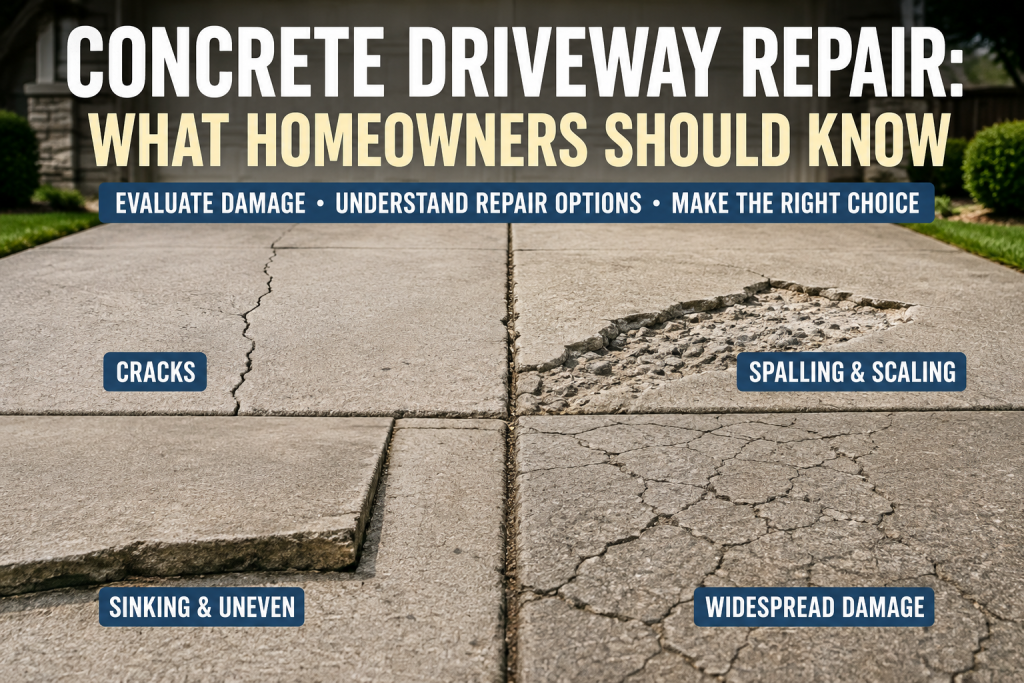
Concrete driveway repair starts with identifying what kind of damage you actually have. A stable isolated crack or small spalled area may need only a localized repair. Widespread surface deterioration over a stable slab may be a resurfacing candidate. But sunken, heaved, displaced, or repeatedly cracking concrete can point to movement or base problems that make replacement a better long-term choice.
The key is to look beyond appearance. Before choosing a repair method, determine whether the damage is isolated, spread across the surface, or associated with slab movement or structural failure.
| Damage Pattern | Likely Remedy | DIY Suitability | When Contractor Assessment Is Warranted |
|---|---|---|---|
| Hairline or narrow stable crack | Monitor or localized repair | Often reasonable | If it widens, returns, or shows movement |
| Isolated non-moving crack | Localized crack repair | Often reasonable | If cause is uncertain or damage is progressing |
| Small area of spalling | Localized patching | Possible for limited areas | If deterioration is deep or spreading |
| Widespread surface scaling | Resurfacing may be considered | Usually more demanding | When determining whether the slab is sound enough to resurface |
| Broad surface deterioration with stable slab | Resurfacing may be appropriate | Project-dependent | If preparation requirements or slab condition are uncertain |
| Crack with vertical displacement | Evaluate movement before repair | Poor DIY candidate | Professional assessment is usually appropriate |
| Sunken section | Determine cause of settlement | Not a surface-repair project | When lifting, base correction, or replacement may be needed |
| Heaved slab | Determine cause of movement | Not a surface-repair project | Professional assessment is appropriate |
| Widespread interconnected cracking | Replacement may be more practical | Usually poor | When multiple sections are failing |
| Recurring damage tied to drainage or movement | Correct underlying cause first | Depends on cause | When settlement, erosion, or drainage problems are significant |
These are practical starting points rather than absolute diagnoses. Concrete can fail for several reasons at once, and the repair that makes sense depends on the slab’s stability as well as what is visible at the surface.
Start by Assessing the Damage Pattern
Before filling a crack or applying a patch, look at the driveway as a whole. Determine whether the damage is limited to one location or appears across several slabs or large surface areas. Pay particular attention to whether both sides of a crack remain level. A narrow crack in otherwise solid, level concrete is very different from a crack where one side has dropped or risen.
Also consider whether the damage is changing. Cracks that continue to widen, sections that sink over time, or repairs that repeatedly fail can suggest ongoing movement. Surface deterioration should also be evaluated for depth. Shallow scaling or pitting may be primarily a surface problem, while deep deterioration can indicate that more of the concrete has lost integrity.
Drainage matters too. Ponding water, runoff from a downspout, erosion near slab edges, or saturated soil can contribute to recurring damage.
Appearance alone does not determine the correct repair. Movement generally matters more than cosmetic severity because a surface repair cannot stabilize a slab that is continuing to move.
Hairline and Non-Moving Cracks
Small cracks are among the most common driveway problems. A hairline or narrow crack may be a reasonable localized-repair candidate when both sides remain level, the surrounding concrete is solid, and there is no obvious settlement or heaving.
Watch for changes before assuming a crack is purely cosmetic. A crack that remains nearly unchanged from season to season is different from one that is rapidly widening or developing vertical displacement. Drainage should also be checked, particularly if water routinely enters the crack or flows toward the damaged area.
For stable cracks that are appropriate for localized treatment, see how to repair cracks in a concrete driveway. Crack-specific preparation and repair methods belong in that process rather than in the broader repair decision.
Localized crack repair can limit water intrusion and further edge deterioration, but it should not be used to disguise active movement. If the two sides of a crack no longer align or the slab continues to shift, the movement needs to be understood before cosmetic repair becomes the priority.
Spalling, Scaling, and Surface Deterioration
Not all driveway damage begins as a crack. Spalling occurs when pieces of the concrete surface break or flake away. Scaling is typically shallower deterioration spread across the surface. Pitting can leave smaller depressions or rough areas.
A small spalled area surrounded by solid concrete may be suitable for localized patching. Broader scaling or deterioration requires a different decision because repairing dozens of individual surface defects may not provide a durable or attractive result.
When deterioration is widespread but the slab remains reasonably stable, resurfacing may be worth considering. Resurfacing places a new bonded surface layer over properly prepared existing concrete. It can restore a worn surface, but it depends on the underlying driveway being suitable to receive the new material.
Resurfacing is less appropriate when deterioration extends deeply through the slab, when major settlement is present, or when sections continue to move. Covering unstable concrete does not eliminate the condition causing the failure.
Sunken, Heaved, or Displaced Slabs
Vertical movement changes the repair decision substantially. If one side of a crack is higher than the other, a panel has sunk, or a section has heaved upward, the problem is no longer limited to the surface.
Movement can create trip hazards, redirect water, and place stress on neighboring sections. Causes can include settlement, erosion, soil movement, drainage problems, or changes in the supporting base.
Crack filler cannot correct slab movement. Filling the visible opening may improve appearance temporarily, but it does not restore support beneath the slab or return displaced sections to their original position.
Homeowners should not use improvised jacks or attempt to lift, stabilize, or pump material beneath concrete slabs without appropriate equipment and expertise. Substantial or recurring movement is a good reason to have the driveway evaluated before deciding between correction of the affected section and replacement.
Why Drainage and Soil Movement Matter
Concrete driveways rely on stable support. When conditions beneath or beside the slab change, damage can appear even if the concrete itself was originally sound.
Ponding water can saturate nearby soil. Downspouts that discharge beside a driveway can concentrate water along an edge. Erosion and washout can remove support, while soil shrink-and-swell cycles may contribute to movement in some locations. Recurring settlement can also indicate that a base or soil condition remains unresolved.
Look for patterns. A sunken corner beside a downspout, erosion along an outside edge, or cracks that repeatedly return after repair may provide clues that the visible defect is only part of the problem.
Repairing the surface without addressing an active underlying cause can lead to another failure. Simple drainage conditions may sometimes be corrected by redirecting obvious surface runoff, but major grading, excavation, or subsurface drainage work requires a broader evaluation.
When Localized Repair Makes Sense
Localized repair is most useful when the problem is truly localized. Stable isolated cracks, small spalled areas, limited edge damage, and other defects surrounded by sound concrete may not justify resurfacing or replacing an entire driveway.
The surrounding slab should remain solid and reasonably level. There should be no clear evidence that a crack is opening because sections are moving independently.
A localized repair should solve a localized defect, not hide a larger failure. When multiple areas require major repair, previous patches have failed, or cracks continue developing, treating each spot separately can become less practical and less durable.
When Resurfacing Makes Sense
Resurfacing can be an option when surface deterioration is widespread but the driveway beneath it remains reasonably stable. This may include scaling, pitting, weathered surfaces, or numerous shallow defects that make individual patching impractical.
Before choosing to resurface a concrete driveway, the slab needs to be evaluated for conditions that a surface layer cannot correct. Major settlement, severe displacement, unstable cracking, and failed base conditions remain problems even if a new surface temporarily hides them.
Preparation is also important. Existing concrete must be suitable for the resurfacing product and prepared according to the manufacturer’s requirements. Weak or contaminated surfaces can interfere with bonding.
Resurfacing should therefore be viewed as a surface-renewal option for appropriate concrete rather than a substitute for correcting structural movement.
When Replacement Is the Better Long-Term Value
Replacement becomes more reasonable as the amount and severity of damage increase. A driveway with large badly deteriorated areas, several displaced sections, recurring movement cracks, or widespread deep failure may require so many separate repairs that replacement becomes the more practical long-term approach.
The same is true when underlying drainage or base problems need to be corrected as part of reconstruction. Removing failed sections may provide access to address conditions that cannot be corrected from the surface.
Age alone is not a reason to replace a driveway, and a few cracks do not automatically mean the slab has failed. The decision should be based on stability, extent of damage, likely repair durability, and the amount of work required to keep repairing separate sections.
In some cases, repairing a limited defect provides many additional years of service. In others, spending repeatedly on failing sections can cost more over time than addressing the broader problem once.
Weather and Curing Considerations
Concrete repair products need suitable conditions to perform properly. Temperature, surface moisture, preparation, curing conditions, and protection from traffic can all affect the finished repair.
Requirements vary by product, so manufacturer instructions should control the timing and application conditions. Avoid assuming that one universal curing period applies to every crack filler, patching material, resurfacer, or sealer.
Even a well-selected repair can perform poorly if it is applied under unsuitable conditions or subjected to vehicles before it is ready.
What Homeowners Can Reasonably Handle
Homeowners can do much of the initial evaluation themselves. Photographing cracks, monitoring changes, checking whether both sides remain level, and observing where water flows are useful first steps.
Limited localized repairs and small patches may also be reasonable DIY projects when the surrounding concrete is sound and the product instructions are within the homeowner’s experience and equipment capabilities. Simple surface drainage issues, such as an obvious downspout discharging directly beside the driveway, may sometimes be corrected without major excavation or grading.
More aggressive work carries different risks. Slab lifting, structural stabilization, extensive grinding, major demolition, large-scale cutting, and heavy slab handling should not be treated as routine homeowner repairs.
Powered cutting, drilling, grinding, and aggressive surface preparation can generate respirable silica dust. Appropriate tools, dust controls, personal protective equipment, and professional handling may be necessary depending on the work.
What to Document Before Calling a Contractor
Good documentation can make a contractor evaluation more useful. Take photographs showing the overall driveway and closer views of specific damage. Note where cracks occur, whether the two sides remain level, and where slabs appear to be sinking or heaving.
Also record ponding, runoff, previous repairs, broad surface deterioration, and any trip hazards. If damage has been changing, older photographs can help show whether the condition is progressing.
Useful questions for a contractor include:
- What do you believe caused the damage?
- Is the slab still stable?
- Would a localized repair realistically last?
- Is resurfacing appropriate for this slab?
- Does the base or drainage need correction?
- Which sections actually require replacement?
- What preparation is included?
- What curing and traffic restrictions apply?
The goal is to understand why a repair method is being recommended, not simply what will make the driveway look better immediately.
When to Call a Concrete Professional
Professional assessment becomes more important when cracks are wide or worsening, vertical displacement is visible, slabs are sinking or heaving, or repaired damage continues to return.
It is also appropriate when several slabs appear to be moving, drainage is contributing to deterioration, or large areas have substantial damage. Work involving significant grinding, slab lifting, demolition, structural correction, or uncertain base conditions generally exceeds the scope of a simple homeowner repair.
A professional evaluation can also help when the main question is whether repairing several separate areas still makes financial sense compared with replacing part or all of the driveway.
Sealing After Repair — Keep Brief
Sealing can be part of long-term driveway maintenance after appropriate repairs have been completed and the concrete is suitable for the selected product.
A sealer does not stabilize moving slabs, repair structural cracking, correct settlement, or substitute for necessary crack and surface repairs. Those conditions should be addressed first.
If sealing fits the condition of the driveway, review how to seal a concrete driveway after completing suitable repairs and allowing required curing time.
Final Thoughts
The correct concrete driveway repair depends on whether the damage is localized, spread across the surface, or associated with movement.
Stable isolated cracks and small surface defects may be practical localized repairs. Broad surface deterioration over otherwise stable concrete may support resurfacing. Sunken, heaved, displaced, repeatedly cracking, or badly deteriorated sections can make partial or complete replacement the better long-term value.
Most importantly, look for the reason behind the damage before choosing a cosmetic fix. If drainage, erosion, settlement, or slab movement remains active, address that condition before relying on a repair intended only for the visible surface.