most durable flooring: best options for busy homes
The most durable flooring for your home depends on what kind of wear it needs to survive. Porcelain tile may excel against scratches and surface water, while hardwood can show wear sooner but remain serviceable for decades because it can often be repaired and refinished.
For a busy household, durability can mean resisting pet claws, dents, spills, stains, dropped objects, furniture movement, or everyday foot traffic. The best choice is the material that handles your most likely problems without creating unacceptable tradeoffs in comfort, maintenance, appearance, or cost.
Compare the most durable flooring options for busy homes, including tile, vinyl, laminate, and hardwood, based on scratches, dents, water, maintenance, and repairability.
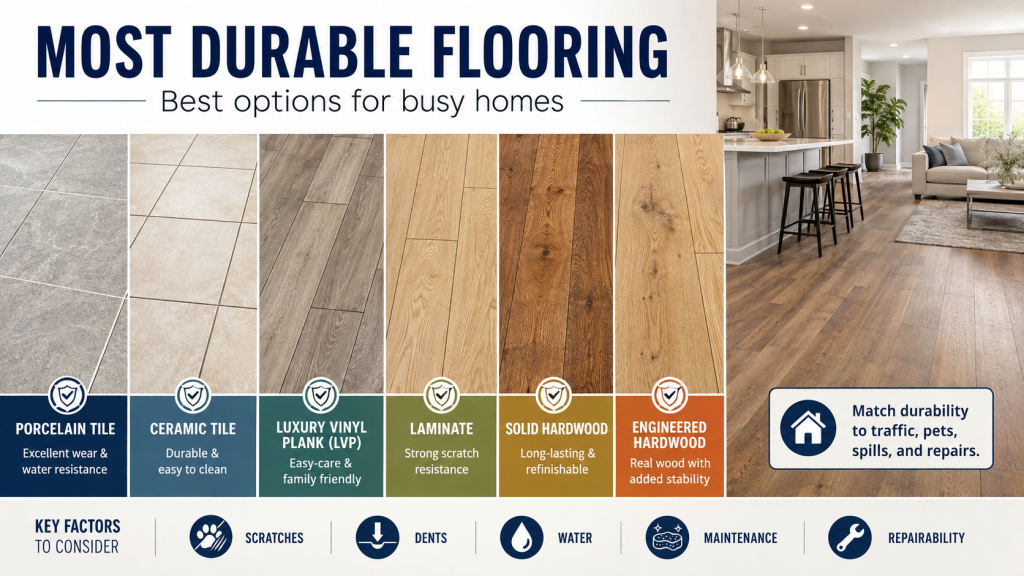
| Flooring type | Scratch resistance | Dent/impact resistance | Water tolerance | Maintenance | Repairability | Best durability use |
|---|---|---|---|---|---|---|
| Porcelain tile | Very good | Very good, but can chip | Excellent at tile surface | Low to moderate | Moderate | Wet, gritty, high-traffic areas |
| Ceramic tile | Very good | Good, but can chip | Very good at tile surface | Low to moderate | Moderate | Kitchens, entries, bathrooms |
| Luxury vinyl plank / vinyl | Good | Moderate | Good to excellent by product | Low | Limited to moderate | Busy households needing easy cleaning |
| Laminate | Very good | Good | Limited to good by product | Low | Limited | High-traffic dry rooms |
| Solid hardwood | Moderate | Moderate | Limited | Moderate | Excellent | Long-term use where renewability matters |
| Engineered hardwood | Moderate | Moderate | Moderate | Moderate | Varies | Wood appearance with improved stability |
Performance varies by product quality, finish, construction, installation, and conditions in the home. A durable material installed over an unsuitable subfloor can still fail prematurely.
If replacing older flooring, use caution during demolition. Older tile, sheet flooring, mastics, and adhesives may contain asbestos. If suspect material may be present, do not sand, grind, scrape, cut, or remove it until it has been appropriately evaluated or tested.
What Makes Flooring Durable?
Flooring durability is more complicated than surface hardness. Different floors fail in different ways, and the type of damage common in your household should guide the decision.
Important durability factors include:
- Surface scratching: Claws, grit, chair legs, and dragged objects can mark the finish.
- Dents: Furniture legs, high point loads, and dropped objects can compress softer flooring.
- Chipping: Hard surfaces such as tile resist dents but can chip when struck.
- Cracking: Tile can crack when the supporting floor moves or a concrete crack transfers into the installation.
- Water damage: Some materials tolerate surface water well, while others can swell, stain, or deform.
- Staining: Food, mud, pet accidents, and household spills can discolor vulnerable surfaces.
- Finish wear: Protective finishes can gradually wear in high-traffic paths.
- Seam or joint damage: Floating floors can develop joint problems when the subfloor is uneven or the floor moves excessively.
- Grout wear: Tile may remain sound while grout becomes stained, cracked, or harder to maintain.
- Movement-related damage: Subfloor deflection, slab movement, or changing moisture conditions can shorten flooring life.
- Long-term visual aging: Some materials still look attractive with scratches and wear, while others look damaged once the original surface changes.
No material leads every category. Tile is hard but brittle. Laminate can resist abrasion but has limited repair options. Hardwood scratches more easily but can often be renewed.
Porcelain Tile
Porcelain tile is one of the strongest choices for homes where surface wear, moisture, grit, and frequent cleaning are major concerns.
Its dense body and hard surface provide excellent resistance to ordinary foot traffic and many household stains. It also has very low water absorption, making it useful in rooms where surface moisture is expected.
That hardness comes with tradeoffs. A heavy object can chip a tile, especially at an exposed edge. Porcelain is also hard underfoot, and dropped glassware or dishes are more likely to break on it.
Grout requires its own maintenance even when the tile remains in excellent condition.
Porcelain also depends on the floor beneath it. Movement, deflection, or significant cracks in the substrate can lead to cracked tile or grout. A premium tile does not compensate for an unstable supporting surface.
Replacing one damaged tile may also be disruptive, particularly if matching tile is no longer available.
Porcelain is a strong durability candidate for:
- Entryways
- Mudrooms
- Kitchens
- Bathrooms
- High-traffic halls
- Other areas exposed to moisture or grit
It is an especially good fit when hardness and water tolerance matter more than softness underfoot.
Ceramic Tile
Ceramic floor tile offers strong everyday durability and can be an excellent choice without stepping up to porcelain in every room.
Like porcelain, ceramic tile handles routine cleaning and surface moisture well when the product is intended for floor use. Quality glazed surfaces can resist staining and ordinary household wear effectively.
Ceramic can chip or crack from impact or movement below the floor. Its durability therefore depends partly on proper product selection and a stable substrate.
Compared with porcelain, many ceramic tiles are somewhat easier to cut and work with. Porcelain’s lower water absorption can be valuable in demanding settings, but that does not make every porcelain tile automatically superior to every ceramic tile for an ordinary indoor floor.
Surface finish matters, too. A tile intended mainly for light-duty use should not be selected merely because the color or pattern looks right.
Grout remains a maintenance consideration with either material. For many kitchens, bathrooms, entries, and similar spaces, a properly selected ceramic floor tile can provide a long-lasting surface without requiring the densest tile available.
Luxury Vinyl Plank and Vinyl
Luxury vinyl plank, or LVP, has become a practical durability option for homeowners who want resistance to everyday traffic without the hardness of tile.
Its protective surface layer helps resist ordinary abrasion, scuffs, and household use. Many products also tolerate spills and surface water well, although water performance varies by construction and manufacturer requirements.
LVP is easier to clean than many natural materials and feels softer underfoot than ceramic or porcelain tile. That combination can work well in busy kitchens, family rooms, hallways, and homes with children.
The surface is not scratch-proof. Grit, pet claws, dragged furniture, and sharp objects can leave marks. Heavy furniture or concentrated loads can also dent some products.
Durability below the surface matters as well. Floating-plank joints can be stressed when the subfloor is uneven or when the flooring flexes excessively. Proper subfloor flatness is therefore part of the durability equation.
Local repairs are possible with some installations, but replacing a damaged plank may require removing surrounding flooring. Matching the original color or pattern years later can also be difficult.
When comparing LVP, consider the entire construction rather than treating one specification as proof of quality.
Laminate Flooring
Laminate is particularly strong at resisting everyday surface abrasion. A quality wear surface can perform well against shoes, pet claws, chairs, and routine traffic in dry household spaces.
That makes laminate a practical choice for busy living rooms, hallways, bedrooms, and family areas where scratch resistance matters.
Moisture is its major durability limitation. Modern laminate products vary considerably in their water resistance, but significant or prolonged exposure can still reach vulnerable areas of the floor.
When moisture affects the core, edges can swell or change shape. Permanent swelling is generally not something that can be sanded away or restored.
Laminate also has limited repairability compared with hardwood. A worn or damaged decorative surface cannot simply be refinished.
Product quality matters beyond a wear or abrasion rating. Impact resistance, core construction, edge treatment, surface quality, and intended use all contribute to how well a laminate floor holds up.
For households that mainly need resistance to scratches and traffic in dry rooms, laminate can provide an effective balance of durability and manageable maintenance.
Solid Hardwood
Solid hardwood illustrates why surface perfection and long-term durability are not the same thing.
Wood can scratch and dent. Pet claws, grit, furniture, and everyday traffic gradually change the appearance of the finish. Softer species may show dents more readily than harder ones, although species hardness alone does not predict how a complete floor will perform.
Finish quality, household conditions, maintenance, and wood movement all matter.
Where hardwood distinguishes itself is repairability. Many solid wood floors can be sanded and refinished when the surface becomes badly worn. Individual boards may also be repairable or replaceable in some situations.
That means a hardwood floor can show visible wear earlier than porcelain tile yet remain useful for a very long time because the surface can be renewed.
Some homeowners also value the patina that develops as real wood ages rather than expecting a permanently flawless surface.
Water remains an important weakness. Leaks and prolonged moisture can cause staining, movement, cupping, or other damage. Changes in indoor humidity can also cause seasonal movement.
Solid hardwood makes the most sense when natural appearance, service life, and future repairability matter more than maximum scratch or water resistance.
One advantage of real hardwood is its repair potential, so homeowners with an existing floor may also want to review when to refinish or replace hardwood floors.
Engineered Hardwood
Engineered hardwood uses a real wood wear surface over a layered core. It therefore shares many of solid hardwood’s surface characteristics while generally providing better dimensional stability.
If engineered hardwood and luxury vinyl are your leading choices, our vinyl plank vs engineered hardwood comparison breaks down the practical tradeoffs.
Pet claws, furniture, grit, and impacts can still scratch or dent the real wood surface. Engineered construction does not make the top layer immune to normal wood-floor wear.
Its layered construction can make it more stable than solid wood when environmental conditions change, which expands the situations where homeowners may consider it. Moisture is still a concern, however, and engineered hardwood should not be treated as waterproof flooring.
One major durability difference among engineered products is the wear layer. Some floors have enough usable wood above the core to permit future refinishing. Others have much less material available and may have limited or no practical refinishing potential.
Core construction, finish quality, wear-layer thickness, and installation requirements can therefore have a large effect on long-term value.
For homeowners who want a genuine wood surface but need more dimensional stability than traditional solid hardwood, engineered wood can be a useful middle ground.
Most Durable Flooring for High-Traffic Areas
High-traffic flooring has to deal with more than footsteps. Entries can collect grit and water, kitchens experience spills and dropped objects, and family rooms may see furniture movement, pets, and constant activity.
Strong candidates include:
- Porcelain tile: Excellent for grit, moisture, and frequent traffic when the substrate is suitable.
- Ceramic tile: Durable for many busy household spaces when the tile is rated for floor use.
- Quality LVP: Practical where easy cleaning, moisture tolerance, and a softer surface are priorities.
- Quality laminate: Strong against surface abrasion in appropriately dry rooms.
- Hardwood: Worth considering where natural aging and the ability to repair or refinish the surface matter.
The right answer changes by room. Porcelain may make sense in a wet mudroom but feel unnecessarily hard in a family room where comfort is important.
A high-traffic floor should also be chosen with grit control and cleaning in mind. Even highly wear-resistant surfaces last longer when abrasive dirt is not constantly ground under shoes and furniture.
Most Durable Flooring for Homes With Dogs
Dogs challenge floors in several different ways, so pet durability should not be reduced to scratch resistance.
Consider:
- Claw scratches: Laminate, tile, and durable LVP surfaces can resist ordinary claw wear well, although no material is completely scratch-proof.
- Traction: Very smooth hard flooring can be difficult for some dogs, especially older pets.
- Water bowls: Repeated splashing favors materials that tolerate moisture.
- Accidents: Easy cleaning and stain resistance become more important.
- Dirt and grit: Material tracked indoors can act like an abrasive.
- Noise: Claws may be more noticeable on hard tile or some floating floors.
- Comfort: Softer surfaces may be more comfortable for pets that spend significant time lying on the floor.
Tile performs well against scratches and moisture but is hard and can be slippery. LVP can provide a useful combination of moisture tolerance and comfort but may still scratch.
Laminate offers good surface wear resistance, while its moisture limitations deserve consideration around frequent accidents or spills. Hardwood and engineered wood can show claw marks more readily, but their natural appearance and potential repairability may outweigh that drawback for some households.
Most Durable Flooring for Homes With Children
Homes with children put floors through spills, toys, dropped objects, moving chairs, constant traffic, and frequent cleaning.
LVP often appeals to families because it combines easy maintenance, relatively forgiving comfort, and good resistance to ordinary household wear.
Laminate can provide strong scratch and abrasion resistance in dry family spaces. Its vulnerability to significant moisture makes fast spill cleanup more important.
Tile is extremely durable for kitchens, entries, and other hard-working areas but can feel unforgiving underfoot. Toys and dishes dropped on tile may also break more easily.
Hardwood may accumulate scratches and dents, yet some families prefer that tradeoff because the floor can age naturally and may eventually be refinished.
For a busy family, a floor that can be maintained and repaired realistically may provide more value than the material with the hardest initial surface.
Scratch Resistance vs Long-Term Repairability
Scratch resistance describes how difficult it is to mark a floor. Repairability describes what happens after damage finally occurs.
Those are different durability strengths.
Porcelain and ceramic tile resist ordinary surface scratches extremely well, but replacing a chipped or cracked tile can require removing the damaged piece without harming those around it. A matching replacement also needs to be available.
Laminate can retain a clean-looking surface under heavy everyday use, but once its decorative layer is permanently damaged, sanding and refinishing are not options.
LVP handles normal wear well, yet replacing one damaged plank may be inconvenient depending on how the floor was installed. Matching an older pattern can become another challenge.
Hardwood usually scratches more readily, but many wood floors can be repaired, recoated, or refinished.
Think about the entire ownership period. A material that remains nearly perfect until it receives one permanent defect is durable in a different way from a surface that develops wear gradually but can later be renewed.
Water Resistance and Durability Are Not the Same Thing
Water performance is particularly important in kitchens, bathrooms, basements, laundry rooms, mudrooms, and other areas where spills or leaks are more likely.
Porcelain and ceramic tile tolerate surface water very well. Many LVP products also provide strong water resistance. Laminate performance varies substantially, while solid and engineered wood require more caution.
Water resistance is only one part of durability. A highly water-tolerant floor may still scratch, dent, chip, or be difficult to repair.
For a closer look at flooring designed for wet and spill-prone areas, compare the best waterproof flooring options for your home.
A waterproof or water-resistant flooring product also does not make the room waterproof. Water can still reach the subfloor through edges, openings, transitions, walls, or plumbing penetrations, and moisture can sometimes originate below the flooring.
How Subfloor Problems Can Shorten Flooring Life
Even the most wear-resistant material can perform poorly over a defective floor system.
Conditions that can reduce flooring life include:
- Uneven subflooring
- Excessive movement or flexing
- Structural deflection
- Persistent moisture
- Significant concrete slab cracks
- Poor surface preparation
- Incompatible underlayment
- Existing rot or other unresolved damage
The consequences differ by flooring type. Tile may crack when the substrate moves. Floating plank joints can be stressed over uneven areas. Moisture can damage wood-based materials or become trapped within a flooring assembly.
Do not use a new finish floor to conceal a moisture, movement, or structural problem that still needs attention.
Most Durable Flooring by Homeowner Priority
| Priority | Strong options | Main tradeoff |
|---|---|---|
| Maximum scratch resistance | Porcelain, ceramic, quality laminate | Tile is hard; laminate has limited repairability |
| Water-prone rooms | Porcelain, ceramic, appropriate LVP | Water-resistant flooring does not protect the entire floor system |
| Pet households | LVP, laminate, tile, repairable wood | Balance scratches with traction and comfort |
| Busy families | LVP, laminate, tile, hardwood | Cleaning, comfort, and repair needs vary |
| Long service life | Tile, solid hardwood, suitable engineered hardwood | Substrate and long-term maintenance matter |
| Easier repair | Solid hardwood, some engineered hardwood | Wood shows surface wear more readily |
| Lower maintenance | LVP, laminate, tile | Grout or permanent plank damage may still need attention |
| Natural appearance | Solid hardwood, engineered hardwood | More scratch and moisture sensitivity |
| Softer feel underfoot | LVP, some floating floors, wood | Softer materials may dent or scratch more easily |
| Budget-conscious durability | Laminate, suitable LVP, some ceramic tile | Compare the complete installed project |
These categories are starting points, not universal rankings. A quality floor suited to its environment will generally be a better durability choice than a poorly matched material selected only because the category has a strong reputation.
What to Look for When Buying Durable Flooring
Once you choose a flooring category, compare the characteristics of actual products. The name of the material alone does not tell you how it will perform.
LVP and Vinyl
Look beyond a single wear-layer number.
Consider:
- Wear-layer construction
- Surface finish and texture
- Core construction
- Manufacturer residential or commercial use rating
- Warranty exclusions and limitations
- Requirements for attached padding or separate underlayment
- Suitability for the room and subfloor
A thicker-looking specification does not compensate for poor construction or use outside the manufacturer’s requirements.
Laminate
For laminate, review:
- Wear or intended-use classification where provided
- Water-resistance claims and their limitations
- Core construction
- Edge protection
- Impact and stain performance information
- Installation and room-use restrictions
An abrasion rating can be useful, but it does not measure every aspect of flooring durability. Impact resistance, stain performance, moisture tolerance, and core quality also matter.
Hardwood
For solid hardwood, consider:
- Wood species
- Factory or site-applied finish
- Plank construction
- Future refinishing potential
- Expected humidity and moisture conditions
- How much natural scratching and aging you are comfortable seeing
Do not choose species hardness alone. A harder wood can still scratch at the finish, and household conditions can matter as much as the species itself.
Engineered Hardwood
Compare engineered wood based on:
- Real wood wear-layer thickness
- Core construction
- Finish quality
- Refinishing limitations
- Approved installation locations
- Moisture and environmental requirements
Two engineered hardwood products can have very different long-term repair and refinishing potential.
Tile
For ceramic or porcelain tile, check:
- Whether the product is suitable for floor use
- Surface texture
- Water absorption where it matters
- Slip characteristics for the intended room
- Intended residential or traffic application
- Compatibility with the planned substrate and installation system
Do not assume every tile displayed in a showroom is appropriate for every floor. The intended application matters more than appearance alone.
Questions to Ask Before Choosing Durable Flooring
Before buying, answer these questions:
- What type of wear is most likely in this room?
- Will the floor be exposed to regular water or occasional spills?
- Are dogs, cats, or other pets present?
- Will children use the room heavily?
- Is the space a high-traffic route through the home?
- How important is softness or comfort underfoot?
- Do I expect the surface to remain nearly scratch-free?
- What happens if one plank, board, or tile becomes damaged?
- How long do I expect to keep this flooring?
- How much cleaning and long-term maintenance am I willing to do?
- Is the subfloor or concrete slab suitable for this material?
- What preparation, underlayment, expansion, moisture, and installation requirements does the manufacturer specify?
These questions help separate a floor that is durable in theory from one that is durable for the conditions in your home.
When Professional Evaluation Makes Sense
Ordinary material comparison does not require a flooring contractor, but some existing-floor conditions should be evaluated before new flooring is installed.
Get qualified help when you find:
- Significant floor movement
- Structural deflection or noticeable sagging
- Major subfloor damage
- Persistent or unexplained moisture
- Rot
- Large or moving concrete slab cracks
- Extensive previous water damage
- Floor preparation beyond your skill level
- Suspected asbestos-containing flooring, mastic, or adhesive
If older flooring or adhesive may contain asbestos, stop disturbing it. Do not sand, grind, scrape, drill, cut, or attempt DIY removal. Appropriate professional evaluation or testing should come before demolition.
Structural movement, major moisture problems, and extensive rot may also require a specialist other than the flooring installer before the finish-floor project can proceed.
Final Thoughts
The most durable flooring is not necessarily the hardest floor or the one that looks newest for the longest time. A busy household may benefit more from scratch resistance, water tolerance, easy cleaning, repairability, or a surface that ages gracefully, depending on the room and the people and pets using it.
Compare the damage most likely to occur, then weigh that against comfort, maintenance, appearance, repair options, subfloor conditions, and total project cost. The floor that fits those conditions is more likely to deliver useful long-term durability than a material chosen from a durability claim alone.