water under vinyl plank flooring: causes and what to do
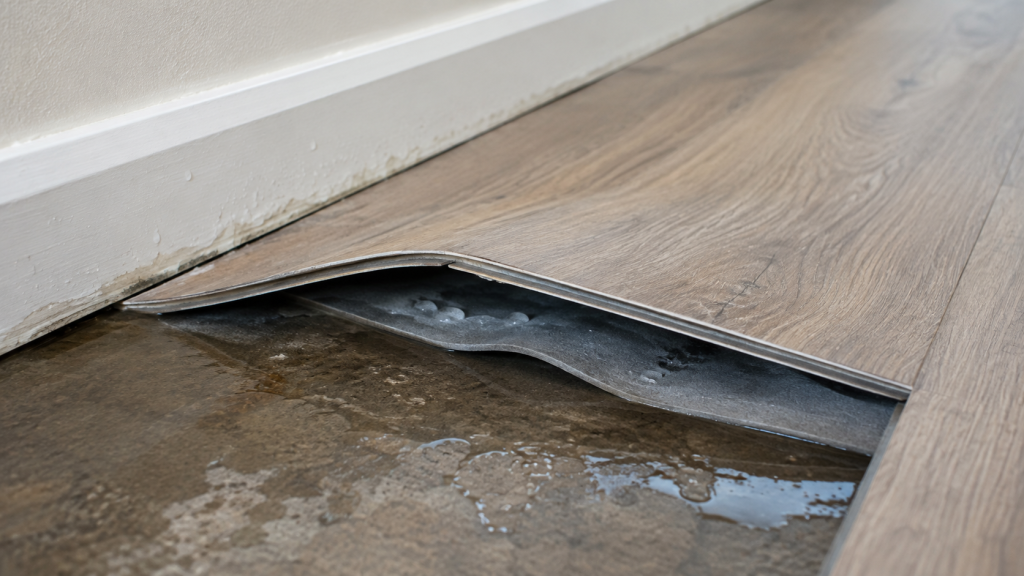
Water under vinyl plank flooring can come from a plumbing or appliance leak, water entering around room edges, basement seepage, or moisture moving through a concrete slab. Even if the vinyl planks themselves tolerate water well, moisture trapped underneath can damage underlayment, plywood or OSB, baseboards, drywall, adhesives, and nearby framing.
The first priority is to stop the water source if you can do so safely. Then determine whether you are dealing with a small recent spill or moisture that has traveled beneath the floor and may require further inspection.
| What you notice | Likely cause | What it suggests | Next step |
|---|---|---|---|
| Water appears after dishwasher or refrigerator leak | Appliance or supply-line leak | Water may have traveled beyond the visible area | Stop the leak and assess how far moisture spread |
| Dampness near exterior wall | Rain entry, door leakage, or exterior moisture | Water may be entering at the perimeter | Look for the source without opening walls |
| Moisture only over concrete slab | Slab moisture, seepage, or condensation | Moisture may be coming from below | Check for recurring dampness and flooring requirements |
| Squishing or movement under floating LVP | Water trapped beneath flooring | Underlayment or subfloor may be wet | Further inspection may require lifting flooring |
| Musty smell with no visible leak | Hidden damp material | Moisture may be lingering beneath or beside the floor | Identify the source and extent |
| Wet flooring after flooding | Floodwater intrusion | Water may be widespread or contaminated | Avoid DIY cleanup if contamination is possible |
| Repeated moisture near washer or water heater | Appliance, plumbing, or drain leak | Ongoing leakage may be present | Stop using the source and arrange repair |
If water is near electrical equipment, receptacles, cords, or appliances, keep people away from the area and do not handle wet electrical components. Get qualified help when water and energized equipment may be in contact.
How Water Gets Under Vinyl Plank Flooring
Floating vinyl plank flooring is not a sealed waterproof basin. Water can reach beneath it through room edges, transitions, openings, joints, or adjacent building materials.
Common sources include:
- Plumbing supply or drain leaks
- Dishwasher leaks
- Refrigerator water-line leaks
- Washing-machine leaks
- Water-heater leaks
- Sink or toilet overflows
- Flooding
- Rain entering at doors or exterior walls
- Basement seepage
- Moisture vapor through concrete
- Water moving through perimeter gaps
- Spills reaching floor edges or vulnerable joints
Water can also travel farther than expected beneath a floating floor. The visible wet spot may not represent the full affected area.
Finding the source matters more than identifying the nearest wet plank. If moisture keeps returning after the surface is dried, there is likely an ongoing source or trapped water below.
Why Water Under LVP Can Be a Problem
Vinyl plank may remain visually intact while moisture-sensitive materials underneath continue to stay wet.
Potential problems include:
- Wet or deteriorating underlayment
- Swollen plywood or OSB
- Adhesive failure
- Musty odors
- Damp baseboards
- Drywall damage
- Moisture affecting nearby framing
- Flooring movement
- Stress on click-lock joints
- Staining or deterioration of surrounding materials
Moist conditions can also support mold growth on susceptible materials if they remain damp. The vinyl itself is generally less vulnerable than materials such as wood subflooring, drywall paper, dust, or nearby framing.
Do not assume the floor is fine simply because the planks have not swollen.
If the planks are beginning to lift or deform, see our guide to vinyl plank flooring buckling for the other causes and warning signs to check.
First: Stop the Water Source
If water is actively entering the room, stop the source before focusing on the flooring.
Safe actions may include:
- Stop using a leaking appliance or fixture.
- Shut off the appropriate water supply if the valve is accessible and can be operated safely.
- Keep people away from wet electrical equipment.
- Avoid touching wet cords, receptacles, appliances, or electrical devices.
If water has reached energized electrical equipment, or you cannot safely reach a water shutoff without entering a wet electrical area, avoid the area and get qualified help.
For a plumbing or appliance leak that you cannot stop safely, contact the appropriate repair professional rather than allowing the floor to remain wet while troubleshooting the appliance.
Small Spill vs Water Trapped Under the Floor
A small surface spill is different from water that has migrated beneath floating LVP.
Small surface spill
If a small spill was cleaned promptly and did not reach floor edges, transitions, damaged joints, or wall perimeters, the risk may be limited.
Monitor the area for:
- Moisture returning at seams
- New movement underfoot
- Damp baseboards
- Persistent odor
If none of these develops, deeper water intrusion may be unlikely.
Water trapped underneath
Possible signs include:
- Squishing sounds
- Water appearing at plank joints
- Damp areas along walls
- Movement underfoot
- A persistent musty smell
- Moisture reappearing after wiping
- Wet or swollen baseboards
When these signs are present, drying the visible surface alone may not address the problem. Part of the flooring may need to be lifted so the materials underneath can be evaluated.
Water Under Vinyl Plank After an Appliance Leak
Appliances can release a surprising amount of water before the problem becomes obvious.
Common sources include:
- Dishwashers
- Refrigerators with water lines or ice makers
- Washing machines
- Water heaters
Water can move beneath floating flooring and spread beyond the appliance footprint. It may follow the slab or subfloor, travel toward walls, or reach nearby rooms before becoming visible.
Do not assume the damage stops where the floor looks wet.
After the source is stopped, check accessible room edges, baseboards, transitions, and nearby areas for signs of moisture. The extent of the leak and how long it was present will help determine whether the flooring needs to be lifted for inspection.
Water Under Vinyl Plank Over Concrete
Concrete can transmit moisture vapor even when the surface appears dry.
That moisture is different from a sudden plumbing leak, but it can still create problems beneath vinyl flooring. Possible effects include damp underlayment, adhesive problems, musty conditions, and moisture affecting trim or surrounding materials.
Recurring moisture over concrete may be related to:
- Slab moisture vapor
- Basement seepage
- Ground moisture
- High humidity
- Drainage problems
- Plumbing leaks
A waterproof vinyl plank does not prevent moisture from existing beneath it.
Some flooring systems require specific slab-moisture conditions, testing, or vapor-control measures. If the problem is recurring rather than tied to a single spill, the slab and moisture source may need further evaluation.
If you are dealing with a concrete slab, our guide to using a vapor barrier for vinyl plank flooring on concrete explains when a moisture-control layer may be required.
Water Under Vinyl Plank Over Plywood or OSB
Plywood and OSB are more vulnerable to prolonged wetting than vinyl plank.
If water reaches a wood-based subfloor, watch for:
- Swelling
- Raised panel seams
- Soft or spongy areas
- Discoloration
- Musty odor
- Delamination
- Movement underfoot
A subfloor can remain wet even when the vinyl surface feels dry.
Do not reinstall flooring over swollen, soft, or visibly deteriorated material. Significant subfloor damage, sagging, or movement should be evaluated before the finish floor is put back in place.
Water Under Vinyl Plank in a Basement
Basements can receive moisture from several directions, which makes diagnosis especially important.
Possible sources include:
- Foundation seepage
- Concrete slab moisture
- Plumbing leaks
- Water after heavy rain
- High indoor humidity
- Condensation
- Drain or sump-related problems
If moisture appears repeatedly after storms or during humid weather, the source may not be the flooring at all.
LVP can be a practical basement floor, but it should not be used to cover an unresolved dampness problem. Repeated moisture should be traced to its source before the floor is restored.
Can Vinyl Plank Dry Out Without Being Removed?
Sometimes, but not always.
A very small amount of moisture close to an accessible edge may dry without extensive removal if the underlying materials were only briefly exposed.
Water trapped beneath a large floating floor is different. The finished surface can slow drying from above, while underlayment or a wood subfloor may retain moisture.
Fans directed at the visible surface do not prove that the area beneath the flooring is dry.
Removal or partial lifting becomes more likely when:
- The leak was substantial
- Water spread beneath multiple planks
- Moisture has been present for an unknown time
- The subfloor is wood
- Underlayment is wet
- Odor persists
- Water keeps reappearing
Glue-down vinyl presents different challenges because the flooring and adhesive are part of the affected assembly.
Should You Remove Vinyl Plank After Water Gets Under It?
Not every spill requires removing the floor, but inspection underneath may be necessary when moisture is clearly trapped.
Consider lifting or professional evaluation when:
- The floor squishes when walked on
- Water appears from joints or edges
- A large leak occurred
- Moisture was present for an unknown period
- The subfloor is wet
- A musty smell persists
- Baseboards or walls are damp
- Water continues to reappear
- Floodwater or contaminated water was involved
- Damage is visible at an accessible edge
The goal is not simply to remove flooring. It is to determine whether moisture-sensitive materials underneath are wet and whether they can dry properly.
Can the Vinyl Plank Be Reused?
Possibly.
Some click-lock LVP can be reused if the planks remain flat, clean, undamaged, and can be removed without breaking their locking edges.
Reuse becomes less practical when planks are:
- Warped
- Gouged or damaged
- Contaminated
- Broken at the locking joints
- Permanently stained
- Difficult to match with the remaining floor
Matching replacement material can be a problem if the original product has been discontinued or has changed appearance over time.
Glue-down vinyl generally has different removal and reuse limitations.
What About Mold?
Mold becomes a concern when moisture remains in materials that can support growth.
The vinyl plank itself is usually not the main concern. More vulnerable materials can include:
- Plywood or OSB
- Drywall paper
- Wood framing
- Dust and debris
- Some adhesives
- Baseboard materials
A small clean-water leak that is discovered and dried promptly is different from widespread hidden moisture that has remained for an unknown period.
Professional evaluation is appropriate when there is extensive visible growth, widespread water damage, hidden moisture across a large area, or conditions that cannot be safely inspected.
Do not pour bleach or other chemicals blindly beneath flooring in an attempt to treat an area you cannot see.
What if the Water Came From Flooding or Sewage?
Water from a clean supply-line leak should not be treated the same way as contaminated water.
Use a stronger safety boundary when the source includes:
- Sewage backups
- Floodwater
- Contaminated groundwater
- Toilet waste
- Other potentially contaminated water
Avoid direct contact and do not treat the situation as an ordinary flooring cleanup.
Professional water-damage or restoration evaluation is appropriate because contaminated water can affect flooring, underlayment, subflooring, walls, and other porous materials.
Signs the Subfloor May Be Damaged
The condition beneath the flooring matters as much as the appearance of the vinyl.
Watch for:
- Soft or spongy areas
- Swelling
- Raised panel seams
- Persistent discoloration
- Delamination
- Musty odors
- Increased movement
- Sagging
- Visible deterioration
Do not cover damaged subflooring with replacement vinyl and assume the new floor will stabilize it.
Softness, sagging, rot, or significant movement can indicate a deeper problem that needs evaluation before flooring is reinstalled.
Common Mistakes
Avoid these common responses to a wet vinyl floor:
- Assuming waterproof LVP means water underneath is harmless
- Drying only the visible surface
- Ignoring a leak because the planks still look normal
- Running fans without determining whether water is trapped
- Reinstalling flooring over a damp subfloor
- Ignoring recurring slab moisture
- Covering mold, rot, or damaged wood
- Disturbing old flooring or adhesive that may contain asbestos
- Applying bleach or other chemicals blindly beneath the floor
If older tile, sheet flooring, mastic, or adhesive may contain asbestos, do not sand, scrape, grind, cut, or demolish it. Stop disturbing the material and obtain appropriate evaluation or testing before proceeding.
Questions to Ask Before Deciding What to Do
Work through these questions before deciding whether the floor needs further inspection:
- Where did the water come from?
- Was the water clean or potentially contaminated?
- How long might it have been present?
- Is the floor floating or glued down?
- Is the subfloor concrete, plywood, or OSB?
- Is water still appearing?
- Is there a persistent musty smell?
- Are baseboards or walls damp?
- Does the flooring squish, flex, or move?
- Are there signs of swelling or softness underneath?
- Is the room below grade?
- Could old flooring or adhesive beneath the LVP contain asbestos?
The more uncertainty there is about the source, duration, or extent of moisture, the stronger the case for inspecting beneath the finished floor.
When Professional Help Makes Sense
A small, quickly cleaned surface spill does not automatically require a contractor.
Qualified help makes sense when there is:
- An active plumbing leak you cannot safely stop
- Electrical equipment exposed to water
- Extensive water beneath the floor
- Floodwater or sewage
- Persistent or unexplained slab moisture
- Significant plywood or OSB swelling or softness
- Structural movement or sagging
- Visible rot
- Extensive mold growth
- Large or repeated basement seepage
- Suspected asbestos-containing flooring, mastic, or adhesive
- An unclear extent of hidden moisture
The right professional depends on the cause. A plumber may be needed for the leak, while extensive water intrusion, structural damage, hazardous materials, or hidden moisture may require other qualified specialists.
Final Thoughts
Water under vinyl plank flooring matters even when the planks themselves appear undamaged. The important questions are where the moisture came from, how far it traveled, how long it remained, and whether the underlayment, subfloor, walls, or other materials became wet.
Stop the source first, keep clear of electrical or contaminated-water hazards, and do not simply cover a damp floor system. When water is trapped, repeatedly returns, or has affected moisture-sensitive materials, further inspection or professional evaluation is the safer next step.