vapor barrier for vinyl plank flooring on concrete
Whether you need a vapor barrier for vinyl plank flooring on concrete depends on the flooring system, installation method, slab conditions, and manufacturer requirements. Some LVP installations require a separate vapor-control layer, while others use an approved combination underlayment or handle moisture control differently.
Even when the vinyl plank itself is described as waterproof, moisture coming from the concrete below still matters. A water-tolerant plank does not automatically protect the underlayment, adhesive, trim, walls, or other materials from slab moisture.
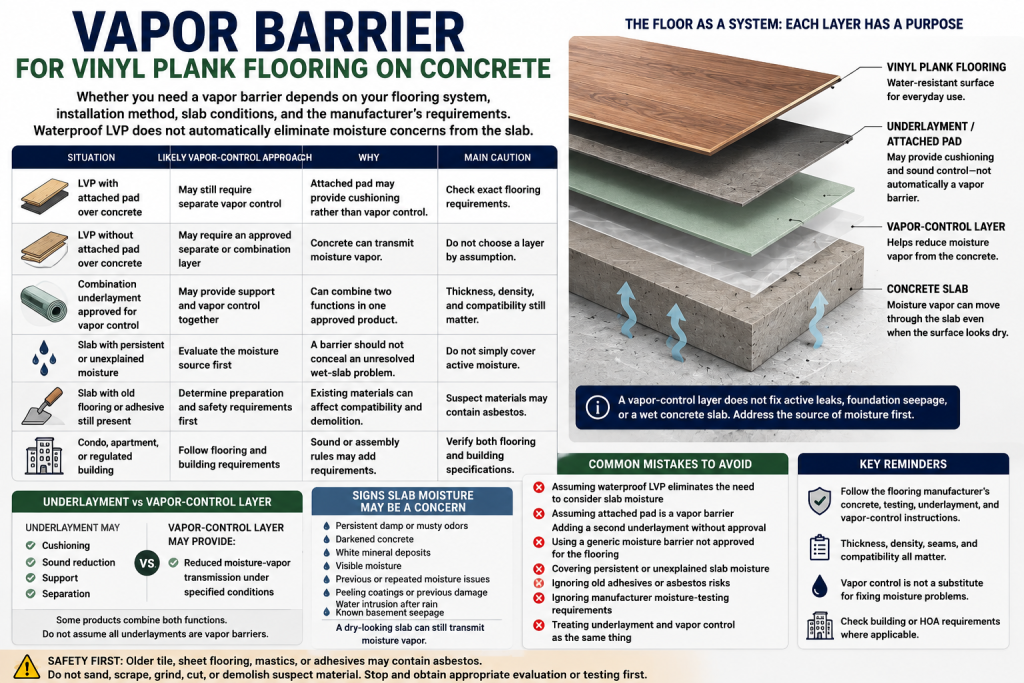
| Situation | Likely vapor-control approach | Why | Main caution |
|---|---|---|---|
| LVP with attached pad over concrete | May still require separate vapor control | Attached pad may provide cushioning rather than vapor control | Check exact flooring requirements |
| LVP without attached pad over concrete | May require an approved separate or combination layer | Concrete can transmit moisture vapor | Do not choose a layer by assumption |
| Combination underlayment approved for vapor control | May provide support and vapor control together | Can combine two functions in one approved product | Thickness, density, and compatibility still matter |
| Slab with persistent or unexplained moisture | Evaluate the moisture source first | A barrier should not conceal an unresolved wet-slab problem | Do not simply cover active moisture |
| Slab with old flooring or adhesive still present | Determine preparation and safety requirements first | Existing materials can affect compatibility and demolition | Suspect materials may contain asbestos |
| Condo, apartment, or regulated building | Follow flooring and building requirements | Sound or assembly rules may add requirements | Verify both flooring and building specifications |
Concrete flooring work can involve dust, heavy materials, existing adhesives, and hidden moisture damage. If older tile, sheet flooring, mastic, or adhesive may contain asbestos, do not sand, scrape, grind, cut, or demolish it. Stop disturbing suspect material and obtain appropriate evaluation or testing before proceeding.
Why Concrete Can Create Moisture Problems Under LVP
Concrete is porous. Moisture vapor can move through a slab even when the visible surface appears dry.
Conditions that can influence slab moisture include:
- Ground moisture
- Indoor and outdoor humidity
- Drainage around the building
- Below-grade conditions
- Slab construction
- Plumbing or foundation leaks
The LVP itself may tolerate moisture well while materials around or beneath it do not. Moisture can affect underlayment, certain adhesives, baseboards, nearby drywall, wood framing at slab edges, or other materials trapped in a damp environment.
A dry-looking slab therefore does not prove that its moisture conditions meet the requirements for a particular flooring system.
Do You Need a Vapor Barrier for Vinyl Plank Flooring on Concrete?
Sometimes.
There is no single vapor-control rule that applies to every vinyl plank product installed over every concrete slab.
The answer depends on:
- LVP construction
- Floating or glue-down installation
- Whether the flooring has an attached pad
- Manufacturer instructions
- Slab conditions
- Whether separate underlayment is permitted
- Whether an approved underlayment also provides vapor control
Some flooring systems may call for a separate vapor-control material. Others may permit a combination underlayment with an approved moisture-control function. A different product may specify another floor assembly entirely.
Check the requirements for the exact flooring before purchasing or adding layers.
Waterproof LVP Is Not the Same as a Moisture-Protected Installation
A waterproof LVP claim generally refers to the flooring material’s ability to resist water under specified conditions.
That does not mean moisture cannot exist beneath the planks.
Water or vapor beneath a finished floor may affect:
- Underlayment
- Adhesives
- Baseboards
- Drywall
- Wood framing near slab edges
- Other moisture-sensitive materials
Water can also enter from plumbing leaks, foundation seepage, or other sources that have nothing to do with the plank’s resistance to swelling.
Think of LVP water resistance as a property of the flooring, not a substitute for moisture management throughout the complete floor system.
Attached Pad vs Vapor Barrier
Attached pad and vapor control should not be assumed to perform the same job.
An attached pad may provide:
- Cushioning
- Sound reduction
- Support
- Separation from the slab
Unless the flooring system specifically identifies the attached material as satisfying its concrete vapor-control requirements, do not assume that it does.
Some attached-pad LVP still requires a separate approved vapor-control layer over concrete. Other products use a different approved assembly.
Adding an extra layer without checking can also create compatibility problems, so verify the exact flooring instructions before adding anything beneath attached-pad LVP.
Underlayment vs Vapor-Control Layer
Underlayment and vapor control may be combined in one product, but the terms describe different functions.
Underlayment may provide:
- Cushioning
- Sound reduction
- Support
- Separation
A vapor-control layer is intended to:
- Reduce moisture-vapor transmission under specified conditions
Some underlayments are designed to do both. Others provide cushioning or sound control without meeting the flooring system’s vapor-control requirement.
Do not assume ordinary foam, cork, fiber material, or attached backing is a moisture barrier simply because it sits between the plank and concrete.
If you are also deciding what cushioning or support layer belongs beneath the floor, see our guide to the best underlayment for vinyl plank flooring.
When Combination Underlayment May Be Used
A combination underlayment can provide LVP-compatible support while also incorporating a moisture-control layer.
This can simplify the floor assembly when the product is specifically approved for the flooring and concrete installation.
Compatibility still depends on factors such as:
- Thickness
- Density
- Moisture-control properties
- Seam requirements
- Installation method
- Flooring manufacturer approval
A product advertised for use over concrete is not automatically correct for every LVP floor.
Combination underlayment also should not be used as a way to conceal persistent water entry or a slab that remains visibly wet.
What About Polyethylene Sheeting?
Some vinyl plank manufacturers may specify polyethylene sheeting or another approved vapor-control material over concrete.
That does not make one polyethylene specification universal.
Required material, thickness, seam treatment, overlap, perimeter details, and compatibility can vary by flooring system. Follow the instructions for the exact LVP rather than copying a detail from a different flooring product.
If the manufacturer specifies another vapor-control approach, adding polyethylene without approval can create an unnecessary or incompatible layer.
How to Tell Whether Slab Moisture Is a Concern
Homeowners can look for conditions that justify closer evaluation before flooring goes down.
Warning signs include:
- Persistent damp or musty odors
- Darkened concrete
- White mineral deposits
- Visible moisture
- Repeated dampness
- Peeling floor coatings
- Previous flooring damaged by moisture
- Water intrusion after rain
- Known basement seepage
These signs do not identify the exact moisture level or cause by themselves. Their importance is that they indicate the slab should not simply be covered without further investigation.
The opposite is also true: the absence of visible moisture does not prove that the slab meets flooring requirements.
Moisture Testing and Manufacturer Requirements
Some LVP manufacturers require concrete moisture testing or set acceptable slab conditions before installation.
Testing methods and allowable limits can vary by flooring system. Results obtained by different test methods should not be treated as interchangeable simply because both produce a number.
Check the flooring instructions for:
- Whether testing is required
- Which testing method is recognized
- What conditions are acceptable
- What action is required when conditions fall outside those limits
If moisture readings are unclear, inconsistent, or beyond the flooring requirements, a qualified flooring installer or concrete-moisture professional can help evaluate the installation before materials are covered.
Vapor Barrier for Vinyl Plank Flooring on Basement Concrete
Basement slabs deserve extra attention because they are below grade and may be exposed to several moisture sources.
Possible concerns include:
- Ground moisture
- Elevated humidity
- Foundation seepage
- Plumbing leaks
- Moisture vapor through the slab
LVP can be a practical basement floor because many products tolerate surface water better than wood-based flooring. That does not make it appropriate to install over unresolved dampness.
If the basement has visible seepage, recurring wet spots, unexplained odors, or previous moisture damage, correct or evaluate the underlying condition before relying on a vapor-control layer.
Vapor Barrier for Vinyl Plank Flooring on Slab-on-Grade Concrete
Slab-on-grade concrete can also transmit moisture vapor.
A slab does not become automatically moisture-free because it is old, appears dry, or is located in a warm climate. The construction beneath an existing slab may also be unknown.
Follow the flooring manufacturer’s concrete requirements regardless of the slab’s age.
If the product requires a vapor-control layer, use an approved system. If it does not permit an additional layer, do not add one simply because the floor is over concrete.
What if the Concrete Already Has Flooring or Adhesive on It?
Existing flooring can change both preparation requirements and safety considerations.
Old flooring or adhesive may:
- Affect whether the new floor can be installed over it
- Create an uneven surface
- Interfere with an adhesive system
- Conceal moisture damage
- Require evaluation before removal
Older tiles, sheet flooring, mastics, and adhesives may also contain asbestos.
If suspect material is present, do not mechanically remove it by sanding, grinding, scraping, or cutting. Appropriate evaluation or testing should occur before demolition or aggressive floor preparation.
What Vapor Barriers Cannot Fix
A vapor-control layer has a specific job. It is not a repair for every moisture or concrete problem.
It does not fix:
- Active plumbing leaks
- Foundation water entry
- Standing water
- Poor drainage
- Persistently wet slab conditions
- Structural concrete cracks
- Major floor movement
- Mold or rot in surrounding materials
If water is actively entering the space, address the source rather than installing new flooring over it.
Likewise, significant slab movement or damage needs evaluation on its own. Vapor control cannot stabilize concrete.
If moisture is already trapped beneath an installed floor, our guide to water under vinyl plank flooring explains the likely causes and what to check next.
Common Mistakes
Avoid these common concrete-flooring mistakes:
- Assuming waterproof LVP eliminates the need to consider slab moisture
- Assuming attached pad is automatically a vapor barrier
- Adding a second underlayment without approval
- Using a generic moisture barrier that is not approved for the flooring
- Covering persistent or unexplained slab moisture
- Disturbing old flooring or adhesive without considering asbestos
- Ignoring manufacturer moisture-testing requirements
- Installing over damaged or moving concrete
- Treating underlayment and vapor control as interchangeable
A simple floor assembly that follows the flooring requirements is better than adding extra layers without a defined purpose.
What to Check Before Buying a Vapor-Control Product
Before purchasing a separate barrier or combination underlayment, check:
- Exact LVP product requirements
- Installation method
- Whether the flooring has attached pad
- Approval for installation over concrete
- Required vapor-control method
- Approved underlayment types
- Maximum permitted thickness
- Combination-underlayment compatibility
- Concrete moisture-testing requirements
- Warranty requirements
- Building or HOA rules where applicable
This check may show that you need a separate vapor-control product, an approved combination layer, or no additional product of that type.
Questions to Ask Before Installation
Before installing LVP over concrete, answer these questions:
- Is this flooring approved for concrete?
- Does it have an attached pad?
- Is a separate vapor-control layer required?
- Is a combination underlayment permitted?
- Has the slab shown signs of moisture problems?
- Is the room below grade?
- Is old flooring or adhesive present?
- Could suspect material contain asbestos?
- Are significant slab cracks or movement present?
- Does the manufacturer require moisture testing?
Resolve unclear moisture, safety, or compatibility conditions before covering the slab.
When Professional Evaluation Makes Sense
Ordinary LVP selection over a sound, dry concrete floor does not automatically require professional help.
Get a qualified evaluation when you find:
- Persistent or unexplained slab moisture
- Visible water entry
- Major basement seepage
- Large or moving concrete cracks
- Structural movement
- Extensive existing-floor damage
- Mold or rot in surrounding materials
- Conflicting or unclear flooring requirements
- Suspected asbestos-containing flooring, mastic, or adhesive
Different problems may call for different specialists. A flooring professional can address installation compatibility, while persistent water entry, structural movement, or hazardous materials may require specialized evaluation before flooring work continues.
Final Thoughts
Whether you need a vapor barrier for vinyl plank flooring on concrete depends on the exact flooring system and the conditions of the slab. Attached pad and waterproof LVP do not automatically eliminate separate concrete moisture requirements.
Check the flooring manufacturer’s concrete, testing, underlayment, and vapor-control instructions before buying additional materials. If the slab has persistent dampness, water entry, major movement, or suspect existing flooring, address that condition before covering it with a new floor.