vinyl plank flooring buckling: causes and what to do
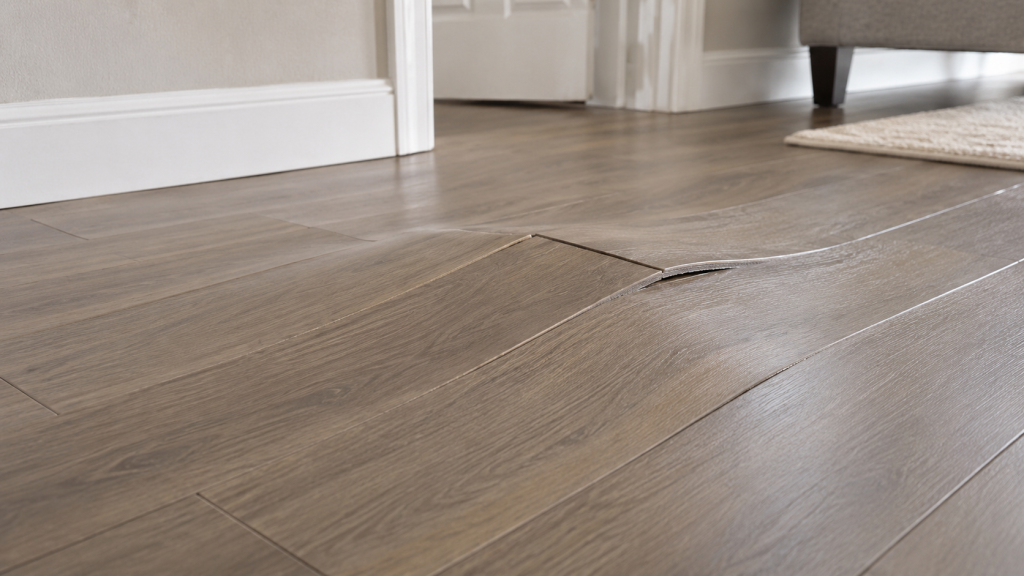
Vinyl plank flooring buckling usually means the floor is being forced upward because it cannot move normally, is being stressed from below, or has been damaged. Common causes include restricted expansion space, heat, moisture, uneven subflooring, incompatible underlayment, trapped floating flooring, or damaged locking joints.
A raised plank does not automatically identify the cause. Before attempting a repair, look at where the problem occurs, whether it changes with temperature, whether a leak happened recently, and whether the floor moves or flexes elsewhere.
| What you see | Likely cause | What to check | Next step |
|---|---|---|---|
| Ridge across several planks | Expansion restriction or heat | Perimeter clearance, fixed objects, recent temperature changes | Identify what is preventing normal movement |
| Buckling near a wall | Insufficient expansion space | Visible clearance at the perimeter | Verify manufacturer expansion requirements |
| Raised floor near a large window | Heat or direct sunlight | Sun exposure, time of day, seasonal pattern | Rule out heat-related expansion |
| Buckling after an appliance leak | Moisture beneath flooring | Damp edges, wet subfloor, underlayment condition | Stop the leak and inspect beneath if needed |
| Movement around a doorway or transition | Flooring trapped at transition | Thresholds, reducers, T-moldings | Check whether the floor can move normally |
| One localized raised joint | Locking-joint damage or local subfloor issue | Joint condition and support below | Determine whether the plank or base is damaged |
| Floor feels uneven or flexes in several areas | Subfloor or underlayment problem | Movement, dips, soft spots, excessive cushioning | Evaluate the supporting floor system |
If older flooring, sheet goods, tiles, mastics, or adhesives may contain asbestos, do not sand, grind, scrape, cut, or demolish suspect material. Stop disturbing it and obtain appropriate evaluation or testing before removal or aggressive floor preparation.
What Vinyl Plank Buckling Looks Like
Homeowners may describe the same general problem in several ways.
Common terms include:
- Buckling
- Tenting
- Lifting
- Peaking
- Raised seams
- Popping
- Separating
- Movement
- Humps
These descriptions can overlap, but they do not always point to the same underlying cause.
A long ridge across several planks may suggest expansion pressure. One raised joint may point toward damaged locking edges or uneven support beneath a small area. A floor that moves or clicks in several places may involve the subfloor or underlayment.
The shape, location, and timing of the problem usually provide better clues than the word used to describe it.
Why Vinyl Plank Flooring Buckles
Floating LVP is designed to rest over a flat, stable supporting surface while retaining enough freedom to expand and contract within the limits of the flooring system.
Buckling can develop when that movement is restricted or when support beneath the floor changes.
Major cause categories include:
- Insufficient expansion space
- Heat or direct sunlight
- Moisture beneath the flooring
- Uneven or moving subflooring
- Incompatible underlayment
- Damaged locking joints
- Transition problems
- Installation errors
- Cabinets or other fixed objects trapping the floor
More than one issue can also be present at the same time.
Insufficient Expansion Space
Floating vinyl plank normally requires clearance around walls and other fixed surfaces so the floor can move slightly as conditions change.
If flooring is installed tightly against a wall, post, hearth, doorway, or other fixed surface, expansion pressure can build instead of being relieved at the perimeter.
That pressure may cause planks to:
- Lift
- Tent
- Peak at joints
- Push against trim
- Develop ridges farther into the room
Areas worth observing include:
- Baseboards
- Door jambs
- Cabinets
- Kitchen islands
- Hearths
- Stair transitions
- Floor registers
Expansion requirements vary by product. Do not cut flooring back or alter the perimeter based on a general rule when the manufacturer’s installation requirements are available.
Cabinets or Fixed Objects Trapping a Floating Floor
Some floating floors are not intended to be pinned beneath permanent objects.
Depending on the flooring system, potential restrictions may include:
- Base cabinets
- Islands
- Heavy built-ins
- Fixed partitions
- Other permanently anchored features
When a floating floor is trapped, one section may be unable to move normally while another section expands. Stress can then appear several feet away from the object actually causing the restriction.
This is manufacturer-dependent. Do not assume every cabinet installed over vinyl plank is automatically wrong, but include fixed objects in the diagnosis when buckling appears without an obvious moisture or subfloor problem.
Heat and Direct Sunlight
Vinyl can expand as it becomes warmer.
Rooms with large windows, sliding glass doors, or intense afternoon sun can expose parts of a floor to much higher surface temperatures than the rest of the room.
Heat may be a clue when buckling:
- Appears near a large window
- Develops during very warm weather
- Is worse in the afternoon
- Changes as temperatures fall
- Occurs in rooms with large glass areas
Sudden heating conditions can also matter.
Check the flooring manufacturer’s temperature limits and any guidance related to sunlight or climate control. Window coverings may reduce intense solar heating, but do not assume sunlight is the cause until expansion restrictions, moisture, and subfloor conditions have also been considered.
Moisture Under Vinyl Plank Flooring
Moisture can contribute to buckling even when the vinyl plank itself tolerates water well.
Possible sources include:
- Plumbing leaks
- Dishwasher or refrigerator leaks
- Washing-machine leaks
- Moisture from concrete
- Basement seepage
Water beneath the floor can wet underlayment, affect adhesives, or cause plywood and OSB to swell. Those changes can create uneven support and push flooring upward.
A waterproof LVP plank does not make the materials underneath waterproof.
If buckling began after a leak or moisture keeps appearing at edges or joints, investigate the underlying materials rather than focusing only on the raised planks.
If moisture is already present beneath the floor, our guide to water under vinyl plank flooring explains the likely sources and what to check before repairing the buckled area.
Uneven or Moving Subfloor
Vinyl plank needs consistent support.
An uneven, flexible, or damaged base can allow sections of the floor to move differently under foot traffic. That movement can place repeated stress on click-lock joints and create localized lifting or separation.
Possible underlying conditions include:
- High spots
- Low spots
- Loose subfloor panels
- Swollen plywood or OSB
- Damaged subflooring
- Concrete irregularities
- Excessive floor movement
Common clues include clicking, flexing, repeated joint movement, or raised areas that correspond with uneven support below.
Do not rely on the finished flooring to stabilize a damaged or structurally moving floor.
Incorrect or Excessive Underlayment
More cushioning is not automatically better beneath LVP.
Underlayment that is too thick or too soft can allow excessive vertical movement. That can stress locking joints and make a floating floor feel unstable.
Problems can also occur when extra underlayment is installed beneath LVP that already has an attached pad and the manufacturer does not permit another layer.
Underlayment also cannot correct a substantially uneven subfloor.
If the floor feels soft, bouncy, or unusually flexible across several areas, verify:
- Whether the LVP has an attached pad
- Whether another underlayment was installed
- Whether that underlayment was approved
- Whether its thickness and density meet flooring requirements
If you are unsure what belongs beneath LVP, see our guide to the best underlayment for vinyl plank flooring before changing the floor system.
Transition and Doorway Problems
Doorways and transitions are common places for a floating floor to become restrained.
Potential trouble spots include:
- T-moldings
- Reducers
- Thresholds
- Doorways
- Transitions to tile or carpet
- Areas where flooring passes between rooms
A transition component that clamps the flooring too tightly can interfere with normal movement.
Buckling near a doorway does not prove the transition is the cause, but it is worth checking whether the problem is concentrated there and whether the floor appears pinched or restricted.
Avoid altering the transition until the flooring requirements and actual cause are clear.
Damaged Locking Joints
Click-lock edges can be damaged during installation or later movement.
A locking joint that has cracked, deformed, or partially separated may no longer hold neighboring planks flat.
Signs may include:
- One raised seam
- A joint that repeatedly pops up
- Separation when walked on
- Clicking in one localized area
- Visible damage at the plank edge
Repeated flexing can make joint damage worse.
A localized joint problem may require replacement of one or several planks, but first determine whether the locking edge failed on its own or because the floor beneath it is uneven or moving.
Buckling After a Leak
Buckling that begins after a dishwasher, refrigerator, washing machine, or plumbing leak deserves extra attention.
The problem may not be damage to the vinyl itself.
Water beneath the floor can lead to:
- Wet underlayment
- Swollen plywood or OSB
- Uneven support
- Adhesive problems
- Moisture trapped beneath floating planks
Water may also spread farther beneath the floor than the visible leak area suggests.
Stop the leak first. If the floor remains raised, moves underfoot, smells musty, or shows moisture at edges, the materials underneath may need to be inspected.
Buckling Near a Window or Sliding Door
A raised area near a large window can make heat a useful diagnostic clue.
Observe:
- Whether the area receives direct sunlight
- What time of day the problem is most noticeable
- Whether it changes seasonally
- Whether the floor settles somewhat as temperatures decrease
These observations can help distinguish a temperature-related problem from constant subfloor or moisture damage.
Do not make a permanent repair based only on location near a window. Expansion restrictions and underlying floor conditions can produce similar symptoms.
How to Check the Perimeter Safely
A basic visual inspection can provide useful information without dismantling the floor.
Look for:
- Flooring that appears tightly wedged against a fixed surface
- Raised areas concentrated along a wall
- Quarter-round or other trim pressing firmly on the floating floor
- Movement concentrated around doorways
- Visible areas where the floor appears to have no room to move
Do not start removing trim or cutting plank edges merely to test a theory. If correction is needed, follow the exact flooring requirements or have the installation evaluated before altering the perimeter.
Can Buckled Vinyl Plank Flatten Back Down?
Sometimes, but it depends on the cause and whether permanent damage occurred.
Temporary heat-related expansion may improve when the temperature normalizes. A floor restricted at the perimeter may also relax after the restriction is properly corrected.
Other problems do not resolve simply by waiting.
For example:
- Swollen plywood or OSB will not be corrected by lower room temperature.
- Broken click-lock joints may remain raised or loose.
- Permanently distorted planks may not lie flat again.
- Moisture trapped underneath still needs attention.
If the flooring settles temporarily and then buckles again, the underlying cause has probably not been resolved.
Should Buckled Vinyl Flooring Be Replaced?
Replacement depends on why the flooring buckled and how much permanent damage occurred.
Factors include:
- Cause of the problem
- Size of the affected area
- Condition of locking joints
- Permanent plank deformation
- Moisture damage below
- Condition of the subfloor
- Ability to correct the underlying cause
- Availability of matching replacement flooring
A few damaged planks may be replaceable after the cause is corrected. Widespread joint damage or extensive problems underneath can make a larger repair necessary.
Do not replace raised planks while leaving the condition that caused them in place.
Common Mistakes
Avoid these common responses to a buckled floor:
- Forcing a raised plank flat without finding the cause
- Assuming every buckle is caused by moisture
- Ignoring expansion clearance
- Ignoring direct heat or sunlight
- Adding more underlayment
- Replacing planks before correcting the underlying problem
- Covering swollen plywood or OSB
- Assuming waterproof LVP cannot have moisture-related problems
- Disturbing old flooring or adhesive that may contain asbestos
Buckling is a symptom. The lasting repair depends on identifying what is creating the pressure, movement, or loss of support.
Questions to Ask Before Repairing
Before deciding what to repair, ask:
- Where is the buckling located?
- Is it near a wall or doorway?
- Does direct sunlight hit the area?
- Did a plumbing or appliance leak occur recently?
- Is the floor over concrete, plywood, or OSB?
- Does the floor move or flex elsewhere?
- Does the LVP have an attached pad?
- Was additional underlayment installed?
- Are cabinets or built-ins sitting on the floating floor?
- Is the problem localized or widespread?
- Are locking joints visibly damaged?
- Is there evidence of moisture underneath?
The pattern of answers can help narrow the likely cause before flooring is disturbed.
When Professional Evaluation Makes Sense
A single slightly raised joint does not automatically require a flooring contractor.
Professional evaluation makes sense when there is:
- Widespread buckling
- Major floor movement
- Significant subfloor damage
- Persistent or unexplained moisture
- Swollen or soft plywood or OSB
- Large concrete irregularities or movement
- Repeated buckling after a previous repair
- Extensive locking-joint damage
- Installation conditions that cannot be identified
- Suspected asbestos-containing flooring, mastic, or adhesive
Structural movement, serious moisture problems, or hazardous materials may require a specialist other than a flooring installer before the finish floor can be repaired.
Final Thoughts
Vinyl plank flooring buckling usually means the floor is being restricted, heated, pushed from below, or inadequately supported. Expansion space, fixed objects, sunlight, moisture, subfloor condition, underlayment, transitions, and locking joints are the main areas to check.
Identify the cause before forcing the floor flat or replacing planks. If the problem is widespread, moisture-related, tied to significant subfloor movement, or difficult to explain, professional evaluation can help prevent the same problem from returning.