
laminate flooring bubbling: Causes and what to do
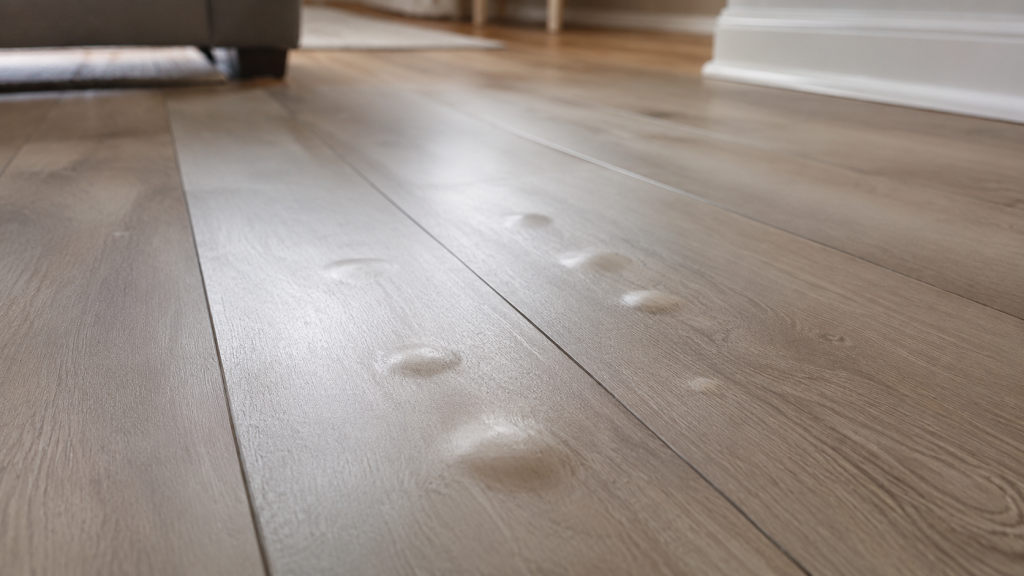
Laminate flooring bubbling often means moisture has reached the flooring core, or the floor is being stressed by expansion or a problem underneath it. Once a wood-fiber-based laminate core has permanently swollen, it usually does not return to its original shape.
Not every raised area is water damage, however. A long ridge across several planks can point toward restricted expansion, while puffy edges or raised seams near a spill or appliance more strongly suggest moisture. The location and shape of the damage are important clues.
| What you see | Likely cause | What it suggests | Next step |
|---|---|---|---|
| Raised edges after a spill | Moisture entered plank seams | Laminate core may have swollen | Dry the area and inspect for permanent edge swelling |
| Bubbling near dishwasher or refrigerator | Appliance or supply-line leak | Water may have traveled beneath or between planks | Stop the leak and determine the affected area |
| Several swollen seams | Repeated moisture or larger leak | Water may have reached multiple plank cores | Find the moisture source before considering replacement |
| Bubble or hump near a wall | Expansion restriction or perimeter moisture | Floor may be trapped or wet at the edge | Check for moisture and visible expansion clearance |
| Raised floor with no visible leak | Expansion, humidity, hidden moisture, or subfloor issue | The cause may not be directly above the raised area | Check surrounding conditions before disturbing flooring |
| Bubbling over concrete | Slab moisture or another moisture source | Moisture may be coming from below | Review slab conditions and flooring moisture requirements |
| One localized raised plank | Small spill, joint damage, or subfloor irregularity | Damage may be limited | Inspect nearby seams and conditions |
If water is near an appliance, cord, receptacle, or other electrical equipment, do not touch wet electrical components. Keep people away from the area and get qualified help if water and energized equipment may be in contact.
If older flooring, sheet goods, tile, mastics, or adhesives may contain asbestos, do not sand, scrape, grind, cut, or demolish suspect material. Stop disturbing it and obtain appropriate evaluation or testing before removal or aggressive floor preparation.
What Laminate Flooring Bubbling Looks Like
Homeowners use several terms to describe laminate that no longer lies flat.
You may notice:
- Bubbling
- Swelling
- Puffy plank edges
- Raised seams
- Blistering
- Peaking
- Humps
- Warping
- Planks lifting
These symptoms can look similar while having different causes.
Swollen edges and puffy seams often point more strongly toward moisture reaching the laminate core. A longer ridge or tented section across several boards may instead indicate expansion pressure or movement below the floor.
The distinction matters because permanently swollen laminate usually requires a different repair decision than flooring that is simply being held under expansion pressure.
Why Laminate Flooring Bubbles
Most laminate uses a rigid wood-fiber-based core beneath the decorative and protective surface layers. That core gives the plank strength but is more vulnerable to moisture than the synthetic cores commonly used in vinyl plank flooring.
Common causes of bubbling or lifting include:
- Water intrusion
- Prolonged surface moisture
- Appliance or plumbing leaks
- High humidity or damp conditions
- Moisture from a concrete slab
- Restricted expansion space
- Uneven or damaged subflooring
- Installation-related stress
More than one condition may be present at the same time. For example, a leaking appliance can swell laminate while also damaging the wood subfloor beneath it.
Water Reaching the Laminate Core
Moisture reaching the core is one of the most common explanations for swollen laminate edges or seams.
Water can enter through:
- Plank joints
- Exposed edges
- Room perimeters
- Damaged seams
- Openings near fixtures
- Areas where water remains on the floor
Possible sources include:
- Spilled drinks
- Repeated wet cleaning
- Pet accidents
- Sink or plumbing leaks
- Dishwasher leaks
- Refrigerator supply-line leaks
- Washing-machine leaks
- Water entering around doors or walls
When the core absorbs moisture, it can expand. The swelling often becomes noticeable first along plank edges because those areas are more vulnerable to water entering the material.
Drying can remove moisture, but it cannot necessarily reverse the physical change in the core. If the plank remains swollen or distorted after the moisture source has been corrected, replacement is often more realistic than expecting it to flatten completely.
If a leak has caused broader damage, see our guide to laminate flooring water damage for help deciding what may be salvageable and what may need replacement.
Repeated Wet Cleaning
Laminate generally requires moisture-conscious cleaning.
Problems can develop when too much liquid repeatedly reaches the floor, especially around plank joints.
Risk increases when:
- A soaking-wet mop is used
- Water is left standing on the surface
- Cleaning solution repeatedly collects at seams
- Steam cleaning is used when the flooring manufacturer does not permit it
- The floor is cleaned frequently with more moisture than the product allows
One cleaning event may not cause obvious damage, but repeated exposure can allow small amounts of moisture to reach the core over time.
Follow the flooring manufacturer’s cleaning requirements rather than assuming that a method safe for tile or vinyl is also safe for laminate.
Dishwasher, Refrigerator, and Washing-Machine Leaks
Appliance leaks can create localized swelling before the water source becomes obvious.
Common sources include:
- Dishwasher leaks
- Refrigerator supply lines
- Washing-machine hoses or connections
- Nearby sink or plumbing leaks
Water may travel under cabinets, beneath floating flooring, or along the subfloor before appearing at an exposed seam.
That means the first swollen plank you see may not be directly beside the leak.
Stop using the leaking appliance or fixture. If an accessible water-supply valve can be shut off safely, do so.
Do not handle wet electrical components, cords, receptacles, or appliances. If water has reached energized equipment, avoid the area and arrange qualified help.
High Humidity and Moisture in the Room
Laminate responds to changes in its environment because much of the plank contains wood-based material.
Persistent high humidity can contribute to dimensional changes, and damp conditions or condensation can increase moisture exposure.
Possible clues include:
- Seasonal changes in the floor
- Problems developing during prolonged humid weather
- Condensation elsewhere in the room
- A damp or musty environment
Humidity should not automatically be blamed for bubbling, however.
Plumbing leaks, wet cleaning, moisture from concrete, and water entering around room edges should also be considered. A localized swollen area near an appliance is more likely to have a localized source than a whole-room humidity problem.
Moisture From Concrete
Concrete can transmit moisture vapor even when the slab looks dry.
That matters beneath laminate because the flooring core is moisture-sensitive. If the installation does not meet the flooring manufacturer’s concrete and moisture-control requirements, moisture from below can contribute to swelling or other damage.
Possible clues include:
- Bubbling across a broader area
- Repeated dampness
- Musty conditions
- No obvious surface spill
- Previous flooring affected by moisture
- Problems concentrated in a basement or slab-on-grade room
Surface appearance alone cannot confirm that a slab has acceptable moisture conditions.
If slab moisture is suspected, check the flooring manufacturer’s requirements. Some installations call for specific testing or moisture-control measures.
Do not cover recurring or unexplained slab moisture with replacement laminate and assume the problem is solved.
Insufficient Expansion Space
Not every raised laminate floor has a swollen core.
Floating laminate needs room to expand and contract within the limits specified for that flooring system. If it is tightly trapped at a wall or fixed object, pressure can build.
Expansion-related problems may appear as:
- Peaking
- Tenting
- Lifting
- Long ridges
- Several boards rising together
Possible restrictions include:
- Walls
- Doorways
- Cabinets
- Islands
- Fixed built-ins
- Transitions
Expansion-related lifting often looks different from moisture-swollen plank edges. A long ridge can suggest pressure traveling across the floor, while a visibly enlarged or puffy core points more strongly toward moisture.
Do not cut back flooring based on a guessed expansion gap. Manufacturer requirements control.
Uneven or Damaged Subfloor
A problem beneath the laminate can also make the surface appear raised or uneven.
Potential causes include:
- High spots
- Low spots
- Swollen plywood or OSB
- Loose panels
- Excessive subfloor movement
- Concrete irregularities
A floating laminate floor needs consistent support. If one section flexes repeatedly, locking joints can move or become stressed.
This may produce:
- Clicking
- Movement underfoot
- Separation
- Localized lifting
- Raised joints
Underlayment cannot correct major subfloor defects. Significant movement, softness, or structural sagging should be evaluated before the laminate is replaced.
If the floor system itself may be contributing to the problem, our guide to the best underlayment for laminate flooring explains what underlayment can and cannot correct.
How to Tell Moisture Swelling From Expansion Pressure
The shape and location of the symptom can help narrow the cause.
Moisture-related swelling may show:
- Puffy plank edges
- Raised seams
- Distorted or visibly enlarged core material
- Localized damage near a known leak
- Staining or dampness nearby
- Swelling that remains after the area dries
Expansion-related lifting may show:
- Longer ridges
- Tenting across several boards
- Problems concentrated near walls or fixed objects
- Seasonal or temperature-related patterns
- Little visible swelling of the plank core
Both conditions can occur together.
For example, moisture can swell individual planks while restricted perimeter movement creates additional pressure across the floor. Diagnose the source before deciding which material needs replacement.
Can Bubbling Laminate Dry Flat Again?
Usually not if the laminate core has permanently swollen.
Minor movement caused by temporary environmental conditions may improve once those conditions change. A floor that is raised because of an expansion restriction may also behave differently once the underlying restriction is properly corrected.
A swollen fiber-based core is less forgiving.
Once the core has absorbed enough water to expand permanently, drying generally does not restore the original dimensions. Raised edges may remain visible even after the material is no longer wet.
Waiting longer is unlikely to correct permanent swelling.
Before replacing anything, make sure the leak, moisture source, or expansion problem has been identified.
Should Bubbling Laminate Be Replaced?
Replacement becomes more likely when the flooring itself has permanent physical damage.
Signs include:
- Visibly swollen core material
- Raised edges that remain after drying
- Damaged locking joints
- Separated decorative surface
- Several permanently distorted planks
- Flooring that no longer fits or locks together properly
Damage limited to a few planks may allow a localized replacement, depending on the installation method and whether matching flooring remains available.
More widespread swelling may require replacement of a larger section.
Do not replace laminate while leaving an active leak, damp subfloor, or unresolved slab-moisture problem underneath it.
What if the Bubbling Is Near a Wall?
A raised area near a wall can have several explanations.
Possible causes include:
- Water entering at the room perimeter
- Insufficient expansion space
- Damp baseboard or drywall
- Exterior water entry
- Plumbing concealed nearby
- Flooring trapped against a fixed surface
Look for damp trim, staining, swollen plank edges, or signs that the floor appears tightly restrained.
Do not assume the floor simply needs more expansion clearance. Moisture entering at the perimeter can create a similar-looking symptom.
What if the Bubbling Is in the Middle of the Room?
A bubble or raised area in the center of a room does not necessarily mean the source is directly underneath it.
Possible causes include:
- A spill that reached a plank joint
- Water traveling beneath the floor
- A high spot in the subfloor
- Swollen material beneath the laminate
- Locking-joint damage
- Expansion pressure originating elsewhere
Look at the overall pattern. If several boards form a ridge, expansion pressure becomes more likely. If individual seams look enlarged or puffy, moisture deserves more attention.
Can You Repair Laminate Bubbling Without Replacing Planks?
There is no reliable cosmetic repair that reverses a permanently swollen laminate core.
Avoid trying to fix the symptom by:
- Injecting adhesive beneath swollen areas without knowing the cause
- Weighing distorted planks down
- Applying heat
- Sanding raised laminate
- Cutting swollen plank edges away
These approaches can damage the floor further without correcting the underlying problem.
If the planks are lifting because the floor is restricted rather than swollen from moisture, correcting the restriction may help. That is why diagnosis should come before replacement or alteration.
Common Mistakes
Avoid these common responses to laminate bubbling:
- Assuming every raised area is caused by water
- Assuming every raised area is an expansion problem
- Continuing to wet-mop damaged laminate
- Waiting indefinitely for permanently swollen laminate to flatten
- Replacing planks before correcting a leak
- Covering a wet or damaged subfloor
- Assuming waterproof-marketed laminate cannot swell
- Applying heat to force drying
- Disturbing old flooring or adhesive that may contain asbestos
The visible bubble is a symptom. The lasting solution depends on identifying whether moisture, expansion pressure, or the surface underneath caused it.
Questions to Ask Before Repairing
Before deciding what to do, ask:
- Did a spill or leak happen recently?
- Is the bubbling near an appliance or plumbing fixture?
- Are the plank edges visibly swollen?
- Does the problem extend across several planks?
- Is the raised area near a wall or doorway?
- Is the room over concrete?
- Has moisture appeared repeatedly?
- Does the floor feel soft, uneven, or mobile?
- Is the subfloor plywood, OSB, or concrete?
- Has the floor been repeatedly wet-mopped?
- Are baseboards or walls damp?
- Is there a musty odor?
These clues can help distinguish permanent core swelling from expansion pressure or a problem beneath the flooring.
When Professional Evaluation Makes Sense
A single damaged plank does not automatically require a flooring contractor.
Qualified help makes sense when there is:
- Widespread bubbling
- Persistent or unexplained moisture
- A major appliance or plumbing leak
- Electrical equipment exposed to water
- Significant subfloor swelling or softness
- Large areas of damaged laminate
- Structural floor movement
- Repeated slab moisture
- Visible rot
- Extensive mold growth
- Suspected asbestos-containing flooring, mastic, or adhesive
- An unclear source of recurring damage
The right professional depends on the underlying problem. A flooring installer can assess the floor itself, while active leaks, structural movement, hazardous materials, or substantial moisture damage may require other specialists.
Final Thoughts
Laminate flooring bubbling most often points to moisture-swollen core material, expansion pressure, or a problem with the floor underneath. Puffy edges and raised seams tend to support a moisture diagnosis, while longer ridges or tenting can point toward restricted movement.
Find and correct the cause before replacing damaged planks. If the laminate core has permanently swollen, it usually will not return to its original shape, but the extent of replacement depends on how much flooring and underlying material were actually affected.