
best underlayment for laminate flooring
The best underlayment for laminate flooring depends on whether the planks already have an attached pad, the type of subfloor, moisture conditions, sound-control needs, and the flooring manufacturer’s requirements. More cushioning is not automatically better, and some laminate products should not have an extra layer underneath them.
Before buying underlayment, check the installation instructions for the exact laminate you plan to use. The correct choice should provide consistent support without creating excessive softness, unwanted movement, or an incompatible moisture-control system.
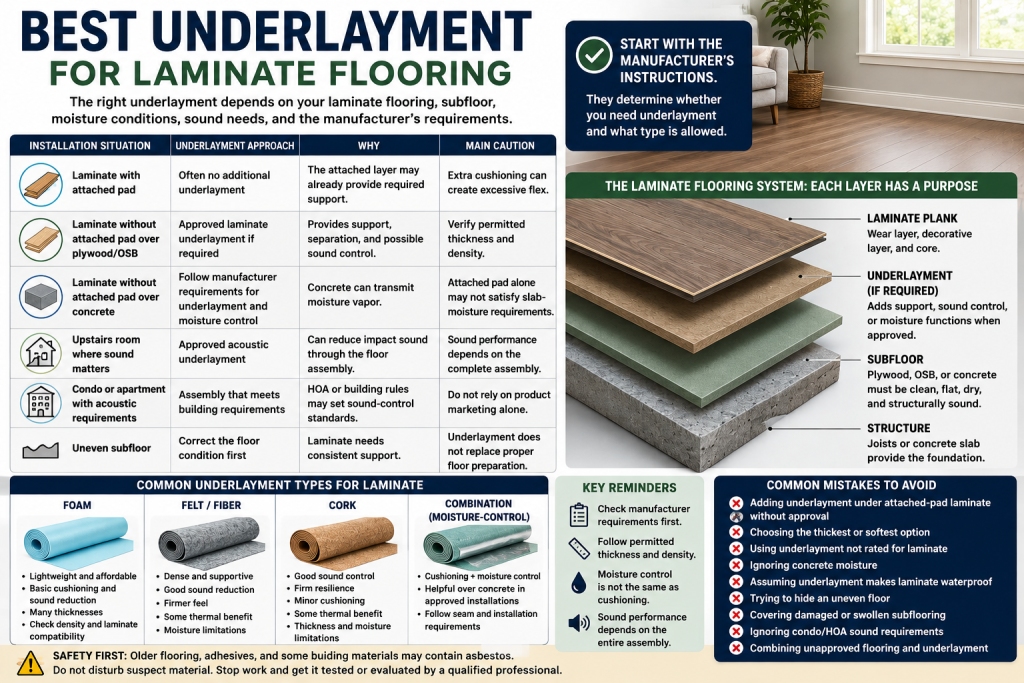
| Installation situation | Underlayment approach | Why | Main caution |
|---|---|---|---|
| Laminate with attached pad | Often no additional underlayment | The attached layer may already provide required support | Extra cushioning can create excessive flex |
| Laminate without attached pad over plywood/OSB | Approved laminate underlayment if required | Provides support, separation, and possible sound control | Verify permitted thickness and density |
| Laminate without attached pad over concrete | Follow manufacturer requirements for underlayment and moisture control | Concrete can transmit moisture vapor | Attached pad alone may not satisfy slab-moisture requirements |
| Upstairs room where sound matters | Approved acoustic underlayment | Can reduce impact sound through the floor assembly | Sound performance depends on the complete assembly |
| Condo or apartment with acoustic requirements | Assembly that meets building requirements | HOA or building rules may set sound-control standards | Do not rely on product marketing alone |
| Uneven subfloor | Correct the floor condition first | Laminate needs consistent support | Underlayment does not replace proper floor preparation |
If older flooring, sheet goods, tiles, mastics, or adhesives may contain asbestos, do not sand, grind, scrape, cut, or demolish them. Stop disturbing suspect material and obtain appropriate evaluation or testing before removal or preparation work continues.
Does Laminate Flooring Need Underlayment?
Many floating laminate floors require underlayment, but not all installations need a separate roll or sheet product.
Some laminate has a foam or similar pad already attached to each plank. Other products require a separate underlayment, allow an optional approved layer, or prohibit additional cushioning.
The installation instructions for the specific flooring should control the decision.
Laminate click-lock joints depend on consistent support beneath the planks. If the flooring moves too much under foot traffic or furniture, the locking system can experience additional stress.
That is why adding extra cushioning beneath attached-pad laminate without approval can be a mistake. A second layer may make the floor feel softer initially while allowing more movement than the joints were designed to handle.
Determine what the laminate requires before selecting underlayment based on comfort, sound, or price.
If you are installing LVP instead of laminate, see our separate guide to the best underlayment for vinyl plank flooring because the requirements can differ.
What Laminate Underlayment Does
Underlayment can perform several useful functions beneath a floating laminate floor.
Depending on the product and installation, it may provide:
- Consistent support beneath the planks
- Minor cushioning
- Sound reduction
- Separation between laminate and the subfloor
- Limited thermal benefit
- Moisture-related protection when specifically designed for that purpose
Its role is limited, however.
Underlayment does not:
- Correct significant floor unevenness
- Repair damaged subflooring
- Stop structural movement
- Solve active leaks or persistent moisture
- Make laminate waterproof
- Automatically act as a vapor barrier
Laminate is especially dependent on a stable supporting surface because its core and locking joints can be damaged by excessive movement or moisture.
Laminate With Attached Pad
Some laminate flooring includes foam or another resilient pad attached to the underside of each plank.
That attached layer may already provide the support and cushioning intended for the flooring system. In those cases, adding a separate underlayment may be unnecessary or prohibited.
A second layer can create:
- Excessive softness
- More vertical movement
- Additional stress on locking joints
- Changes in finished floor height
- Transition problems
- Installation outside manufacturer requirements
Attached pad also does not automatically mean every other floor-system requirement has been satisfied. For example, concrete installations may still require separate moisture-control measures even when the laminate has a backing layer.
Before adding anything beneath attached-pad laminate, confirm what the flooring manufacturer allows.
Foam Underlayment
Foam is one of the most common materials used beneath floating laminate floors.
It is lightweight, relatively easy to handle, and can provide basic cushioning and sound reduction when matched correctly to the flooring.
Foam products vary in thickness, density, firmness, and intended application. A generic roll should not be assumed suitable simply because it is labeled as flooring underlayment.
A very soft or thick foam can allow more movement than the laminate locking system permits.
When comparing foam underlayment, check:
- Explicit compatibility with laminate
- Permitted thickness
- Density and support
- Subfloor suitability
- Sound-control features
- Moisture-related features, if required
The goal is consistent support, not maximum softness.
Felt or Fiber Underlayment
Felt and fiber underlayments can provide a denser feel than lightweight foam and may offer useful sound reduction.
Depending on the product, they can also provide minor thermal benefit and cushioning while supporting a floating laminate system.
Fiber products are not all constructed alike. Their density, compression, moisture resistance, and approved uses can differ.
Before choosing one, verify:
- Laminate compatibility
- Maximum permitted thickness
- Subfloor compatibility
- Moisture limitations
- Installation requirements
A fiber product that performs well over a dry plywood subfloor may not be appropriate over concrete or in a location with elevated moisture.
Cork Underlayment
Cork is another option used beneath some floating floors when the flooring manufacturer permits it.
It can provide:
- Sound reduction
- Firm resilience
- Minor cushioning
- Some thermal benefit
Cork is generally firmer than very soft foam, but thickness still matters. Too much resilient material can affect how the laminate joints are supported.
Moisture is another consideration. Cork should not automatically be selected for a concrete installation or damp location without confirming that the complete floor system allows it.
If cork is being considered, verify the flooring requirements, the permitted thickness, and the moisture conditions beneath the floor.
Combination Underlayment With Moisture-Control Features
Some underlayments combine cushioning or acoustic properties with a vapor-retarding or moisture-control layer.
These products can be useful when a laminate installation requires both functions and the flooring manufacturer approves the combination.
They can simplify the number of separate layers in the floor assembly, but compatibility still matters. Construction, seam requirements, moisture performance, and subfloor suitability vary.
Combination underlayment does not solve an active leak, persistently wet slab, or other unresolved moisture problem.
If the floor is already damp, determine why before installing laminate over it.
Best Underlayment for Laminate Over Plywood or OSB
A plywood or OSB subfloor should be dry, stable, and sufficiently flat before laminate is installed.
If the laminate has an attached pad, a separate underlayment may not be needed. If it does not, the flooring manufacturer may specify an approved foam, fiber, cork, or other underlayment.
Over a dry wood subfloor, the main reasons for underlayment may be support, sound reduction, separation, or minor comfort rather than moisture control.
Do not assume a moisture-barrier layer should automatically be added over wood. The required floor assembly depends on the laminate and site conditions.
Before covering plywood or OSB, watch for:
- Loose panels
- Swollen material
- Soft areas
- Water damage
- Significant dips or high spots
- Excessive movement
Underlayment should not be used to hide these conditions. Laminate performs best when the subfloor provides consistent support.
Best Underlayment for Laminate Over Concrete
Concrete deserves extra attention because moisture vapor can move through a slab even when the surface appears dry.
That matters because laminate generally contains a moisture-sensitive core. If moisture reaches vulnerable parts of the flooring, swelling or joint damage can occur.
Depending on the laminate system, the manufacturer may require:
- A separate vapor-control layer
- A combination underlayment with an approved moisture-control function
- Specific underlayment over the slab
- Moisture testing before installation
An attached pad beneath the laminate does not automatically satisfy these requirements.
Before selecting underlayment over concrete, confirm both the cushioning or support requirements and the separate moisture-control requirements for the flooring.
Do not install laminate over persistent or unexplained slab moisture without addressing the underlying condition.
Best Underlayment for Sound Reduction
Sound control can be important in upstairs bedrooms, home offices, condos, apartments, and rooms above living areas.
Underlayment can reduce some impact noise caused by footsteps and objects contacting the floor. However, sound performance depends on the complete floor and ceiling assembly, not only the material directly beneath the laminate.
Product information may include IIC or STC ratings. These describe different aspects of sound performance, but the numbers are only useful for comparison when the tested assemblies are sufficiently similar.
A product tested with one type of subfloor and ceiling system should not automatically be expected to produce the same result in a different building.
Condo associations, apartment buildings, or HOAs may also require flooring assemblies to meet specific acoustic standards. Check those requirements before purchasing flooring or underlayment.
Is Thicker Underlayment Better for Laminate?
Not necessarily.
A thicker or softer product may sound more comfortable, but laminate flooring needs firm, consistent support.
Excessive thickness or softness can:
- Increase flex underfoot
- Stress click-lock joints
- Allow unwanted movement
- Make the floor feel unstable
- Change finished floor height
- Complicate transitions
- Violate manufacturer requirements
Choose underlayment based on permitted thickness, density, support, and compatibility rather than assuming the thickest option is the highest-quality choice.
Can Underlayment Fix an Uneven Subfloor?
No. Underlayment is not a floor-leveling material.
It may accommodate very minor surface texture within the flooring manufacturer’s limits, but it cannot correct significant conditions such as:
- Deep dips
- High spots
- Structural sagging
- Loose subfloor panels
- Large concrete irregularities
- Areas that move under load
Laminate installed over an unsuitable base can flex, squeak, move, separate at joints, or experience premature locking-system damage.
If the floor has significant irregularities or movement, determine the cause before installing the finished flooring.
Underlayment vs Vapor Barrier
Underlayment and vapor control serve different purposes.
Underlayment may provide:
- Cushioning
- Support
- Sound reduction
- Separation
A vapor barrier or vapor-control layer is intended to limit moisture-vapor transmission under specified conditions.
Some flooring products combine both functions into one layer, but the terms are not interchangeable.
Ordinary foam, felt, cork, or attached pad should not be assumed to meet a manufacturer’s moisture-control requirements unless the product is specifically designed and approved for that purpose.
If your vinyl plank will be installed over a concrete slab, see our guide to using a vapor barrier for vinyl plank flooring on concrete.
What to Look for When Buying the Best Underlayment for Laminate Flooring
Once you know a separate layer is required or permitted, compare underlayment based on how well it matches the flooring system.
Check:
- Explicit compatibility with laminate flooring
- Flooring-manufacturer approval
- Compatibility with attached-pad laminate
- Maximum allowed thickness
- Density and support
- Subfloor type
- Suitability for concrete, if applicable
- Moisture-control function where required
- Sound-control performance
- Building or HOA acoustic requirements
- Compatibility with the installation method
- Warranty restrictions
Avoid choosing underlayment from a single marketing claim. A product may advertise superior sound reduction or cushioning yet still be unsuitable for your laminate or subfloor.
If moisture resistance is driving the larger flooring decision, compare the best waterproof flooring options before choosing the complete floor system.
Common Laminate Underlayment Mistakes
Common mistakes include:
- Adding underlayment beneath attached-pad laminate without approval
- Choosing the thickest or softest material available
- Using underlayment that is not rated for laminate
- Ignoring concrete moisture
- Assuming underlayment makes laminate waterproof
- Trying to hide an uneven floor with cushioning
- Covering swollen, loose, or damaged subflooring
- Ignoring condo or HOA sound requirements
- Combining flooring and underlayment products that are not approved together
The correct floor assembly is usually the one that follows the laminate manufacturer’s requirements with no unnecessary layers.
If an existing laminate floor is already swelling or developing raised areas, our guide to laminate flooring bubbling explains the likely causes and what to check.
Questions to Ask Before Buying Underlayment
Before purchasing laminate underlayment, answer these questions:
- Does my laminate already have an attached pad?
- Does the manufacturer require, allow, or prohibit a separate layer?
- What type of subfloor is beneath the laminate?
- Will the flooring be installed over concrete?
- Could moisture vapor be a concern?
- Is sound reduction important?
- Does my building or HOA have acoustic requirements?
- What thickness and density are permitted?
- Is the underlayment explicitly approved for laminate?
- Does the flooring installation method change the requirement?
These checks can prevent unnecessary purchases and reduce the chance of creating an incompatible flooring system.
When Professional Evaluation Makes Sense
Normal underlayment selection usually does not require professional help, but problems beneath the floor may need qualified evaluation.
Consider professional help when you find:
- Significant subfloor movement
- Major unevenness
- Persistent concrete moisture
- Rot or substantial subfloor deterioration
- Structural sagging
- Large or moving slab cracks
- Condo or HOA acoustic requirements you cannot interpret
- Suspected asbestos-containing flooring, mastic, or adhesive
If older flooring or adhesive may contain asbestos, stop disturbing it. Appropriate evaluation or testing should come before scraping, sanding, grinding, cutting, or demolition.
Final Thoughts
The best underlayment for laminate flooring is the one that provides the support and performance your specific flooring system requires. Laminate with attached pad may need no additional cushioning, while other products require an approved underlayment for support, sound reduction, or other functions.
Check the laminate manufacturer’s instructions first, then match the permitted underlayment to the subfloor, moisture conditions, and sound requirements. Correct compatibility and a stable base matter more than extra thickness or softness.