
laminate floor water damage: what can be saved?
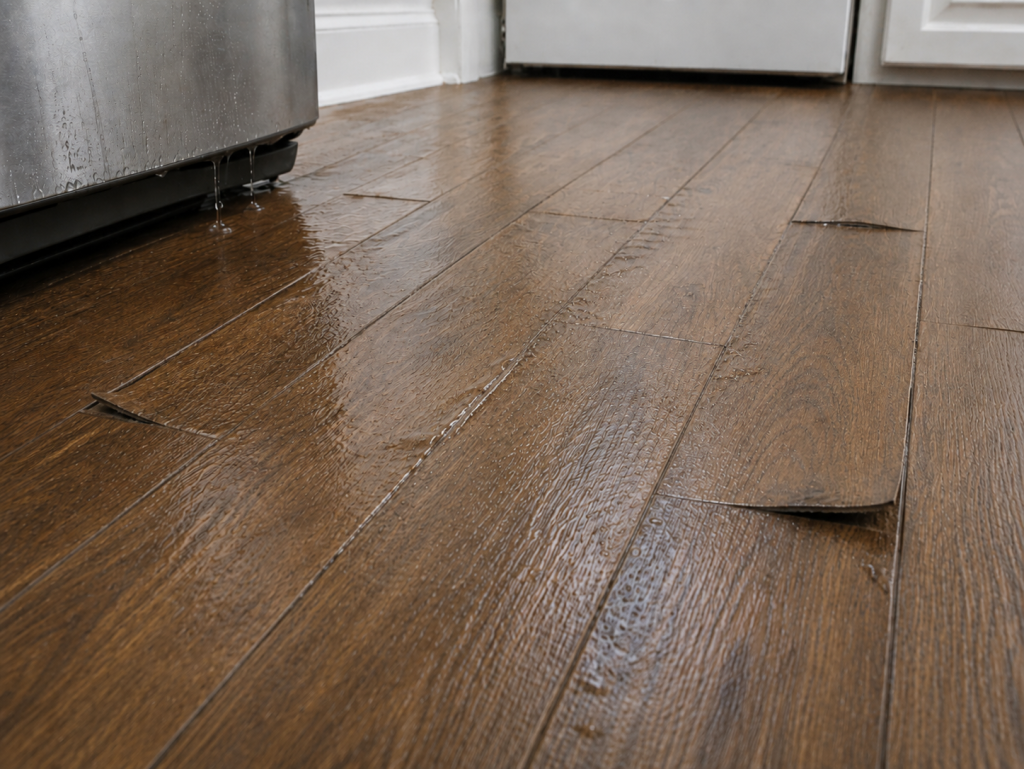
Laminate flooring water damage does not automatically mean the entire floor is ruined. A small spill cleaned quickly may cause no permanent harm, but once the wood-fiber core swells or deforms, the affected plank usually cannot be restored to its original shape.
The visible flooring is only part of the decision. Water can remain beneath floating laminate and affect underlayment, plywood, OSB, baseboards, drywall, or other materials even after the surface appears dry.
| Situation | What may be salvageable | What may need replacement | What to check |
|---|---|---|---|
| Small spill cleaned immediately | Usually the existing laminate | Nothing if no swelling develops | Seams, edges, odor, movement |
| Minor clean-water leak found quickly | Undamaged, dry planks | Permanently swollen planks | Water spread and materials below |
| Swollen seams or plank edges | Unaffected nearby flooring | Swollen planks | Core and locking-joint condition |
| Water squishing beneath floating laminate | Some undamaged planks | Wet underlayment or damaged flooring | Extent of trapped water |
| Large appliance leak | Dry, unaffected material | Damaged planks and possibly underlayment | Subfloor, walls, leak extent |
| Wet plywood or OSB | Flooring not exposed to damage | Damaged subfloor or laminate | Swelling, softness, delamination |
| Water damage over concrete | Undamaged flooring may be reusable | Moisture-damaged materials | Recurring slab moisture |
| Floodwater or sewage exposure | Depends on contamination and material | Contaminated porous materials may need disposal | Professional contamination assessment |
If water has reached appliances, receptacles, cords, or other electrical equipment, do not handle wet electrical components. Avoid the affected area if energized equipment may be involved and get qualified help.
What Water Does to Laminate Flooring
Laminate flooring typically includes several layers:
- A protective wear surface
- A decorative layer
- A rigid wood-fiber-based core
- A backing layer
The core is usually the component most vulnerable to water.
If enough moisture reaches it through seams, edges, or the underside of the plank, the core can absorb water and expand.
That may cause:
- Swollen edges
- Raised seams
- Warping
- Distorted plank shapes
- Damaged locking joints
- Loss of dimensional stability
The protective top surface may still look relatively intact even while the core has changed shape.
This is why drying the floor does not necessarily reverse the damage. Once the core has swollen permanently, the physical change usually remains.
Small Spill: Can the Laminate Be Saved?
A small spill cleaned promptly may cause no permanent damage.
If water stayed on the wear surface and did not penetrate seams, edges, or damaged areas, the laminate may remain completely usable.
After cleaning the spill, monitor the area for:
- Raised seams
- Puffy plank edges
- New clicking or movement
- Discoloration
- Persistent odor
If the flooring remains flat and stable and no moisture symptoms appear, removing planks usually is not necessary just because a small spill occurred.
The risk increases when liquid sits for a longer period, reaches plank edges, or repeatedly wets the same area.
Clean-Water Leak Found Quickly
A short-duration leak from a clean household water source does not automatically require complete floor replacement.
Possible sources include:
- Appliance supply lines
- Dishwashers
- Refrigerators
- Washing machines
- Sink plumbing
- Water heaters
Even clean water can travel beneath floating laminate farther than the visible wet area suggests.
The laminate may remain usable when:
- The leak was found quickly
- Planks did not swell
- Locking joints remain intact
- The flooring stayed flat
- Materials underneath can be properly dried
- No contamination occurred
The main question is not simply whether the surface dried. Determine whether water reached beneath the laminate and affected underlayment or the subfloor.
When Swollen Laminate Usually Cannot Be Saved
Once a laminate core has permanently swollen, it generally does not return to its original dimensions.
Signs of permanent damage include:
- Puffy edges
- Raised seams that remain after drying
- Distorted plank profiles
- Separated decorative surfaces
- Broken or deformed locking joints
- Planks that no longer sit flat
Drying can stop continued moisture exposure, but it cannot rebuild the compressed and swollen core.
Avoid attempts to flatten damaged laminate by:
- Sanding raised areas
- Applying concentrated heat
- Weighing planks down
- Injecting adhesive
- Cutting swollen edges
These approaches do not restore the damaged core and may make replacement more difficult.
If the damage first appeared as raised or swollen areas, our guide to laminate flooring bubbling explains the common causes and how to distinguish moisture swelling from expansion pressure.
Water Under the Laminate
Water beneath floating laminate can remain hidden after the visible surface is dry.
It may affect:
- Underlayment
- Plywood
- OSB
- Adhesives
- Baseboards
- Drywall
- Nearby framing
Possible signs include:
- Squishing sounds
- Water appearing at joints
- Damp perimeter areas
- Musty odors
- Movement underfoot
A large leak can spread beneath many planks, so the visible wet spot may not represent the entire affected area.
When trapped moisture is suspected, the floor system may need further inspection rather than surface drying alone.
Laminate Over Plywood or OSB
Wood-based subfloors need particular attention after a leak.
Prolonged moisture can cause plywood or OSB to swell, soften, separate, or lose stability.
Watch for:
- Raised panel seams
- Swelling
- Soft or spongy areas
- Delamination
- Discoloration
- Sagging
- Persistent odor
Even undamaged laminate should not be reinstalled over wood that remains wet or has become structurally unsound.
Significant softness, sagging, rot, or widespread deterioration calls for qualified evaluation before new flooring covers the area.
Laminate Over Concrete
Concrete creates a different moisture concern.
A slab can retain or transmit moisture even when its surface appears dry. Laminate installed over concrete may also rely on an underlayment or vapor-control system specified for that flooring.
If moisture damage keeps returning without an obvious plumbing or surface-water source, slab conditions deserve attention.
Recurring moisture should be diagnosed before replacement laminate is installed.
Do not assume a new underlayment or replacement floor will correct an unresolved moisture problem coming from below.
How Much Laminate Needs to Be Replaced?
Replacement can range from a few planks to a much larger section.
Factors include:
- Number of damaged planks
- Location of the damage
- Installation method
- Condition of locking joints
- How far water traveled underneath
- Condition of underlayment
- Condition of the subfloor
- Availability of matching flooring
A few permanently swollen planks surrounded by dry, undamaged material may allow localized replacement.
Widespread swelling, damaged locking joints, or water that traveled beneath a large section can make broader replacement more practical.
Correct the moisture source before deciding the final repair area.
Can Undamaged Laminate Planks Be Reused?
Some click-lock laminate planks may be reusable.
Good candidates are:
- Dry
- Flat
- Clean
- Structurally intact
- Free of swollen edges
- Free of broken locking joints
Reuse becomes less realistic when:
- The core has swollen
- Planks are warped
- Locking edges are broken
- Material was contaminated
- The decorative surface has separated
- Removing the floor damages the joints
Do not assume every plank removed from a wet area is either automatically ruined or automatically reusable. Inspect its condition individually.
What About the Underlayment?
Underlayment can hold moisture even when the laminate above feels dry.
Whether it can remain depends on its material, how wet it became, how long it stayed wet, and the requirements of the flooring system.
Absorbent cushioning materials may need replacement after significant wetting. Attached pads can also be affected.
A moisture-control layer serves a different purpose from cushioning underlayment and should not be assumed to dry or behave the same way.
Do not reinstall flooring over underlayment that remains damp or deteriorated.
If you are replacing damaged material, see our guide to the best underlayment for laminate flooring before choosing what goes beneath the new floor.
What About Mold?
Prolonged moisture can support mold growth on suitable materials beneath or around laminate.
Potentially vulnerable materials include:
- Wood subflooring
- Drywall paper
- Baseboards
- Framing
- Dust and debris
- Some adhesives or other organic material
The laminate itself may not be the primary material supporting growth.
Professional evaluation is appropriate when there is extensive visible growth, widespread hidden wet areas, prolonged moisture, or significant water damage beyond what can be safely inspected.
Do not pour bleach or other chemicals beneath flooring in an attempt to treat hidden areas.
What if the Water Was Contaminated?
Contaminated water requires a different salvage decision from a clean household spill.
Examples include:
- Sewage
- Floodwater
- Toilet waste
- Contaminated groundwater
- Other potentially contaminated sources
Avoid direct contact and do not treat these situations as ordinary flooring cleanup.
Materials that might otherwise have been dried after a clean-water leak may no longer be appropriate to reuse after contamination.
Professional cleanup or restoration evaluation is the safer boundary when contaminated water has reached the floor system.
Electrical Safety After a Leak
Water and energized electrical equipment require extra caution.
Do not handle wet:
- Appliances
- Receptacles
- Extension cords
- Power strips
- Electrical equipment
If water has reached electrical components or you are unsure whether equipment remains energized, stay clear of the area and get qualified help.
Do not attempt electrical troubleshooting in the wet area.
Signs the Floor May Need More Than Localized Repair
A larger repair becomes more likely when you find:
- Widespread swelling
- Multiple damaged seams
- A large wet area
- Persistent squishing beneath the floor
- Extensively wet underlayment
- Soft or swollen subflooring
- Repeated moisture
- Strong persistent musty odor
- Wet or damaged baseboards and walls
- Significant floor movement
- Contaminated water exposure
These signs suggest that the problem extends beyond one or two visibly damaged planks.
What to Do Before Replacing Laminate
Use this sequence before deciding what can stay:
- Stop the water source.
- Determine whether the water was clean or contaminated.
- Identify how far moisture traveled.
- Check for permanently swollen laminate edges or cores.
- Determine whether the underlayment became wet.
- Evaluate the plywood, OSB, or concrete below.
- Allow affected materials to dry appropriately before covering them.
- Correct the original leak or moisture problem.
- Decide which flooring can be reused and which needs replacement.
Do not rush to reinstall laminate because the top surface feels dry.
Common Mistakes
Avoid these common responses to a wet laminate floor:
- Assuming the floor is dry because the surface looks dry
- Waiting for permanently swollen laminate to flatten
- Replacing planks before correcting the leak
- Reusing damaged locking joints
- Covering wet underlayment
- Reinstalling flooring over swollen plywood or OSB
- Ignoring recurring concrete moisture
- Treating contaminated water like a clean spill
- Applying bleach blindly beneath flooring
- Disturbing old flooring or adhesive that may contain asbestos
Older flooring, sheet goods, tiles, mastics, or adhesives may contain asbestos. Do not sand, scrape, grind, cut, or demolish suspect material until it has been appropriately evaluated or tested.
Questions to Ask Before Deciding What Can Be Saved
Before making a repair decision, ask:
- Where did the water come from?
- Was it clean or contaminated?
- How long was the floor wet?
- Are plank edges swollen?
- Are locking joints damaged?
- Is water still trapped underneath?
- Is the subfloor concrete, plywood, or OSB?
- Is the underlayment wet?
- Are walls or baseboards damp?
- Is the damage localized or widespread?
- Is matching laminate still available?
- Could older flooring or adhesive underneath contain asbestos?
These answers help separate reusable material from flooring that has suffered permanent damage.
When Professional Help Makes Sense
A small spill cleaned immediately does not automatically require professional help.
Qualified evaluation makes sense when there is:
- A large or prolonged leak
- Water near electrical equipment
- Floodwater or sewage
- Persistent slab moisture
- Significant plywood or OSB swelling
- Structural movement or sagging
- Extensive laminate damage
- Hidden moisture across a large area
- Visible rot
- Extensive mold growth
- An unclear extent of damage
- Suspected asbestos-containing flooring, mastic, or adhesive
The appropriate professional depends on the cause. A plumber may need to address the leak, while flooring, water-damage, structural, moisture, or hazardous-material specialists may be appropriate for other conditions.
Final Thoughts
Laminate flooring water damage can range from a harmless quickly cleaned spill to permanent swelling that requires plank replacement. Laminate that remains dry, flat, and structurally intact may be salvageable, while a permanently swollen wood-fiber core generally cannot be restored.
Before replacing anything, determine how far the water traveled and whether the underlayment or subfloor remains wet or damaged. Correct the original moisture source first, then base the repair on the condition of the entire floor system rather than the appearance of the laminate alone.