hardwood floor gaps: causes and when to worry
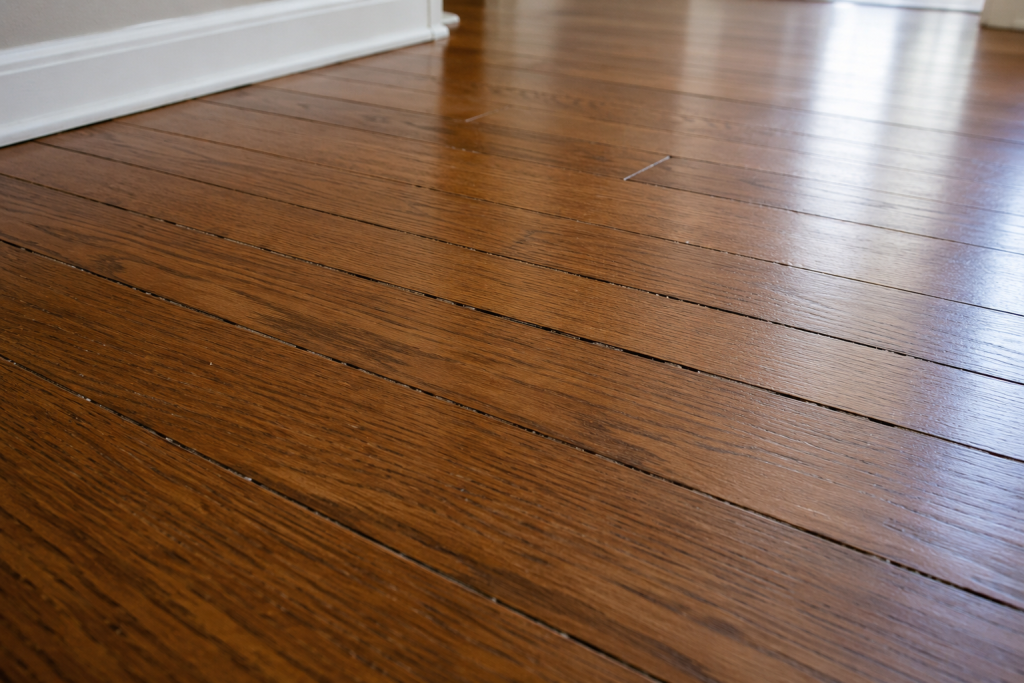
Hardwood floor gaps are often normal when they appear during dry winter conditions and shrink or close as indoor humidity rises. Wood naturally changes width as its moisture content changes, so thin seasonal gaps do not automatically mean the floor is failing.
Pay closer attention to gaps that are large, permanent, widening, concentrated in one area, or accompanied by loose boards, movement, cupping, or buckling. The pattern and whether the gaps change with the seasons usually tell you more than one isolated measurement.
| What you notice | Likely cause | Usually concerning? | What to do |
|---|---|---|---|
| Thin gaps throughout the floor during winter | Seasonal shrinkage | Usually no | Monitor through a full seasonal cycle |
| Gaps shrink during humid summer weather | Normal wood movement | Usually no | Leave them alone if the floor is stable |
| One large gap between two boards | Localized movement or installation issue | Sometimes | Check whether either board moves |
| Gaps growing wider over time | Ongoing movement, dryness, or installation problem | Yes | Track the change and investigate the cause |
| Gaps with loose or moving boards | Fastening or subfloor issue | More concerning | Have the movement evaluated |
| Gaps after water damage | Moisture-related dimensional change | Sometimes | Check for continuing moisture or deformation |
| Gaps plus cupping or buckling | Moisture imbalance or more serious movement | Yes | Address the underlying condition first |
| Gaps concentrated in one area | Localized floor or subfloor issue | Sometimes | Compare that area with the rest of the floor |
Why Hardwood Floors Develop Gaps
Wood changes dimension as it gains and loses moisture.
When hardwood absorbs moisture, it generally expands across the width of each board. When it loses moisture, it shrinks. Small changes across many boards can create visible spaces between them.
Indoor conditions often change throughout the year. Winter heating can make the air significantly drier than it is during warmer, more humid months, causing boards to shrink.
How much movement you see can also depend on:
- Wood species
- Board width
- Solid versus engineered construction
- Flooring age
- Installation method
- Indoor climate
- Previous moisture exposure
Some movement is expected in real wood flooring. The key is determining whether the gaps are part of a predictable seasonal pattern or evidence of an ongoing problem.
Seasonal Hardwood Floor Gaps
Seasonal gaps are especially common during the heating season.
As indoor air becomes drier, hardwood can lose moisture and contract across its width. Thin spaces may then appear between multiple boards.
When warmer or more humid conditions return, those gaps may become smaller or disappear.
This type of movement is usually less concerning when:
- Gaps are narrow and widespread
- They appear at roughly the same time each year
- Boards remain flat and firmly attached
- Gaps shrink during more humid months
- No recent leak or water problem occurred
Avoid judging the floor based only on how it looks during the driest part of the year.
Flooring manufacturers may specify acceptable environmental ranges for individual products, so product-specific requirements are more useful than applying one universal humidity or gap-width number to every hardwood floor.
Low Indoor Humidity
Prolonged dry indoor air can make seasonal gaps more noticeable.
Possible clues include:
- Gaps appearing throughout the room
- Gaps becoming more obvious during winter
- Similar movement in several wood-floored rooms
- Gaps improving when seasonal humidity rises
Reasonable indoor moisture conditions can help reduce extreme expansion and contraction, but aggressively humidifying a house simply to force gaps closed is not a good repair strategy.
Large or sudden changes in indoor conditions can create other problems.
If you know the flooring product, check its environmental requirements and aim for stable, comfortable household conditions rather than trying to make the boards perfectly tight in every season.
When Hardwood Floor Gaps Are More Concerning
Seasonal movement is common. Other gap patterns deserve a closer look.
Pay more attention when gaps are:
- Unusually noticeable
- Continuing to widen
- Present throughout the year
- Limited to one section of the room
- Accompanied by loose boards
- Associated with movement underfoot
- New after a significant water event
- Combined with cupping, crowning, or buckling
A changing pattern is usually more important than the exact size of one gap.
For example, a stable irregular gap in a decades-old floor may be mostly cosmetic. A smaller gap that keeps growing while boards begin moving may signal a developing installation or subfloor issue.
One Large Gap Between Hardwood Boards
One large space in an otherwise tight floor usually deserves more attention than many small seasonal gaps.
Possible causes include:
- Installation spacing
- Movement of one board
- A damaged tongue-and-groove connection
- A previous localized repair
- Shrinkage concentrated in a particular board
- Loose fastening
- Movement in the supporting floor below
A single large gap does not automatically mean the floor has a structural problem.
Check whether either adjacent board feels loose, shifts underfoot, sits at a different height, or has other signs of damage. If the gap stays stable and the boards are secure, the concern may be primarily cosmetic.
Gaps That Keep Getting Wider
Progressive change is worth investigating.
Gaps can continue to widen because of:
- Persistently dry conditions
- Continued board movement
- Loose flooring
- Installation problems
- Subfloor movement
- Previous moisture-related deformation
Watch the floor over time rather than relying on memory.
A few dated photos from the same location can help show whether a gap changes with the seasons or continues to increase regardless of weather.
If a gap grows steadily and surrounding boards are also moving, that is different from a winter gap that repeatedly closes or narrows each summer.
Gaps After Water Damage
Wood may swell while wet and then shrink as it dries.
After a significant leak, that moisture cycle can leave new or larger gaps even if the boards initially expanded tightly against one another.
Severe water exposure can also affect:
- Fasteners
- Subflooring
- Board shape
- Tongue-and-groove connections
If new gaps appeared after a major leak and you also notice staining, movement, cupping, or buckling, the floor may need further evaluation.
Do not fill the gaps simply to hide the symptom while moisture conditions are still changing.
If the gaps appeared after a leak or other significant wetting, our guide to hardwood floor water damage explains what to check before deciding on repair.
Gaps With Cupping or Crowning
Gaps combined with cupping or crowning suggest more than ordinary seasonal shrinkage.
Cupping means the edges of boards sit higher than their centers. Crowning means the centers sit higher than the edges.
Both shapes can reflect uneven moisture conditions through the wood.
If gaps appear alongside either type of deformation, identify the moisture condition first. Cosmetic gap repair or refinishing should wait until the floor has stabilized.
If the board edges are also rising higher than the centers, see our guide to hardwood floor cupping for the moisture conditions that can cause that shape.
Gaps With Buckling or Loose Boards
Boards that lift, shift, or feel loose underfoot are different from boards that simply shrink slightly apart.
Possible causes include:
- Fastener failure
- Subfloor movement
- Severe moisture exposure
- Damaged board connections
- Installation problems
Gaps paired with noticeable movement deserve closer evaluation because the issue may involve the attachment or supporting floor system rather than seasonal wood movement alone.
Do not try to force moving boards back together without understanding why they have shifted.
Hardwood Floor Gaps in Older Homes
Older hardwood often develops irregular spacing over decades of use.
Contributing factors can include:
- Repeated seasonal movement
- Previous repairs
- Wear
- Minor settling
- Changes in heating or cooling
- Different indoor moisture conditions over time
Small stable gaps may simply be part of an older floor’s appearance.
The more important question is whether the condition is stable.
A floor that has looked similar for many years, feels solid underfoot, and shows no active moisture problems usually deserves less concern than an older floor where gaps are suddenly widening or boards are becoming loose.
Solid Hardwood vs Engineered Hardwood Gaps
Both flooring types can develop gaps, but their construction affects how they respond to moisture.
Solid hardwood
Solid boards generally experience more dimensional movement across their width as moisture conditions change.
Wider boards may make seasonal movement more noticeable because each board can contribute more visible change.
Engineered hardwood
Engineered hardwood uses layered construction that generally improves dimensional stability.
It can still gap, especially when indoor conditions change substantially or when installation, moisture, or subfloor issues are present.
Product construction varies, so engineered flooring should not be treated as immune to seasonal or moisture-related movement.
Can Hardwood Floor Gaps Close on Their Own?
Seasonal gaps sometimes can. Permanent gaps generally will not.
A winter gap caused by dry indoor conditions may shrink considerably when seasonal humidity rises and the boards regain moisture.
A gap caused by permanent board movement, damaged connections, installation spacing, or subfloor problems is more likely to remain.
This is why immediately filling every visible winter gap can create problems.
If the boards expand later, material placed in the gap may crack, loosen, squeeze upward, or interfere with normal movement.
When the floor is stable and the gap follows a seasonal pattern, monitoring is often the better first step.
Should You Fill Hardwood Floor Gaps?
Sometimes, but not before understanding why the gap exists.
Whether filling is appropriate depends on:
- Whether the gap changes seasonally
- Its location
- Flooring type
- Floor age
- Amount of movement
- Whether boards are loose
- Finish condition
A stable gap in an older floor presents a different repair question from a seasonal gap that repeatedly opens and closes.
Likewise, filling does not correct loose flooring, moisture problems, or subfloor movement.
Diagnose those conditions before making a cosmetic repair.
Why Wood Filler Is Not Always the Answer
Wood flooring moves. Many fillers do not move in the same way.
A rigid filler placed between boards that continue expanding and contracting may:
- Crack
- Break loose
- Be pushed upward
- Leave another visible gap later
That makes filler a poor automatic response to seasonal movement.
If the gap is actively changing, the underlying movement should be understood before anything is placed between the boards.
What Homeowners Can Check
A simple observation-based inspection can narrow the cause without damaging the floor.
Check:
- Whether gaps are widespread or localized
- Whether they change with the seasons
- Whether boards move when walked on
- Whether cupping or buckling is present
- Whether a recent leak occurred
- Whether nearby baseboards or walls show moisture
- Whether the whole house seems unusually dry
- Whether the gap is visibly increasing over time
Also note whether the issue appeared suddenly or has been present for years.
Avoid destructive inspection simply to confirm a cosmetic gap.
If older flooring, mastic, adhesive, or underlying material may contain asbestos, do not sand, grind, scrape, cut, or demolish suspect material. Obtain appropriate evaluation before disturbing it.
Common Mistakes
Avoid these common responses to hardwood gaps:
- Filling every winter gap immediately
- Assuming all gaps indicate poor installation
- Ignoring a gap that keeps widening
- Ignoring loose or moving boards
- Trying to force boards together
- Sanding or refinishing before moisture conditions stabilize
- Filling gaps while an active moisture problem exists
- Disturbing suspect older flooring or adhesive without considering asbestos
The correct response depends on whether the floor is moving normally or showing signs of a developing problem.
Questions to Ask Before Repairing Hardwood Floor Gaps
Before choosing a repair, ask:
- Do the gaps appear only in winter?
- Do they shrink during more humid weather?
- Are gaps widespread or concentrated in one place?
- Is one gap much larger than the others?
- Are boards loose or moving?
- Did a leak occur recently?
- Is there cupping, crowning, or buckling?
- Is the floor solid or engineered hardwood?
- Is the flooring old or recently installed?
- Are gaps continuing to grow?
- Is there evidence of subfloor movement?
- Have indoor moisture conditions been unusual?
If the floor is stable and the gaps predictably come and go with the seasons, repair may not be necessary.
When Professional Evaluation Makes Sense
Normal seasonal gaps generally do not require professional repair.
Consider qualified evaluation when there are:
- Large permanent gaps that continue widening
- Loose or moving boards
- Structural movement or sagging
- Gaps associated with severe cupping or buckling
- Significant previous water damage
- Persistent moisture problems
- Multiple failed previous repairs
- Extensive subfloor damage
- Unclear installation problems
- Suspected asbestos-containing flooring, mastic, or adhesive
A flooring professional can evaluate board movement and installation conditions. Structural movement, persistent moisture, or hazardous materials may require a different specialist.
Final Thoughts
Hardwood floor gaps are often a normal result of seasonal moisture changes, especially when thin gaps appear during dry winter weather and shrink again as humidity rises. Stable seasonal movement usually calls for monitoring rather than immediate filling.
Large, permanent, widening, localized, or movement-related gaps deserve more attention. Before repairing them, determine whether the cause is normal wood movement, moisture history, loose flooring, installation conditions, or a problem with the supporting floor system.