refinish or replace hardwood floors: how to decide
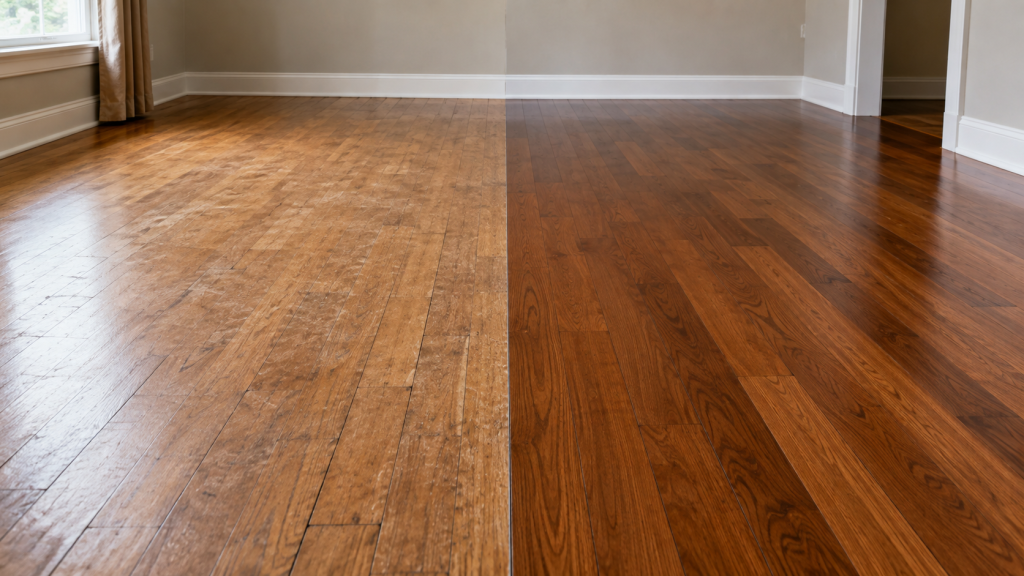
Deciding whether to refinish or replace hardwood floors starts with separating surface wear from deeper damage. Refinishing usually makes sense when the wood is still sound and the main problems are scratches, dull finish, or repairable staining. Replacement becomes more likely when boards are severely damaged, too thin to sand safely, structurally unstable, extensively buckled, or installed over a damaged subfloor.
The choice is not always all-or-nothing. In many homes, a few damaged boards can be repaired or replaced while the rest of the floor is refinished and preserved.
| Floor condition | Refinish may make sense | Replace may make more sense | What to check |
|---|---|---|---|
| Dull or scratched finish | Usually | Rarely for this reason alone | Whether wood below the finish is sound |
| Deep scratches or gouges | Sometimes | If damage is severe or widespread | Depth of damage |
| Dark stains | Sometimes | If staining penetrates deeply | Extent and cause |
| Small localized board damage | Often after board repair | If matching repair is impractical | Number of affected boards |
| Widespread cupping | Only after moisture stabilizes | If deformation remains severe | Moisture source and final board shape |
| Severe buckling | Usually not as a first step | Often for damaged boards | Attachment, moisture, subfloor |
| Large permanent gaps | Sometimes | If boards are loose or damaged | Stability and movement |
| Thin engineered wear layer | Possibly limited | More likely if sanding is unsafe | Remaining real-wood layer |
| Floor refinished several times | Depends | More likely if little wood remains | Remaining sanding thickness |
| Soft or damaged subfloor | Not until repaired | Hardwood may need removal for access | Subfloor condition |
What Refinishing Actually Fixes
Refinishing removes part of the existing surface and applies a new finish. It works best when the boards remain sound and the problems are mostly cosmetic.
Refinishing may improve:
- Worn finish
- Light-to-moderate scratches
- Dullness
- Uneven sheen
- Minor surface discoloration
- Some shallow staining
- Overall color when a compatible finish system is used
It does not solve problems underneath or within badly damaged boards.
Refinishing will not correct:
- Structural subfloor damage
- Severe buckling
- Persistent moisture problems
- Broken or loose boards
- Major tongue-and-groove damage
- Extensive rot
- Severe permanent deformation
If the floor is wet, unstable, or significantly distorted, address those conditions before considering cosmetic refinishing.
When Refinishing Hardwood Floors Usually Makes Sense
Refinishing is often the better choice when most of the floor is still solid and the damage is mainly cosmetic.
Good candidates commonly have:
- Boards that remain flat and securely attached
- Widespread finish wear
- Surface scratches
- Faded or dull appearance
- Minor stains
- A few damaged boards that can be repaired separately
A worn floor can look worse than its actual condition. If the wood remains sound, refinishing may preserve most or all of the original flooring.
Do not assume every stain or gouge will disappear completely. Deeper damage can remain visible even after the surface is renewed.
When Replacement Usually Makes More Sense
Replacement becomes more practical when the problem goes beyond finish wear.
Examples include:
- Severe widespread buckling
- Extensive board splitting
- Large areas of permanent deformation
- Widespread rot or deterioration
- Extensive loss of attachment
- Severely damaged tongues or grooves
- Major subfloor damage requiring broad access
- Too little remaining wood for another safe sanding
- Engineered flooring with insufficient wear layer
- Large areas of incompatible previous repairs
- Contamination that makes salvage inappropriate
Ordinary scratches, fading, or dullness do not justify replacement by themselves.
The key question is whether the existing floor still provides a sound base for restoration.
Surface Scratches vs Deep Damage
Surface scratches often affect the finish more than the wood itself. A floor with widespread light scratching may still be an excellent refinishing candidate.
Deeper gouges can penetrate into the wood. Refinishing may reduce their appearance, but some may remain.
Very deep damage, broken edges, or badly damaged boards may be better handled with localized repair before the surrounding floor is refinished.
Do not judge the entire floor by its worst single plank.
What About Dark Stains?
Staining can range from a surface issue to discoloration that extends deeper into the wood.
Possible causes include:
- Water exposure
- Pet urine
- Reactions involving wood and metal
- Long-term moisture
- Finish deterioration
Some shallow staining may improve with refinishing. Deep staining may remain.
When dark damage is limited to a few boards, localized replacement may produce a better result than removing excessive wood from the entire floor.
Any active moisture source should be corrected before refinishing or replacement.
Hardwood Floor Gaps
Small seasonal gaps may open during dry conditions and narrow again as humidity rises. These may need no repair at all.
Large permanent gaps, loose boards, or spaces that continue widening deserve more attention. Filling gaps does not correct ongoing movement, moisture problems, or damaged board connections.
Cupped Hardwood Floors
Newly cupped hardwood should not be refinished simply to make it look flat.
Some cupping can lessen after the moisture source is corrected and the floor stabilizes. Sanding while the boards are still changing shape can create a different uneven surface later.
If severe deformation remains after moisture conditions stabilize, localized repair or replacement may be more appropriate.
If the board edges are higher than the centers, see our guide to hardwood floor cupping before deciding whether refinishing is appropriate.
Buckled Hardwood Floors
True buckling means boards have lifted significantly from the subfloor or lost normal attachment.
Refinishing does not correct failed attachment, damaged boards, or underlying moisture. Correct the cause first, then decide whether affected boards can be repaired, reattached professionally, or replaced.
If boards are lifting away from the subfloor, our guide to hardwood floor buckling explains the likely causes and why the underlying problem should be corrected before choosing a repair.
Water-Damaged Hardwood
Water exposure alone does not determine whether hardwood should be refinished or replaced.
Consider:
- How long the floor remained wet
- Whether boards stabilized after drying
- Whether staining remains
- Whether cupping or buckling persists
- Whether the subfloor was damaged
- Whether contamination occurred
A floor that got wet briefly but remained flat and stable may need limited repair. Permanent deformation, contamination, or subfloor damage can make replacement more likely.
Solid Hardwood vs Engineered Hardwood
Flooring construction can significantly affect whether refinishing remains an option.
Solid hardwood
Solid hardwood generally has more material available above its tongue-and-groove system and may tolerate multiple refinishing cycles over its life.
How many refinishes remain depends on original board thickness, previous sanding, wear, and installation.
Engineered hardwood
Engineered hardwood has a real wood wear layer over a layered core.
That wear layer may be substantial or very thin. Depending on the product:
- Some engineered floors can be refinished
- Some can tolerate only limited surface renewal
- Some should not be sanded again
Do not assume all engineered hardwood must be replaced or that every engineered product can safely be refinished.
Manufacturer information or professional evaluation may be needed when wear-layer thickness is uncertain.
Has the Floor Been Refinished Before?
Every full sanding removes wood.
A floor refinished several times may eventually have too little material remaining for another safe sanding.
Possible warning signs include:
- Fastener heads becoming visible
- Tongue-and-groove areas unusually close to the surface
- A thin engineered wear layer
- Evidence of aggressive previous sanding
- Noticeably uneven board thickness
If remaining material is uncertain, have the floor evaluated before committing to refinishing.
Removing too much wood can weaken or permanently damage the flooring.
Localized Repair Plus Refinishing
The choice is not always between refinishing every existing board and replacing the entire floor.
A practical middle path may be:
- Replace a few badly damaged boards
- Correct localized defects
- Refinish the broader floor afterward
This can preserve a high-quality floor while removing damage that refinishing alone cannot fix.
Localized repairs are easier to blend when replacement boards match the existing:
- Species
- Width
- Grade
- Grain
- Color
- Finish
Perfect matching is not always possible, especially with older floors that have changed color over time.
Subfloor Condition Can Change the Decision
A hardwood surface can look repairable while the supporting floor underneath is not.
Watch for:
- Soft areas
- Sagging
- Excessive movement
- Swollen plywood or OSB
- Delamination
- Persistent moisture
- Structural deterioration
Significant subfloor problems need to be addressed before either refinishing or replacement.
Refinishing does not correct an unstable floor underneath it, and replacement may require removal simply to access damaged supporting materials.
Do not cover significant softness, movement, or moisture with a new finished floor.
Refinishing vs Replacement: Appearance Goals
A structurally sound floor can still be replaced for design reasons.
You may prefer:
- Wider boards
- A different species
- A new layout
- Another flooring type
- A major style change
- Different maintenance needs
- Greater dimensional stability
That is a preference and budget decision, not evidence that the existing hardwood has failed.
If you still like the current floor and it remains structurally sound, refinishing may preserve more of what you already have.
Cost Factors to Compare
Refinishing often involves fewer project components than complete replacement, but extensive repairs can narrow the difference.
Refinishing costs may be affected by:
- Square footage
- Board repairs
- Existing finish
- Staining
- Stairways
- Labor
- Finish system
Replacement may involve:
- Existing-floor removal
- Disposal
- New flooring
- Underlayment
- Subfloor work
- Installation
- Trim and transitions
Compare the complete project scope rather than flooring price alone.
How Long Will You Stay in the Home?
Long-term plans can help break a close decision.
Refinishing may be attractive when the existing hardwood is high quality, you like its appearance, and most boards remain sound.
Replacement may make more sense when major repairs are already required or you want a substantially different flooring system for long-term use.
Avoid basing the decision on assumed resale value alone.
How to Decide Whether to Refinish or Replace Hardwood Floors
Use this sequence:
- Decide whether the main problems are cosmetic or structural.
- Correct active moisture problems first.
- Check whether the boards remain stable and properly attached.
- Determine whether damage is localized or widespread.
- Verify whether enough solid wood or engineered wear layer remains for refinishing.
- Consider whether replacing a few damaged boards could preserve the rest.
- Compare total project scope, disruption, and long-term goals.
- Choose refinishing, localized repair plus refinishing, or replacement.
This framework helps prevent cosmetic wear from being mistaken for floor failure and avoids using refinishing where deeper repair is needed.
Common Mistakes
Avoid these decision errors:
- Replacing a sound floor because the finish looks worn
- Refinishing before correcting moisture
- Sanding cupped flooring before it stabilizes
- Assuming every engineered floor can be refinished
- Assuming every engineered floor must be replaced
- Ignoring subfloor problems
- Assuming deep stains will disappear completely
- Skipping localized repair as an option
- Sanding or disturbing suspect old materials without evaluating hazards
Older sheet flooring, tile, mastics, adhesives, underlayment, or other materials beneath hardwood may contain asbestos. Older coatings or painted surfaces may present other hazards.
Do not sand, grind, scrape, cut, or demolish suspect materials until they have been appropriately evaluated.
When Professional Evaluation Makes Sense
Professional evaluation is useful when:
- Remaining sanding thickness is uncertain
- Engineered wear-layer thickness is unknown
- Severe cupping or buckling is present
- Significant water damage occurred
- Large areas are loose
- Subfloor damage or structural movement is suspected
- The floor has been refinished several times
- Hazardous materials may be present
- You are choosing between major refinishing and whole-floor replacement
A qualified flooring professional can help determine whether the existing boards can safely be refinished and whether localized repair could preserve more of the floor.
Final Thoughts
The decision to refinish or replace hardwood floors comes down to the condition of the wood, the supporting floor system, and how much usable material remains. Cosmetic wear, dullness, and ordinary scratches usually favor refinishing, while severe deformation, structural damage, inadequate sanding thickness, or widespread failure can make replacement more practical.
Before removing a floor that may still have years of useful life, consider whether localized repairs and refinishing can preserve it. When moisture, subfloor damage, severe buckling, or uncertain wear-layer thickness is involved, evaluate those conditions before committing to either path.