hardwood floor buckling: causes and repair options
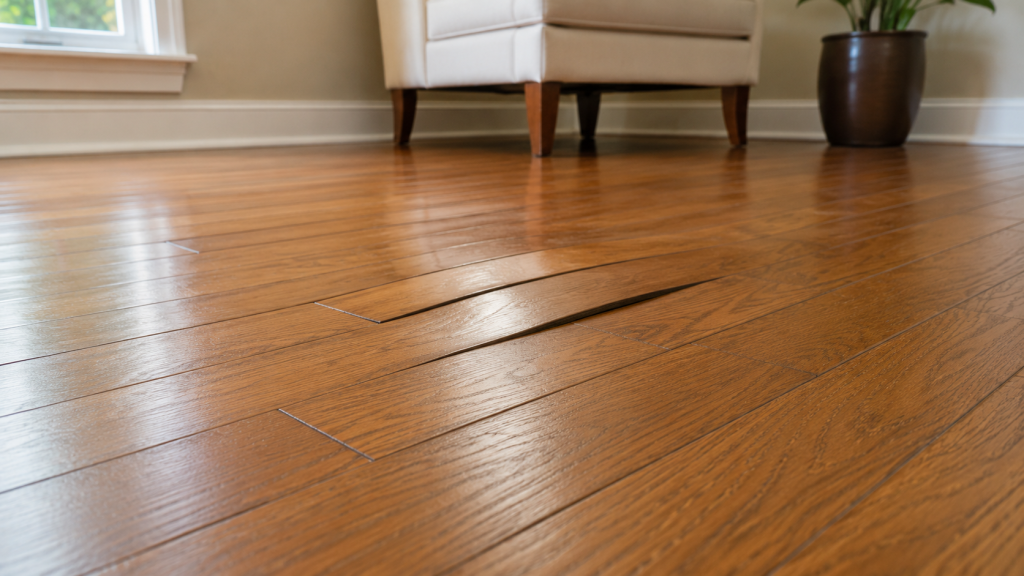
Hardwood floor buckling is more severe than ordinary seasonal movement or cupping. It means boards have lifted substantially away from the subfloor, arched upward, or lost their normal attachment.
The underlying cause needs to be corrected before the flooring is forced flat, reattached, or replaced. Moisture, expansion pressure, damaged subflooring, or failed attachment can all produce similar-looking symptoms, so diagnosis comes first.
| What you notice | Possible cause | What it suggests | First step |
|---|---|---|---|
| One board lifting after a small leak | Local moisture damage or attachment failure | Damage may be limited | Stop the leak and check whether nearby boards also moved |
| Several boards arched upward | Moisture expansion or restricted movement | Pressure may affect a larger section | Identify moisture and expansion conditions |
| Buckling near dishwasher or refrigerator | Appliance or supply-line leak | Water may have traveled beneath the floor | Stop the source and assess the affected area |
| Buckling near a wall | Expansion restriction or perimeter moisture | Flooring may be trapped or wet | Check visible clearance and signs of moisture |
| Buckling over damp subfloor | Moisture from below | Supporting materials may be involved | Address the moisture source before flooring repair |
| Floor moves or feels loose | Fastener, adhesive, or subfloor problem | Normal attachment may be compromised | Avoid forcing boards down |
| Buckling across a large room | Widespread moisture or installation issue | Repair may extend beyond individual boards | Arrange broader evaluation |
| Buckling after floodwater or sewage | Contamination and severe moisture exposure | Salvage decisions are more complex | Avoid direct contact and seek professional restoration help |
Raised boards can create a trip hazard. If buckling followed a leak involving wet appliances, receptacles, cords, or other electrical equipment, keep clear of wet electrical components and obtain qualified help.
What Hardwood Floor Buckling Looks Like
True buckling involves significant movement away from the supporting surface.
You may see:
- Boards lifting upward
- Flooring arching or tenting
- Sections moving noticeably underfoot
- Gaps beneath raised boards
- Individual boards separating from the subfloor
- Several boards lifting together
Severe movement can damage tongues, grooves, fasteners, or adhesive.
Cupping
Cupping means the edges of a board are higher than its center while the board remains generally attached.
Crowning
Crowning means the center of the board is higher than its edges.
Buckling
Buckling means boards have lifted substantially away from the subfloor or lost their normal attachment.
That distinction matters because buckling usually calls for closer inspection of moisture, attachment, expansion, and the supporting floor below.
Why Hardwood Floors Buckle
Buckling usually results from excessive dimensional movement, loss of attachment, or both.
Possible contributors include:
- Excess moisture
- Plumbing or appliance leaks
- Wet subflooring
- Moisture coming from below
- Insufficient expansion space
- Installation problems
- Failed fasteners
- Failed adhesive
- Severe environmental changes
More than one cause can occur at once.
For example, a leak can make the wood expand while also weakening adhesive or swelling the subfloor underneath it.
Moisture: The Most Common Concern
Hardwood expands as its moisture content rises.
If the boards absorb enough moisture, they can press against neighboring boards, walls, or fixed objects. Severe expansion can create enough force to lift flooring upward.
Water can also affect the parts holding the floor down.
Moisture may:
- Weaken adhesive
- Contribute to fastener movement
- Swell plywood or OSB
- Distort individual boards
- Remain trapped beneath the floor after the surface appears dry
A dry-looking surface does not prove that the subfloor or underside of the hardwood has returned to normal conditions.
Buckling After a Plumbing or Appliance Leak
Household leaks are a common reason hardwood suddenly lifts.
Possible sources include:
- Dishwashers
- Refrigerator supply lines
- Washing machines
- Water heaters
- Sink plumbing
- Other supply or drain leaks
Water can spread beneath boards farther than the visible wet area suggests.
Buckling may appear near the leak, several feet away, or along a path where water traveled through the floor assembly.
If water reached appliances, receptacles, cords, or other electrical equipment, do not handle wet electrical components. Stay clear and get qualified help when energized equipment may be involved.
Do not assume the flooring repair starts where the leak first became visible.
If the buckling followed a leak, our guide to hardwood floor water damage explains what to check beneath the floor before deciding on repair or replacement.
Moisture Coming From Below
A floor can buckle even when there was no spill in the room.
Possible moisture sources below the hardwood include:
- Wet plywood or OSB
- Damp crawl-space conditions
- Basement moisture
- Ground moisture
- Plumbing below the floor
- Moisture entering through the floor assembly
Clues may include:
- Buckling without an obvious surface leak
- Multiple boards affected
- A persistent musty odor
- Damp materials below
- Seasonal recurrence
A room can look dry from above while the underside of the flooring remains exposed to higher moisture.
When that happens, treating only the visible hardwood is unlikely to solve the problem.
Can Lack of Expansion Space Cause Buckling?
Yes, in some installations.
Wood flooring needs room for normal dimensional movement. If the flooring expands but cannot move at its edges, pressure can build.
Possible restrictions include:
- Flooring installed tightly against walls
- Fixed objects trapping the floor
- Expansion space blocked during later remodeling
- Major moisture increase combined with inadequate clearance
Expansion requirements vary by flooring type, installation method, and manufacturer.
Do not rely on one universal gap measurement.
If the floor appears tightly wedged at a wall or fixed surface, that condition may be part of the diagnosis, but avoid cutting flooring until the actual cause is clear.
Buckling Near Walls, Cabinets, or Doorways
Localized buckling near a fixed feature may point toward a pressure or moisture problem in that area.
Check for:
- Flooring visibly contacting a wall
- Trim or transitions restricting movement
- Fixed cabinetry or partitions trapping an approved floating or engineered system
- Moisture entering near the perimeter
- Plumbing or exterior water nearby
Buckling next to a wall does not automatically mean the floor only needs more expansion space.
Water entering at the perimeter can create a similar symptom.
Diagnose moisture and movement together before altering the flooring.
Wet or Damaged Subflooring
Buckling may involve the subfloor as much as the hardwood.
Warning signs can include:
- Swollen plywood or OSB
- Soft areas
- Raised panel seams
- Delamination
- Sagging
- Persistent dampness
- Excessive movement
A damaged subfloor can push flooring upward or prevent repaired boards from lying flat and staying attached.
Do not cover a wet, soft, or structurally questionable subfloor simply because the hardwood itself can be replaced.
Significant softness, sagging, or movement warrants qualified evaluation before the finish floor is repaired.
Fastener or Adhesive Failure
Hardwood may be installed using different approved attachment systems.
Depending on the floor, boards may be:
- Nailed
- Stapled
- Glued
- Installed with another approved method
Moisture, movement, deterioration, or installation problems can contribute to a loss of attachment.
Possible clues include:
- Boards moving vertically
- Localized lifting
- Squeaking combined with movement
- Raised boards without widespread cupping or deformation
These signs suggest the problem may involve attachment rather than board shape alone.
Do not drive screws through the face or attempt improvised re-fastening before the underlying condition is understood.
Localized Buckling vs Widespread Buckling
The extent of the problem helps determine the likely repair scope.
Localized buckling
A small affected area may result from:
- One leak
- One damaged board
- Local fastening failure
- A restricted expansion point
Localized damage may allow a smaller repair after the cause is corrected.
Widespread buckling
Buckling across much of a room or multiple rooms may suggest:
- Significant moisture exposure
- Broad environmental conditions
- Installation problems
- Subfloor moisture
- Larger attachment failure
Widespread movement usually deserves broader evaluation because replacing a few boards will not solve a floor-system problem.
Can Buckled Hardwood Flatten Again?
Minor movement may improve after moisture conditions normalize, but true severe buckling often does not fully correct itself.
Improvement is more likely when:
- Movement is limited
- Boards remain structurally intact
- Attachment has not failed extensively
- Moisture exposure was corrected promptly
Replacement becomes more likely when boards are:
- Severely arched
- Split
- Cracked
- Permanently distorted
- Detached
- Damaged at tongues or grooves
- Contaminated
Do not assume that waiting will restore a severely lifted board.
The moisture source and attachment condition need to be resolved first.
Should You Put Weight on Buckled Hardwood?
No.
Do not try to flatten raised hardwood with:
- Heavy furniture
- Concrete blocks
- Clamps
- Screws driven through the face
- Other improvised downward pressure
Weight does not correct moisture, subfloor damage, expansion pressure, or failed attachment.
Forcing a board down can crack it, damage joints, stress neighboring boards, or conceal a problem that still exists underneath.
Do Not Sand Buckled Hardwood Flat
Sanding is not a repair for buckling.
It does not restore failed attachment, correct a wet subfloor, or remove expansion pressure.
The boards may also still be changing dimensions as moisture conditions change.
Severely distorted or detached boards may ultimately need localized repair or replacement rather than surface sanding.
Correct the cause and allow the floor system to stabilize before making refinishing decisions.
Repair Options After the Cause Is Corrected
The appropriate repair depends on how much the floor recovered and what was damaged.
Monitor after drying
Minor movement that substantially resolves may only need observation if the boards remain stable and structurally sound.
Localized board repair or replacement
Permanently distorted, split, or damaged boards may be replaced when the surrounding floor and subfloor are sound.
Reattachment by a flooring professional
Intact boards that have lost attachment may sometimes be candidates for professional reattachment when the supporting system remains suitable.
Larger floor repair
Widespread damage, extensive failed attachment, or severe deformation may require repair across a larger section.
Subfloor repair before flooring repair
Damaged supporting material must be addressed before the hardwood is restored.
Repairing the finish floor first will not solve a wet, swollen, or unstable base.
If the floor has stabilized but significant damage remains, see our guide on when to refinish or replace hardwood floors.
Can Buckled Boards Be Reused?
Sometimes.
Potentially reusable boards should be:
- Dry
- Flat enough to meet installation requirements
- Structurally intact
- Free of split tongues or grooves
- Free of contamination
- Compatible with the planned repair
Severely arched, cracked, swollen, or damaged boards are poor candidates for reuse.
Matching species, width, grade, color, and finish may also affect whether localized replacement is practical.
Contaminated Water
Buckling caused by sewage, floodwater, toilet waste, contaminated groundwater, or other potentially contaminated water requires a stronger safety boundary.
Avoid direct contact and do not assume flooring can be salvaged simply because it looks intact.
Contamination can affect:
- Hardwood
- Subflooring
- Baseboards
- Drywall
- Other porous materials
Professional restoration evaluation is appropriate for contaminated-water exposure.
Do not attempt contaminated-water cleanup beneath hardwood as a beginner DIY project.
What About Mold and Rot?
Persistent moisture can affect more than the visible boards.
Potentially affected materials include:
- Hardwood
- Plywood or OSB
- Baseboards
- Drywall
- Framing
- Dust and debris
Professional evaluation makes sense when there is:
- Extensive visible growth
- Visible rot
- Prolonged hidden wetting
- A large affected area
- Structural deterioration
Do not assume every moisture event leads to mold, but do not cover visibly deteriorated or persistently damp materials.
What Homeowners Can Check Safely
Use observation rather than destructive inspection.
Check:
- Where the buckling begins
- Whether it is localized or widespread
- Whether a leak occurred
- Whether walls or baseboards are damp
- Whether floor movement is increasing
- Whether cupping is also present
- Whether the floor is above a basement or crawl space
- Whether there is a musty odor
- Whether subfloor problems are visible from an accessible lower area
- Whether boards contact walls or fixed objects where visible
If older flooring, tiles, sheet goods, mastics, or adhesives may contain asbestos, do not sand, grind, scrape, cut, drill, or demolish suspect material. Obtain appropriate evaluation or testing before disturbance.
Common Mistakes
Avoid these responses to a buckled hardwood floor:
- Forcing boards flat
- Putting heavy objects on raised boards
- Re-fastening before correcting moisture
- Sanding buckled boards flat
- Replacing boards before finding the cause
- Assuming a dry surface means the subfloor is dry
- Ignoring expansion restrictions
- Covering damaged subflooring
- Treating contaminated water like a normal leak
- Disturbing suspect older flooring or adhesives without asbestos evaluation
Buckling is a symptom. Repair the cause before repairing the appearance.
When Professional Evaluation Makes Sense
One raised board does not automatically mean the whole floor needs reconstruction.
Qualified help is appropriate when there is:
- Severe buckling
- Widespread lifting
- An unknown moisture source
- A large plumbing or appliance leak
- Floodwater or sewage
- Wet electrical equipment
- Significant subfloor swelling or softness
- Structural movement or sagging
- Boards lifting across several rooms
- Persistent crawl-space or basement moisture
- Failed attachment across a large area
- Visible rot
- Extensive mold growth
- Suspected asbestos-containing flooring, mastic, or adhesive
A flooring professional can evaluate the hardwood and attachment system. Plumbing, electrical, moisture, structural, restoration, or hazardous-material specialists may be appropriate when the source lies outside the flooring itself.
Final Thoughts
Hardwood floor buckling means boards have lifted substantially from the subfloor or lost their normal attachment, making it more serious than ordinary seasonal movement or cupping. Moisture, expansion restrictions, subfloor damage, or attachment failure are the main conditions to investigate.
Correct the underlying problem before forcing boards down, sanding, reattaching, or replacing them. Minor localized movement may allow a limited repair, while severe distortion, widespread lifting, damaged subflooring, contamination, or ongoing moisture may require broader professional evaluation.