freezer not freezing: causes and what to check
Freezer not freezing can be caused by something as simple as a changed temperature setting, blocked airflow, heavy loading, or a door that is not closing fully, but it can also point to an internal cooling-system failure. Start by confirming the freezer is actually too warm, protect food that may be thawing, and work through the accessible checks before considering service.
Use an appliance thermometer when practical. If food has thawed or warmed for an uncertain or extended period, evaluate it using current food-safety guidance rather than relying only on how it looks, feels, or whether some ice crystals remain.
Stop troubleshooting if you notice a burning odor, sparking, arcing, damaged wiring, repeated breaker trips, or unusual overheating. Do not open service panels, test energized components, handle refrigerant, or attempt compressor or sealed-system repairs.
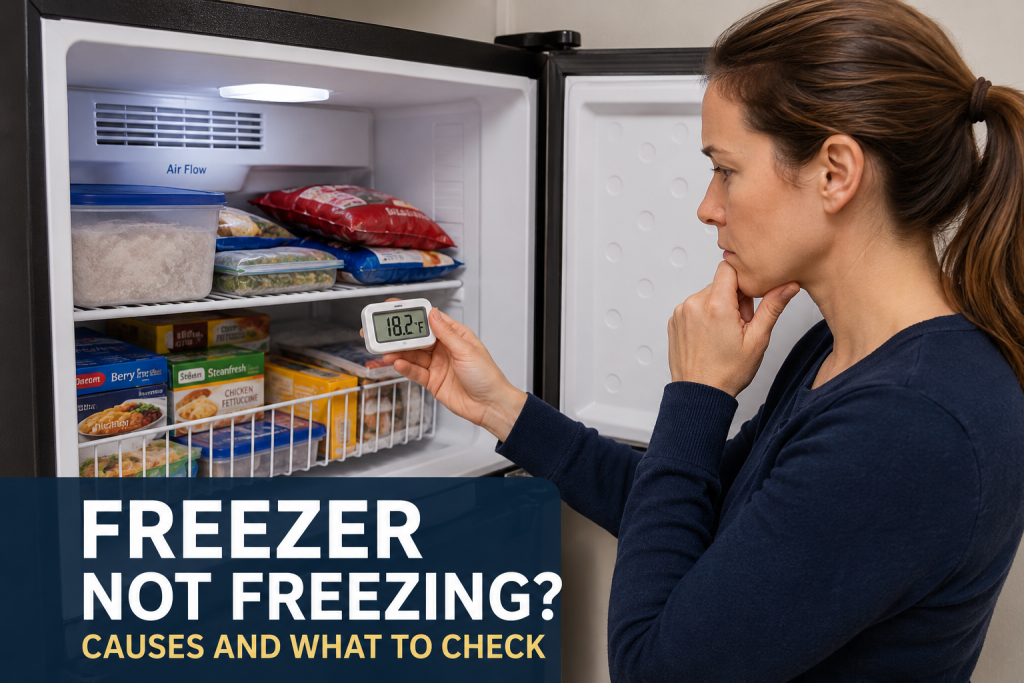
Freezer Not Freezing? Start With These Checks
Work from simple external causes toward problems that require appliance service.
| What to Check | What You May Notice | Safe First Step |
|---|---|---|
| Temperature setting | Control was changed or bumped | Check the selected setting |
| Loading | Packages packed tightly | Clear normal airflow paths |
| Air vents | Food or ice blocks a vent | Move packages away |
| Door or lid | Gap or incomplete closure | Remove obstructions |
| Gasket | Dirt, tear, or poor contact | Clean and inspect |
| Recent loading | Problem began after groceries | Keep closed and monitor |
| Heavy frost | Ice around vents or closure areas | Check for air leaks |
| Exterior ventilation | Appliance crowded by stored items | Restore required clearance |
| Condenser area | Accessible area is dusty, if applicable | Follow the owner’s manual |
| Power | No lights, display, or normal operation | Check accessible power supply |
| Internal failure | Runs but stays too warm | Arrange professional diagnosis |
Confirm the Freezer Is Actually Too Warm
Food texture alone can be misleading. Ice cream may soften before some other foods, while a recently loaded package may feel warmer even when the freezer is recovering normally.
An appliance thermometer gives you a better reference. A freezer intended for normal long-term frozen-food storage should generally maintain about 0°F (-18°C), but use the appliance manufacturer’s instructions when checking settings and operation.
Also consider what happened shortly before you noticed the problem:
- Was a large amount of unfrozen food added?
- Has the door or lid been opened repeatedly?
- Was it accidentally left partly open?
- Has the room or garage become unusually hot or cold?
- Is the temperature continuing to rise?
Avoid judging the appliance from one brief temperature change. Recovery varies with the freezer design, food load, room conditions, and how often it is opened.
If food is thawing, do not assume it is safe because it still feels cool or contains some ice. When its temperature history is uncertain, evaluate the food using current food-safety guidance.
Check the Temperature Setting
Start with the controls because they can be changed accidentally.
A mechanical dial may have been bumped while loading food. A digital control may have been changed during cleaning, or a power interruption may have affected settings on some models.
On refrigerator-freezer combinations, cooling controls may also interact differently depending on the appliance design. Check the owner’s manual and return the controls to the manufacturer’s recommended setting.
Do not turn the freezer permanently to its coldest possible setting as a substitute for finding the cause. If a normal setting cannot maintain the proper temperature, continue troubleshooting.
Make Sure the Freezer Is Not Overloaded
A well-stocked freezer is not automatically overloaded. The problem occurs when packages interfere with the way that particular freezer moves cold air.
In an upright or refrigerator-freezer compartment, tightly packed boxes or large containers may cover vents or restrict circulation. Rearranging the load may restore the intended airflow.
Chest freezers use different storage arrangements, so they do not necessarily need the same open spaces as an upright model. Follow the storage guidance for your appliance rather than applying one rule to every freezer.
Remember that a large load of unfrozen groceries also adds heat. That can create a temporary temperature rise even when nothing has failed.
Check Whether Air Vents Are Blocked
Many freezers use forced-air circulation, and blocked vents can leave parts of the compartment much warmer than others.
Look only at vents that are plainly visible and accessible. Move packages that are pressed against them, and check for obvious frost or ice that may be restricting airflow.
Vent locations vary widely. If you cannot identify them, check the appliance manual rather than removing covers or internal panels to search for hidden airflow passages.
Check the Door or Lid Closure
A freezer cannot perform normally if warm, humid room air keeps entering.
Look for:
- Food packages protruding past shelves or baskets
- A basket or shelf preventing full closure
- Frost around the opening
- A door or lid that was left slightly open
- An appliance that is unstable enough to interfere with closure
- A chest-freezer lid that is not fully seated
Close the door or lid slowly and watch the entire perimeter. Nothing should interfere with normal contact.
An incomplete seal can both raise the temperature and create additional frost, which may eventually make the closure problem worse.
Inspect the Freezer Gasket
The gasket is the flexible seal around the door or lid. Dirt, sticky residue, physical damage, or deformation can keep sections of it from contacting the cabinet normally.
With the freezer closed, inspect the accessible perimeter for obvious gaps or areas that look folded or displaced. Open it and check for:
- Food residue
- Sticky buildup
- Tears or splits
- Distorted sections
- Packaging caught against the gasket
Clean accessible gasket surfaces using the method recommended for the appliance. If the gasket is badly damaged or will not make normal contact, service or replacement may be necessary.
There is no need to disassemble the door to perform this check.
Was the Freezer Recently Loaded With Unfrozen Food?
A large grocery load can make a working freezer appear to be failing temporarily.
Warm or unfrozen items bring heat into the compartment, and the appliance must remove that heat before everything reaches normal frozen-food conditions.
Keep the door or lid closed as much as practical and follow the manufacturer’s loading guidance. Avoid repeatedly opening the freezer to see whether individual packages have frozen yet.
There is no single recovery time that applies to every freezer. Monitor whether the measured temperature is moving back toward normal rather than assuming immediate appliance failure.
Look for Heavy Frost or Ice Buildup
A light amount of frost may occur on some freezer designs, but substantial or recurring ice can interfere with airflow or prevent the door from closing properly.
Heavy frost may be associated with:
- A door or lid left open
- A poor gasket seal
- Humid air entering the compartment
- An airflow restriction
- A defrost-related problem on a frost-free model
Do not chip ice with a knife, screwdriver, or other sharp object. A puncture can damage hidden components or refrigeration tubing.
Also avoid open flames and uncontrolled high heat. Do not dismantle the evaporator area or internal panels to reach ice.
If heavy frost repeatedly returns after obvious closure problems have been corrected, professional diagnosis may be needed.
Check Ventilation Around the Freezer
A freezer removes heat from its interior and releases that heat into the surrounding space. Restricted exterior ventilation can interfere with that process.
Check for stored boxes, furniture, dust, or other objects crowding accessible ventilation areas. Make sure the appliance is installed with the clearances required for that specific model.
Do not rely on a universal clearance measurement. Requirements vary by appliance design.
Location matters too. Some freezers are designed for garages or wider ambient-temperature ranges, while others have more restrictive operating conditions. Check the installation specifications if the problem appears only during very hot or cold weather.
Should You Clean the Condenser Area?
Maybe, depending on the model.
Some standalone freezers and refrigerator-freezer combinations have condenser areas intended for periodic homeowner cleaning. Others use enclosed designs that require little or no routine owner access.
Check the manual before assuming the condenser needs cleaning.
If cleaning is specifically permitted:
- Follow the manufacturer’s power-disconnection instructions.
- Work only in accessible areas intended for owner maintenance.
- Use a soft brush or vacuum as appropriate.
- Keep tools away from wiring and tubing.
- Do not remove service-only panels.
Condenser cleaning can help when restricted heat transfer is actually part of the problem, but it is not a guaranteed solution for a freezer that has stopped cooling.
Check the Power Supply Safely
If the freezer is completely dead, start with observation rather than electrical testing.
Check whether lights or displays operate. If the plug is plainly accessible and the surrounding area is dry, confirm that it appears securely connected. You can also check the home’s breaker panel.
A tripped breaker may be reset once when there are no signs of an electrical fault. If it trips again, stop. Repeated resetting can mask a problem that needs qualified evaluation.
Do not perform live receptacle measurements or test internal electrical components.
If melting ice or water is near electrical components, avoid touching wet or energized areas. Unplug the appliance only if both the plug and surrounding area are safely accessible and dry. Otherwise, use an appropriate safe shutoff or get professional help.
Stop using the freezer if you see damaged wiring, sparking, arcing, overheating, or smell burning.
What If the Freezer Is Running but Not Freezing?
A freezer that appears to run normally but remains too warm deserves a second look at the accessible causes before assuming an internal failure.
Recheck:
- Temperature controls
- Food loading
- Visible airflow paths
- Door or lid closure
- Gasket condition
- Exterior ventilation
- Manufacturer-approved maintenance areas
You may notice the freezer running for long periods, hear normal operating sounds, or see an unusual frost pattern while the temperature remains too high.
Internal problems can involve fans, sensors, controls, the compressor, or the refrigeration system. Diagnosing those components may require powered testing, panel removal, specialized instruments, or refrigerant-system work.
That is where homeowner troubleshooting should stop.
What If the Freezer Is Not Running at All?
If there are no normal operating signs, check the control setting, accessible plug, breaker, lights, and display.
A completely inactive freezer can have an external power problem, but internal thermostats, controls, relays, motors, wiring, and compressors can also fail.
Do not bypass switches or interlocks or test these components yourself. If basic power checks do not reveal the cause, arrange appliance service.
What If the Refrigerator Is Warm Too?
When a refrigerator-freezer combination has both warm fresh-food and freezer compartments, the problem may affect the appliance’s broader cooling system rather than only the freezer.
You can still check power, controls, door closure, visible airflow, ventilation, and approved maintenance areas.
If both compartments remain too warm after those basic checks, professional diagnosis becomes more appropriate. Troubleshooting the refrigerator compartment itself is a separate task.
If the refrigerator compartment is also too warm, use our refrigerator not cooling guide to work through the checks that apply to the fresh-food side of the appliance.
When a Freezer Not Freezing Needs Professional Service
Arrange qualified appliance service when:
- Safe basic checks do not restore normal freezing.
- The measured temperature continues to rise.
- Both freezer and refrigerator compartments stay warm.
- Heavy frost repeatedly returns.
- Abnormal clicking or starting behavior continues.
- The appliance runs nearly constantly but remains too warm.
- Diagnosis would require removing internal or service-only panels.
- A compressor or sealed refrigeration-system problem is suspected.
- A breaker trips again after one reset.
- You notice damaged wiring, burning odor, sparking, arcing, or overheating.
Fans, control boards, sensors, compressors, refrigerant circuits, and other internal components are not appropriate areas for beginner live testing or invasive troubleshooting.
Common Freezer Troubleshooting Mistakes
Avoid actions that can hide the original problem or create a new one:
- Turning the control to maximum cold immediately and leaving it there
- Packing food directly against required airflow paths
- Repeatedly opening the door to check progress
- Assuming every freezer has condenser coils that need owner cleaning
- Ignoring a door, lid, basket, or package that prevents full closure
- Chipping frost with knives or screwdrivers
- Applying uncontrolled heat to remove ice
- Repeatedly resetting a tripping breaker
- Removing panels before completing external checks
- Attempting refrigerant, compressor, or energized electrical repairs
- Assuming thawed food is safe based only on appearance, coolness, or remaining ice
If the freezer temperature problem is also preventing normal ice production, check the separate causes covered in our ice maker not working guide.
Freezer Not Freezing FAQ
Why is my freezer running but not freezing?
A freezer may run without reaching the proper temperature if settings, airflow, loading, door closure, ventilation, or heavy frost are interfering with normal operation. If those checks are normal, an internal fan, control, sensor, compressor, or refrigeration-system problem may require professional diagnosis.
Why is my freezer cold but food is not staying frozen?
The compartment may be below room temperature without being cold enough for normal frozen-food storage. Use an appliance thermometer instead of judging only by touch. Also check for blocked vents, a poor door seal, recent warm food loading, or rising temperatures.
Can too much food stop a freezer from freezing properly?
Too much food can cause trouble when packages block vents or restrict the airflow required by the appliance. A large amount of newly added unfrozen food can also temporarily raise the temperature. The correct loading arrangement depends on the freezer design.
Can frost buildup make a freezer too warm?
Yes. Heavy frost can restrict airflow or interfere with door closure. Recurring frost may also indicate ongoing warm-air infiltration or a defrost-related problem. Do not chip the ice with sharp tools or dismantle internal freezer components.
When should I call for freezer repair?
If you have a freezer not freezing after checking temperature, settings, loading, airflow, closure, gasket condition, ventilation, approved maintenance areas, and power, service is reasonable. Call sooner for repeated breaker trips, electrical symptoms, recurring heavy frost, or a freezer that runs continuously without reaching the proper temperature.
Final Thoughts
Diagnose a freezer not freezing in a simple order: verify the temperature, check the controls, correct loading and airflow problems, inspect the door or lid and gasket, look for excessive frost, confirm exterior ventilation, perform only manufacturer-approved maintenance, and check the power supply safely.
If those checks do not restore normal freezing, stop before internal electrical testing, compressor work, or sealed-system diagnosis. Protect questionable food based on its temperature history and current food-safety guidance, then have the appliance professionally evaluated if the cooling problem continues.