
refrigerator not cooling: what to check first
Refrigerator not cooling problems can range from a simple temperature-setting, airflow, or door-closure issue to an internal refrigeration-system failure. Start with non-invasive checks you can perform safely, protect perishable food while you troubleshoot, and stop before the job requires service-panel removal, live electrical testing, refrigerant work, or compressor diagnosis.
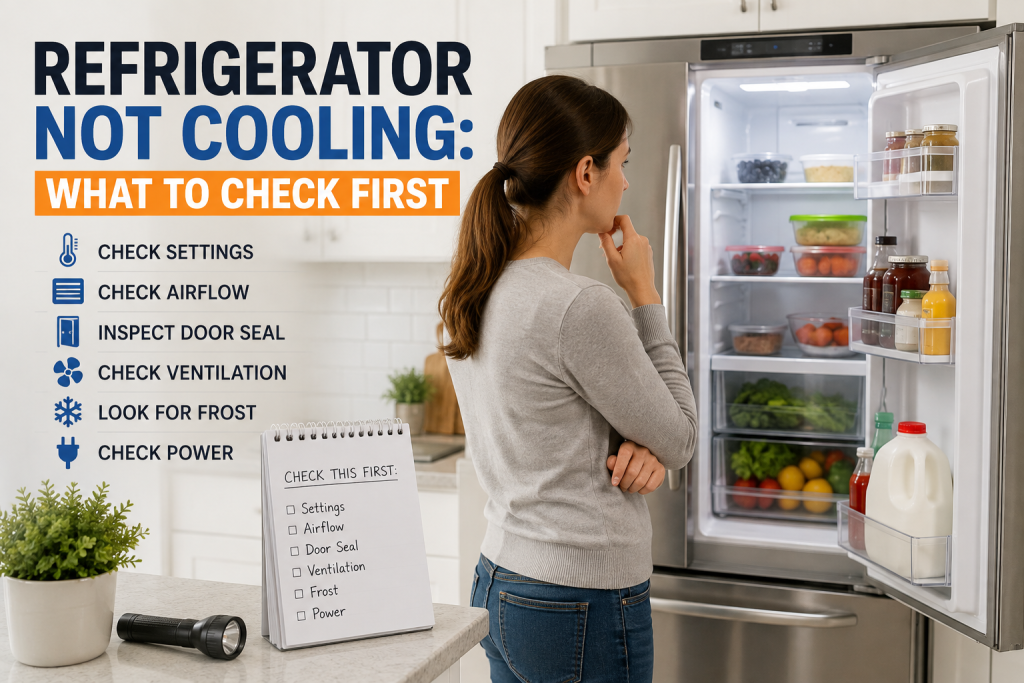
Refrigerator Not Cooling? Start With These Checks
Work through the simplest possibilities before assuming a major component has failed.
| What to Check | What You May Notice | Homeowner Action |
|---|---|---|
| Temperature setting | Controls were changed | Restore the recommended setting |
| Interior vents | Food blocks airflow | Move items away from vents |
| Overloading | Uneven temperatures | Create space for air circulation |
| Door closure | Door sits slightly open | Remove obstructions and inspect gasket |
| Door gasket | Dirt, gaps, deformation | Clean and visually inspect |
| Exterior ventilation | Dust or blocked clearance | Clear accessible ventilation areas |
| Condenser area | Dust where homeowner cleaning is permitted | Follow the appliance manual |
| Heavy frost | Thick or unusual ice buildup | Check doors, seals, and airflow |
| Power | Lights or controls are off | Make safe external power checks |
| Internal cooling problem | Refrigerator stays warm after basic checks | Arrange professional diagnosis |
While troubleshooting, do not judge food safety by smell or appearance alone. An appliance thermometer can confirm whether the refrigerator is maintaining 40°F or below. If perishable food has been too warm for an uncertain or extended period, follow current food-safety guidance rather than assuming it is safe because it still feels cool.
Confirm the Refrigerator Is Actually Too Warm
A refrigerator can feel temporarily warmer after frequent door opening, a large grocery load, or other normal use. Kitchen temperature and the appliance’s operating cycle can also affect what you notice when you open the door.
If you are unsure, use an appliance thermometer rather than relying on how cold containers feel. Place it as directed for refrigerator-temperature monitoring and look for a persistent problem rather than reacting to one brief temperature change.
Newly loaded groceries and repeated door opening can require some recovery time. There is no single recovery period that applies to every refrigerator, so use the appliance instructions and continued temperature readings to judge whether cooling is returning normally.
Check the Temperature Setting
Temperature controls are one of the easiest causes to rule out.
Check whether:
- A dial was accidentally moved.
- Digital controls were bumped or changed.
- A recent cleaning or loading session altered the setting.
- Refrigerator and freezer settings interact on your model.
Return the controls to the manufacturer’s recommended settings if they have changed.
Do not immediately turn the refrigerator to its coldest setting as a substitute for diagnosis. If airflow, door closure, or an internal failure is causing the problem, an extreme setting does not correct the underlying issue.
Make Sure Interior Air Vents Are Not Blocked
Refrigerators rely on moving cold air through the cabinet. Food containers packed against an air outlet or return can create warmer areas even when the cooling system is operating.
Look for:
- Large containers directly against vents
- Food packed tightly around the rear or upper portions of the compartment
- Shelves filled so completely that air cannot circulate reasonably
- Items shifted during loading and covering an opening
Move food away from visible vents and create some space for circulation.
Vent locations vary among refrigerator designs. If you cannot identify them, check the appliance manual instead of removing covers or panels to search for them.
Check Whether the Door Is Closing Completely
A refrigerator door that remains slightly open allows warm room air to enter and can prevent the compartment from maintaining its intended temperature.
Check for simple interference first:
- Food containers extending beyond a shelf
- A drawer that is not fully seated
- A bin or shelf installed incorrectly
- Packaging caught between the door and cabinet
- An unstable refrigerator affecting normal door operation
Then inspect the gasket around the door. Wipe away sticky food residue and look for obvious tears, deformation, loose sections, or areas that do not meet the cabinet normally.
A damaged gasket may require repair or replacement. Routine diagnosis does not require removing the door or disassembling its internal components.
Check Refrigerator Ventilation Around the Appliance
A refrigerator removes heat from inside the cabinet and releases it to the surrounding area. Blocking exterior ventilation can interfere with that process.
Inspect accessible areas for:
- Stored objects blocking ventilation openings
- Heavy dust around accessible grilles
- Items pushed tightly against areas intended for airflow
- Installation conditions that do not appear to provide the required clearance
Do not rely on a universal clearance measurement. Required spacing varies with refrigerator design and installation, so check the manufacturer’s installation guidance.
Avoid pulling a heavy refrigerator out if doing so could damage flooring or strain a water line, electrical cord, or other connection.
Should You Clean the Refrigerator Condenser Coils?
Sometimes, but not every refrigerator is designed for routine homeowner condenser cleaning.
Some models have accessible condenser coils or ventilation areas that the manufacturer instructs homeowners to clean. Other modern refrigerators enclose these components or do not call for regular owner access.
Check the appliance manual before proceeding.
If homeowner cleaning is specified:
- Disconnect power first when the manufacturer’s procedure calls for it.
- Use a vacuum or soft brush only in accessible areas.
- Avoid bending tubing.
- Do not disturb wiring.
- Do not remove service-only panels.
Condenser cleaning is maintenance, not a guaranteed fix for a refrigerator that is not cooling. If the approved cleaning area is already clear and the refrigerator remains warm, continue diagnosis rather than dismantling the appliance.
Look for Heavy Frost or Ice Buildup
Unusual frost provides useful diagnostic information because heavy ice can interfere with airflow.
Look for obvious frost buildup while also checking:
- Whether a door was left partly open
- Whether containers are preventing full closure
- Whether the gasket seals normally
- Whether visible air vents are blocked
Do not chip ice with a knife, screwdriver, or other sharp metal tool. Avoid open flames, high heat, and attempts to expose internal evaporator components.
If heavy frost returns after normal door closure and airflow conditions are restored, an internal defrost, airflow, control, or sealing problem may require professional diagnosis.
Check the Refrigerator’s Power Supply Safely
Keep electrical checks external and simple.
If the refrigerator appears completely dead:
- See whether interior lights or displays operate.
- Check whether the plug is visibly secure if it is safely accessible.
- Check the home’s electrical panel for a tripped breaker.
Do not perform live receptacle testing or remove electrical covers.
A breaker that trips again should not simply be reset repeatedly. Stop and seek qualified help if you find repeated breaker trips, damaged wiring, a burning odor, sparking, arcing, or unusual overheating.
If water is near electrical components, avoid touching wet or energized parts. Unplug the refrigerator only when the plug and surrounding area are safely accessible and dry; otherwise, use an appropriate safe shutoff or professional assistance.
Is the Refrigerator Running Constantly or Not Running at All?
Operating behavior can help describe the problem even when it does not identify a specific failed part.
Notice whether:
- The refrigerator seems to run for unusually long periods while remaining warm.
- The appliance is much quieter than normal.
- You hear repeated clicking or attempts to start.
- Normal operating sounds have changed significantly.
Fan sounds vary by model and operating cycle, so silence at one particular moment does not prove that a component has failed.
Do not test compressors, relays, capacitors, fans, control boards, or other energized internal parts. Repeated starting noises or abnormal operation combined with poor cooling are useful symptoms to report to an appliance technician.
What If the Freezer Is Cold but the Refrigerator Is Warm?
Many refrigerator designs depend on controlled airflow between compartments. A cold freezer combined with a warm refrigerator can therefore point toward an airflow problem.
Homeowner-safe checks include:
- Make sure refrigerator vents are not blocked.
- Reduce overpacking.
- Look for heavy frost.
- Confirm the refrigerator door closes fully.
- Inspect the gasket for obvious problems.
Internal fans, dampers, sensors, and controls can also affect compartment temperatures, but diagnosing those components may require internal access or electrical testing.
If the freezer is also failing to hold temperature, work through the freezer-specific checks in our guide to a freezer not freezing.
If basic airflow and door checks do not identify the cause, professional diagnosis is the safer next step.
What If Both the Refrigerator and Freezer Are Warm?
When both compartments are abnormally warm, look first for a broader issue rather than focusing only on refrigerator-compartment airflow.
Recheck:
- Power
- Temperature settings
- Door closure
- Interior airflow
- Exterior ventilation
- Manufacturer-approved condenser maintenance areas
If both sections remain warm after these checks, the cause may involve a fan, control, compressor, sealed refrigeration system, or another internal component.
Those possibilities require diagnosis rather than guesswork. Do not open the sealed system, handle refrigerant, test the compressor, or remove service-only panels.
When a Refrigerator Not Cooling Needs Professional Service
Arrange professional diagnosis when:
- Safe basic checks do not restore normal cooling.
- Both refrigerator and freezer compartments remain warm.
- Cooling repeatedly stops and returns.
- Heavy frost keeps coming back.
- Abnormal clicking or starting behavior continues.
- A breaker trips repeatedly.
- Internal panels would need removal to continue.
- A sealed-system or refrigerant problem is suspected.
- Food can no longer be maintained at a safe storage temperature.
Stop using the refrigerator and seek prompt professional evaluation if there is a burning odor, sparking, arcing, damaged wiring, or unusual overheating.
Refrigerant charging, sealed-system work, compressor testing, and energized electrical diagnosis are not homeowner troubleshooting steps.
Common Refrigerator Troubleshooting Mistakes
Avoid turning a straightforward diagnosis into a larger problem.
Common mistakes include:
- Setting the controls immediately to maximum cold
- Packing food directly against air vents
- Overloading the refrigerator
- Assuming every refrigerator needs condenser-coil cleaning
- Removing panels without checking the manual
- Chipping frost with a knife or metal tool
- Repeatedly resetting a tripped breaker
- Continuing to operate an appliance with electrical symptoms
- Attempting compressor or sealed-system work
- Assuming questionable food is safe because it looks or smells normal
The goal of basic troubleshooting is to identify accessible causes and useful symptoms, not to prove which internal component has failed.
If you also discover water around or beneath the appliance, treat a refrigerator leaking water as a separate symptom and trace that leak before assuming it is part of the cooling problem.
Refrigerator Not Cooling FAQ
Why is my refrigerator running but not cooling?
A refrigerator not cooling while it continues to run may have blocked airflow, a door-sealing problem, poor external ventilation, heavy frost, or another cooling-system issue.
Check settings, vents, loading, door closure, and manufacturer-approved maintenance areas first. If the refrigerator keeps running while temperatures remain too warm, professional diagnosis may be needed.
Why is the freezer cold but the refrigerator warm?
Restricted airflow between compartments can cause this pattern on many refrigerator designs. Check for blocked vents, excessive packing, heavy frost, and a refrigerator door that does not close properly.
Internal airflow controls or components can also cause the symptom and may require service.
Can dirty condenser coils cause a refrigerator not to cool?
Dust on a condenser area can interfere with heat removal on refrigerators designed for homeowner condenser cleaning. However, condenser designs vary, and some units do not require or permit routine owner access.
Check the appliance manual before cleaning, and do not remove service-only panels.
How do I know whether my refrigerator needs repair?
Professional diagnosis is appropriate when temperatures remain abnormal after checking settings, airflow, door closure, ventilation, and permitted maintenance areas.
Recurring frost, repeated starting problems, electrical symptoms, or both compartments remaining warm also justify service.
Should I unplug a refrigerator that is not cooling?
Not automatically. A refrigerator that is simply cooling poorly can usually remain powered while you perform safe visual checks unless the manufacturer directs otherwise.
Stop using it if you notice burning, sparking, damaged wiring, unusual overheating, or unsafe water contact near electrical components. Unplug only when the plug and surrounding area are safely accessible and dry.
Final Thoughts
When a refrigerator not cooling problem appears, work in a simple sequence: verify the temperature, check the controls, clear interior airflow, inspect door closure and gaskets, check exterior ventilation, and perform only manufacturer-approved maintenance. Then note any frost, power, or unusual operating behavior.
If those checks do not explain the problem, stop before internal electrical or refrigeration-system work begins. Protect the food, document the symptoms you observed, and have the refrigerator professionally diagnosed rather than opening sealed components or guessing at internal repairs.