
refrigerator leaking water: common causes and what to check
Refrigerator leaking water problems are easiest to narrow down by first determining whether the water is inside the appliance, beneath it, behind it, or coming from an external water connection. Some causes are minor, such as spills or condensation, while others involve a drain, filter, supply line, internal component, or household plumbing.
If water is near the plug, receptacle, damaged wiring, or electrical controls, stop troubleshooting. Do not stand in water while touching the refrigerator or electrical equipment. Unplug the refrigerator only if the plug and surrounding area are dry and safely accessible.
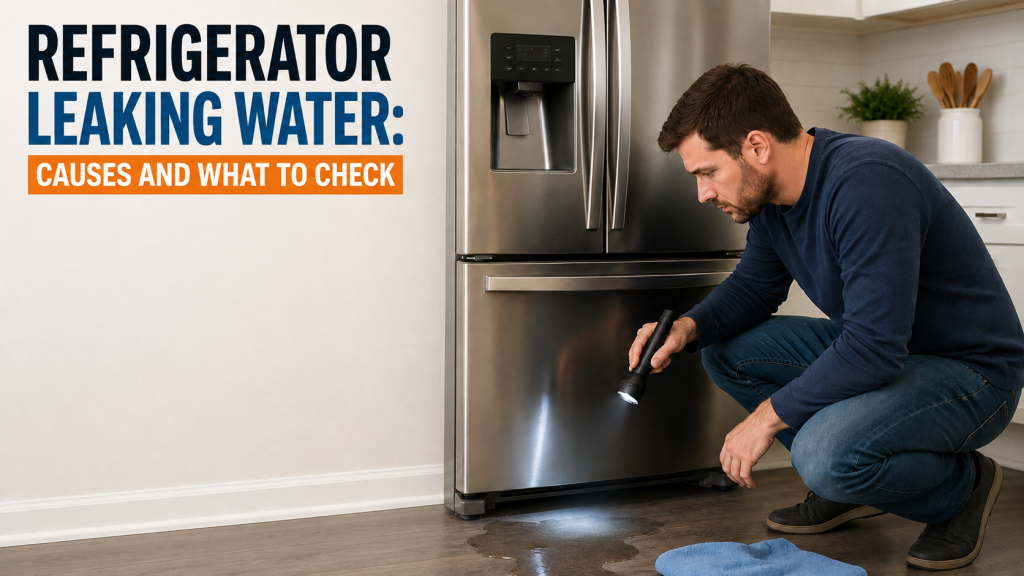
Refrigerator Leaking Water? Start by Finding the Source
Dry any safely accessible water first, then watch where fresh moisture appears. The location often provides the fastest clue.
| Where You See Water | Possible Cause | First Safe Check |
|---|---|---|
| Inside refrigerator | Spill, condensation, filter leak | Dry area and watch for new water |
| Beneath crisper drawers | Drain issue, spill | Inspect accessible areas |
| Inside freezer | Frost, ice, defrost-related water | Check door closure and frost |
| Beneath refrigerator | Supply line, drain, internal leak | Observe where fresh water appears |
| Behind refrigerator | Supply tubing or household plumbing | Visually inspect accessible connections |
| Near water filter | Filter installation or housing | Check filter and visible moisture |
| Near ice maker | Water supply or ice-maker issue | Note location without disassembly |
| Near supply connection | Tubing, fitting, shutoff valve | Inspect accessible plumbing |
Avoid reaching beneath an energized refrigerator into pooled water. If you cannot safely inspect the area without contacting water or moving a heavy appliance, stop and arrange professional help.
Rule Out a Simple Spill or Condensation Problem
Not every puddle means the refrigerator has failed.
Start by checking for:
- Spilled drinks or food containers
- Packages that are slowly leaking
- Wet containers recently placed inside
- Moisture around a door that was left partly open
- Condensation after frequent door opening
- Increased condensation during humid conditions
Remove the obvious source, dry the affected area, and observe whether water returns.
This simple check is especially useful when water appears on a shelf or at the bottom of the fresh-food compartment. If the area stays dry afterward, there may be no appliance leak to diagnose.
If fresh water continues appearing, note exactly where it starts rather than immediately removing panels or internal parts.
Check Whether the Refrigerator Door Is Closing Completely
Warm, humid room air entering the refrigerator can create extra condensation and frost. A door that appears closed may still have a small gap.
Check for:
- Food containers interfering with the door
- Drawers that are not fully seated
- Shelves or bins installed incorrectly
- Packaging caught against the cabinet
- Dirt or sticky residue on the gasket
- A visibly damaged or distorted gasket
- Refrigerator instability that affects normal door operation
Clean the accessible gasket gently and inspect it for obvious gaps, tears, or deformation.
A damaged gasket may need repair or replacement, but routine leak diagnosis does not require dismantling the refrigerator door.
If condensation keeps returning even though the door closes properly, continue checking for another source.
Look for Water Beneath the Crisper Drawers
Water beneath the crisper drawers can sometimes be related to the refrigerator’s defrost drainage system, depending on the model. Meltwater that cannot follow its intended drainage path may collect inside the compartment.
For a homeowner-safe inspection:
- Remove food that blocks your view.
- Remove drawers only as intended for normal cleaning.
- Look for visible water, ice, or debris.
- Inspect an accessible drain area only if the appliance instructions identify one for homeowner cleaning.
- Remove loose visible debris only where normal owner access is intended.
Do not remove evaporator covers or service-only panels to find a hidden drain.
Avoid knives, screwdrivers, or other sharp tools for removing ice. Do not pour boiling water into concealed passages or apply high heat to internal refrigerator components.
If the drain is inaccessible, remains blocked, or repeatedly causes water to return, appliance service may be needed.
Check the Water Filter and Filter Housing
If the refrigerator has a water dispenser or ice maker, the filter area is another useful place to inspect.
A leak can sometimes follow:
- Incorrect filter installation
- A filter that is not fully seated
- A damaged filter
- An incompatible replacement filter
- A leaking seal or filter housing
Look around the filter for fresh moisture. If the filter is designed for normal homeowner replacement, confirm that it is the correct type and installed in the proper position.
Reinstall it only as permitted by the appliance instructions. Do not force a filter that does not seat normally.
If the filter itself appears damaged, replace it with a compatible filter. If the housing is cracked, damaged, or continues leaking after the filter has been correctly installed, stop there rather than disassembling the housing.
Inspect the Refrigerator Water-Supply Line
Refrigerators equipped with an ice maker or water dispenser commonly have external tubing that connects the appliance to the household water supply.
Where it is safely visible, inspect the tubing for:
- Moisture
- Cracks
- Kinks
- Abrasion
- Obvious physical damage
- Drips at accessible fittings
Also look at the floor behind or beside the refrigerator if you can do so without unsafe movement.
Do not abruptly pull a heavy refrigerator away from the wall. Moving it can strain the water tubing, electrical cord, flooring, and other connections.
Some installations provide enough access for a visual check without moving the appliance significantly. If yours does not, professional help is preferable to forcing the refrigerator out.
Avoid aggressively bending, pulling, or manipulating tubing that appears brittle, corroded, damaged, or difficult to reach.
Check the Water-Supply Shutoff Valve and Connection
The leak may come from the home’s plumbing rather than the refrigerator.
If the refrigerator has a water supply, visually inspect the accessible shutoff valve and nearby connection for moisture. Look for a drip that originates at the valve, fitting, wall, or floor rather than from the appliance.
If you need to stop an active supply leak and the shutoff valve is safely accessible, operate it only if it turns normally.
Do not force a stuck or heavily corroded valve. Excessive force can damage old plumbing and make the leak worse.
A problem at an internal refrigerator valve generally belongs to an appliance technician. A leaking household shutoff valve, concealed supply pipe, or other home plumbing problem may be better handled by a plumber.
Could the Ice Maker Be Causing the Leak?
An ice maker can be related to a refrigerator leak, but water near the freezer does not automatically mean the ice maker itself has failed.
Look for:
- Water near the ice-making area
- Drips from that part of the freezer
- Water or ice where it normally should not collect
- Moisture near accessible supply connections
Possible causes can involve the water supply, fill process, ice blockage, an internal valve, or control components.
Keep the inspection visual and accessible. Do not dismantle the ice maker, test energized components, or open internal valve assemblies.
If water repeatedly returns from the ice-maker area, professional diagnosis is the appropriate next step.
If the ice maker is also failing to produce ice normally, work through the separate checks in our guide to an ice maker not working.
Check for Excess Frost or Ice
Unusual frost can sometimes contribute to leaking by affecting airflow or changing where defrost water travels.
Check:
- Whether the refrigerator or freezer door closes completely
- Whether the gasket appears to seal normally
- Whether visible vents are blocked
- Whether unusually heavy frost is present
- Where water appears as ice melts during normal operation
Do not chip frost with knives, screwdrivers, or other sharp tools. Avoid open flames, high heat, and dismantling internal evaporator areas.
Recurring heavy frost accompanied by leaking may indicate a door-sealing, drainage, defrost, or other internal problem that needs service.
What If Water Is Leaking From Under the Refrigerator?
A puddle beneath the refrigerator can come from several places, so try to identify where new water appears before assuming the cause.
Possibilities include:
- An external water-supply line
- A filter or filter connection
- Drain-related water
- Internal tubing or another appliance component
- Household plumbing nearby
- A spill that ran beneath the refrigerator
If it is electrically safe to do so, dry the visible floor and observe the edges of the appliance for fresh water.
Where does it appear first? Near the back may suggest a supply connection or another rear source. Water beginning inside and eventually reaching the floor points in a different direction.
Do not reach beneath the refrigerator through pooled water or touch wet electrical equipment.
What If Water Is Leaking Behind the Refrigerator?
Water behind a refrigerator deserves careful inspection because the source may not be the refrigerator itself.
Potential sources include:
- Accessible water-supply tubing
- Water-line fittings
- The household shutoff valve
- Wall or floor plumbing
- Appliance drainage or condensation components, depending on the design
Look for the highest or earliest visible wet point rather than judging the source only by where the puddle spreads.
Water can travel along tubing, cabinets, floors, and appliance surfaces before collecting somewhere else. A puddle behind the refrigerator therefore does not prove that a specific refrigerator component has failed.
Keep this inspection visual. If confirming the source requires major appliance movement or service-panel removal, arrange professional help.
When a Refrigerator Leak Needs Professional Service
Stop homeowner troubleshooting when the source is inaccessible, hazardous, or clearly beyond routine maintenance.
Call an appliance technician when:
- Water continues after basic accessible checks.
- The filter housing appears cracked or damaged.
- Accessible refrigerator tubing is damaged.
- The leak originates inside a service-only area.
- The defrost drain cannot be safely accessed.
- Water repeatedly returns after the visible area is cleaned.
- An internal valve or ice-maker component is suspected.
- Diagnosing the source would require refrigerator disassembly.
A plumber may be more appropriate when the leak originates from:
- A household shutoff valve
- Supply plumbing outside the appliance
- A concealed pipe or fitting
- Another nearby plumbing source
Water near electrical equipment requires a stricter stop point. Do not touch wet or energized components, and do not stand in water while handling the refrigerator, plug, receptacle, or electrical controls.
If the refrigerator has damaged wiring, sparking, arcing, a burning odor, or other electrical symptoms, stop using it and arrange qualified evaluation.
Common Refrigerator Leak Troubleshooting Mistakes
Avoid these common errors:
- Assuming every puddle came from the refrigerator
- Overlooking leaking food containers or spills
- Moving a heavy refrigerator without considering its connections
- Forcing a stuck or corroded water shutoff valve
- Removing internal panels too early
- Chipping ice with sharp tools
- Ignoring water near electrical equipment
- Repeatedly wiping up water without finding where it starts
- Assuming the ice maker is responsible for every freezer-area leak
- Attempting internal valve, electrical, or sealed-system repairs
If the refrigerator is also struggling to maintain temperature, treat a refrigerator not cooling as a separate symptom rather than assuming the water leak explains the cooling problem.
A successful diagnosis does not always mean identifying the exact failed internal part. Sometimes the useful result is determining whether you need an appliance technician or plumber.
Refrigerator Leaking Water FAQ
Why is my refrigerator leaking water underneath?
A refrigerator leaking water underneath may have an external supply-line leak, a filter-related problem, drain-related water, an internal appliance leak, or even a nearby household plumbing leak.
Dry the area if it is electrically safe, then watch where fresh water first appears. Avoid reaching into pooled water beneath an energized appliance.
Why is water collecting beneath the crisper drawers?
Depending on the refrigerator design, water beneath the drawers may come from a spill, condensation, or a defrost drainage problem.
Check for leaking containers first. Then inspect only the drain areas intended for homeowner access. Recurring water from an inaccessible drain may require appliance service.
Can a refrigerator water filter cause a leak?
Yes. A filter that is damaged, incorrectly installed, incompatible, or not fully seated can sometimes leak.
Check for visible moisture and confirm that the filter is installed correctly. A damaged or leaking filter housing should be professionally evaluated rather than disassembled.
Can an ice maker cause a refrigerator leak?
It can. Water near the ice maker may be related to its supply, fill process, internal valve, ice blockage, or another component.
A visual inspection can help identify the general location, but continuing leaks that require internal ice-maker access should be professionally diagnosed.
Who should I call for a refrigerator water leak?
Call an appliance technician when the leak appears to originate inside the refrigerator, filter housing, ice-maker system, internal tubing, or another appliance component.
A plumber is usually the better choice when the source is a household shutoff valve, supply pipe, concealed plumbing, or another part of the home’s water system.
Final Thoughts
When you find a refrigerator leaking water, diagnose it in order: locate the water, rule out spills and condensation, check door closure, and inspect accessible drains, filters, supply tubing, and connections. Note any unusual frost or ice-maker symptoms, then decide whether the leak comes from the appliance or household plumbing.
Stop when water creates an electrical hazard or finding the source requires heavy appliance movement, internal panel removal, electrical work, or major disassembly. At that point, identifying the right professional is more useful than continuing to take the refrigerator apart.