
best grout sealer for showers: what to look for
Best grout sealer for shower use depends on the grout formulation, surrounding tile or stone, and the installation’s requirements. Some cement grouts can benefit from a penetrating sealer, while many epoxy and premixed grouts need no sealer. A grout sealer can reduce absorption and staining, but it cannot repair cracked grout, stop a leak, or replace the shower’s waterproofing system.
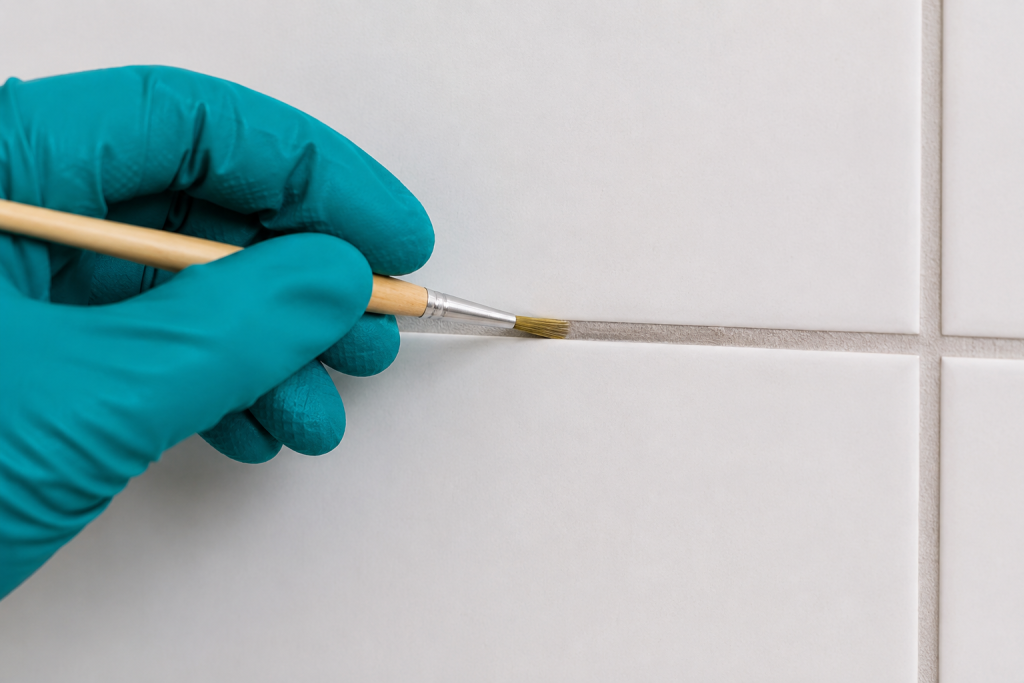
Determine Whether Your Shower Grout Needs Sealing
Identify the grout before buying anything. Installation records, leftover packaging, receipts, or installer information are more useful than judging grout by color or texture.
- Cement-based grout may accept a penetrating sealer, but not every cement grout must be sealed. Follow the exact grout manufacturer’s directions.
- Epoxy grout generally has very low absorption and often requires no sealer. LATICRETE SPECTRALOCK PRO grouts, for example, are specifically designed to be used without sealing.
- Premixed or single-component grout varies by formulation. MAPEI Flexcolor CQ is one current example that requires no sealer. Other premixed products may have different requirements.
- Previously sealed grout requires another compatibility check. Identify the existing treatment before adding a new sealer.
Do not rely on water beading alone to identify grout chemistry, prove that a sealer is present, or decide whether another coat is needed. Grout density, cleaning residue, surface treatments, and moisture conditions can all affect how water behaves.
The right buying decision may be no sealer. If the grout manufacturer says sealing is unnecessary, applying another product provides no automatic benefit.
Inspect the shower before sealing as well. Do not seal over suspected mold, persistent unexplained dampness, crumbling grout, cracks, loose tile, or significant water damage. Those conditions need cleaning, repair, or moisture assessment first.
What Grout Sealer Does—and Does Not Do
A penetrating or impregnating sealer enters the pores of compatible grout or stone and reduces absorption of materials that can cause stains. The three products shortlisted here are penetrating sealers intended to preserve a natural appearance rather than create a visible film.
That can make compatible grout easier to maintain, but it does not make grout waterproof, chemical-proof, stain-proof, or maintenance-free.
Grout sealer is also different from:
- A waterproofing membrane behind or beneath the tile.
- Flexible sealant at changes of plane and movement joints.
- Grout repair or replacement material.
- Grout colorant used to change appearance.
- A film-forming surface coating.
Sealer cannot close cracks, stabilize loose tile, fix deteriorated joints, or correct water entering the shower assembly from another source. Persistent dampness or unexplained recurring discoloration should be investigated before sealing.
Best Grout Sealer for Shower Use: Shortlist
| Product | Best-fit application | Compatible grout/surfaces | Buying consideration |
|---|---|---|---|
| MAPEI UltraCare Penetrating Plus Stone, Tile & Grout Sealer | Cement grout with compatible stone or tile | Cement grout and listed porous tile, stone, and masonry | Requires a clean, dry surface and prompt excess removal |
| STONETECH BulletProof Sealer | Porous stone-and-grout installations | Listed porous natural stone, tile, masonry, and grout | Application can allow a damp surface under specific conditions; annual reapplication is recommended for best results |
| Miracle Sealants 511 Spray-On Grout Sealer | Targeted cement-grout joints | Sanded and unsanded cementitious grout with compatible tile or stone | Solvent-based aerosol requires overspray control and careful return-to-use planning |
None is a universal winner. Choose according to the actual grout, adjacent materials, application method, and the time the shower can remain out of service.
MAPEI UltraCare Penetrating Plus Stone, Tile & Grout Sealer
Best fit for: homeowners with compatible cement grout and porous stone or tile who want a water-based, natural-look penetrating sealer.
This product is listed for cement grout and compatible natural stone, unglazed tile, masonry, and similar porous surfaces. It is particularly useful when both the grout and adjoining porous material are intended to receive the same treatment.
For new grout, the current product documentation specifies at least 48 hours of cure before application. The surface must be clean, dry, and free of contaminants and previously applied surface sealers. The sealer is given 5 to 10 minutes to penetrate before all unabsorbed material is buffed dry. Very porous surfaces may receive another coat after one hour.
After the final coat, the documented instructions say not to use or walk on the treated area for at least three hours and to keep it dry for 12 hours for best results. That 12-hour dry period is useful for planning, but it should not be generalized into a universal statement that every shower installation is ready for repeated water exposure exactly 12 hours later. Follow the instructions supplied with the purchased product and the grout manufacturer’s requirements.
A key buying consideration is excess removal. Penetrating sealer left on dense tile can leave residue, so a shower with many small tiles may involve considerably more wiping than one with large-format tile.
STONETECH BulletProof Sealer
Best fit for: porous natural-stone-and-grout showers where the listed stone and grout are both appropriate for one natural-look, water-based penetrating treatment.
The current North American DS-282-0826 lists grout along with porous stones including marble, granite, quartzite, limestone, travertine, sandstone, and several other masonry materials. It preserves the natural appearance rather than creating a topical finish.
New grout must cure for at least 72 hours before application. Unlike many sealer instructions that require a completely dry surface, this data sheet specifically permits application to a damp surface one hour after standing water has been removed. That is a product-specific allowance, not permission to apply other penetrating sealers to damp grout.
The sealer is allowed to penetrate for 10 to 15 minutes while the treated surface is kept wet with sealer, then the entire surface is wiped thoroughly dry. If the surface is porous enough to need another coat, the data sheet calls for it within 30 to 40 minutes of the first application.
DS-282-0826 lists a full cure of 24 to 72 hours and says use of the treated surface may resume after 6 to 8 hours. For a shower, do not automatically interpret general surface use as explicit permission for repeated water exposure. If the label on the purchased product does not state when shower-water exposure can resume, confirm that interval with LATICRETE rather than assuming the shortest general-use figure applies.
The same data sheet lists expected wear of up to five years on interior surfaces while also recommending annual reapplication for best results. That annual recommendation is specific to this product’s current instructions; it is not a reason to reseal every shower every year.
Miracle Sealants 511 Spray-On Grout Sealer
Best fit for: sanded or unsanded cementitious grout when a directional spray along grout joints is preferable to treating an entire tile or stone surface.
511 Spray-On Grout Sealer is a solvent-based penetrating aerosol intended for cementitious grout and explicitly lists showers among its uses. It preserves the natural appearance rather than forming a topical coating.
Existing grout must be clean, dry, and free of contaminants and previous sealers or coatings. During application, the aerosol is directed along the grout joints, and overspray or heavy excess must be removed before it dries. If another application is needed, the current technical data calls for at least two hours between applications.
The current MS-06 technical data says the sealer becomes dry to the touch in 1 to 3 hours, allows light use at that point, and should be kept dry and free of staining materials for 24 hours for optimal results. Older Miracle documentation, however, specifies a longer 72-hour dry period.
For shower use, follow the instructions matching the product you actually purchase. If the container label and available technical guidance conflict, confirm the appropriate water-exposure interval with the manufacturer before using the shower. Do not assume that the shorter published interval overrides the label on your product.
The aerosol format is the main tradeoff. Overspray can reach metal and other surfaces that were not meant to be treated, and the solvent-based formulation requires good ventilation and careful handling around ignition sources.
How to Choose the Right Grout Sealer
Start with compatibility rather than brand recognition.
Confirm the grout formulation. A sealer for cement grout is not automatically appropriate for epoxy or premixed grout. This check may eliminate the need to buy a sealer at all.
Confirm wet-area suitability. Look beyond generic claims about resisting water. The sealer and grout must be appropriate for the shower’s repeated intermittent water exposure. Shower use is also different from continuous immersion.
Account for surrounding materials. Natural stone may be intended to receive the same penetrating treatment as the grout, while glazed tile may absorb little. Glass treatments, metals, flexible sealants, and shower bases can have separate restrictions.
Choose the intended appearance. These three products are natural-look penetrating sealers. If you want deliberate color enhancement or a visible surface finish, you are choosing a different category of product.
Think about application control. Liquid sealers applied with a pad, brush, sponge, or roller suit broad porous surfaces. A directional aerosol can make grout-joint application convenient but adds overspray concerns.
Compare excess-removal requirements. Penetrating products are not meant to leave a dried coating on dense adjoining surfaces. Consider how easily you can remove excess from the tile before it becomes residue.
Plan around shower downtime. Dry-to-touch time, time between coats, general surface use, full cure, and permission for repeated shower-water exposure are different milestones. Do not collapse them into one universal waiting period.
Follow the safety information. Water-based does not mean harmless, and solvent-based does not automatically mean better. Use the ventilation, skin and eye protection, handling, and disposal measures specified for the chosen product.
Before Applying Any Grout Sealer
Make sure the installation is ready before opening the container:
- Grout is sound, with no crumbling, missing material, or unexplained cracks.
- Tile is stable, and significant water damage is absent.
- New grout has completed the required cure.
- Existing grout has been cleaned with compatible products.
- Cleaner, soap, mineral, and grout-haze residue have been removed.
- The surface meets the sealer’s required moisture condition.
- Any existing treatment has been identified as compatible.
- A required test area has been completed.
- Glass, metal, sealants, shower bases, and other excluded surfaces can be protected.
- Required ventilation and protective equipment are available.
- The required cure and water-exposure interval is understood before work begins.
A test area can reveal an undesirable appearance or absorption change, but it does not override a manufacturer restriction.
Do not mix sealers or improvise chemical preparation. Do not apply a new product over an unidentified existing treatment.
For cleaning before sealing, see our guide on how to clean shower grout, then follow the sealer’s specific preparation and drying requirements.
Maintenance and Resealing
There is no single resealing schedule that applies to every shower.
The appropriate interval depends on the grout, sealer, surface porosity, cleaning products, shower use, wear, and the sealer manufacturer’s current maintenance instructions. An advertised maximum lifespan is not a guaranteed resealing interval under shower conditions.
Product-specific guidance can also differ sharply. The current BulletProof data sheet, for example, recommends annual reapplication for best results even though it also lists longer expected wear for interior surfaces. Follow that recommendation when using that product rather than turning it into a rule for other sealers.
Before resealing, make sure the grout is clean, appropriately dry, sound, and compatible with another application. Do not add more sealer over dirt, suspected mold, persistent dampness, or unexplained discoloration.
Between sealing treatments, our guide on how to clean shower tile explains how to care for the tile while protecting the grout and any existing sealer.
FAQs
Does epoxy shower grout need sealer?
Many epoxy grouts do not. LATICRETE SPECTRALOCK PRO grouts, for example, are specifically described as not requiring sealing because of their low porosity. Follow the instructions for the exact grout rather than assuming every product with the same general chemistry is identical.
Will grout sealer stop a shower leak?
No. Penetrating grout sealer can reduce absorption and improve stain resistance on compatible grout, but it is not a waterproofing system. Cracked joints, loose tile, failed waterproofing, plumbing leaks, or other sources of water intrusion need assessment or repair.
How often should shower grout be resealed?
Use the instructions for the actual grout and sealer. Wear, porosity, cleaning methods, and shower use all affect performance, and some products give their own maintenance interval. Do not adopt an annual schedule unless the specific product calls for it.
Final Thoughts
The best grout sealer for shower use is the one that matches the grout, surrounding materials, application conditions, and realistic shower downtime. For compatible cement grout, a penetrating sealer can improve stain resistance; for many epoxy and premixed grouts, buying no sealer may be the correct choice.
Whichever product fits, begin with sound, properly prepared grout and distinguish general cure figures from actual permission to resume shower-water exposure. Sealer is a maintenance treatment, not a way to hide damage or compensate for a shower assembly that needs repair.